
Standing charges are one of the most frustrating elements of business energy bills. Whether your premises is fully operational or barely used, a daily fixed charge still applies. This leads many UK businesses to ask a common question:
Is it possible to get business gas and electricity with no standing charge at all? The short answer is almost always no.
However, there are a few limited scenarios and practical alternatives worth understanding. This guide explains how standing charges work for business gas and electricity, whether zero-standing-charge tariffs exist, and how low-usage businesses can reduce fixed energy costs.
What is a business energy standing charge?
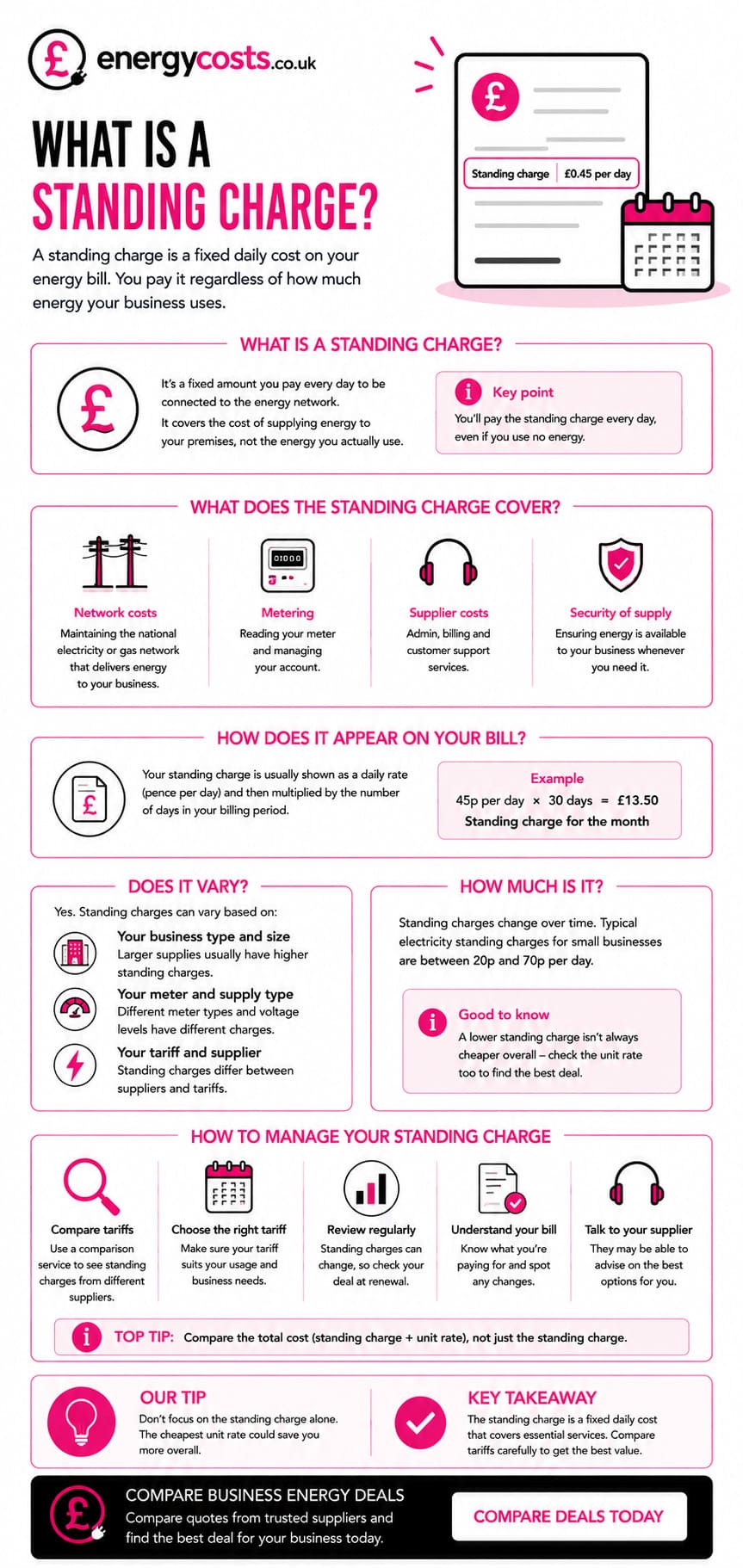
A standing charge is a fixed daily cost applied to your gas and electricity supply, regardless of how much energy you use. It covers costs that exist even when consumption is low or zero, including:
- Maintaining the local gas and electricity networks
- Metering, readings and data collection
- System capacity and infrastructure
- Administration, billing and compliance
How much are standing charges for business energy?
For UK businesses, typical standing charges are:
- Electricity: around 25p to £1.00+ per day
- Gas: around 20p to 80p per day, depending on meter size and location
Over a year, these charges can add £150–£400+ per supply, even before any energy is consumed.
Do no standing charge business gas and electricity tariffs exist?
In most cases, no
For the vast majority of UK businesses, true zero standing charge tariffs for gas or electricity are not available. Suppliers must recover fixed network and operational costs, and they do this through either:
- A standing charge
- A higher unit (kWh) rate
- Or a combination of both
Removing the standing charge entirely usually results in significantly higher unit prices, making these tariffs uncompetitive for most businesses.
Rare and niche exceptions
In limited situations, businesses may come across tariffs that appear to have no standing charge, such as:
- Legacy or historic contracts where costs are bundled into the unit rate
- High unit-rate tariffs marketed as “no standing charge”
- Very specific micro-supply or export arrangements, which are not standard business energy contracts
These options are rare, often short-lived, and usually disappear at renewal.
Why business gas and electricity almost always include standing charges
Both gas and electricity supply involve fixed costs that exist regardless of usage. Even if a business uses no energy in a given month, suppliers and network operators still incur costs for:
- Keeping the premises connected to the gas or electricity grid
- Maintaining pipes, cables, meters and pressure systems
- Reserving network capacity for potential demand
- Providing regulatory and safety compliance
For this reason, standing charges are a fundamental part of how commercial gas and electricity pricing works in the UK.
Are “no standing charge” business energy tariffs misleading?
Often, yes.
Some tariffs are advertised as having no standing charge, but the cost is simply recovered through higher unit rates.
This pricing structure may suit businesses that:
- Use large volumes of gas or electricity
- Operate for long hours
- Have consistent, predictable demand
However, for low-usage or seasonal businesses, these tariffs frequently result in higher overall costs.
Which businesses usually look for no standing charge energy?
Interest in no standing charge business energy is highest among businesses with irregular or minimal usage, including:
- Home-based businesses
- Small offices with limited equipment
- Storage units and lock-ups
- Holiday lets and seasonal premises
- Vacant or rarely used commercial properties
For these businesses, standing charges can represent a disproportionately large share of the total bill.
Better alternatives to no standing charge business energy
While zero-standing-charge gas and electricity is rarely realistic, there are practical ways to reduce fixed energy costs.
Choose low standing charge tariffs
Some suppliers offer tariffs with:
- Slightly higher unit rates
- But significantly lower standing charges
This can be cost-effective for businesses with low annual consumption of gas or electricity.
Check your meter type and setup
Incorrect meter configurations can increase standing charges, such as:
- Half-hourly electricity meters at very small sites
- Oversized gas meters (e.g. U16 or U25) for low-demand premises
Ensuring your meter matches your actual usage profile can reduce daily charges.
Avoid long-term deemed rates
Deemed gas and electricity contracts typically have high standing charges and high unit rates. Switching to a fixed contract almost always reduces:
- Standing charges
- Unit prices
- Overall annual cost
Consider disconnection for unused sites
If a premises will be unused for a long period, formally disconnecting gas or electricity may be cheaper than paying standing charges indefinitely.
Is no standing charge business gas or electricity right for you?
In most cases, no standing charge tariffs are not the cheapest option. What matters is the total annual cost, not whether a standing charge appears on the bill.
A tariff with moderate standing charges and low unit rates often costs less overall than a so-called “zero standing charge” option with inflated per-kWh pricing.
How EnergyCosts.co.uk helps businesses cut gas and electricity costs
EnergyCosts.co.uk compares total business energy costs, not just headline prices. That includes:
- Gas and electricity standing charges
- Unit rates per kWh
- Meter type and capacity
- Usage profile and seasonality
- Contract length and supplier terms
This allows UK businesses to find the lowest overall cost, whether energy usage is high, low or irregular.
Key takeaways
- True no standing charge business gas and electricity tariffs are extremely rare
- Most “no standing charge” options recover costs through higher unit rates
- Standing charges reflect unavoidable gas and electricity network costs
- Low-usage businesses should focus on low standing charge tariffs, not zero
- Comparing total annual costs is the most reliable way to save money
If you want to reduce your gas or electricity standing charges or find a cheaper overall business energy deal, comparing suppliers is the best place to start.
FAQ
In almost all cases, no. UK business gas and electricity suppliers include standing charges to cover fixed network, metering and administrative costs. Tariffs advertised as “no standing charge” usually recover these costs through higher unit rates, making them more expensive overall for most businesses.
Often, yes. While removing the standing charge can look attractive, suppliers typically increase the per-kWh price. For many businesses, especially those with steady usage, the higher unit rates outweigh any savings from avoiding a daily charge.
Standing charges cover costs that exist regardless of usage, such as maintaining gas pipes and electricity cables, metering, data collection, billing and reserving network capacity. These costs apply even if a business uses very little energy.
Not usually. Low-usage businesses often benefit more from tariffs with low standing charges and reasonable unit rates. A zero standing charge tariff with high per-kWh pricing can still result in a higher annual bill.
Yes. Electricity standing charges are often higher than gas, reflecting grid complexity and metering requirements. Gas standing charges vary based on meter size, pressure and location, with larger meters attracting higher daily costs.
They can sometimes be reduced by switching supplier, correcting meter types, or moving away from deemed rates. Businesses cannot usually remove standing charges entirely, but they can often lower them with the right contract.
Yes. Deemed gas and electricity contracts typically have higher standing charges and unit rates. Actively switching to a fixed business energy contract usually reduces both costs.
Not unless the supply is formally disconnected. Simply not using energy does not stop standing charges. For long-term vacant properties, permanent disconnection may be cheaper than paying daily charges.
They can. Half-hourly electricity meters often come with higher standing charges due to additional data and network costs. For very small businesses, this can increase fixed costs unnecessarily.
No. The most important figure is the total annual cost. A slightly higher standing charge paired with lower unit rates often results in a cheaper overall gas or electricity bill.