

Find the cheapest business gas rates per kWh in September 2026
Managing your business gas costs can be a critical factor in keeping operational expenses low. Gas is a key energy source for many businesses, whether it’s heating office spaces, fueling industrial processes, or powering commercial kitchens. However, with business gas prices constantly fluctuating, it can be difficult to know if you’re paying more than you should.
At EnergyCosts.co.uk, we provide an efficient and straightforward online business gas price comparison that enables you to find the best commercial gas tariffs for your business. Our service is designed to take the hassle out of comparing suppliers, so you can focus on what really matters: running your business.
Compare business gas suppliers online
Business gas prices vary by location, business size, and consumption, making it essential to compare multiple tariffs. Below is a table showing the average price per kWh for business gas in the UK based on business size:
Average business gas tariff prices: commercial rates per kWh
| Supplier | Unit rate PC 01–04 (p/kWh) | Standing charge PC 01–04 (p/day) | Unit rate PC 05–08 (p/kWh) | Standing charge PC 05–08 (p/day) | Estimated monthly cost (10,000 kWh) | Estimated annual cost (120,000 kWh) | Standing charge share (%) | Renewable / green gas (%) | Best suited business type |
|---|---|---|---|---|---|---|---|---|---|
| Octopus Energy | 7.8 | 95 | 7.2 | 180 | 1,065 | 13,847 | 25% | 0 | Offices, retail |
| British Gas | 7.5 | 100 | 7.0 | 200 | 1,050 | 13,725 | 27% | 0 | Hospitality, shops |
| EDF Energy | 8.2 | 110 | 7.6 | 240 | 1,160 | 15,030 | 27% | 0 | SMEs, light industry |
| E.ON Next | 8.5 | 120 | 7.8 | 260 | 1,210 | 15,605 | 29% | 0 | Growing SMEs |
| SSE | 8.0 | 105 | 7.4 | 230 | 1,145 | 14,855 | 27% | 0 | Multi-site businesses |
| Scottish Power | 8.3 | 115 | 7.7 | 250 | 1,175 | 15,250 | 28% | 0 | Shops, offices |
| Utilita | 7.4 | 95 | 6.9 | 200 | 1,025 | 13,410 | 26% | 0 | Small retail |
| OVO Energy | 7.9 | 100 | 7.3 | 220 | 1,090 | 14,200 | 27% | 0 | Service businesses |
| Opus Energy | 8.1 | 130 | 7.5 | 280 | 1,195 | 15,745 | 30% | 0 | Medium SMEs |
| TotalEnergies | 7.7 | 105 | 7.1 | 240 | 1,085 | 14,150 | 27% | 0 | Industrial SMEs |
| Yü Energy | 9.2 | 300 | 8.8 | 1,100 | 1,460 | 19,530 | 46% | 0 | OOC / distressed sites |
| Drax | 8.6 | 180 | 8.0 | 420 | 1,310 | 17,430 | 35% | 0 | Large SMEs |
| Crown Gas & Power | 8.0 | 140 | 7.4 | 300 | 1,180 | 15,680 | 31% | 0 | SMEs |
| Good Energy | 10.5 | 220 | 9.8 | 420 | 1,710 | 22,335 | 36% | 100 | ESG-led businesses |
| Ecotricity | 8.4 | 90 | 8.4 | 350 | 1,110 | 14,850 | 22% | 100 | Sustainable SMEs |
| Utility Warehouse | 7.3 | 85 | 6.8 | 160 | 985 | 12,915 | 24% | 0 | Microbusinesses |
| United Gas & Power | 7.0 | 600 | 7.0 | 4,000 | 1,390 | 18,780 | 52% | 0 | Legacy / OOC contracts |
| Ruby Energy | 9.8 | 300 | 9.2 | 500 | 1,580 | 21,240 | 43% | 0 | High-risk contracts |
| SEFE Energy | 6.9 | 220 | 6.5 | 450 | 1,115 | 14,370 | 34% | 0 | Energy-intensive SMEs |
These figures are indicative of average prices, but the actual cost will depend on your location, contract terms, and supplier. Our easy commercial gas comparison website ensures that you get the most accurate and competitive prices for your business.
Methodology used
- Profile classes:
- 01–04 = small / micro-business
- 05–08 = larger SME
- Gas usage assumptions:
- Monthly: 10,000 kWh
- Annual: 120,000 kWh
- Prices shown in p/kWh and p/day
- Excludes VAT and CCL
- Estimated monthly cost = (unit rate × 10,000 ÷ 100) + (standing charge × 30)
- Estimated annual cost = (unit rate × 120,000 ÷ 100) + (standing charge × 365)
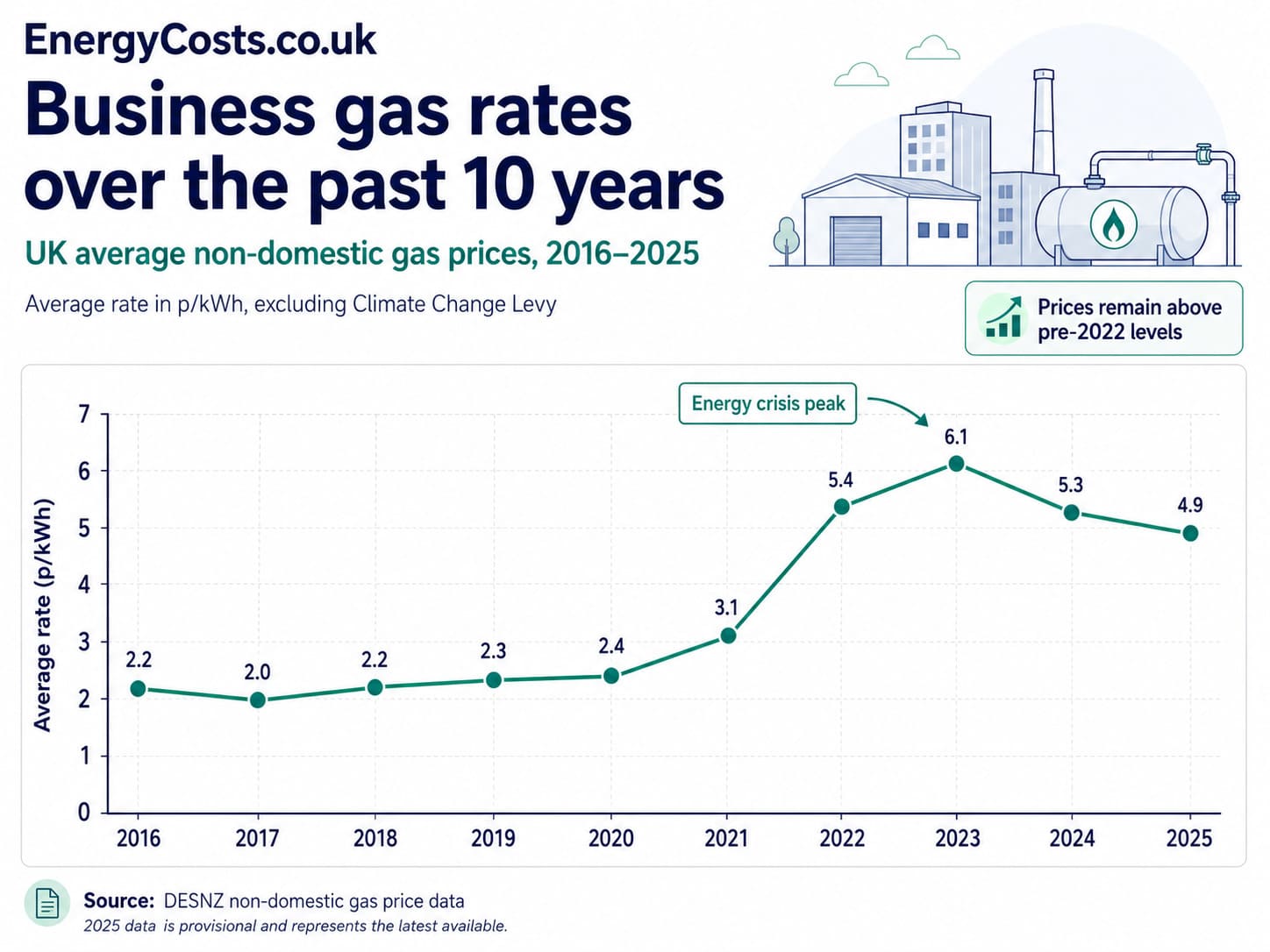
Average business gas rates over the last 10 years
Business gas standing charges explained
A business gas standing charge is the fixed daily amount you pay to keep the supply live at your premises. It sits alongside the unit rate and helps cover fixed elements of supply, such as metering, billing and other contract-related costs. Business energy bills can include both a unit rate and a standing charge, depending on the contract type.
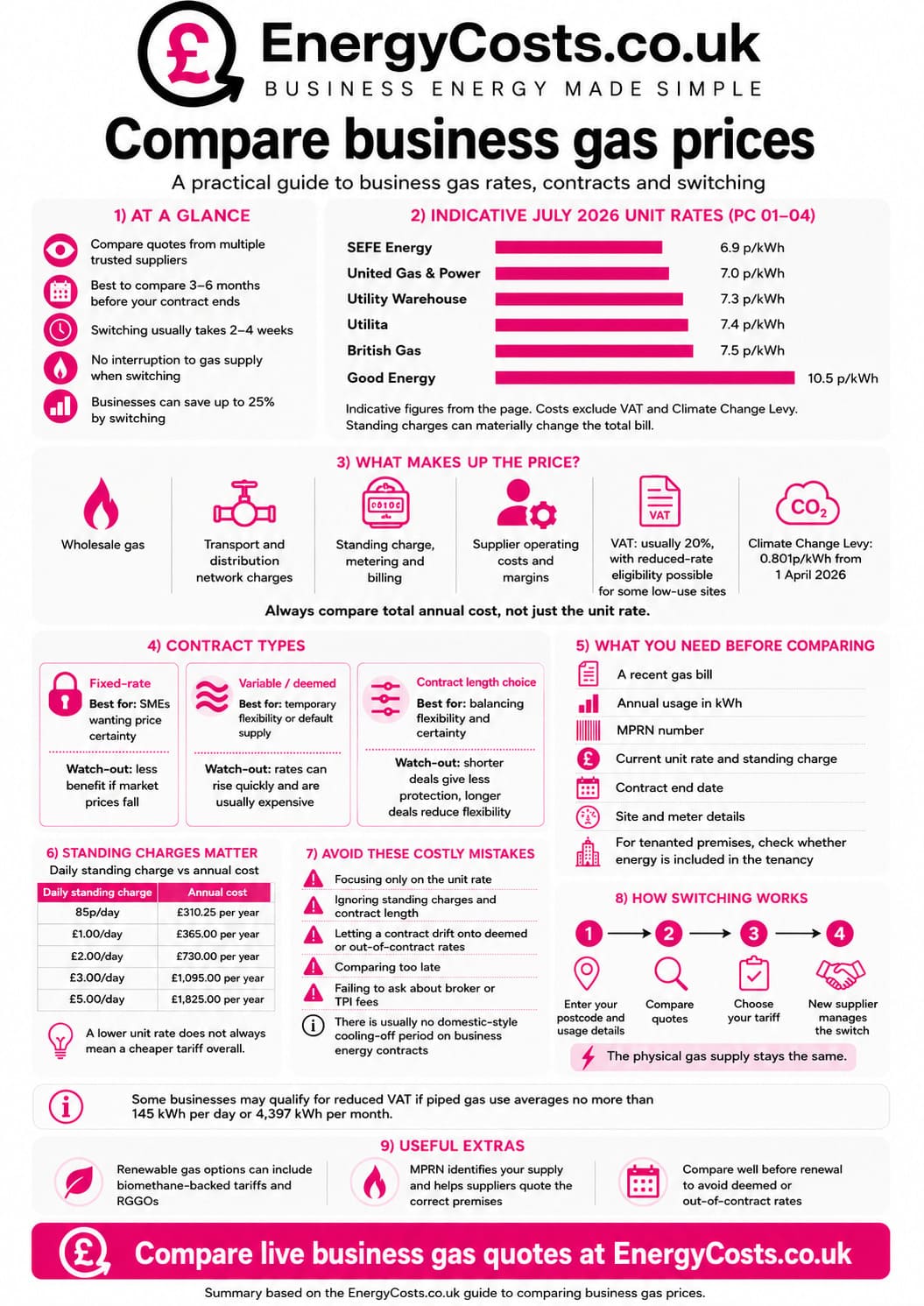
On the current live supplier table on this page, example gas standing charges range from 85p per day to 600p per day for profile classes 01–04 and from 160p per day to 4,000p per day for profile classes 05–08. That makes it essential to compare the full annual cost of a tariff, not just the price per kWh.
Using example standing charges already shown on this page, the fixed annual cost looks like this:
| Daily standing charge | Approx. annual cost | Approx. 3-year cost |
|---|---|---|
| 85p/day | £310.25 | £930.75 |
| £1.00/day | £365.00 | £1,095.00 |
| £2.00/day | £730.00 | £2,190.00 |
| £3.00/day | £1,095.00 | £3,285.00 |
| £5.00/day | £1,825.00 | £5,475.00 |
For low-usage sites, a high standing charge can make up a large share of the total bill. That is why anyone searching for the average standing charge business gas or wondering how much is standing charge for business gas should compare annual totals rather than unit rates in isolation. A search for no standing charge business gas is usually really a search for the lowest fixed-cost tariff overall, and that only works if the higher unit rate does not outweigh the daily saving.
Deemed business gas rates and out-of-contract business gas rates
Deemed business gas rates usually apply when a business moves into premises and starts using gas before agreeing a contract with a supplier. Ofgem also says a deemed contract can apply if your old contract ends and does not say what happens afterwards. Out-of-contract business gas rates are different: they apply when your contract does specify what happens at the end, but you do not renew or switch in time.
Deemed contracts and default tariffs are usually among a supplier’s most expensive offers. That means businesses should treat deemed business gas rates and out-of-contract business gas rates as short-term fallback positions rather than tariffs to remain on for long.
| Situation | What usually happens |
|---|---|
| You move into new premises and use gas before agreeing terms | You are likely to be placed on a deemed contract |
| Your old contract expires and has no renewal provisions | You may be moved onto deemed business gas rates |
| Your contract says what happens after expiry | You may pay out-of-contract business gas rates |
| You renew or switch before the end date | You stay on agreed contract pricing |
If your business gas contract is ending soon, early business gas contract renewal is usually the safest way to avoid these more expensive fallback rates. This page already recommends comparing business gas prices around three to six months before the contract ends.
Business gas when moving premises
Sorting out business gas when moving premises should be one of the first jobs on any relocation checklist. Ofgem says that before moving to new business premises, you should check the terms of your existing contract, tell your old supplier you are moving, check whether energy costs are included in the tenancy agreement, and arrange a new business energy contract for the new site if needed.
Ofgem also warns that if you use energy before the new contract starts, the supplier could place you onto a deemed rate contract. For that reason, change of tenancy business gas issues should be dealt with as early as possible.
A practical moving checklist looks like this:
- Take an opening meter reading on the day you move in.
- Ask who currently supplies the site.
- Check whether energy costs are included in the tenancy.
- Confirm whether the site is already on a contract or a deemed rate.
- Arrange a new business gas contract as soon as possible.
- Keep copies of the tenancy agreement, opening reading and any supplier emails.
This helps reduce billing disputes, limits time spent on deemed rates and makes it easier to compare new quotes accurately.
What is an MPRN and how do I find my business gas supplier?
If you are asking what is an MPRN, it stands for Meter Point Reference Number. Ofgem describes the MPRN as the identifier for your gas supply, and says it can be found on your energy bill.
The MPRN matters because it helps suppliers identify the exact gas supply point they are quoting, billing or switching. If you want to find my business gas supplier, Ofgem says the Meter Point Administration Service can help. You can use its online Find My Supplier tool, call the service, or use your MPRN to identify the supply.
A recent gas bill will usually show the MPRN, your annual consumption in kWh, the current unit rate, and the current standing charge. Having all of that information ready makes business gas comparison quicker and more accurate.
Business gas VAT and Climate Change Levy gas
For most firms, business gas VAT is charged at the standard rate. However, HMRC says piped gas can qualify for the reduced VAT rate where the supply is no more than 145 kWh per day on average, or 4,397 kWh per month.
The same 4,397 kWh per month threshold also matters for Climate Change Levy gas. GOV.UK says small de minimis amounts of piped gas supplied to a business may automatically be treated as domestic use for CCL purposes where the supply is below 4,397 kWh per month.
The main Climate Change Levy gas rate from 1 April 2026 is £0.00801 per kWh, which is 0.801p per kWh. That means the levy adds roughly £80.10 on 10,000 kWh of gas, £400.50 on 50,000 kWh and £801.00 on 100,000 kWh before VAT is added.
| Annual gas use | CCL at 0.801p/kWh |
|---|---|
| 10,000 kWh | £80.10 |
| 25,000 kWh | £200.25 |
| 50,000 kWh | £400.50 |
| 100,000 kWh | £801.00 |
This is why businesses should compare gas tariffs on a full-cost basis, including unit rate, standing charge, VAT and levy exposure, rather than focusing only on the headline pence-per-kWh figure.
How business gas pricing works: AQ, usage and network costs
Gas pricing is influenced by more than wholesale market movements. Business gas bills can include wholesale costs, taxes such as VAT and CCL, government schemes and levies, network costs, third-party services like brokerage, and other supplier costs.
One of the most important gas-specific data points is AQ, or Annual Quantity. The Annual Quantity of a gas meter point is an estimate of how much gas that point will use in a year under seasonal normal weather conditions. It is an important industry data item and helps determine how sites are handled within the gas market.
AQ is used for operational tasks such as validating meter readings and assigning sites to categories, while Formula Year AQ helps set SOQ for certain sites, which in turn affects transportation charge rates and the amount of system capacity required. In simple terms, business gas AQ helps shape how your supply is costed and managed in the background.
That means two businesses with similar annual use can still receive different quotes if their supply characteristics, meter point data, standing charges or network-related costs differ. It is one reason why a like-for-like supplier comparison matters more than a headline average alone.
Renewable business gas, biomethane and RGGOs
Interest in renewable business gas has grown as more firms look for lower-carbon energy procurement options. One route is biomethane business gas, where renewable gas produced from feedstocks such as food waste, manure, plant waste and sewage is upgraded to biomethane and injected into the gas grid. This gas has the same specifications as fossil natural gas and can be used as part of the normal supply system.
Because gas from different sources mixes in the grid, a renewable gas contract does not mean physically separate gas arrives at your premises. Instead, the renewable element is matched through Renewable Gas Guarantees of Origin (RGGOs). RGGOs are official documents issued through the Green Gas Certification Scheme and that 100% renewable gas products are backed by biomethane-generated RGGOs from the UK.
For businesses comparing green gas for businesses, renewable business gas or biomethane business gas, the key questions are how much of the tariff is RGGO-backed, whether offsetting is also used, and how the green credentials are evidenced in the contract.
Business gas broker, TPI fees and commission
A business gas broker is one type of Third Party Intermediary (TPI). Ofgem says TPIs include switching sites, energy brokers and other organisations that give energy-related advice to help businesses buy energy or manage their energy needs.
Using a TPI can be helpful there are very few published prices in the business market, and businesses usually need to contact suppliers to get a quotation. At the same time, suppliers are not obliged to supply every business, and may make decisions based on factors such as size of supply or credit rating.
There is no cooling-off period after you agree a business energy contract, even if the agreement is made over the phone. It also says energy brokers charge a fee, and that some brokers may charge upfront while others may include a service fee in the supplier bill. That makes business energy broker commission and TPI business gas transparency important when comparing offers.
Before agreeing a broker-arranged tariff, ask which suppliers are being approached, whether any commission or service fee is included in the price, and whether the full contract terms will be sent before you agree.
Why compare business gas prices?
Business gas prices are often overlooked when companies evaluate their energy expenses. Yet, for many businesses, gas represents a significant portion of their energy usage. Comparing prices regularly can lead to big savings and ensure your business stays on the most competitive tariff. Here are some key reasons why comparing gas prices is essential:
- Cost savings: Switching to a more cost-effective gas tariff can save your business hundreds or even thousands of pounds annually.
- Improved cash flow: Predictable, lower gas costs make it easier to plan your financial outlay, providing more funds for other essential business operations.
- Avoid being overcharged: If your business hasn’t reviewed its gas tariff recently, you may be paying more than necessary, especially if you’ve been rolled over onto a standard or default rate.
- Access to fixed-price deals: By comparing tariffs, you may find long-term, fixed-rate options that protect your business from price fluctuations.
How our easy online business gas comparison works
- Input your business details: Start by entering your business postcode and gas usage. This helps us generate the most accurate quotes for your specific situation.
- View and compare tariffs: You’ll receive a list of gas tariffs from a range of suppliers. Each option is clearly displayed, allowing you to compare prices, contract terms, and additional services, such as green gas options.
- Switch hassle-free: Once you’ve selected the best deal, our team will guide you through the switching process, ensuring there’s no disruption to your gas supply.
We understand that your time is valuable, so we’ve made our commercial gas price comparison quick and simple. In just a few minutes, you can find competitive quotes from multiple suppliers and choose the best option for your business.
Factors affecting business gas prices
Business gas tariffs differ from domestic tariffs due to several key factors. Understanding these can help you make more informed decisions when comparing suppliers.
- Business size and consumption: Large businesses that use significant amounts of gas often receive lower per-unit prices compared to smaller businesses. However, even smaller businesses can secure competitive deals by shopping around.
- Location: The region where your business is located can impact the price of gas, as transport and distribution costs vary across the UK.
- Contract length: Most business gas contracts run between one to five years. Longer contracts typically offer more price stability, while shorter ones may offer more flexibility but can expose you to market price changes.
- Fixed vs. variable rates: Fixed-rate tariffs guarantee the same price per kWh throughout the contract, while variable-rate tariffs fluctuate in line with market prices. Businesses with high energy usage may benefit from the predictability of fixed rates, while smaller businesses may prefer the flexibility of variable rates.
Benefits of switching business gas suppliers
Switching gas suppliers has never been easier. Many businesses stay on the same tariff for years, often missing out on potential savings. Here’s why making the switch could benefit your business:
- Immediate cost savings: By switching to a cheaper tariff, you could lower your gas bills instantly. For example, a small business consuming 20,000 kWh per year could save around £100-£200 annually by moving to a more competitive deal.
- Better contract terms: Switching suppliers allows you to negotiate favourable contract terms, such as lower standing charges or longer fixed rates, reducing your overall energy costs.
- Eco-friendly options: Some gas suppliers now offer carbon-neutral or renewable gas tariffs, allowing businesses to meet their sustainability goals without increasing energy costs.
- Avoiding automatic renewals: Many businesses are automatically rolled onto a higher-priced standard tariff when their contract expires. By regularly comparing commercial gas tariffs, you can avoid this trap and ensure you’re always on the best deal.
How to choose the best business gas supplier
When comparing gas prices, it’s important to look beyond just the price per kWh. Here are a few other factors to consider when choosing the best supplier for your business:
- Customer service: Opt for a supplier with strong customer support and good reviews to ensure any issues are resolved quickly and efficiently.
- Billing options: Some suppliers offer flexible billing, such as monthly, quarterly, or biannual options. Choose a payment plan that best suits your business’s cash flow.
- Contract terms: Ensure the contract length, rates, and any potential exit fees align with your business needs and future plans.
Start comparing UK business gas prices today
Managing your business gas costs doesn’t need to be a time-consuming task. With our easy-to-use price comparison tool, you can find the best tariffs available in just a few minutes. Whether you’re looking to switch suppliers or renew your current contract, we’ve got you covered.
Start saving on your business gas costs today by using our quick and straightforward price comparison platform.
How UK business gas pricing works
Business gas prices are made up of several components, not just the unit rate quoted by suppliers. Understanding how pricing is structured helps businesses compare quotes accurately and avoid unexpected costs.
The largest element is the wholesale gas price, which fluctuates based on global supply and demand, storage levels, weather patterns and geopolitical factors. Suppliers purchase gas in advance or closer to delivery, and their buying strategy influences the rates they offer.
On top of wholesale costs are network charges, which cover the transportation of gas through the National Transmission System and local distribution networks. These charges vary by region and usage level.
Most tariffs also include a standing charge, covering metering, billing and account administration. VAT is typically charged at 20%, although some smaller businesses may qualify for the reduced 5% rate. The Climate Change Levy (CCL) may also apply, depending on business type and usage.
Business gas contract types explained
Business gas contracts differ significantly from domestic tariffs and choosing the right contract type can have a major impact on overall costs.
- Fixed-rate contracts lock in a unit rate and standing charge for a set period, usually between one and five years. These contracts provide budget certainty and protection from price rises, making them the most popular choice for SMEs.
- Variable and deemed contracts apply when a business is not on an agreed fixed deal. Rates can change at short notice and are usually much higher than negotiated contracts, making them one of the most expensive options.
Contract length also matters. Shorter contracts offer flexibility but less protection from market volatility, while longer contracts provide stability but reduce the ability to benefit from falling prices.
Typical business gas costs by usage band
Business gas costs vary widely depending on consumption, location, contract terms and market conditions, but usage bands can provide helpful benchmarks.
Small businesses such as offices, salons and cafés often consume between 5,000 and 15,000 kWh per year. Medium-sized businesses, including restaurants and retail premises, typically fall between 15,000 and 50,000 kWh. Larger sites such as hotels, care homes and manufacturing facilities may exceed 50,000 kWh annually.
As usage increases, unit rates often decrease, but total costs rise due to higher consumption. Standing charges, network fees and levies still play a role, making it important to compare quotes based on total annual cost rather than unit rate alone.
How to prepare before comparing gas quotes
Having the right information ready makes business gas comparison faster and more accurate.
A recent gas bill will usually show annual consumption in kilowatt-hours, the MPRN (Meter Point Reference Number), current unit rates and standing charges. Knowing the contract end date is particularly important, as it affects which deals are available.
For multi-site businesses, details for each meter help ensure quotes reflect actual usage rather than estimates. Accurate information leads to more reliable comparisons and avoids pricing surprises later.
Common mistakes when comparing business gas
- One of the most common mistakes is focusing solely on the unit rate while ignoring standing charges and contract length. A lower unit price does not always mean a cheaper deal overall.
- Many businesses also remain on deemed or out-of-contract tariffs for longer than necessary, often without realising how expensive they are. Auto-renewing contracts without checking the market can also lock businesses into uncompetitive rates.
- Another common issue is comparing too late. Leaving comparison until after a contract ends reduces choice and often leads to higher costs.
When to compare business gas rates online
The best time to compare business gas prices is usually three to six months before a contract ends. Most suppliers allow new contracts to be agreed in advance, helping businesses avoid rolling onto deemed rates.
Wholesale gas prices fluctuate throughout the year, influenced by seasonal demand and global market conditions. While it is difficult to predict the lowest point, comparing early gives businesses more control and choice.
Regular comparison ensures businesses remain on competitive tariffs rather than reacting after prices increase.
Benefits of switching business gas suppliers
Switching business gas supplier can deliver immediate and long-term benefits beyond simple cost savings.
A new contract may offer lower rates, improved contract terms or better billing transparency. Fixed contracts can help with cashflow planning, while switching away from deemed rates often results in significant savings.
Some suppliers also offer low-carbon or green gas options, supporting sustainability goals without major cost increases.
Green and low-carbon gas options
Businesses increasingly consider environmental impact when choosing gas tariffs. While fully renewable gas is limited, some suppliers offer biomethane-backed tariffs or carbon-offset gas options.
These tariffs typically support renewable gas production or offset emissions through certified schemes. Costs may be slightly higher than standard gas tariffs, but the difference has narrowed in recent years.
For businesses with ESG or sustainability reporting requirements, choosing a low-carbon gas option can support wider environmental commitments.
What happens after you choose a gas tariff?
Once a business selects a gas tariff, the switching process is managed by the new supplier. There is no interruption to gas supply, as the physical infrastructure remains unchanged.
The new supplier handles contract administration and coordinates with the existing supplier. The business receives a final bill from the old supplier and begins billing under the new contract once it goes live.
Switching typically completes within a few weeks, depending on contract start dates and meter details.
Related guides and next steps
Businesses comparing gas often benefit from reviewing their wider energy strategy. Related guides explain business electricity comparison, VAT and levies on energy bills, and practical ways to reduce gas usage.
Comparing gas and electricity together can provide a clearer picture of total energy costs and highlight further savings opportunities.
FAQ: Compare UK business gas costs
There is no single national average that fits every business. On the live examples shown on this page, gas standing charges range from 85p per day to 600p per day for smaller profile classes and from 160p per day to 4,000p per day for larger ones. The right comparison is the total annual cost, not the standing charge in isolation.
Deemed business gas rates normally apply when you move into a property and start using gas before agreeing a contract, or when a previous contract ends without clear renewal terms. Ofgem says deemed tariffs are usually among a supplier’s most expensive offers, so they are best treated as temporary only.
Out-of-contract business gas rates apply when your contract says what happens after the fixed term ends, but you do not renew or switch in time. Ofgem distinguishes these from deemed contracts, even though both can be significantly more expensive than a negotiated fixed-rate tariff.
An MPRN is your Meter Point Reference Number. It identifies your gas supply point and helps suppliers quote, bill and switch the correct premises. Ofgem says you can usually find it on your energy bill.
If you need to find my business gas supplier, Ofgem says the Meter Point Administration Service can help. You can use its Find My Supplier tool, call the service directly, or use your MPRN to identify the gas supply attached to the premises.
For business gas when moving premises, you should check your current contract, tell your old supplier you are moving, confirm whether energy is included in the tenancy, and arrange a new contract for the new site if needed. Ofgem warns that using gas before the new contract starts can lead to a deemed rate.
Business gas VAT is usually charged at the standard rate, but HMRC says piped gas can qualify for the reduced rate when average use is no more than 145 kWh per day or 4,397 kWh per month at a premises. Whether your tariff display includes VAT depends on how prices are presented, so always check the quote terms.
Many do, but not all. The main Climate Change Levy gas rate from 1 April 2026 is £0.00801 per kWh. However, GOV.UK says piped gas supplied below 4,397 kWh per month falls within the de minimis limits, where the supply may be treated as domestic use for CCL purposes.
AQ, or Annual Quantity, is an estimate of how much gas a meter point is expected to use in a year under seasonal normal weather conditions. Xoserve says AQ is important to the gas industry because it is used in operational processes such as assigning categories, validating reads and helping determine transport-related charging inputs.
Yes. Renewable business gas tariffs are available in the market, typically backed by RGGOs linked to UK-generated biomethane. British Gas says this renewable gas is injected into the grid and matched to usage through certificates rather than sent physically as a separate stream to your premises.
A no standing charge business gas tariff can look attractive for a very low-usage site, but it is not automatically cheaper overall. Suppliers still need to recover wholesale, network, levy and service costs somewhere in the tariff, so the key comparison is the full annual bill rather than whether the daily fixed fee is shown separately.
A business gas broker or other TPI can be useful because very few prices are published openly and many businesses need help gathering quotes. But Ofgem says there is no cooling-off period once you agree a contract, and brokers may charge fees either upfront or through the supplier bill, so transparency matters.
A business gas contract renewal is usually best started before the end date. This page already advises comparing around three to six months before a contract expires, which gives more time to gather quotes and reduces the risk of slipping onto deemed or out-of-contract rates.
Businesses can save up to 25% by switching to a more competitive tariff. For example, a medium-sized business using 50,000 kWh of gas per year could save as much as £500 annually, depending on the rates offered by different suppliers.
No, switching gas suppliers does not affect your gas supply. The process is seamless, and you won’t experience any interruptions. The only difference will be the company that bills you for your gas usage.
Switching typically takes 2-4 weeks, depending on the terms of your current contract and the new supplier. You’ll receive notifications at each step of the process to ensure everything proceeds smoothly.
If you’re in a fixed-term contract, early exit fees may apply, usually ranging between £50 and £300. However, you can still compare tariffs and set up a switch for when your current contract ends to ensure you move to a better deal.
Yes, several suppliers offer renewable or carbon-neutral gas tariffs, usually at competitive rates. These options are ideal for businesses that are looking to reduce their carbon footprint and contribute to a more sustainable energy market.
The standing charge is a daily fee paid to cover the maintenance and delivery of gas to your premises. Standing charges for business gas typically range between 10-80 pence per day, depending on the supplier and contract terms.
The average standing charge for business gas ranges from 10 to 80 pence per day, depending on your supplier and contract. This charge covers the fixed cost of delivering gas to your business, regardless of your consumption.
Yes, many suppliers are open to negotiating rates, particularly for larger businesses with high energy consumption. Negotiating can help you secure lower rates, flexible terms, or added benefits, such as carbon offsetting or renewable gas options.
Yes, business gas prices typically include 20% VAT. However, if your business uses less than 145 kWh of gas per day, you may qualify for a reduced VAT rate of 5%, which can significantly reduce your gas bills.
Fixed rates lock in your price per kWh for the contract duration, offering price stability. Variable rates fluctuate with market conditions, which can lead to savings when prices drop, but also higher costs if prices rise. Fixed rates are often preferred for budgeting certainty.
If you don’t switch when your contract ends, you may be automatically moved onto a standard or ‘out-of-contract’ tariff, which is usually much more expensive. These rates can be up to 80% higher than the rates available through comparison.
Yes, some suppliers offer contracts that include renewable or carbon-neutral gas. While historically these contracts were more expensive, today many renewable gas tariffs are competitively priced and offer a way to make your business more sustainable.
It’s a good practice to review your gas contract 6 months before it ends. This gives you plenty of time to compare new tariffs, avoid automatic renewal on a higher rate, and lock in a competitive price for your next contract.
Yes, gas usage can contribute to carbon emissions. However, many suppliers now offer green gas options, which are either renewable or offset through environmental projects. Switching to a greener tariff can help reduce your business’s environmental impact.
Yes, if your business relocates, you can switch suppliers to a new contract at your new premises. In many cases, moving provides an opportunity to review your energy needs and potentially secure a better deal at the new location.
Latest updates to this page
1 September 2026
- Monthly data accuracy checks and updates
6 August 2026
- Monthly data accuracy checks and updates
30 July 2026
- Added links to new resources
17 July 2026
- Minor formatting updates and text tweaks
3 July 2026
- Added 2 visualisation graphics
1 July 2026
- Updated rates and checked details for July 2026.