

Finding the best business energy suppliers is about more than chasing the lowest unit rate. The right supplier for your business depends on your annual kWh usage, whether you need business electricity suppliers, business gas suppliers or both, your meter type, your credit profile, your contract length, and how important renewable energy, online tools, and multi-site support are to your operation. Business contracts are priced differently from domestic tariffs, and the domestic energy price cap does not apply to standard non-domestic contracts.
Our guide compares leading UK business energy suppliers for small firms, growing SMEs and larger commercial users. It also covers the cheapest business energy suppliers, small business energy suppliers, renewable business energy suppliers, multi-site and half-hourly suppliers, no standing charge business energy, and the difference between fixed, variable, deemed and out-of-contract pricing.
Compare UK business energy suppliers
The best commercial energy suppliers are not always the same as the cheapest business energy suppliers. A small office may care most about low standing charges and easy billing, while a restaurant or hotel may care more about business gas pricing, and a multi-site operator may need half-hourly data, flexible purchasing and consolidated billing. Ofgem notes that business energy costs can include wholesale costs, network charges, VAT, Climate Change Levy, government schemes, brokerage, excess-capacity charges and other supplier costs, so the cheapest-looking quote is not always the lowest total cost.
The comparison below is designed to help businesses shortlist the most relevant suppliers by contract style, business fit and pricing approach.
Best business energy suppliers: our shortlist of the top 20 options
| Supplier | Best for | Fuels | Typical contract style | Renewable / specialist angle | Better suited to | Key watchpoints |
|---|---|---|---|---|---|---|
| Octopus Energy | Tech-led businesses | Electricity and dual fuel | Quote-led fixed deals, smart tariffs | Carbon-free electricity, export tariffs, no standing charge trial | Offices, EV fleets, solar sites, multi-site portfolios | Advance payment often applies |
| British Gas | Big-brand familiarity | Electricity and gas | Fixed and variable | Broad market coverage | SMEs and larger businesses | Compare total cost, not brand alone |
| EDF Energy | Fixed-contract buyers | Electricity and gas | Fixed terms up to several years | Renewable options and large-scale supply | SMEs, light industry, larger sites | Renewal timing matters |
| E.ON Next | Simple greener electricity | Electricity and gas | Quote-led fixed supply | 100% renewable electricity messaging | Smaller firms wanting a familiar supplier | Compare against more specialist SME suppliers |
| SSE Energy Solutions | Larger commercial users | Electricity and gas | Tailored contracts | Stronger large-business and multi-site fit | Multi-site, half-hourly, higher-usage sites | Not usually the first choice for very small sites |
| Scottish Power | Established national supplier | Electricity and gas | Fixed and variable | Renewable generation credentials | Shops, offices, general SMEs | Always compare standing charges closely |
| Yü Energy | SMEs wanting a practical shortlist | Electricity, gas and utilities | Fixed and flexible | Multi-utility positioning | Small and mid-sized firms | Out-of-contract pricing can rise sharply |
| TotalEnergies | Businesses wanting wider energy support | Electricity and gas | Tailored commercial contracts | Broader energy services | Commercial users with bigger requirements | Often more relevant beyond the smallest sites |
| Crown Gas & Power | Gas-heavy premises | Gas and electricity | Commercial supply focus | Stronger gas relevance | Hospitality, manufacturing, heat-heavy sites | Check gas and electricity separately |
| Good Energy | Green-led brands | Electricity and gas | Fixed supply | Strong renewable positioning | ESG-led SMEs and service businesses | Premium positioning may not be cheapest |
| Ecotricity | Sustainability-first buyers | Electricity and gas | Business supply with green emphasis | Renewable brand strength | Businesses prioritising green credentials | Compare cost against mainstream green deals |
| United Gas & Power | SME dual-fuel buyers | Electricity and gas | 12, 24 and 36-month examples | Straightforward business-market focus | SMEs wanting a business-only supplier feel | Green variants can cost more |
| SEFE Energy | Commercial gas users | Gas and electricity | Fixed and flexible commercial contracts | Strong gas relevance | Gas-reliant businesses and larger sites | Check electricity charges separately |
| Engie | Commercial and industrial users | Electricity and gas | 12 to 60-month terms | Competitive gas and renewable options | Higher-usage, industrial and multi-site users | Deemed pricing can be expensive |
| Utilita | Businesses wanting published schedules | Electricity and gas | Variable, deemed and out-of-contract published schedules | Transparent published tariff tables | Smaller businesses and rate researchers | Standing charges can be high |
| Ruby Energy | Smaller firms and multi-site SMEs | Electricity and gas | Bespoke pricing | Multi-site discounts available | SMEs, grouped locations | Quotes vary strongly by usage profile |
| Utility Warehouse | Businesses wanting bundled admin | Electricity and gas | Fixed, variable and green examples | Utilities bundle appeal | Microbusinesses and admin-light setups | Not usually the cheapest on pure unit price |
| Drax | Large users and net zero plans | Electricity and gas | Bespoke commercial supply | Larger-user and decarbonisation relevance | Bigger sites, corporate energy strategies | Less suited to tiny low-usage sites |
| Avanti Gas | LPG and specialist gas needs | LPG / gas-led | Fixed-term commercial contracts | Off-grid and specialist gas use | Rural and off-grid businesses | Different buying criteria from mains gas |
| Corona Energy | UK businesses of all sizes | Electricity and gas | Fixed, variable and green examples | They emphasise flexible contract options | Small business, corporate, public sector | Business-only, non-domestic |
Octopus Energy
Octopus Energy is one of the most visible renewable business energy suppliers in the UK. It is a strong option for firms that want a greener brand, technology-led account tools and a supplier that fits well with businesses focused on sustainability, electrification and smarter energy use.
- Pricing: Offers competitive and transparent pricing with fixed-rate options. Uniquely, Octopus takes the full annual energy bill upfront, which could be a challenge for cash flow in some businesses. Prices are typically on the lower end for both gas and electricity, especially for those seeking renewable energy options.
- Features: All energy supplied by Octopus is backed by renewable sources, including wind and solar. The company has innovative tools, such as its ‘Agile Octopus’ tariff, which offers cheaper rates during off-peak hours and integrates with smart technology.
- Customer Service: Octopus is lauded for its excellent customer service, with a 4.8/5 Trustpilot rating. It offers multiple communication channels, including social media, email, and phone, with rapid response times and weekend support.
- Green Energy: As a leader in renewable energy, Octopus powers all its customers with green energy, aiming to support businesses in their sustainability goals.
- Review: See our Octopus Energy business prices review.
British Gas
British Gas remains one of the most recognisable business electricity suppliers and business gas suppliers in the market. It is often a sensible shortlist option for businesses that prefer a large national supplier with broad coverage, established support channels and the ability to serve both smaller firms and larger sites.
- Pricing: British Gas provides competitive fixed-rate deals ranging from one to three years, with pricing tailored for both small and large businesses. It has flexible payment options, including monthly direct debit discounts.
- Features: The company offers smart meters, energy-saving advice, and the option to choose renewable energy tariffs if businesses consume more than 150,000 kWh of electricity or gas annually.
- Customer Service: British Gas maintains a solid reputation for customer service with a 4.1/5 Trustpilot rating. It offers dedicated business support with a focus on larger enterprises.
- Green Energy: While not all tariffs are green, businesses that consume large amounts of energy can access renewable options, with British Gas committed to supporting businesses in their transition to greener energy.
- Review: See our British Gas business prices review.
EDF Energy
EDF Energy is a strong all-round comparison option for businesses looking for fixed contracts and a major supplier footprint. It is especially relevant for firms that want a large provider with clear business-market positioning and established experience across the SME and corporate space.
- Pricing: EDF offers fixed rates across one- to three-year contracts, with pricing that is competitive for businesses of varying sizes. Businesses can choose between standard electricity or zero-carbon/renewable contracts at a slightly higher rate.
- Features: EDF provides 100% renewable electricity tariffs and energy efficiency services tailored to help businesses lower their consumption.
- Customer Service: EDF has a strong reputation for customer support with a 4.4/5 rating on Trustpilot. The company is known for being transparent with billing and provides personalised support to help businesses optimise their energy use.
- Green Energy: EDF is heavily involved in renewable energy, offering zero-carbon contracts as a default for large business customers, and has a strong focus on sustainability.
- Review: See our EDF Energy business prices review.
EON Next

E.ON Next is a natural option for businesses looking for a recognised supplier with renewable electricity positioning. It suits firms that want a familiar brand and may appeal to smaller organisations seeking a simpler route into greener business electricity supply.
- Pricing: Offers bespoke tariffs, including fixed-rate options, typically in line with market rates. The company focuses on providing tailored solutions to meet individual business needs.
- Features: E.ON Next supplies 100% renewable electricity as part of its business tariffs and is involved in broader sustainability projects to help businesses lower their carbon footprints.
- Customer Service: Rated 4.3/5 on Trustpilot, E.ON Next is known for its robust customer support. However, fixed-rate tariffs are not always displayed online, requiring customers to engage directly for quotes.
- Green Energy: E.ON was one of the first major suppliers to fully switch to 100% renewable electricity, and it remains a leader in offering green business solutions.
- Review: See our EON business energy prices review.
SSE Energy Solutions
SSE Energy Solutions is better suited to larger organisations, more complex sites and businesses that need a more tailored commercial energy arrangement. It is a stronger name for firms with significant consumption or operational complexity than for very small businesses seeking the cheapest simple contract.
- Pricing: SSE offers both fixed-price and flexible contracts, allowing businesses to choose what best fits their needs. Pricing tends to be in the mid-range, with options for both small and large businesses.
- Features: SSE is known for its large renewable energy capacity in the UK and Ireland, offering tailored energy solutions that include smart meters and energy-saving tools.
- Customer Service: SSE’s customer service ratings are mixed, with a 1.7/5 Trustpilot rating. While they offer 24/7 support, many customers report delays and communication issues.
- Green Energy: A strong player in the renewable sector, SSE provides 100% renewable electricity options for businesses that prioritise sustainability.
- Review: SSE Energy Solutions business prices review.
Scottish Power

Scottish Power is another major supplier brand that businesses may compare when looking for established-scale supply and renewable generation credentials. It is usually a better fit for firms that prefer dealing with a large national provider rather than a smaller specialist supplier.
- Pricing: Scottish Power offers both fixed and variable price contracts, but their rates tend to be on the higher side compared to other suppliers.
- Features: Businesses can access green energy options through fixed-term contracts. Scottish Power is involved in generating renewable energy, particularly from its UK-based wind farms.
- Customer Service: Despite being a large player, Scottish Power has a low Trustpilot rating of 1.1/5, with many complaints about slow responses and unclear billing.
- Green Energy: Scottish Power is a leader in renewable energy generation, with a focus on wind power. Their green tariffs are a good fit for businesses looking to improve sustainability.
- Review: Scottish Power business prices review.
Yu Energy
Yü Energy is commonly compared by SMEs that want business utilities managed in one place. It is particularly relevant for smaller businesses that like the idea of comparing electricity, gas and water services together rather than treating them as separate buying decisions.
- Pricing: Yu Energy offers competitive fixed-rate deals, making it an attractive option for small and medium-sized enterprises (SMEs) looking to manage their energy costs effectively. Its contracts provide transparency and flexibility, making it easier for businesses to plan their expenses.
- Features: Yu Energy is known for providing certified renewable green energy options, including carbon-neutral gas and pure green electricity. This positions the company as a strong option for businesses with sustainability goals. They also provide water supply services, which allows businesses to consolidate their utility bills.
- Customer Service: With a 4.2/5 rating on Trustpilot, Yu Energy is praised for its customer-centric approach. Businesses value their transparent contracts and responsive support team, making it a reliable choice for SMEs.
- Green Energy: Yu Energy offers both green electricity and lower carbon gas options, helping businesses meet their environmental objectives without sacrificing cost efficiency.
- Review: Yu Energy business prices review.
TotalEnergies
TotalEnergies is worth comparing if your business wants more than basic supply. It can be a useful shortlist option for organisations interested in broader energy services, carbon reduction and energy management support alongside business gas or electricity contracts.
- Pricing: Offers mid-range tariffs with a focus on renewable energy options. Prices are competitive for businesses looking for carbon reduction solutions.
- Features: TotalEnergies focuses on sustainability, offering tailored energy management services, including energy audits.
- Customer Service: Provides dedicated support for businesses with a strong emphasis on sustainability. Generally well-regarded by customers.
- Green Energy: All tariffs are backed by renewable energy, positioning the company as a leader in the sustainability space.
- Review: TotalEnergies business prices review.
Crown Gas & Power

Crown Gas & Power is particularly relevant where business gas costs are a major concern. Businesses with gas-heavy operations often compare it alongside broader commercial energy suppliers because specialist strength in gas can matter more than having the biggest national brand.
- Pricing: Crown Gas & Power specialises in providing competitive gas pricing to businesses, with contracts tailored to suit various sizes and types of organisations. They are particularly noted for offering lower-cost gas contracts for SMEs.
- Features: The company focuses on gas supply, with flexible contracts and an emphasis on efficient customer service. Crown Gas & Power also offers metering services and works closely with businesses to ensure smooth operations.
- Customer Service: With a Manchester-based customer support team, Crown Gas & Power is praised for its personalised service and fast response times. Customers appreciate their straightforward approach to billing and contract management.
- Green Energy: While primarily a gas supplier, Crown Gas & Power offers some renewable gas options, making them a viable choice for businesses interested in greener energy.
- Review: Crown Gas & Power business prices review.
Good Energy
Good Energy remains a strong option for businesses that want renewable business energy suppliers and are willing to pay close attention to environmental credentials as well as price. It is best suited to firms where sustainability is part of the brand story or procurement policy.
- Pricing: Good Energy’s pricing is on the higher end of the market, reflecting its commitment to providing 100% renewable electricity. It is particularly suited to businesses that prioritise environmental sustainability over cost savings.
- Features: As a pioneer in green energy, Good Energy offers 100% renewable electricity from wind and solar power. They also provide carbon-neutral gas and have been recognised for supporting community energy projects. Their services are especially valuable for businesses looking to improve their environmental credentials.
- Customer Service: Good Energy has a Trustpilot rating of 4.1/5, with customers praising its ethical stance and transparent billing. They are known for excellent customer service, especially for businesses committed to sustainability.
- Green Energy: Good Energy only supplies 100% renewable electricity and carbon-neutral gas, making it a leading choice for environmentally conscious businesses.
- Review: Good Energy business prices review.
Ecotricity

Ecotricity is another green-focused supplier that businesses often compare when environmental positioning matters. It is likely to appeal most to organisations that want a recognisable renewable brand and are comfortable prioritising green credentials over being solely focused on the lowest headline quote.
- Pricing: Ecotricity’s pricing is generally higher compared to other business energy suppliers due to its strong focus on green energy. However, for businesses that prioritise environmental impact, the extra cost is often seen as worthwhile.
- Features: Ecotricity offers 100% green electricity and carbon-neutral gas. As one of the first green energy suppliers in the UK, the company is committed to using energy generated from its own wind and solar parks, making it a top choice for businesses seeking to minimise their carbon footprints.
- Customer Service: With a Trustpilot rating of 4/5, Ecotricity is noted for its commitment to ethical practices and strong environmental principles. Businesses appreciate the company’s dedication to transparency and sustainability, although some reviews mention higher costs.
- Green Energy: Ecotricity offers 100% renewable electricity and gas, positioning itself as a key player for businesses focusing on reducing their environmental impact.
- Review: Ecotricity business prices review.
United Gas & Power

United Gas & Power is often compared by SMEs that want a supplier known for business-market focus rather than household energy. It is a relevant option for firms wanting a smaller-feel supplier while still comparing business electricity suppliers and business gas suppliers on a competitive basis.
- Pricing: United Gas & Power provides competitive pricing for both gas and electricity, particularly for small and medium businesses. Their contracts are flexible, and they are known for offering cost-effective solutions tailored to business needs.
- Features: This Yorkshire-based supplier prides itself on customer service, offering tailored energy packages and green energy options. United Gas & Power is focused on helping businesses reduce their energy costs while improving sustainability.
- Customer Service: With a 4.2/5 Trustpilot rating, United Gas & Power is highly regarded for its customer service, with many businesses highlighting the company’s proactive support and easy-to-understand contracts.
- Green Energy: United Gas & Power offers green electricity and carbon-neutral gas options, making them an appealing choice for businesses looking to make environmentally responsible energy choices.
- Review: UGP business prices review.
SEFE Energy

SEFE Energy is especially relevant for businesses where gas is a major part of the energy bill. Firms in manufacturing, food production, hospitality and other gas-reliant sectors may want to compare it as a specialist option alongside broader commercial energy suppliers.
- Pricing: SEFE Energy specialises in providing competitive gas prices, particularly for businesses with high gas usage. The company’s pricing is flexible, allowing businesses to negotiate contracts based on their consumption patterns.
- Features: SEFE Energy provides gas supply services with flexible contracts tailored to business needs. The company also offers energy efficiency advice and services to help businesses reduce their gas consumption and costs.
- Customer Service: SEFE Energy is known for its personalised customer service, offering dedicated account management for businesses. Customers appreciate their straightforward approach and commitment to helping businesses manage energy costs effectively.
- Green Energy: SEFE Energy offers some renewable gas options, making them a suitable choice for businesses that want to balance cost savings with environmental responsibility.
- Review: SEFE Energy business prices review.
Engie

ENGIE UK is part of the broader international ENGIE Group, a multinational energy firm with operations in generation, supply and services. This means ENGIE can cater to everything from a small office to a large industrial facility.
- Pricing: ENGIE offers tailored business electricity and gas contracts, with both fixed and flexible options depending on a company’s usage, risk appetite and sustainability goals. Its positioning is aimed at giving businesses competitive prices while also allowing more customised contract structures than a one-size-fits-all tariff.
- Features: ENGIE supplies both business electricity and gas, with options for fixed contracts, flexible purchasing, real-time market access for some customers, and quotes tailored to operational needs. It also provides online account tools for invoices, payments, meter readings and contract documents, alongside wider support around energy management and net zero goals.
- Customer Service: ENGIE presents itself as a strategic energy partner rather than just a supplier, with expert guidance and dedicated account manager support for some business customers. It also provides direct customer service and complaints channels, which helps businesses manage contracts, renewals and day-to-day account issues more easily.
- Green Energy: ENGIE has a stronger green energy focus than SEFE, offering 100% renewable electricity backed by REGO certificates as well as green gas options for businesses pursuing net zero goals. It also highlights its own renewable generation and wider low-carbon infrastructure, making it a good fit for businesses that want sustainability credentials alongside energy supply.
- Review: Engie business energy prices review.
Utilita

Utilita is often more relevant to smaller organisations than to large industrial users. Businesses comparing small business energy suppliers may include Utilita when they want a straightforward option with simpler account management and a brand associated with practical energy control.
- Pricing: Offers fixed or variable tariffs with affordable rates tailored to small and medium businesses. Utilita focuses on smart meters and pay-as-you-go options.
- Features: Businesses can access free smart meters and manage their consumption in real-time. Utilita is known for its user-friendly app that helps track energy use.
- Customer Service: Utilita has a strong 4.3/5 Trustpilot rating, with customers appreciating the flexibility of their services.
- Green Energy: Limited renewable energy offerings, although the company is expanding its green energy capabilities.
- Review: Utilita business prices review.
Ruby Energy
Ruby Energy is primarily a smaller-business option. It is likely to appeal to firms that want a compact shortlist of small business energy suppliers rather than a supplier designed mainly for large corporates and complex procurement structures.
- Pricing: Ruby Energy focuses on providing competitive pricing to small and medium businesses, particularly those looking for flexible energy contracts. They are emerging as a strong competitor in the SME energy sector.
- Features: The company emphasises renewable energy, offering 100% renewable electricity plans and smart meters to help businesses monitor and reduce their energy consumption.
- Customer Service: Ruby Energy is gaining a reputation for responsive and personalised customer service, catering to the needs of SMEs. Although still growing, it has earned positive early reviews for its transparency and customer support.
- Green Energy: Ruby Energy offers 100% renewable electricity as part of its commitment to sustainable energy solutions for businesses.
- Review: Ruby Energy business prices review.
Utility Warehouse
Utility Warehouse stands out from many other business energy suppliers because it is often considered as part of a broader bundled-services decision. That makes it more relevant to businesses that want administrative simplicity and may value combining utilities rather than sourcing each service separately.
- Pricing: Utility Warehouse offers bundled deals that combine energy, broadband, mobile, and insurance, allowing businesses to save by consolidating their utilities. Pricing for energy is competitive, especially for businesses looking to reduce costs across multiple services.
- Features: As a multi-service provider, Utility Warehouse is unique in the market. Businesses can access discounts by bundling their energy with other services. The company also offers straightforward energy tariffs and user-friendly account management tools.
- Customer Service: Utility Warehouse is well-rated for its customer service, with a 4.5/5 Trustpilot rating. Businesses appreciate the convenience of managing multiple services under one provider and report a generally smooth customer experience.
- Green Energy: While not all of Utility Warehouse’s tariffs are green, they offer renewable energy options, making them a flexible choice for businesses that want to reduce their carbon footprint.
- Review: UW business prices review.
Drax
Drax is a more natural fit for large commercial users than for the average small firm. Businesses with high usage, net zero targets or more advanced reporting requirements may find it more relevant than businesses simply searching for the cheapest business energy suppliers for a single low-usage site.
- Pricing: Drax Energy (formerly Haven Power) focuses on providing tailored pricing for large businesses, particularly those with high energy consumption. It offers bespoke energy solutions that help enterprises optimise their energy usage and manage their carbon footprints.
- Features: Drax is known for its renewable energy solutions and net-zero consultancy services, providing businesses with energy efficiency tools and advice on reducing emissions. It also offers detailed reporting on energy usage and savings.
- Customer Service: Drax has built a solid reputation for working with large businesses and corporations, offering dedicated account management and personalised service. Customer reviews indicate that Drax’s services are particularly useful for businesses looking to meet sustainability targets.
- Green Energy: As a leader in renewable energy, Drax offers green electricity and carbon reduction plans, helping businesses achieve their net-zero goals through innovative energy solutions.
- Review: Drax Energy business prices review.
Avanti Gas
AvantiGas is not a typical mains gas supplier. Instead, it specialises in LPG (liquefied petroleum gas) and energy solutions for businesses that are off-grid or not connected to the national gas network. This means AvantiGas serves sectors such as agriculture, hospitality, manufacturing and rural enterprises — essentially any business that uses LPG for heating, industrial processes, hot water or specialised equipment.
- Pricing: AvantiGas focuses on LPG rather than mains electricity or natural gas, so it is mainly relevant for off-grid businesses. Its pricing is quote-led and tailored to factors such as fuel volume, tank type, site layout and delivery requirements, with the company positioning LPG as a cost-effective option for businesses that need heating, cooking or process fuel away from the gas grid.
- Features: AvantiGas provides business LPG through bulk tank installations, bottled gas and sector-specific supply options, including solutions for commercial sites, industrial users and forklift fleets. It also offers online account management tools that let customers pay bills, place orders, view invoices, track usage and submit gauge or meter readings.
- Customer Eervice: AvantiGas puts a lot of emphasis on support and practical account management, with a customer experience team available by phone, online help resources, and digital account tools for ordering, billing and account monitoring. Its messaging is centred on reliable delivery, straightforward support and helping customers find a supply arrangement that suits their site and usage needs.
- Green Energy: AvantiGas has a clearer green fuel proposition than a traditional LPG-only supplier because it also offers BioLPG, described as a renewable liquid gas made from renewable sources, waste and recycled carbon. That makes it a suitable option for businesses that want an off-grid fuel with lower-carbon credentials while still using LPG infrastructure.
- Review: AvantiGas business prices review.
Corona Energy
Corona is an independent UK business energy supplier specialising in commercial gas and electricity. They serve a substantial number of industrial and commercial customers.
- Pricing: Corona Energy supplies business gas and electricity, with pricing built around tailored quotes rather than simple standard tariffs. Its offer includes both fixed and flexible contracts, and it is particularly geared towards organisations that want contract structures matched to their usage profile, portfolio complexity and purchasing preferences.
- Features: Corona Energy provides business gas and electricity supply for small businesses, corporates and public sector organisations. Its features include fixed and flexible contracts, renewable product options, online account management through myCorona, meter reading submission, usage tracking, billing history access and support for larger multi-site portfolios.
- Customer service: Corona Energy places a strong emphasis on account management and service support, especially for larger or more complex customers. It highlights dedicated account management for corporate and public sector clients, while its small business messaging focuses on accurate billing, smooth onboarding, 24/7 portal access and responses to queries within 48 hours.
- Green energy: Corona Energy has a stronger green energy proposition than a standard business supplier, with renewable electricity and renewable gas options available. Its site states that it can provide 100% renewable gas and electricity, including biogas from UK renewable generators, which makes it suitable for businesses that want to strengthen their sustainability credentials alongside securing commercial energy supply.
- Review: Corona Energy business prices review.
If you take the time to read through our individual supplier review pages, you’ll find very different pricing styles across the market. Octopus is highly quote-led but currently references 12, 24 and 36-month contracts, a no standing charge trial and export tariffs. Yü Energy, SEFE Energy, Engie, UGP, Ruby, Utilita and Utility Warehouse all publish more numerical pricing examples, while SSE and larger commercial suppliers lean more towards tailored contracts for bigger or more complex users.
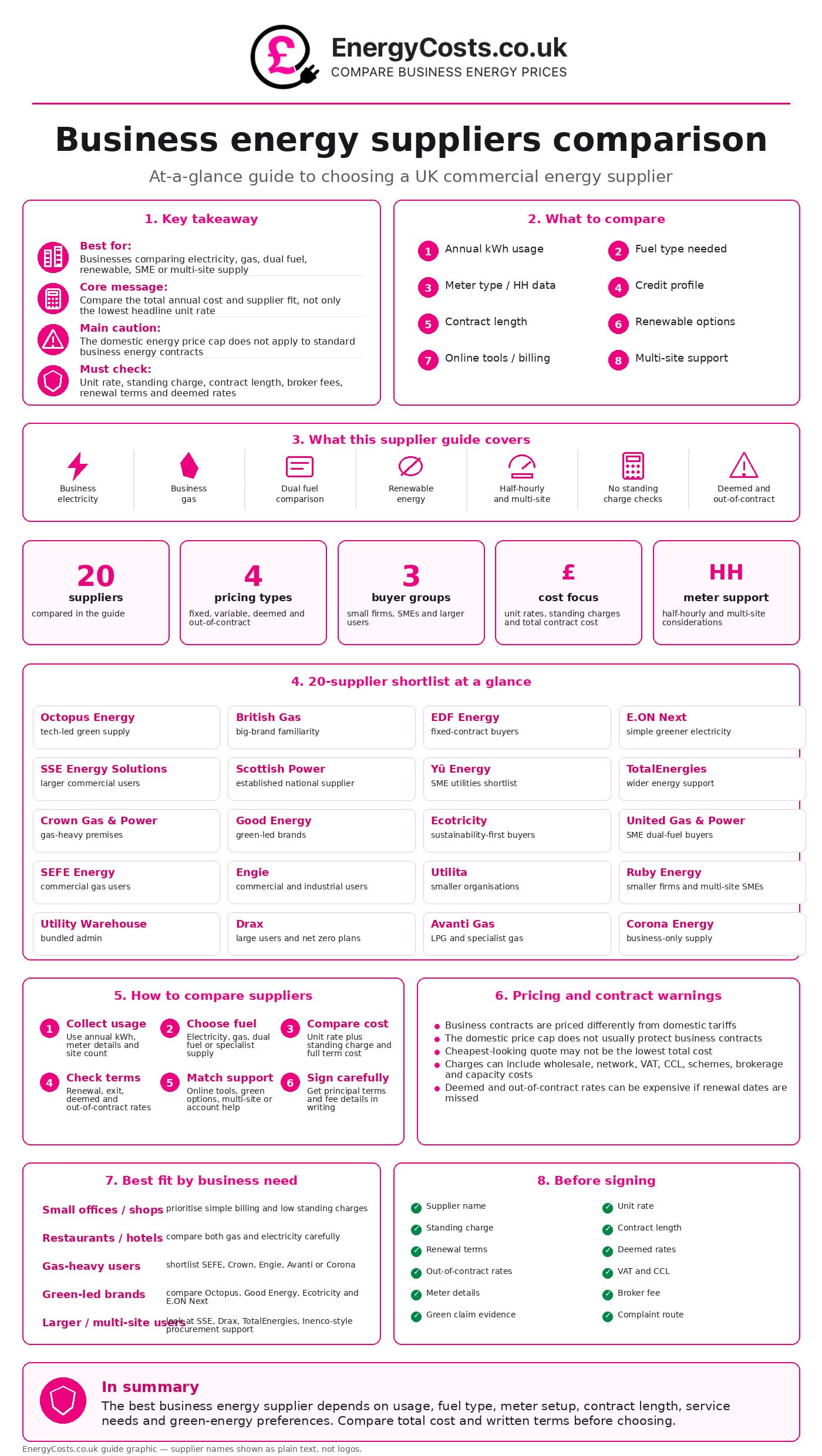
Typical business energy prices and charges in September 2026
Business energy prices move constantly, but our current comparison data gives a useful benchmark. On our current business electricity comparison page, many mainstream PC 01–04 examples sit around 29.8p to 36.5p per kWh, with 65p to 115p per day standing charges for many listed suppliers in that smaller non-half-hourly profile range. For PC 05–08 examples, many listed rates sit around 28.5p to 34.0p per kWh, with standing charges commonly much higher at roughly 140p to 260p per day, and some premium, green or higher-risk entries materially above that.
On our current business gas comparison page, example PC 01–04 gas rates for large-brand suppliers sit around 7.5p to 8.2p per kWh with 95p to 110p per day standing charges. At the same time, supplier-specific pages show more competitive commercial gas examples in the 4p to 7p per kWh range for suppliers such as SEFE and Yü, while Engie’s published business gas examples sit around 5.1p to 6.2p per kWh.
These ranges show why businesses should compare whole-contract cost rather than just one headline number. The standing charge alone can vary substantially, and Ofgem says business bills can also include charges for balancing, distribution, transmission, meter operation, brokerage, bad debt, excess capacity and policy costs.
Full list of UK business energy suppliers
| Supplier trading name | Non-domestic electricity licence? | Non-domestic gas licence? | Customer type | Typical business size | Green energy available? | Contract types | Accepts new business customers? | Service offered to businesses |
|---|---|---|---|---|---|---|---|---|
| 100Green | Yes | Yes | Green retail supplier | SME / microbusiness | Yes – core offer | Fixed, green tariffs | Yes | Exclusively green tariffs to SMEs |
| Axpo UK | Yes | Yes | PPA / corporate supplier | Large business / generators | Yes – PPA-led | PPAs, flexible, bespoke | Specialist only | PPAs for large business customers |
| Barbican Power | Yes | No | Green retail supplier | SME | Yes – core offer | Fixed, green electricity | Yes | Exclusively green tariffs to SMEs |
| BP Gas Marketing | Yes | Yes | Wholesale / corporate supplier | Large industrial / corporate | Limited / bespoke | Wholesale, bespoke supply | Specialist only | Non-domestic gas and electricity supply, mainly wholesale/corporate market activity |
| British Gas | Yes | Yes | Retail supplier | SME / microbusiness | Yes | Fixed, variable, deemed/OOC | Yes | Offers energy tariffs to SMEs |
| Brook Green Supply | Yes | Yes | Retail supplier | SME / mid-market | Yes | Fixed, flexible, bespoke | Yes | Offers energy tariffs to SMEs |
| Bryt Energy | Yes | No | Green retail supplier | SME / mid-market | Yes – core offer | Fixed, renewable electricity | Yes | Exclusively green tariffs to SMEs |
| Ceres Energy | No | Yes | Gas supplier | SME / mid-market | No / unclear | Gas supply contracts | Limited / unclear | Non-domestic gas supply |
| Champion Energy | Yes | No | Retail supplier | SME | Limited | Fixed electricity tariffs | Yes | Offers energy tariffs to SMEs |
| Clear Business Energy | Yes | Yes | Retail supplier | SME / microbusiness | Limited | Fixed, variable, deemed/OOC | Yes | Offers energy tariffs to SMEs |
| Conrad Energy | Yes | Yes | Retail / corporate supplier | SME / mid-market | Yes | Fixed, flexible, bespoke | Yes | Offers energy tariffs to SMEs |
| Corona Energy | Yes | Yes | Retail supplier | SME / mid-market | Limited | Fixed, variable, gas-focused | Yes | Offers energy tariffs to SMEs |
| Coulomb Energy Supply | Yes | Yes | Retail supplier | SME / mid-market | Limited | Fixed, variable, bespoke | Limited / unclear | Non-domestic gas and electricity supply |
| Crown Gas & Power | Yes | Yes | Retail supplier | SME | Limited | Fixed, variable, deemed/OOC | Yes | Offers energy tariffs to SMEs |
| D-ENERGi | Yes | Yes | Retail supplier | SME | Limited | Fixed, variable, deemed/OOC | Yes | Offers energy tariffs to SMEs |
| DGP Energy | Yes | Yes | Retail supplier | SME | Limited | Fixed, variable | Yes | Offers energy tariffs to SMEs |
| Digital Power Energy | Yes | No | Former / inactive retail supplier | SME | No | N/A | No | No longer offering business energy tariffs |
| Drax Energy Solutions | Yes | No | Large business supplier | Large business / I&C | Yes | Fixed, flexible, renewable electricity | Large customers only | Tariffs offered to large businesses |
| Dyce Energy | Yes | No | Retail supplier | SME | Limited | Fixed electricity tariffs | Yes | Offers energy tariffs to SMEs |
| E.ON | Yes | Yes | Retail supplier | SME / large business | Yes | Fixed, variable, flexible, deemed/OOC | Yes | Offers energy tariffs to SMEs |
| Ecotricity | Yes | Yes | Green retail supplier | SME / microbusiness | Yes – core offer | Fixed, green tariffs | Yes | Exclusively green tariffs to SMEs |
| EDF Energy | Yes | Yes | Retail supplier | SME / large business | Yes | Fixed, variable, deemed/OOC | Yes | Offers energy tariffs to SMEs |
| ElectroRoute Energy | Yes | No | PPA / trading provider | Generators / large users | Yes – PPA-led | Route-to-market, PPAs | Specialist only | Energy trading, route-to-market and PPA services |
| Eneco UK | Yes | No | Green corporate supplier | Industrial / commercial | Yes – core offer | Renewable electricity supply | Specialist only | 100% renewable electricity supply to industrial and commercial customers |
| ENGIE | Yes | Yes | Retail / corporate supplier | SME / large business | Yes | Fixed, flexible, bespoke | Yes | Offers energy tariffs to SMEs |
| EPG Energy | Yes | No | Retail supplier | SME | Limited | Fixed electricity tariffs | Yes | Offers energy tariffs to SMEs |
| Equinor UK | No | Yes | Wholesale / gas supplier | Large industrial / wholesale | Limited | Wholesale gas, bespoke supply | Specialist only | Large-scale gas supply and wholesale market activity |
| Evolve Energy | Yes | Yes | Retail supplier | SME | Limited | Fixed, variable | Yes | Offers energy tariffs to SMEs |
| F & S Energy | Yes | No | Green retail supplier | SME | Yes – core offer | Fixed, green electricity | Yes | Exclusively green tariffs to SMEs |
| Flexitricity | Yes | Yes | Flexibility provider | I&C / generators | Yes – flexibility-led | Demand response, aggregation | Specialist only | Demand-side flexibility service provider |
| Flogas Enterprise Solutions | No | Yes | Gas / energy solutions provider | Industrial / commercial | Limited | Gas supply, bespoke energy solutions | Specialist only | Gas and wider energy solutions for industrial and commercial customers |
| Fuse Energy | Yes | Yes | Retail supplier | SME / domestic crossover | Yes | Fixed, variable | Yes | Offers energy tariffs to SMEs |
| Good Energy | Yes | Yes | Green retail supplier | SME / microbusiness | Yes – core offer | Fixed, green tariffs | Yes | Exclusively green tariffs to SMEs |
| Hartree Partners | Yes | Yes | Corporate supplier / trader | Corporate / I&C | Yes – bespoke | Bespoke supply, on-site generation | Specialist only | Tailored supply with on-site generation for corporates |
| Jellyfish Energy | Yes | Yes | Retail supplier | SME | Limited | Fixed, variable | Yes | Offers energy tariffs to SMEs |
| Limejump | Yes | No | Flexibility provider | I&C / generators | Yes – flexibility-led | Demand response, aggregation | Specialist only | Demand-side flexibility service provider |
| Marble Power | Yes | Yes | Retail supplier | SME | Limited | Fixed, variable, deemed/OOC | Yes | Offers energy tariffs to SMEs |
| Maxen Power | Yes | Yes | Retail supplier | SME | Limited | Fixed, variable | Yes | Offers energy tariffs to SMEs |
| Nadara Energy Trading | Yes | No | PPA / trading provider | Generators / corporates | Yes – PPA-led | Renewable offtake, PPAs | Specialist only | Renewable electricity trading, offtake and PPA support |
| npower Business Solutions | Yes | Yes | Large business supplier | Large business / I&C | Yes | Fixed, flexible, pass-through | Large customers only | Tariffs offered to large businesses |
| Octopus Energy | Yes | Yes | Retail supplier | SME / microbusiness | Yes | Fixed, variable, smart tariffs | Yes | Offers energy tariffs to SMEs |
| Opal Gas | No | Yes | Gas supplier | SME | Limited | Fixed, variable gas | Yes | Offers energy tariffs to SMEs |
| Opus Energy | Yes | Yes | Former / exiting retail supplier | SME | Limited | N/A | No | No longer offering business energy tariffs |
| Osso Energy | No | Yes | Gas supplier | SME | Limited | Fixed, variable gas | Yes | Offers energy tariffs to SMEs |
| Pozitive Energy | Yes | Yes | Retail supplier | SME | Limited | Fixed, variable, deemed/OOC | Yes | Offers energy tariffs to SMEs |
| PX Supply | Yes | No | Route-to-market supplier | Industrial / generators | Yes – PPA-led | Offtake, route-to-market | Specialist only | Route-to-market electricity supply and offtake for large industrial consumers and generators |
| Radius Energy | Yes | No | Broker / procurement platform | SME / multi-site | Yes – via procurement | Brokered contracts, procurement | Yes – brokerage-led | Business energy procurement/brokerage; holds a non-domestic electricity supply licence |
| Regent | Yes | Yes | Retail supplier | SME | Limited | Fixed, variable | Yes | Offers energy tariffs to SMEs |
| Ruby Energy | Yes | Yes | Retail supplier | SME | Limited | Fixed, variable, deemed/OOC | Yes | Offers energy tariffs to SMEs |
| RWE Supply & Trading | No | Yes | Wholesale / trading supplier | Large industrial / wholesale | Limited | Wholesale, bespoke gas supply | Specialist only | Energy trading and gas supply for wholesale and large industrial markets |
| Scottish Power | Yes | Yes | Retail supplier | SME / large business | Yes | Fixed, variable, deemed/OOC | Yes | Offers energy tariffs to SMEs |
| SEFE Energy | Yes | Yes | Retail / corporate supplier | SME / large business | Limited | Fixed, flexible, gas-focused | Yes | Offers energy tariffs to SMEs |
| Sembcorp Utilities | No | Yes | Industrial utilities supplier | Large industrial / sites | Limited | Bespoke industrial gas supply | Specialist only | Non-domestic gas supply for industrial and large-site customers |
| Shell Energy | Yes | Yes | Corporate supplier | Business / I&C | Yes | Gas, power, environmental products | Specialist / business only | Offers energy tariffs to SMEs |
| SmartestEnergy | Yes | Yes | Retail / corporate supplier | SME / I&C | Yes | Fixed, flexible, renewable supply | Yes | Offers energy tariffs to SMEs |
| SQE Energy | Yes | No | Large business supplier | Large business | Limited | Bespoke electricity supply | Large customers only | Tariffs offered to large businesses |
| SSE Energy Solutions | Yes | Yes | Retail / corporate supplier | SME / large business | Yes | Fixed, flexible, deemed/OOC | Yes | Offers energy tariffs to SMEs |
| Statkraft | Yes | No | PPA / trading provider | Large business / generators | Yes – PPA-led | PPAs, offtake, trading | Specialist only | PPAs for large business customers |
| Tesla Energy | Yes | No | Specialist EV/energy supplier | EV charging facilities | Yes | EV charging / specialist supply | Specialist only | Tariff for EV charging facilities only |
| TotalEnergies Gas & Power | Yes | Yes | Retail / corporate supplier | SME / large business | Yes | Fixed, flexible, pass-through | Yes | Offers energy tariffs to SMEs |
| Toucan Energy | Yes | No | Former / inactive retail supplier | SME | No | N/A | No | No longer offering business energy tariffs |
| UK Gas Supply | No | Yes | Gas supplier | SME | Limited | Fixed, variable gas | Yes | Offers energy tariffs to SMEs |
| Unify Energy | Yes | Yes | Retail supplier | SME | Limited | Fixed, variable | Yes | Offers energy tariffs to SMEs |
| United Gas & Power | Yes | Yes | Retail supplier | SME | Limited | Fixed, variable, deemed/OOC | Yes | Offers energy tariffs to SMEs |
| UrbanChain | Yes | No | Peer-to-peer / green supplier | SME / corporates | Yes | Renewable supply, PPA-style matching | Yes | Offers energy tariffs to SMEs |
| Utilita | Yes | Yes | Retail supplier | SME / microbusiness | Limited | Fixed, variable | Yes | Offers energy tariffs to SMEs |
| Utility Warehouse | Yes | Yes | Retail supplier | SME / microbusiness | Limited | Fixed, variable | Yes | Offers energy tariffs to SMEs |
| Valda Energy | Yes | Yes | Retail supplier | SME | Limited | Fixed, variable, smart tariffs | Yes | Offers energy tariffs to SMEs |
| Versa Energy | Yes | Yes | Retail / platform supplier | SME | Yes – RED tariff link | Fixed, platform-enabled tariffs | Yes | Offers energy tariffs to SMEs and provides the mechanics behind the TEM Energy RED tariff. |
| Voltx Power | Yes | No | Retail supplier | SME | Limited | Fixed electricity tariffs | Yes | Offers energy tariffs to SMEs |
| Wilton Energy | Yes | No | Large business supplier | Large business / industrial | Limited | Bespoke electricity supply | Large customers only | Tariffs offered to large businesses |
| Yorkshire Gas & Power | Yes | Yes | Retail supplier | SME | Limited | Fixed, variable, deemed/OOC | Yes | Offers energy tariffs to SMEs |
| Yü Energy | Yes | Yes | Retail supplier | SME | Limited | Fixed, variable, smart meters | Yes | Offers energy tariffs to SMEs |
Worst business energy suppliers
Here are the UK’s worst business energy suppliers ranked by average customer review rating:
| Rank | Supplier | Average Trustpilot score | Number of ratings |
|---|---|---|---|
| 1 | British Gas Lite | 1.1 | 3,971 |
| 2 | SSE Energy Solutions | 1.8 | 461 |
| 3 | ENGIE UK & Ireland | 2.5 | 5 |
| 4 | Drax Energy Solutions / energy.drax.com profile | 2.8 | 3 |
| 5 | Jellyfish Energy | 3.5 | 72 |
| 6 | Yü Energy | 3.6 | 6,932 |
| 7 | Yorkshire Gas & Power | 3.8 | 3,657 |
| 8 | E.ON UK | 4.0 | 65,617 |
| 9 | SmartestEnergy Business | 4.1 | 5,681 |
| 10 | Opus Energy | 4.3 | 7,566 |
Cheapest business energy suppliers
There is no single supplier that is always the cheapest business energy supplier. The cheapest business energy suppliers for a low-usage office may be different from the cheapest commercial energy suppliers for a restaurant, bakery, factory or care home. The biggest variables are annual usage, region, meter type, fuel mix, contract length, payment method, broker costs, network charges and the timing of the quote.
For that reason, comparing only the pence-per-kWh headline is a mistake. Businesses should compare unit rate, standing charge, contract term, pass-through charges, green premium, renewal terms, notice requirements and any advance-payment or security-deposit rules before deciding which supplier is really cheapest overall.
Small business energy suppliers
Small business energy suppliers need to work well for firms with limited admin time, tighter cash flow and lower annual usage. For many SMEs, the most important features are clear billing, competitive fixed rates, manageable standing charges, online account access, and the ability to avoid expensive rollover, deemed or out-of-contract pricing.
Ofgem defines a microbusiness as one with fewer than 10 employees and turnover or balance sheet of no more than £2 million, or one using no more than 100,000 kWh of electricity or 293,000 kWh of gas a year. It also defines a newer Small Business category as fewer than 50 employees and turnover of at most £6.5 million or balance sheet total of not more than £5 million, or one using no more than 200,000 kWh of electricity or 500,000 kWh of gas a year.
For small business energy suppliers, the most useful shortlist often includes Octopus Energy, British Gas, EDF Energy, E.ON Next, Yü Energy, United Gas & Power, Utilita, Ruby Energy and Utility Warehouse. The best fit depends on whether you want the strongest digital experience, the broadest brand familiarity, the most transparent published schedules, or the lowest quote for a straightforward single site.
Business electricity suppliers comparison
When comparing business electricity suppliers, the biggest cost drivers are not just your import unit rate. Electricity pricing can also be shaped by non-half-hourly or half-hourly metering, profile class, distribution area, demand pattern, renewable tariff structure, meter operator charges and whether your contract includes pass-through network costs.
Businesses that want renewable business electricity should also understand REGOs. Ofgem says the Renewable Energy Guarantees of Origin scheme provides transparency about the proportion of electricity suppliers source from renewable generation, and that one REGO certificate is issued per megawatt hour of eligible renewable output. That makes REGOs relevant when comparing green business electricity suppliers and renewable business energy suppliers.
For electricity-led businesses, strong comparison options include Octopus Energy, EDF Energy, E.ON Next, Good Energy, Ecotricity and SSE Energy Solutions, with Yü Energy, UGP and Utilita also worth comparing depending on business size and contract style.
Business gas suppliers
Business gas suppliers are especially important for heat-heavy premises such as restaurants, hotels, bakeries, food manufacturers, factories, breweries, laundrettes, care homes and workshops. In those sectors, a lower gas rate can matter more to total annual cost than a small electricity saving.
If gas is the biggest part of your bill, it makes sense to compare general dual-fuel brands with more gas-relevant suppliers such as Crown Gas & Power, SEFE Energy, Engie, UGP, Yü Energy, Corona Energy and Avanti Gas where appropriate. The right shortlist for a gas-heavy business can look very different from the shortlist for an office-led electricity user.
Renewable business energy suppliers
Renewable business energy suppliers are no longer a niche choice. Many UK businesses now want green electricity to support carbon reporting, procurement policies, tenant expectations, investor communications or brand positioning. At the same time, the cost premium for green supply is not always large. Engie’s current examples suggest renewable electricity can sometimes add only around 0.3p to 0.5p per kWh, or roughly £60 to £100 a year on a 20,000 kWh example business.
If green supply matters, compare Octopus Energy, Good Energy, Ecotricity, EDF Energy, E.ON Next and Drax, and then check exactly how the renewable claim is framed. Some suppliers lead with a green brand identity, while others offer renewable-backed contracts within a broader commercial supply portfolio.
Multi-site and half-hourly business energy suppliers
Multi-site businesses usually need more than a simple fixed tariff. They often need consolidated billing, centralised reporting, stronger account management, half-hourly data, clearer procurement support and the ability to manage different supply start and end dates across a property portfolio. Ofgem notes that business bill detail will vary by business size, contract type and meter type, including half-hourly and smart meters.
SSE Energy Solutions, Drax, TotalEnergies, British Gas, EDF Energy, Engie and Octopus are more relevant to this type of business than suppliers focused mainly on small single-site accounts. Octopus says it can support portfolios from 4 accounts and 100 MWh upwards, while Ruby says multi-site businesses consuming over 100,000 kWh annually can see electricity rates as low as 14p per kWh and standing charges from 18p per day depending on profile.
No standing charge business energy
One of the strongest long-tail search terms in the market is business energy with no standing charge. For most suppliers, standing charges still apply, and Ofgem says the standing charge covers costs such as moving energy through cables and pipes, supplier business costs and some government social and environmental schemes.
However, Octopus has launched a No Standing Charge Tariff for some business customers. Its current public guidance says the tariff has a 0p per day standing charge, is on a fixed 12-month contract, is aimed at certain electricity bands, and does not require a smart meter. That will not suit every business, but it is relevant for searchers specifically looking for no standing charge business electricity.
Deemed and out-of-contract business energy rates
Deemed and out-of-contract rates are among the most important topics businesses overlook. Ofgem says that if a supplier fails, the new supplier will place the business on a special deemed contract, which is a contract the business has not chosen. Ofgem also says these deemed contracts can be more expensive because the supplier is taking on more risk.
Published supplier schedules show how big the gap can be. Utilita’s current schedules show non-half-hourly unrestricted variable electricity at 31.395p to 33.156p per kWh with 150.000p per day standing charge, while its deemed and out-of-contract unrestricted electricity is 29.884p to 31.562p per kWh with 115.000p per day standing charge depending on region. Its deemed and out-of-contract gas is published at 10.639p to 10.788p per kWh with 115.000p per day standing charge, and its half-hourly deemed electricity examples are £14.40 per day plus kVA. Yü Energy’s review page also gives out-of-contract examples of roughly 25p to 30p per kWh for electricity and 6p to 9p per kWh for gas.
The key lesson is simple: do not drift past renewal. Compare business energy suppliers early, because deemed and out-of-contract pricing can wipe out any savings you thought you had secured on the previous deal.
How to choose the best business energy supplier
Start with your latest bill and gather your annual kWh usage, meter numbers, current unit rates, standing charges and contract end date. A recent bill will tell you how much energy you use and helps you work out what type of contract you need.
Then decide what matters most. If your priority is the cheapest business energy supplier, compare whole-contract cost. If your priority is sustainability, compare renewable business energy suppliers and ask how green claims are evidenced. If your priority is operational complexity, focus on suppliers that are stronger on half-hourly, multi-site or export arrangements.
Finally, compare early. The best time to compare is usually three to six months before a contract ends, helping businesses avoid rolling onto deemed rates. Octopus also says businesses can choose supply dates up to 6 months in the future, which shows that early contracting is already part of the market.
FAQ
A business energy supplier provides gas, electricity or both to a non-domestic premises. Business contracts differ from domestic tariffs in structure, pricing and protections.
No. The domestic energy price cap applies to household tariffs, not to standard business energy contracts.
There is no universal winner. The cheapest business energy suppliers change according to usage, meter type, region, contract term, credit profile and the date you request quotes.
For many SMEs, strong shortlist options include Octopus Energy, British Gas, EDF Energy, E.ON Next, Yü Energy, UGP, Ruby Energy, Utilita and Utility Warehouse. The best choice depends on whether you prioritise low pricing, digital tools, published rates, bundled services or multi-site support.
It varies by supplier, meter type and whether you are free to switch immediately. Octopus says electricity can take around 5 to 6 days and gas around 16 to 17 days if the business is free to move straight away, while some commercial supplier pages use broader 2 to 6 week switching examples depending on complexity.
A sensible window is around three to six months before renewal, because suppliers often allow advance contracting and it reduces the risk of landing on deemed or out-of-contract rates.
A standing charge is a daily cost charged whether or not you use energy. Ofgem says it helps cover network costs, supplier operating costs and some government schemes.
Usually no, but some niche offers exist. Octopus currently markets a business no standing charge tariff for some customers on a fixed 12-month basis.
A deemed contract is one you have not actively chosen. Ofgem says businesses moved to a new supplier after supplier failure are placed on a special deemed contract, and that deemed contracts can be more expensive.
Out-of-contract pricing applies when a fixed agreement ends and a business has not secured a new deal. It is usually less competitive than negotiated fixed prices and should be avoided where possible. Published supplier schedules such as Utilita’s show just how important it is to renew in good time.
A half-hourly meter records electricity usage in 30-minute intervals. These meters are common on larger sites and can make supplier comparison more complex because charges may include extra demand, network and capacity elements.
Often, yes. If your premises are electricity-led or gas-led, comparing the two markets separately can reveal a better-fit supplier than relying on broad dual-fuel brand recognition alone.
Not always. The premium can be small, and the total bill still depends heavily on usage, contract timing, standing charges and the supplier’s buying strategy.
Sometimes only temporarily. A landlord or managing agent may influence the starting arrangement in serviced or managed premises, but most businesses should still check whether they can switch or negotiate their own contract once occupation is established. You should always confirm who controls the meter and who is named on the contract before assuming you can switch.
Some suppliers reference pay-as-you-go or prepayment-style options, but mainstream business energy supply is still dominated by fixed, variable and tailored commercial contracts. Businesses considering prepayment should look very closely at total cost, meter limitations and contract flexibility.
A broker can save time and widen your quote set, but you should still check how they are paid. Ofgem says business costs can include third-party services such as brokerage, and recent rules require clearer disclosure and wider protections around broker fees and complaint handling for business customers. Government has also confirmed its intention to bring TPIs under direct regulation.
Ofgem says newer rules give businesses fairer treatment, more support resolving disputes and greater transparency on broker fees. It also expanded Standards of Conduct to all businesses and created stronger complaint-handling and redress routes for small businesses.
Ofgem says your supply will not be disrupted. It aims to appoint a new supplier within a few days, up to a maximum of 14 days, and you will not be charged exit fees if you want to switch away once the process is complete.
Not in the same way as domestic balances. Ofgem says its safety net does not protect business customer credit balances, although it will try to appoint a new supplier that covers all or some outstanding credit where possible.
There are more than 50 active business energy suppliers in the UK, ranging from large national providers to smaller specialist and renewable-focused suppliers. The exact number changes regularly as suppliers enter, exit, merge or rebrand within the business energy market.
Business energy suppliers set prices based on wholesale energy costs, network charges, environmental levies, contract length and risk. Unlike domestic tariffs, there is no price cap for businesses, so suppliers can offer widely different rates for similar usage levels.
Businesses can switch energy suppliers at the end of a contract without penalty. Switching mid-contract is possible, but most suppliers charge exit fees. Deemed or out-of-contract rates allow switching at short notice, although these tariffs are usually much more expensive.
Renewable energy suppliers are not always more expensive. Many green business tariffs are now priced competitively, particularly for electricity. Costs depend on contract length, usage profile and market conditions rather than whether the supplier sources renewable energy.
Many suppliers offer bespoke contracts for larger businesses with high or half-hourly consumption. These contracts can include flexible purchasing, pass-through charges and custom pricing structures tailored to usage patterns, risk appetite and budget planning requirements.
Yes, all licensed gas and electricity suppliers operating in the UK are regulated by Ofgem. However, business energy contracts are less protected than domestic ones, meaning pricing, terms and dispute resolution can vary significantly between suppliers.
Latest updates to this page
6 October 2026
- Monthly data accuracy checks and updates
- Added links to internal resources
1 September 2026
- Monthly data accuracy checks and updates
6 August 2026
- Monthly data accuracy checks and updates
2 July 2026
Added links to new reviews of SmartestEnergy, Shell Energy and Flexitricity
1 July 2026
- Updated rates and checked details for July 2026
19 June 2026
- Added a full list of business energy suppliers to compliment the top 20 list
- Added a section on worst business energy suppliers