EDF Energy is one of the UK’s leading energy suppliers, offering a range of business gas and electricity tariffs designed to meet the needs of companies of all sizes.
Whether you’re a small business looking to manage costs or a larger enterprise seeking more sustainable energy solutions, understanding EDF’s offerings can help you make an informed decision.
In this article, we’ll review EDF Energy business prices, explore their tariffs, and explain the key features available to UK businesses.
EDF Energy at a glance
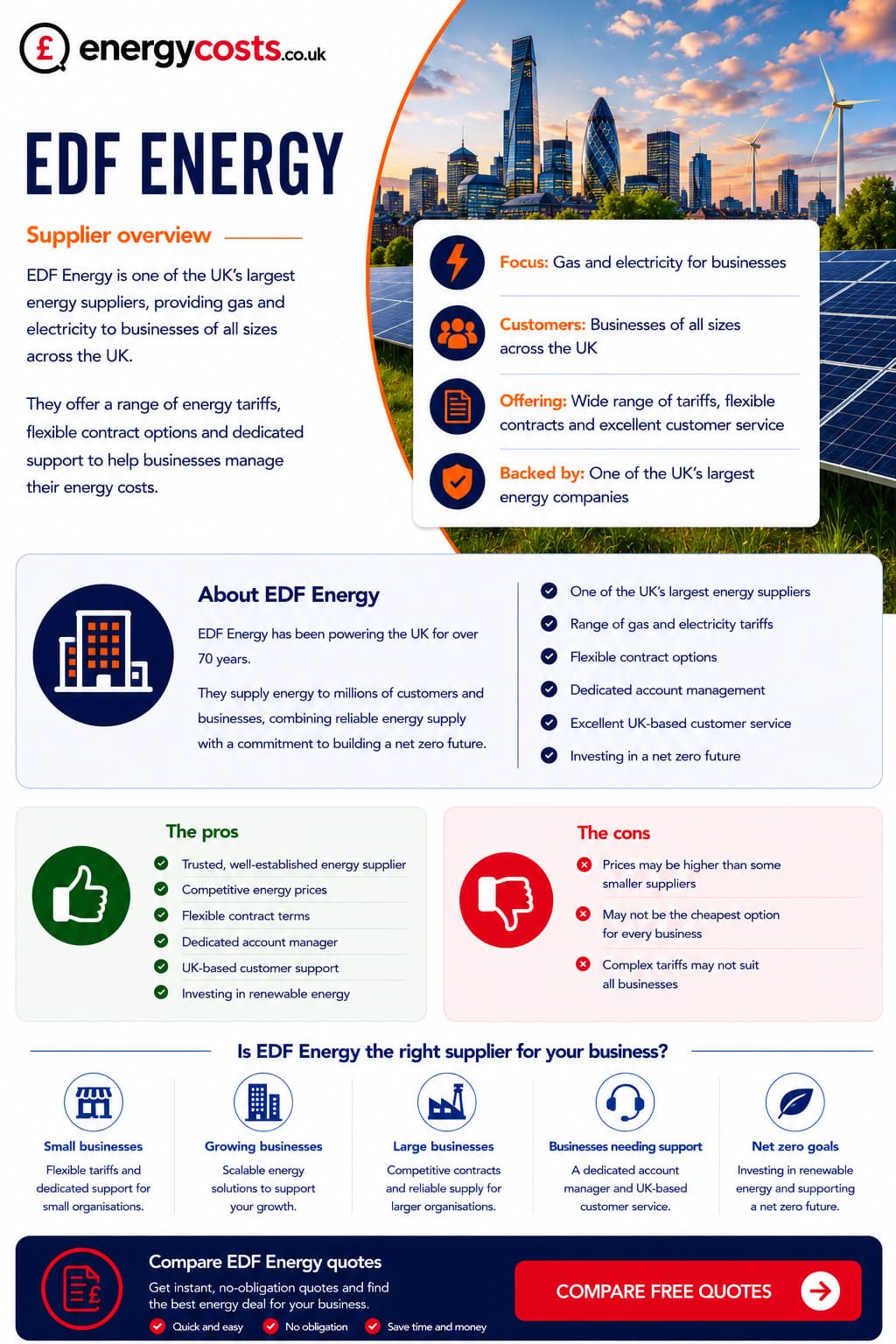
EDF Energy is one of the UK’s largest and most established energy suppliers, serving businesses of all sizes across the country. As part of the EDF Group, it combines retail supply with large-scale generation assets, giving it a different profile to smaller independent suppliers.
- Supplier type: Major national energy supplier (EDF Group)
- Fuel supplied: Electricity and gas (dual fuel available)
- Target customers: Small businesses, SMEs and large commercial users
- Tariff types: Fixed, variable and bespoke business contracts
- Smart metering: Supported
- Low-carbon focus: Strong emphasis on nuclear and renewable electricity
EDF Energy is particularly suited to businesses that want the reassurance of a large supplier with broad infrastructure, a wide range of contract options and the ability to manage both electricity and gas under a single provider.
Who EDF Energy is best for
EDF is likely to suit businesses that want a large supplier with a strong small-business offer and clear online self-service tools. Its small-business pages focus on simple fixed tariffs, price security for up to four years, online quoting, and dedicated small-business support, while its quote journey separates smaller users from larger businesses that need a bespoke quote. EDF defines its small-business route as under 100MWh for electricity and/or 300MWh for gas, with larger users directed to a tailored large-business quote process.
That makes EDF especially relevant for smaller firms that want price certainty and digital account management, but it can also suit larger businesses that want fixed-price supply with dedicated specialists rather than a purely self-serve model. Existing EDF small-business customers are also directed to contact sales for a quote rather than rely only on the standard online flow, which is useful to know before comparing prices.
EDF Energy business prices list: commercial rates per kWh
Keep in mind that actual prices may differ, and it’s best to get a tailored quote for precise rates.
| Tariff Type | Electricity Unit Rate (per kWh) | Gas Unit Rate (per kWh) | Standing Charge (per day) |
|---|---|---|---|
| Fixed-rate (1-year contract) | 26.50p | 8.00p | 40.00p |
| Fixed-rate (3-year contract) | 25.80p | 7.80p | 39.50p |
| Fixed-rate (5-year contract) | 25.20p | 7.50p | 39.00p |
| Variable-rate | 27.00p | 8.20p | 41.00p |
| Green energy tariff | 26.80p | 8.10p | 40.50p |
Notes:
- Electricity Unit Rate (per kWh): The cost of each unit of electricity your business consumes.
- Gas Unit Rate (per kWh): The cost of each unit of gas your business consumes.
- Standing Charge (per day): A daily fee for providing your business with energy, regardless of usage.
These rates are indicative and subject to change based on market conditions, contract terms, and specific business requirements. For the most accurate and up-to-date pricing, it’s recommended to contact EDF Energy directly or visit their website to request a tailored quote.
EDF business deemed rates
EDF says that if a small business reaches the end of a fixed tariff and does nothing, it can be auto-renewed onto Freedom, which EDF describes as a variable contract with no termination fees. EDF also says a deemed tariff applies where a business is using energy without an agreed contract, such as after moving into new premises.
EDF Freedom for Business rates
| Fuel / meter type | Standing charge | Unit rate | Off-peak / other rates |
|---|---|---|---|
| Electricity – Standard | 200.00p/day | 48.98p/kWh | — |
| Electricity – Economy 7 | 200.00p/day | 50.04p/kWh | 44.93p/kWh night/off-peak |
| Electricity – Evening Weekend | 200.00p/day | 50.15p/kWh | 47.42p/kWh evening/weekend |
| Electricity – Evening Weekend Night | 200.00p/day | 51.01p/kWh | 44.63p/kWh night/off-peak; 48.79p/kWh evening/weekend |
| Electricity – White Meter | 200.00p/day | 50.04p/kWh | 44.93p/kWh night/off-peak |
| Electricity – Off Peak | 200.00p/day | — | 44.93p/kWh off-peak |
| Gas – Standard | 200.00p/day | 16.03p/kWh | — |
These are EDF’s published Freedom for Business prices effective from 1 April 2026. The same rate card says prices exclude VAT and CCL, and that customers paying monthly by Budget Direct Debit receive a 7% discount off every bill before VAT and CCL.
EDF deemed electricity rates
| Meter type | Unit rate | Standing charge |
|---|---|---|
| Profile Class 01–04 | 36.839p/kWh | Varies by region and TCR band |
| Profile Class 05–08 | 36.839p/kWh | Varies by region and TCR band |
| Unmetered supply | 36.839p/kWh | 348.01p/day |
EDF’s published non-half-hourly deemed electricity card effective from 1 January 2026 shows the same 36.839p/kWh unit rate for Profile Classes 01–04 and 05–08, with the standing charge varying by electricity distribution zone and TCR band. Across the published table, the standing charge runs from 355.58p/day to 376.27p/day for no-residual sites, 375.48p/day to 409.73p/day for Band 1, 395.05p/day to 472.21p/day for Band 2, 445.77p/day to 599.93p/day for Band 3, and 613.86p/day to 1,062.05p/day for Band 4.
EDF deemed gas rates
| Meter type | Standing charge | Unit rate |
|---|---|---|
| Standard | 893.86p/day | 7.031p/kWh |
EDF’s published deemed business gas card effective from 1 January 2026 lists a standard deemed standing charge of 893.86p/day and a unit rate of 7.031p/kWh, excluding VAT and CCL.
What the tables show
| Key point | What it means |
|---|---|
| Freedom is EDF’s main small-business variable fallback | EDF says Freedom is the variable contract it can move customers onto if they do nothing at renewal. |
| Deemed rates apply when there is no agreed contract | EDF says this usually happens when a business starts using energy without agreeing terms, such as after moving into a property. |
| EDF’s deemed electricity is more complex than British Gas’s published table | The unit rate is simple, but the daily charge depends on region and TCR band. |
| Half-hourly deemed electricity is even more granular | EDF publishes separate HH deemed cards by voltage level, region, time band and TCR standing-charge band. |
Moving premises and deemed rates
EDF has a much more developed moving-premises process than the current page reflects. Its small-business moving section says businesses moving in or out can change their address and sort their supply in three steps, while its large-business moving page says that, if EDF has all the required information, the process is completed within 28 days from notification.
For incoming occupiers, EDF’s large-business moving page also states that once the request is completed, the incoming customer will receive a deemed notification confirming they are on EDF’s deemed rates and giving the details needed to contact sales to arrange a contract.
Why deemed rates matter
EDF’s small-business terms make the position even clearer. The terms say the deemed contract scheme applies where EDF is supplying a small-business customer but there is no current energy-supply agreement in place that can be enforced by law. In other words, if the business is taking supply without a signed contract, EDF can still supply the site under deemed terms.
Deemed supply is something businesses should normally move away from quickly. If a company is moving into new premises, the practical steps are to take opening and closing meter readings, notify the supplier promptly and arrange a proper contract as soon as possible rather than remain on a default position.
Fuel mix and sustainability credentials
EDF Energy’s sustainability credentials are shaped by its role not only as a supplier, but also as a major electricity generator in the UK. EDF operates the country’s nuclear power stations and invests heavily in renewable generation, including wind and solar.
For business customers, this means access to low-carbon electricity options that go beyond simple renewable matching. EDF’s electricity fuel mix typically includes a high proportion of nuclear and renewable generation, resulting in a lower average carbon intensity than the UK grid mix.
EDF also offers renewable electricity tariffs supported by Renewable Energy Guarantees of Origin (REGOs), helping businesses demonstrate renewable sourcing for Scope 2 emissions reporting. This can be particularly valuable for organisations with ESG commitments, sustainability audits or carbon-reduction targets.
While EDF supplies gas as well as electricity, businesses should be aware that gas remains a higher-carbon fuel. EDF’s strength lies primarily in low-carbon electricity rather than green gas solutions.
EDF Energy customer service and satisfaction insights
Service quality is a key consideration for business energy customers, particularly for organisations that rely on uninterrupted supply and clear billing. As a large national supplier, EDF Energy operates extensive customer support infrastructure for business users.
EDF provides dedicated business support channels, including online account management tools, billing portals and specialist business helplines. These services are designed to help with contract management, meter queries, billing issues and renewals.
Independent customer satisfaction surveys often show that large incumbent suppliers such as EDF perform solidly on reliability and operational scale, though service ratings can vary depending on business size and complexity. SMEs may value EDF’s structured support systems, while larger organisations benefit from tailored account management.
EDF also publishes complaint handling and service performance data in line with regulatory requirements, giving businesses transparency when assessing supplier reliability and long-term service standards.
Overview of EDF Energy business energy tariffs
EDF Energy provides a variety of business energy tariffs tailored to different business needs. Their plans cater to small and medium-sized enterprises (SMEs), as well as larger organisations with more complex energy requirements. The tariffs are designed to be flexible, offering both fixed-rate and variable-rate options to suit various budget preferences.
Fixed-rate business tariffs
Fixed-rate tariffs are one of the most popular choices among businesses because they offer stability and predictability in energy costs. With a fixed-rate plan from EDF Energy, your gas and electricity rates remain constant for the duration of the contract, protecting you against market fluctuations. This can be especially beneficial during periods of rising energy prices, as your business will not be subject to sudden increases.
Key benefits of EDF’s fixed-rate tariffs:
- Budget certainty with stable prices
- Protection from market volatility
- Flexible contract lengths, typically ranging from one to five years
Variable-rate business tariffs
For businesses that prefer a more flexible approach, EDF offers variable-rate tariffs. These rates can go up or down based on market conditions, which could allow your business to benefit from falling prices. However, it also means that your costs may increase if market prices rise. Variable-rate tariffs are usually best suited for businesses that can handle some level of risk and are not heavily dependent on predictable energy costs.
Key benefits of EDF’s variable-rate tariffs:
- Potential to benefit from lower market prices
- No long-term commitment
- More flexible exit terms compared to fixed-rate tariffs
Green and renewable energy options
As sustainability becomes a more pressing concern for businesses and consumers alike, EDF Energy has increased its focus on renewable energy options. EDF’s green tariffs provide electricity sourced from renewable energy, helping businesses reduce their carbon footprint and demonstrate their commitment to sustainability. These tariffs are ideal for businesses looking to meet corporate social responsibility (CSR) goals or achieve net-zero emissions targets.
Key benefits of EDF’s green energy tariffs:
- 100% renewable electricity from wind, solar, and hydro sources
- Supports your business’s environmental goals
- Helps attract environmentally conscious customers and partners
Features of EDF Energy business energy plans
Beyond their competitive pricing and tariff options, EDF Energy offers several features designed to enhance the customer experience for businesses. Here are some of the key features that set EDF Energy apart:
Smart meters and online account management
EDF Energy provides smart meters to its business customers, which can significantly improve the efficiency of energy usage and cost management. Smart meters allow businesses to monitor their energy consumption in real time, helping to identify areas where savings can be made.
Additionally, EDF’s online account management system offers an easy way to track energy usage, view bills, and make payments. This feature can save businesses time and reduce the administrative burden of managing energy accounts.
Dedicated business support
EDF Energy offers dedicated support for its business customers, providing assistance through a team of energy specialists. Whether you need help with billing queries, energy management advice, or technical support, EDF’s team is equipped to address your needs. This level of service is particularly valuable for businesses that require more personalised attention and quick resolution of issues.
Flexible payment options
Understanding that businesses have different cash flow situations, EDF Energy offers flexible payment options. This includes direct debit, online payments, and tailored billing schedules to suit the specific needs of your business. These payment plans can help you manage your finances more effectively and ensure that energy bills are paid on time.
Energy efficiency solutions
To help businesses reduce energy consumption and save money, EDF Energy offers a range of energy efficiency solutions. These services include energy audits, lighting upgrades, and advice on optimising equipment performance. By investing in these solutions, businesses can lower their operational costs and contribute to a more sustainable future.
MyAccount, billing and usage visibility
EDF says all of its small-business customers get MyAccount, an online portal where they can access their energy account anytime, including for tasks such as paying a bill, checking business consumption and resetting a password. Its support pages also say customers can view information, make payments, submit meter readings and manage more of the account online.
EDF also promotes Energy Hub within MyAccount. It says Energy Hub lets customers see where and when they are using the most energy, and that most customers with a smart or AMR meter can download consumption data from Energy Hub within MyAccount. That is useful because it gives businesses something more tangible than a generic promise of online account management: better visibility over usage, easier bill checking and less reliance on estimated reads.
Complaints and escalation
EDF has a clear published complaints route for small-business customers. Its complaints page says customers should first contact its business energy specialists, and that the person who registers the complaint will act as the complaint handler from beginning to end. EDF lists the small-business contact number as 0330 912 9959, with opening hours of Monday to Thursday 8am to 6pm and Friday 8am to 4pm, and it also gives the email address [email protected].
EDF’s complaints page also says that if the problem has not been fixed after eight weeks, or the customer has received a deadlock letter, they can contact the Energy Ombudsman. It separately points customers in England and Wales to Citizens Advice and customers in Scotland to Advice Direct Scotland for free, independent energy advice.
How to switch to EDF Energy for your business
Switching your business energy supplier to EDF Energy is a straightforward process. You can get a quote online by providing details about your current energy usage and requirements. EDF will then offer you a range of tariffs to choose from, along with a detailed breakdown of costs. Once you’ve selected a plan, EDF Energy will handle the switch, ensuring a seamless transition with no disruption to your energy supply.
Benefits of switching to EDF Energy
- Competitive rates and fixed-price options
- Access to renewable energy tariffs
- Comprehensive support for the switching process
- Tools and resources to help manage and reduce energy usage
VAT and Climate Change Levy
EDF has a dedicated VAT and CCL support section for business customers. Its VAT FAQ page says businesses can submit VAT relief online and links directly to a VAT and CCL guide. EDF’s invoice guidance also states that the standard VAT rate is 20% for small-business customers, but that this can vary depending on the VAT declaration and whether energy consumption is below de minimis levels, which it lists as 12,045 kWh per year for electricity and 52,925 kWh per year for gas.
This is especially relevant for qualifying low-usage, mixed-use or other eligible sites, because VAT treatment can affect the overall bill rather than just the unit rate.
Is EDF Energy the right choice for your business?
Choosing the right business energy supplier for your business depends on various factors, including your budget, energy consumption patterns, and sustainability goals. EDF Energy is a strong contender in the UK market, offering a wide range of tariffs, green energy options, and customer-centric features that make it an attractive choice for many businesses.
Pros of choosing EDF Energy
- Reliable supplier with extensive experience in the UK market
- Diverse tariff options for businesses of all sizes
- Strong focus on renewable energy and sustainability
Cons of choosing EDF Energy
- Variable tariffs can be risky during periods of rising energy prices
- Some businesses may find cheaper rates with niche suppliers
Conclusion: EDF Energy business prices review
EDF Energy offers a comprehensive suite of business gas and electricity tariffs designed to meet the needs of UK businesses. With a variety of fixed-rate, variable-rate, and green energy options, along with features like smart meters and dedicated support, EDF Energy provides flexibility and value to companies of all sizes. If you’re looking to switch to a reliable energy supplier that can support your sustainability goals while providing competitive rates, EDF Energy is well worth considering.
For more, visit the EDF Energy website, or see our guides to the cheapest business electricity and cheapest business gas.
EDF Energy business prices FAQ
EDF Energy charges an early exit fee of up to £300 per meter for terminating a fixed-rate business energy contract before its end date. The exact fee depends on your contract length and the remaining period left on the agreement.
EDF Energy reviews and updates its variable rates every three months, reflecting changes in the wholesale energy market. This frequency means your rates can increase or decrease during these intervals, influencing your overall energy costs.
EDF Energy provides a discount of up to 7% on business energy bills when payments are made via direct debit. This saving can significantly reduce the overall cost of energy over the course of the contract period.
EDF Energy applies a green energy surcharge of approximately 1.5p per kWh for its renewable electricity tariffs. This additional cost supports the production and sourcing of electricity from 100% renewable energy sources like wind, solar, and hydro.
EDF Energy’s business energy quotes are typically valid for 30 days from the date of issue. This gives businesses a limited window to decide and lock in the offered rates before potential market fluctuations affect the prices.