


Artificial intelligence (AI) can do incredible things. But it still “breaks a sweat” while it does so.
Every time you prompt Anthropic’s Claude to generate an email, explanation, plan, or code snippet, servers run huge numbers of calculations to produce the response. That process uses electricity, and (in many data centres) water is also used somewhere in the cooling chain.
Unlike some rivals, Anthropic does not publicly publish a single, definitive “energy per prompt” (or “water per prompt”) figure for Claude, and estimates vary depending on model size, response length, hardware, and whether “reasoning” modes are used.
So, how much electricity and water might Claude use in total? Below is our best-effort, transparent estimate based on publicly available inference energy benchmarks (per request) plus a standard data-centre water-efficiency metric, combined with an assumption about how many prompts users send each day.
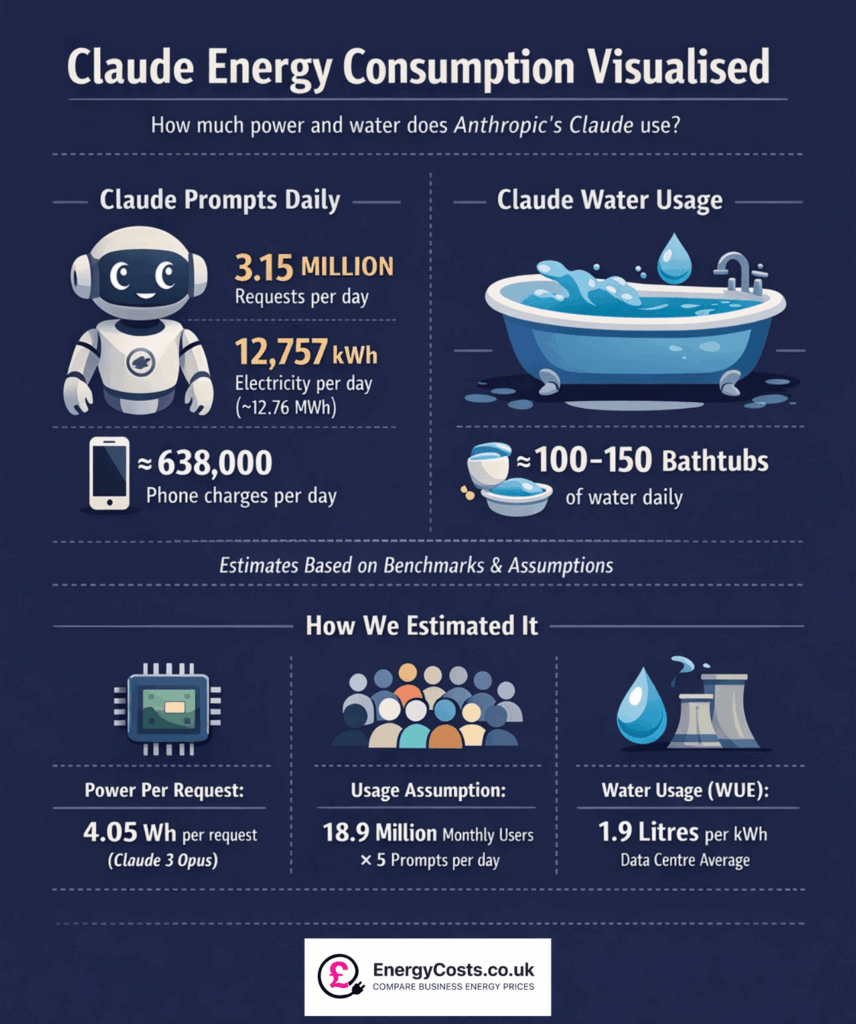
Anthropic’s Claude prompts consume enough electricity daily to charge over 600,000 phones
Public benchmarks suggest that a “typical” Claude request can be in the low single-digit watt-hours (Wh) range for larger Claude models, and well under 1 Wh for smaller ones—depending on the model and the token count.
Using one published benchmark for Claude 3 Opus of 4.05 Wh per ~400-token exchange as a working estimate, that’s 0.00405 kWh per request.
To scale this up, we also need a usage assumption. Since Anthropic does not publish daily prompts, this article uses a conservative consumer-side proxy: 18.9 million monthly active users (MAU), converted to daily users, then multiplied by five prompts per user per day. (This MAU figure is widely repeated in third-party roundups, but should be treated as an estimate.)
On those assumptions, Claude would generate roughly:
- ~3.15 million prompts per day
- ~12,757 kWh per day (≈ 12.76 MWh/day)
- ~4.66 GWh per year
For a relatable comparison: if a full phone charge is ~20 Wh, then 12.76 MWh/day is enough for ~638,000 full phone charges per day.
Claude consumes over 100 bathfuls of water every day
Water accounting is even messier than electricity.
Some data centres use very little on-site water (for example, air-cooled designs). Others use much more. A common metric is Water Usage Effectiveness (WUE), measured in litres per kWh of IT load. A widely cited benchmark for “average” data-centre WUE is around 1.9 L/kWh (with large variation by site and cooling design).
Applying 1.9 L/kWh to the electricity estimate above:
- ~24,239 litres per day (≈ 6,403 US gallons/day)
That’s roughly ~100–150 typical baths per day, depending on the bath size (UK baths vary a lot in capacity).
Important: this is not a claim about Claude’s exact water use. It’s a scaled estimate based on a generic WUE figure, and real-world water impact depends heavily on where the compute runs and how that facility cools.
Energising the future
Two things can be true at once:
- Per-request energy can be small, especially for short, non-reasoning prompts on smaller models.
- At scale, even small per-request costs become meaningful—particularly as users shift from short chats to long-context work, coding agents, tool use, and “thinking longer” modes (which can push per-interaction energy up substantially).
What’s missing most today is consistent disclosure: without standard reporting, the public ends up comparing apples to oranges (different models, different token counts, different definitions of a “query”, and different infrastructure).
Methodology and sources
We estimated electricity and water usage for Claude using a simple, reproducible approach:
There are two sides to our calculations:
- Electricity per Claude request (inference).
We used a published benchmark of 4.05 Wh per ~400-token exchange for Claude 3 Opus as a representative “larger model” estimate. - Estimated daily Claude requests.
Because Anthropic does not publish daily prompt volume, we used a third-party estimate of 18.9 million monthly active users, converted to a daily average (MAU ÷ 30), and assumed 5 prompts per user per day.
For water:
- Water usage effectiveness (WUE).
We used an “average data centre” WUE of ~1.9 L/kWh to translate kWh into litres of water consumed (again: actual facilities vary widely).
What this means: treat the totals as order-of-magnitude indicators, not audited operational figures. The biggest sources of uncertainty are (a) real prompt volumes across consumer + API, and (b) where Claude is served and how those sites are cooled.