
Takeaway businesses, whether fish and chip shops, Chinese takeaways, Indian takeaways, pizza shops, kebab houses, or fast-food outlets, are among the highest energy users in the UK SME sector.
High-heat cooking equipment, powerful extraction systems, long trading hours, and constant refrigeration all contribute to above-average monthly bills.
Here we model monthly bills for several takeaway setups and explain their cost drivers. The kWh ranges are transparent planning assumptions, not measured national averages for each cuisine.
Typical monthly energy costs for takeaway businesses
The specified 30-day scenarios below range from £1,413–£2,563 for the Indian/Chinese example to £3,063–£5,463 for the large mixed-food example, before VAT, CCL and separately billed items. Actual bills depend on metered consumption, cooking equipment, hours and the individual contract.
Illustrative monthly costs by takeaway type
| Takeaway example | Electricity kWh/month | Gas kWh/month | Electricity incl. standing charge | Gas incl. standing charge | Combined model cost |
|---|---|---|---|---|---|
| Small fish and chip shop | 3,000–6,000 | 5,000–9,000 | £945.00–£1,845.00 | £518.00–£918.00 | £1,463.00–£2,763.00 |
| Indian / Chinese takeaway | 2,500–5,000 | 6,000–10,000 | £795.00–£1,545.00 | £618.00–£1,018.00 | £1,413.00–£2,563.00 |
| Pizza takeaway with electric ovens | 6,000–10,000 | 1,000–2,500 | £1,845.00–£3,045.00 | £118.00–£268.00 | £1,963.00–£3,313.00 |
| Kebab shop / grill house | 4,000–7,000 | 3,500–6,000 | £1,245.00–£2,145.00 | £368.00–£618.00 | £1,613.00–£2,763.00 |
| Large mixed hot-food takeaway | 8,000–14,000 | 6,000–12,000 | £2,445.00–£4,245.00 | £618.00–£1,218.00 | £3,063.00–£5,463.00 |
Pricing assumptions used:
- Electricity unit rate: 30p/kWh in this illustrative model.
- Electricity standing charge: £1.50/day.
- Gas unit rate: 10p/kWh.
- Gas standing charge: 60p/day. Table costs exclude VAT, CCL and separately billed items.
Unit rates and standing charges used in these takeaway cost examples
All cost models below use a 30-day month, electricity at 30p/kWh plus £1.50/day and gas at 10p/kWh plus 60p/day. These are rounded planning inputs near November 2026 published quote observations, held constant to isolate the effect of consumption. They are not supplier offers or measured sector averages. Totals exclude VAT, CCL, additional metering/capacity charges and other separately billed items; add only the items applicable to the site.
| Input | Electricity | Gas |
|---|---|---|
| Model unit rate | 30p/kWh | 10p/kWh |
| Model standing charge | £1.50/day | 60p/day |
| Standing charge over 30 days | £45 | £18 |
For context, published November small-business observations were 29.5p/kWh plus 157.4p/day for electricity and 9.3p/kWh plus 57.8p/day for gas. Dated reference figures cover supplier-panel offers from 1–9 November 2026, including the maximum commission in that dataset. These are not whole-market averages or a quote for a particular site. Electricity and gas size bands differ. Confirm VAT, CCL, other fees and fixed/pass-through terms on any actual offer. A larger site using the same model inputs may receive a different actual quote.
What changes the real bill?
Opening and preparation hours, equipment duty cycles, refrigeration, extraction, hot water, building heat loss, weather, meter type, capacity, credit terms and the contract start date all affect the result. Use actual bills or interval readings; the kWh ranges in the examples are assumptions rather than a survey of takeaway businesses.
Standard business supplies normally attract 20% VAT. Small-quantity and other qualifying supplies have different treatment: during 1 October 2026–30 June 2027, qualifying electricity in Great Britain is temporarily zero-rated; qualifying electricity in Northern Ireland and qualifying gas remain at 5%. The small-quantity tests are applied separately to each fuel and billing supply, not simply to a combined annual bill. Check HMRC’s fuel and power guidance.
The main CCL rate is 0.801p/kWh for electricity and gas from 1 April 2026 to 31 March 2027. Add it only to taxable consumption and only if it is not already included. Small-quantity supplies can be exempt; a renewable tariff alone does not remove CCL.
A site without a gas supply has no gas standing charge. Remove both the assumed gas consumption and the £18 model charge. A 31-day month also has one extra day of fixed charges. The calculations compare purchased fuel; they do not compare equal useful heat from appliances of different efficiency.
Why takeaways have higher energy costs than many SMEs
Takeaways often operate 10–14 hours per day, including prep and late-night trading. Core loads include:
| Energy driver | What to measure | Notes |
|---|---|---|
| Cooking equipment | Input power, duty cycle and service hours | Fryers, burners, tandoors, ovens and grills |
| Refrigeration | Complete-day measured kWh | Include closed-hour operation |
| Extraction / ventilation | Fan input and safe operating schedule | Maintain required extraction and gas interlocks |
| HVAC | Plant runtime, controls and fuel consumption | Account for cooking heat and make-up air |
| Lighting | Wattage and actual lit hours | Separate kitchen, customer and external lighting |
Cooking intensity and ventilation requirements are the two biggest factors pushing bills upward.
Cuisine type and its impact on energy costs
Different takeaway cuisines have very different usage profiles.
| Cuisine / equipment type | Cost impact | Key reasons |
|---|---|---|
| Pizza (electric deck ovens) | Very high | Ovens often run at 300–400°C for hours; high electricity draw. |
| Fish and chips | High | Large fryers (gas or electric), long cooking cycles. |
| Chinese takeaway | High | Powerful wok burners and extraction systems. |
| Indian takeaway | Medium-high | Tandoors and multiple gas burners driving heat load. |
| Kebab shops | Medium-high | Vertical grills and fryers create consistent high heat use. |
| Mixed hot-food takeaway | Very high | Combination of fryers, grills, ovens, wok burners and refrigeration. |
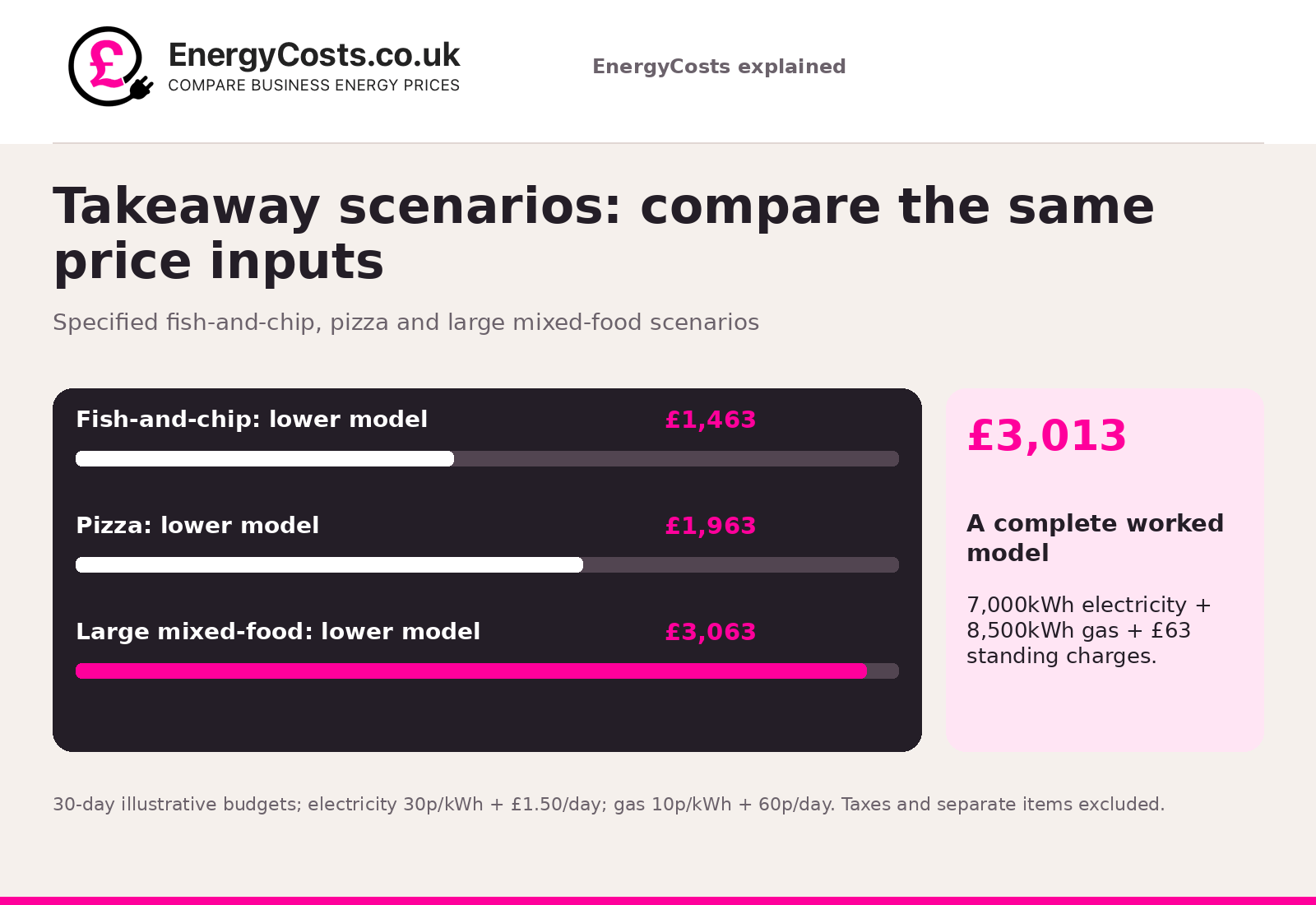
An electric oven’s energy use depends on power, warm-up and thermostat cycling. For illustration, a 12kW oven at a 50% average duty factor for 10 hours × 26 days uses 1,560kWh, costing £468 at 30p/kWh before tax. This is an equipment model, not a universal 3,000–5,000kWh oven rating.
Electricity-heavy vs gas-heavy takeaway kitchens
Whether a takeaway relies on electricity or gas makes a major difference to monthly cost.
Typical gas-heavy kitchen example
- 4,000 kWh electricity + 9,000 kWh gas
- Modelled 30-day cost: £2,163, including £63 combined standing charges and excluding VAT, CCL and separately billed items.
Typical electricity-heavy kitchen example
- 9,000 kWh electricity + 2,000 kWh gas
- Modelled 30-day cost: £2,963 on the same basis.
The second specified load costs £800 more in this model. Electricity is three times the gas price per purchased kWh, but appliance efficiency and ventilation mean this is not an equal-useful-heat comparison or proof that one fuel always costs three times more to cook with.
Refrigeration loads in takeaways
Refrigeration accounts for a significant baseline cost, even outside trading hours.
| Refrigeration scenario | Assumed electricity per month | Energy charge at 30p/kWh |
|---|---|---|
| Small bank scenario | 300–500kWh | £90–£150 |
| Multiple-unit scenario | 1,000–2,000kWh | £300–£600 |
| Walk-in scenario | 2,000–3,500kWh | £600–£1,050 |
| Extensive bank scenario | 3,000–5,000kWh | £900–£1,500 |
These are load sensitivities rather than guaranteed consumption for a given appliance count. Use product energy data and actual readings. Refrigeration already present in the site’s meter total is included in the whole-site kWh and must not be added a second time.
Daily energy usage profile
A typical takeaway uses energy in the following pattern:
- 09:00–11:00: Refrigeration stabilisation, hot-holding equipment warming, prep begins
- 11:00–14:00: Midday trade heating up, fryers and ovens running
- 17:00–22:30: Peak trading period, highest extraction and cooking demand
- Overnight: Freezers, chillers, CCTV and alarms continue operating. If measured use is 6–12kWh per night, 30 nights use 180–360kWh; this is an illustrative load range, not a national average.
That assumed overnight energy costs £54–£108 per 30 nights at 30p/kWh before tax. Keep essential refrigeration and safety systems running; target unnecessary loads identified from readings.
How to calculate your takeaway’s energy bill
- Find your monthly kWh usage on your bills or smart meter.
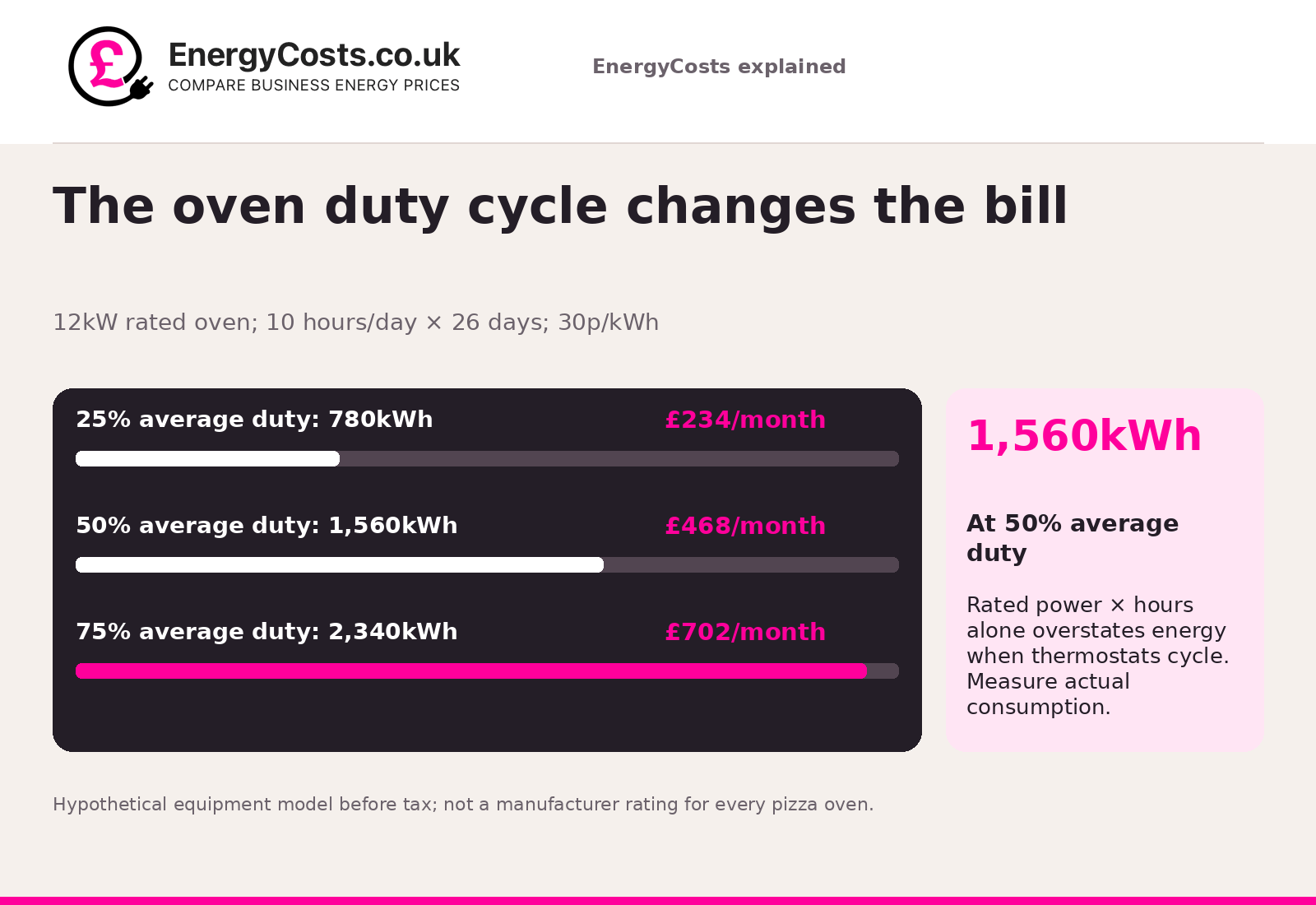
- Multiply usage by the unit rate: 7,000kWh electricity × 30p = £2,100.
- Add standing charges: (£1.50 + £0.60) × 30 days = £63 for both connected fuels.
- Add gas usage: 8,500kWh gas × 10p = £850.
- Apply the correct taxes: First calculate £3,013 in energy and standing charges, then add applicable CCL, VAT and other separate items; test each fuel’s eligibility independently.
The worked example totals £3,013 before VAT, CCL and separately billed items. It follows the stated 7,000kWh electricity / 8,500kWh gas inputs and does not establish a typical bill for every medium takeaway.
How to reduce energy costs in a takeaway business
- Service fryers and cookers regularly to maintain heat efficiency.
- Assess induction using useful cooking output, measured duty cycle, fuel rates and available electrical capacity; calculate the saving for the particular replacement.
- Clean and maintain extraction filters to the manufacturer’s and risk-assessment schedule; preserve required airflow, interlocks and gas safety.
- Use suitable manufacturer-approved blinds or lids where appropriate, while maintaining safe food temperatures and airflow; measure the result.
- Use appropriate efficient lighting; calculate savings from wattage and hours rather than a blanket 40–70% reduction.
- Reduce overnight electricity use by turning off non-essential kit.
- Compare tariffs using EnergyCosts.co.uk on the same usage, fixed charges, fees and contract scope. Savings depend on the current and offered prices.
For more, see: how to reduce business energy costs.
Summary
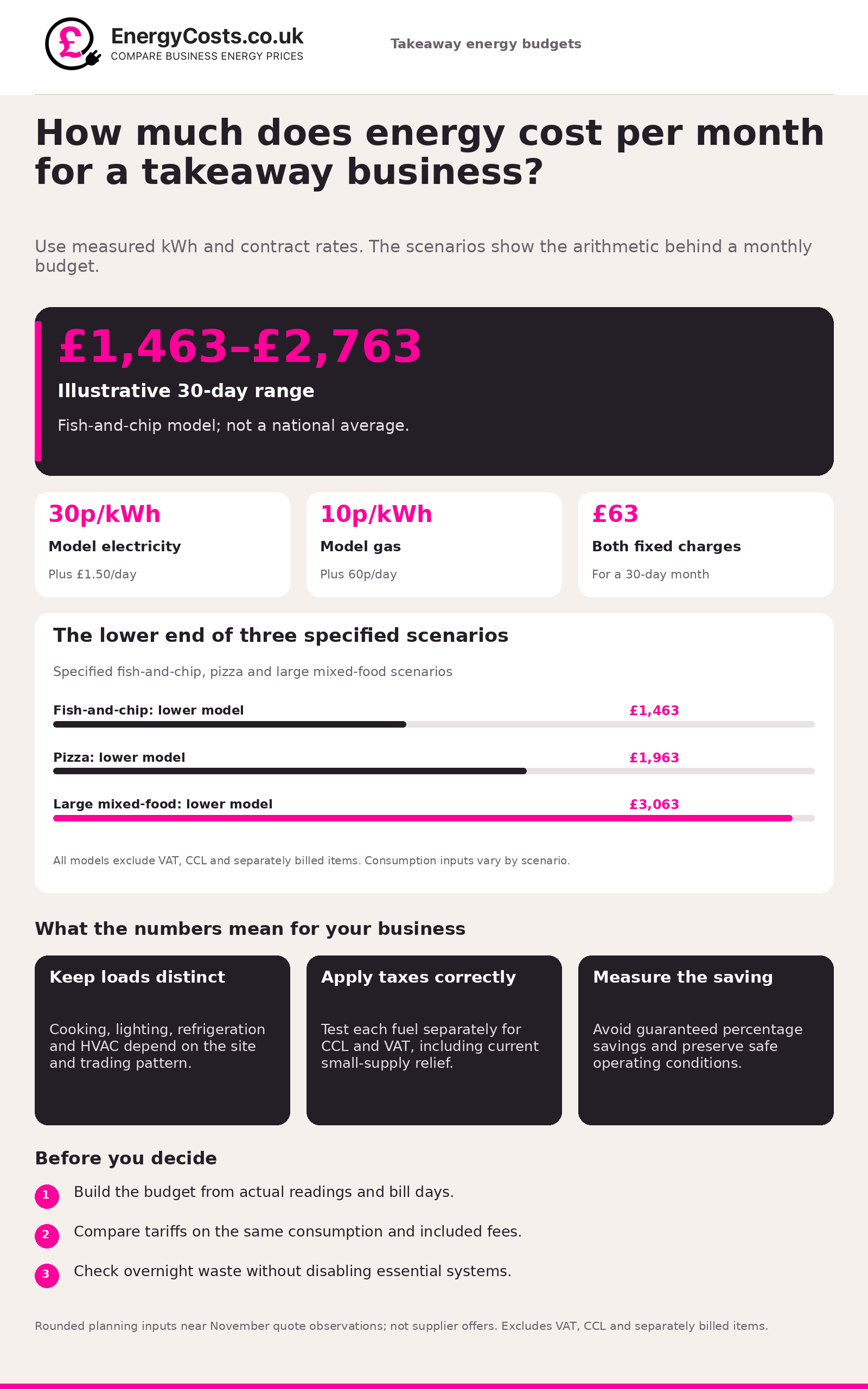
The scenarios show how takeaway bills vary with the stated electricity and gas loads: for example, £1,463–£2,763 for the fish-and-chip model and £1,963–£3,313 for the pizza model per 30-day month, before VAT, CCL and separately billed items. Use readings, supplier quotes and safe equipment schedules to build the actual budget.
FAQ: Takeaway business energy costs
No single national average fits every takeaway. The fish-and-chip model here costs £1,463–£2,763 over 30 days for the specified loads. It includes combined standing charges and excludes VAT, CCL and separately billed items. Actual quotes and usage can differ materially.
High-temperature cooking, extraction, refrigeration and long operating hours create substantial loads. The percentage split depends on the equipment and business. Measure those loads instead of assuming that cooking or ventilation always takes the same share of every takeaway’s energy.
Large sites and those with sustained electric cooking or extensive refrigeration can have high bills. The large mixed-food example uses 8,000–14,000kWh electricity and 6,000–12,000kWh gas, costing £3,063–£5,463 before VAT, CCL and separate items. It is a scenario rather than a cuisine ranking.
Use measured kWh or product energy data. At 30p/kWh, an assumed 2,000–3,500kWh monthly refrigeration load costs £600–£1,050 before tax and fixed charges. That load is already part of the site’s total meter reading and should not be added twice.
Additional cooking, extraction and lighting runtime increases consumption, while refrigeration may continue when closed. Estimate average extra kW multiplied by extra hours and trading days. There is no universal 20–35% uplift for every takeaway that opens longer.
The specified 9,000kWh electricity / 2,000kWh gas model costs £2,963, versus £2,163 for 4,000kWh electricity / 9,000kWh gas, before tax and separate items. These are different fuel loads, not equal useful cooking outputs. Equipment efficiency and operating practice matter.
The example assumes 6,000–10,000kWh electricity and 1,000–2,500kWh gas and costs £1,963–£3,313 including model standing charges, before taxes and separate items. It is a planning range, not measured average pizza-shop usage. Check oven power, cycling, preparation time and refrigeration.
Measure the actual closed-hour total. An assumed 6–12kWh per night becomes 180–360kWh over 30 nights and costs £54–£108 at the model electricity rate before tax. Keep essential refrigeration, fire and security systems operating safely.
Maintain refrigeration seals and coils, schedule avoidable idle loads and set controls correctly. Preserve safe storage temperatures, extraction airflow and gas interlocks. Measure before and after the change; use the measured reduction to calculate the saving.
A lower comparable tariff can reduce bills, particularly if the current arrangement is expensive. Actual savings depend on the existing and offered contract. Compare the same consumption, standing charges, commission and pass-through scope and check when the existing contract allows a switch.