
Managing energy effectively is an increasingly strategic priority for large UK businesses. Rising wholesale costs, market volatility, new sustainability targets and complex contract structures mean that energy procurement is no longer just a finance or facilities activity – it is now a critical part of risk management, budgeting, sustainability planning and long-term operational resilience.
Our guide explains how large UK organisations can take control of their energy procurement, reduce exposure to price spikes, negotiate better contracts, and align energy usage with corporate sustainability goals.
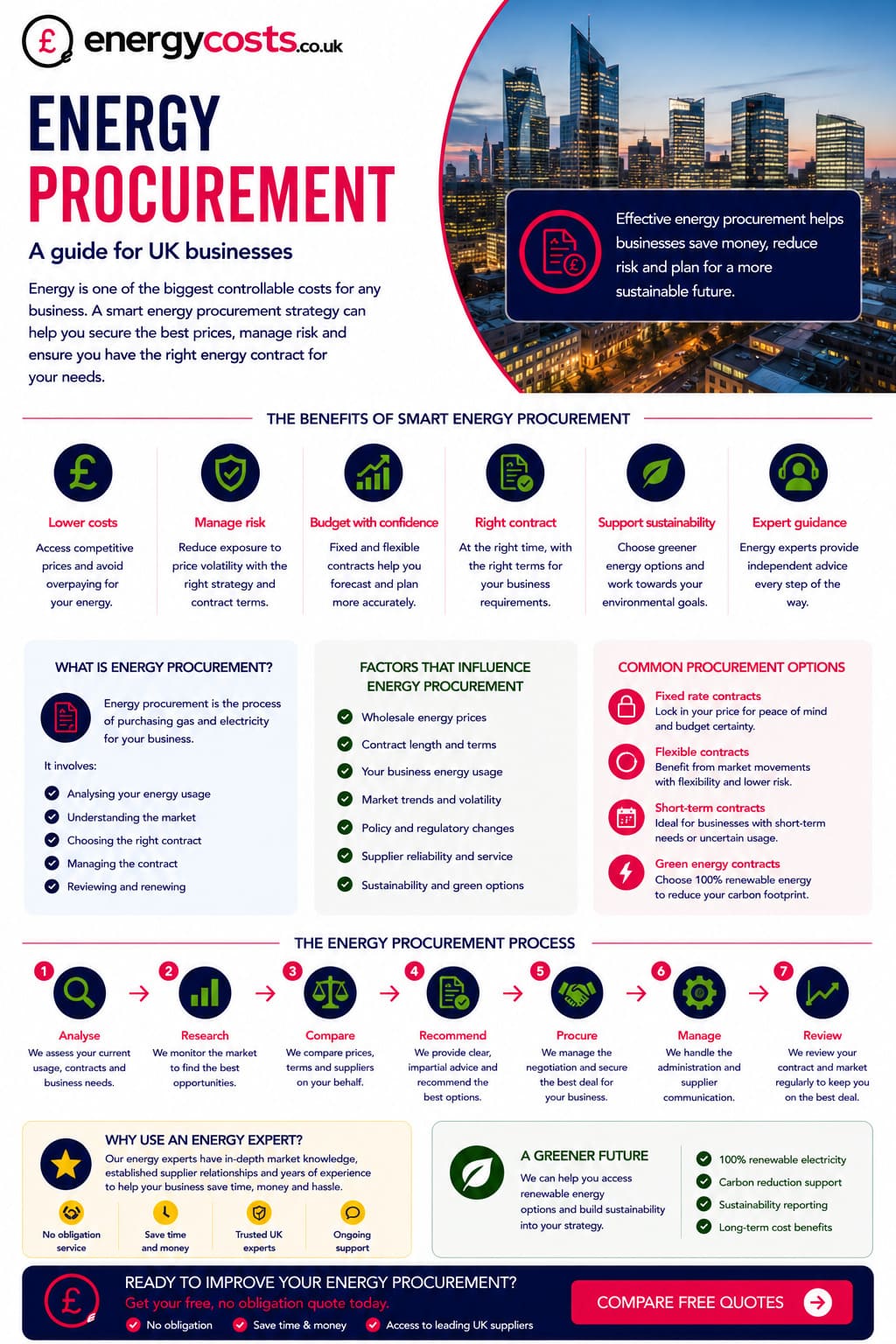
What is energy procurement?
Energy procurement refers to the process of sourcing and purchasing electricity and gas for a business. For large UK organisations, this usually involves choosing between flexible and fixed contracts, monitoring wholesale markets, managing risk across multiple sites, and leveraging consumption data to negotiate favourable terms.
Well-managed procurement saves money, improves budget predictability, enhances sustainability performance, and reduces exposure to market shocks.
Key energy procurement challenges for large UK businesses
Large energy users face a range of procurement challenges, including:
- Wholesale market volatility – energy prices can move rapidly due to geopolitical pressure, supply disruption or seasonal demand.
- Contract complexity – flexible, pass-through and bespoke agreements require close monitoring of risk and pricing structures.
- Multi-site management – coordinating procurement across multiple offices, warehouses or manufacturing plants can be difficult.
- Budget uncertainty – volatile pricing and variable consumption create financial forecasting challenges.
- Sustainability and compliance – organisations must consider carbon reporting, renewable energy targets, and future regulatory changes.
Procurement strategies for large energy users
Large organisations typically use one of three strategies:
Fixed-price procurement
A fixed contract locks in energy rates for up to five years, giving excellent budget predictability. Suitable for organisations with limited tolerance for risk, but may miss potential savings if market prices fall.
Best for: businesses with strict budgeting needs, such as schools, hospitals, councils or service firms.
Flexible purchasing (flex contracts)
Energy is bought in blocks on the wholesale market throughout the contract term. Prices are not fully fixed, but risk is actively managed. Requires active monitoring or a specialist procurement partner.
Best for: energy-intensive industries such as manufacturing, logistics, and large retailers who can take advantage of market dips.
Basket procurement
Multiple organisations join a shared purchase, using combined buying power to secure improved rates. Popular among public sector groups, education networks and smaller corporate groups.
Best for: businesses wanting better pricing without individual volume strength.
What does a flexible contract involve?
A flexible or risk-managed contract allows businesses to purchase energy in multiple tranches rather than locking in a single price. It requires forecasting, risk tolerance assessment and market timing. Large businesses often work with specialist brokers or consultants to execute purchasing strategies.
Key components include:
- Defined risk strategy (low, moderate or speculative)
- Multiple purchase windows timed to market shifts
- Regular reporting on price trends and financial exposure
- Option for renewable energy or non-commodity cost management
Key contract terms to understand
| Term | Meaning |
|---|---|
| Pass-through | Some costs (network charges, green levies) are billed separately, outside your unit rate |
| Non-commodity charges | Costs not relating to energy itself such as transmission charges, balancing fees and levies |
| Volume tolerance | Contract allowance for variation in usage without penalty |
| Market index | Your contract may be linked to wholesale market prices, changing day-to-day |
| Risk premium | Additional cost added by the supplier to cover uncertain wholesale price movements |
Non-commodity costs – the hidden 60%
For large businesses, non-commodity charges (network fees, renewables obligations, balancing services and capacity market costs) can make up over half of your total electricity bill. These charges are non-negotiable, but they can be better managed through:
- Smart procurement (choosing pass-through or fixed non-commodity options)
- Load shifting and efficiency measures
- Demand Side Response and Battery Storage
- Better forecasting and budget allocation
Working with energy procurement consultants
Many large UK businesses partner with energy consultants or brokers to manage flexible purchasing. These consultants:
- Track wholesale energy price movements daily
- Track forward curves and recommend ideal purchase times
- Advise on risk strategy and hedging
- Negotiate contract terms and volume allowances
- Manage reporting, compliance and sustainability credentials
A good consultant should provide clear reporting and transparency on fees, ideally on a fully disclosed basis.
Sustainability and renewable procurement
Large organisations increasingly include renewable energy in their procurement strategy. Options include:
- Green tariffs – electricity backed by REGOs (Renewable Energy Guarantees of Origin)
- Corporate Power Purchase Agreements (PPAs) – long-term agreements with renewable generators
- Renewable Certificates – evidence of renewable energy usage
- Carbon offset inclusion – helps support net zero strategies
For organisations aiming for ISO 50001 certification or ESG reporting, renewable procurement forms a critical part of corporate sustainability.
Steps to build an effective energy procurement strategy
- Assess current consumption and costs: Analyse consumption patterns, peak usage, and current contract performance.
- Define budget risk tolerance: Decide whether stability or potential savings matter more.
- Choose contract type: Fixed, flexible or basket – each carries different risk levels.
- Engage suppliers or consultants: Negotiate using usage data, credit rating and ESG capabilities.
- Monitor performance continuously: Track prices, non-commodity charges, and sustainability progress.
Energy procurement is now a strategic business function rather than just a utility cost. Large UK organisations can significantly reduce risk, improve financial control and meet sustainability goals by adopting structured procurement strategies, monitoring the market, and making informed contract decisions.
FAQ
There is no one-size-fits-all answer. Businesses with strict budget needs may prefer fixed contracts, while energy-intensive or risk-tolerant organisations often benefit from flexible purchasing models. Hybrid approaches are becoming increasingly common.
Flexible contracts allow energy to be purchased in multiple blocks over time, based on market conditions. This spreads risk and enables businesses to benefit from favourable price movements.
These are charges separate from the raw energy cost, including network charges, policy levies, balancing costs and environmental obligations. They make up around 50–60% of an electricity bill for large users.
A corporate Power Purchase Agreement is a direct contract with a renewable energy generator, typically spanning 10–15 years, offering price stability and carbon footprint reduction.
Consultants offer market tracking, price risk management, performance reporting, and contract negotiation. They are particularly useful for businesses using flexible purchasing strategies.
In a pass-through contract, some non-commodity costs are billed separately at actual cost rather than included in the unit price, providing greater transparency but less budget certainty.
Yes – choosing renewable energy tariffs, buying REGOs, using corporate PPAs and including carbon offset agreements all support net zero business commitments.
Basket procurement is when multiple organisations pool their demand to negotiate stronger pricing and purchasing terms with suppliers.