
When running a business, every cost counts. One expense that is often overlooked is the VAT applied to commercial gas and electricity bills. Understanding how VAT works, when reduced rates apply, and whether your business is eligible for exemptions or rebates can help lower your energy costs. Here’s a clear guide to help your UK business navigate VAT on commercial energy bills.
What is VAT on business energy?
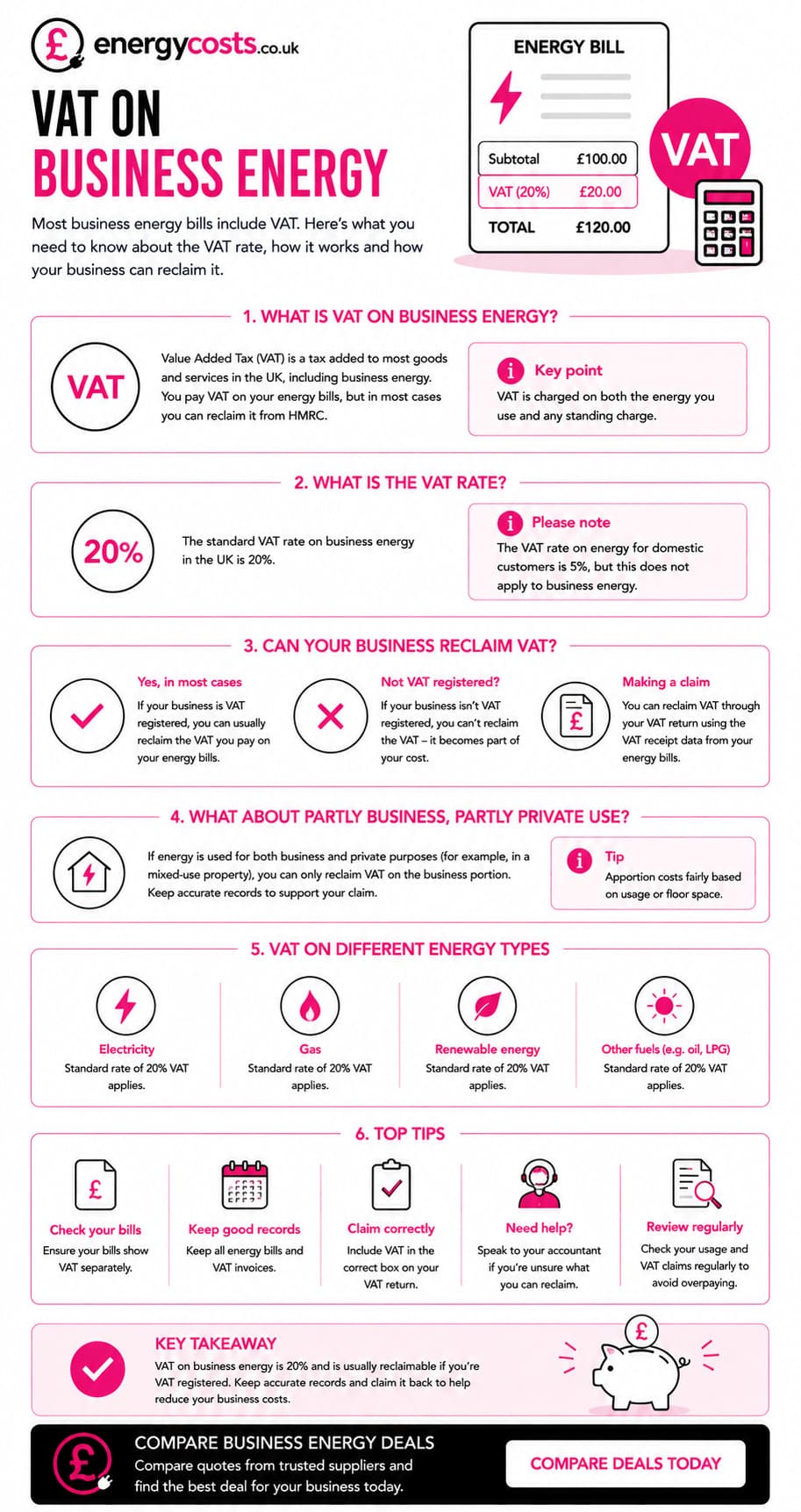
Value Added Tax (VAT) is a government tax applied to most goods and services, including commercial energy.
For the majority of UK businesses, VAT on energy is standard rated at 20%. However, certain businesses and usage types may qualify for a reduced rate of 5%.
VAT is calculated on both the energy usage and any standing charges, and is applied after Climate Change Levy (CCL) has been added.
VAT rates for business energy
| Business type or usage | VAT rate | CCL charged? |
|---|---|---|
| Standard commercial usage (offices, shops, manufacturers) | 20% | Yes |
| Low energy usage (de minimis) | 5% | No |
| Charities and not-for-profit organisations (qualifying usage) | 5% | Sometimes exempt |
| Domestic or mixed-use properties | 5% | No |
| Community centres, care homes, schools, places of worship | 5% | Sometimes exempt |
| Business using energy wholly for domestic purposes, e.g. student accommodation | 5% | No |
What is de minimis usage?
Businesses that use a small amount of energy each month may qualify for the reduced VAT rate of 5% under de minimis rules.
These limits are:
- Gas: less than 4,397 kWh per month (or 52,764 kWh annually)
- Electricity: less than 1,000 kWh per month (or 12,000 kWh annually)
If your usage falls below these thresholds, your bills should automatically be charged at 5% VAT without CCL. However, suppliers do not always apply this correctly, so it is important to check.
Mixed-use premises
Some properties have both business and domestic use, such as pubs with living accommodation, care homes, farmhouses and religious buildings. If more than 60% of the energy is used for domestic or charitable purposes, VAT on the entire bill can be reduced to 5% and CCL may be removed.
Your business energy supplier will normally require a declaration form to apply reduced VAT for mixed use.
Charities and non-profit organisations
While charities are not automatically VAT-exempt, they may qualify for reduced VAT if energy is used for non-business or charitable purposes such as residential care, education, or religious activities.
Examples include:
- Care homes
- Village halls
- Churches and faith centres
- Schools and nurseries (not run as commercial businesses)
- Hospices
VAT can be reduced to 5% and CCL may be exempt if your organisation qualifies.
Can businesses claim VAT back?
VAT-registered businesses can usually reclaim VAT on commercial energy bills as input tax in their VAT return, provided the energy was used for business purposes. The full 20% VAT can be reclaimed, but Climate Change Levy (CCL) cannot be reclaimed, as it is not VAT.
Businesses on flat rate VAT schemes cannot fully reclaim VAT on energy. Instead, VAT is treated as part of their flat rate turnover.
What to do if you’ve been overcharged
If your business has been wrongly charged 20% VAT instead of 5%, or CCL has been applied incorrectly, you may be able to claim a rebate. To do this:
- Complete a VAT declaration form confirming eligible usage.
- Send it to your supplier with supporting evidence.
- Request corrected billing or a VAT rebate for past invoices (up to four years allowed).
Climate Change Levy and VAT
Climate Change Levy is an environmental tax added to most non-domestic energy bills. VAT is then calculated on the total of energy plus CCL, meaning VAT is charged on the levy as well.
Businesses with reduced VAT (5%) are usually exempt from CCL.
How to check if your business is getting the correct VAT rate
Look for these key details on your energy bill:
- VAT rate (typically shown next to energy charge breakdown)
- Whether CCL has been applied
- Usage levels against de minimis thresholds
- Business type or exemption status
If you believe your business qualifies for the reduced rate, request a VAT declaration form from your supplier.
VAT may seem like a fixed cost, but many businesses are unknowingly paying more than they should. Whether your business qualifies for reduced VAT because of low usage, mixed use, or charitable activity, it pays to understand the rules. Taking a few minutes to check your bills could result in meaningful savings.
FAQ
Most UK businesses pay the standard VAT rate of 20% on commercial gas and electricity. This applies to the majority of offices, factories, shops and industrial premises.
Yes. Charities, non-profit organisations, mixed-use premises and businesses with low energy usage below the de minimis threshold may qualify for a reduced VAT rate of 5%.
The de minimis limits are less than 1,000 kWh of electricity per month or less than 4,397 kWh of gas per month. Staying below these thresholds may qualify your business for 5% VAT and exemption from Climate Change Levy.
If your business uses low volumes of energy, is a charity, operates mixed-use premises or uses energy for residential or non-business purposes, you may qualify. You may need to complete a VAT declaration form from your supplier.
Yes. Care homes, schools, hospices and other residential or educational establishments are often charged 5% VAT and may be exempt from Climate Change Levy if energy is used for non-commercial purposes.
VAT is a general consumption tax charged at 5% or 20%, while Climate Change Levy is an environmental tax added to most commercial energy bills to encourage efficiency. VAT is then calculated on the total including CCL.
If your business is VAT registered, you can usually reclaim VAT on energy as input tax on your VAT return. However, you cannot reclaim Climate Change Levy, as it is not VAT.
Businesses on the flat rate VAT scheme cannot fully reclaim VAT on their energy bills. VAT is treated as part of their flat rate calculation.
Contact your energy supplier and request a VAT declaration form. You will need to confirm your business type, usage and eligibility. Once approved, reduced VAT should apply to future bills, and you may claim refunds for previous overpayments.
Yes. If your business should have been charged 5% VAT but was incorrectly charged 20%, you can request a refund from your supplier. You can usually claim back up to four years of overpayments.
Yes. VAT applies to both energy usage charges and standing charges, and is calculated after Climate Change Levy has been added, where applicable.
Businesses operating from domestic-type premises, such as care homes, student accommodation, religious buildings or mixed-use properties with a residential element, may qualify for 5% VAT if more than 60% of usage is domestic or qualifying use.
If energy is supplied to tenants for domestic purposes, such as in residential flats or student housing, landlords may charge 5% VAT on the energy. Mixed-use residential and commercial properties may require a usage breakdown.
VAT is applied to the total energy cost, which includes both the energy usage and the Climate Change Levy. This is because VAT is charged on almost all goods and services, including other taxes.
You can review your bills, check your usage levels, request a VAT declaration form from your supplier, or use EnergyCosts.co.uk to compare business energy tariffs, understand exemptions and explore ways to reduce both VAT and overall energy spend.