

Installing a business electricity meter is a key step in managing energy consumption, ensuring accurate billing, and complying with UK regulations. Whether you are moving into a new commercial premises, upgrading your supply for higher usage, or switching suppliers, understanding the process helps avoid costly delays and ensures your business gets the right meter for its needs.
Our guide explains the types of business electricity meters, when you need a new installation, how the process works, associated costs, and how to prepare your site for installation.
What is a business electricity meter?
A business electricity meter records the amount of electricity used at your premises. It enables your supplier to calculate your bills accurately, helps you monitor usage, and supports compliance with industry and safety standards. Business meters differ from domestic meters as they are designed to handle larger loads, different tariffs, and specific business requirements such as multi-rate billing or half-hourly metering.
Reasons you may need a new meter installation
You may require a business electricity meter installation if:
- You are moving into a new or previously unused commercial property.
- Your premises has been refurbished or upgraded, requiring more load capacity.
- You are switching from a domestic to commercial tariff.
- You want to install a smart or half-hourly meter.
- Your current meter is outdated, faulty, or non-compliant.
- You are switching commercial energy suppliers and your new provider requires a different meter type.
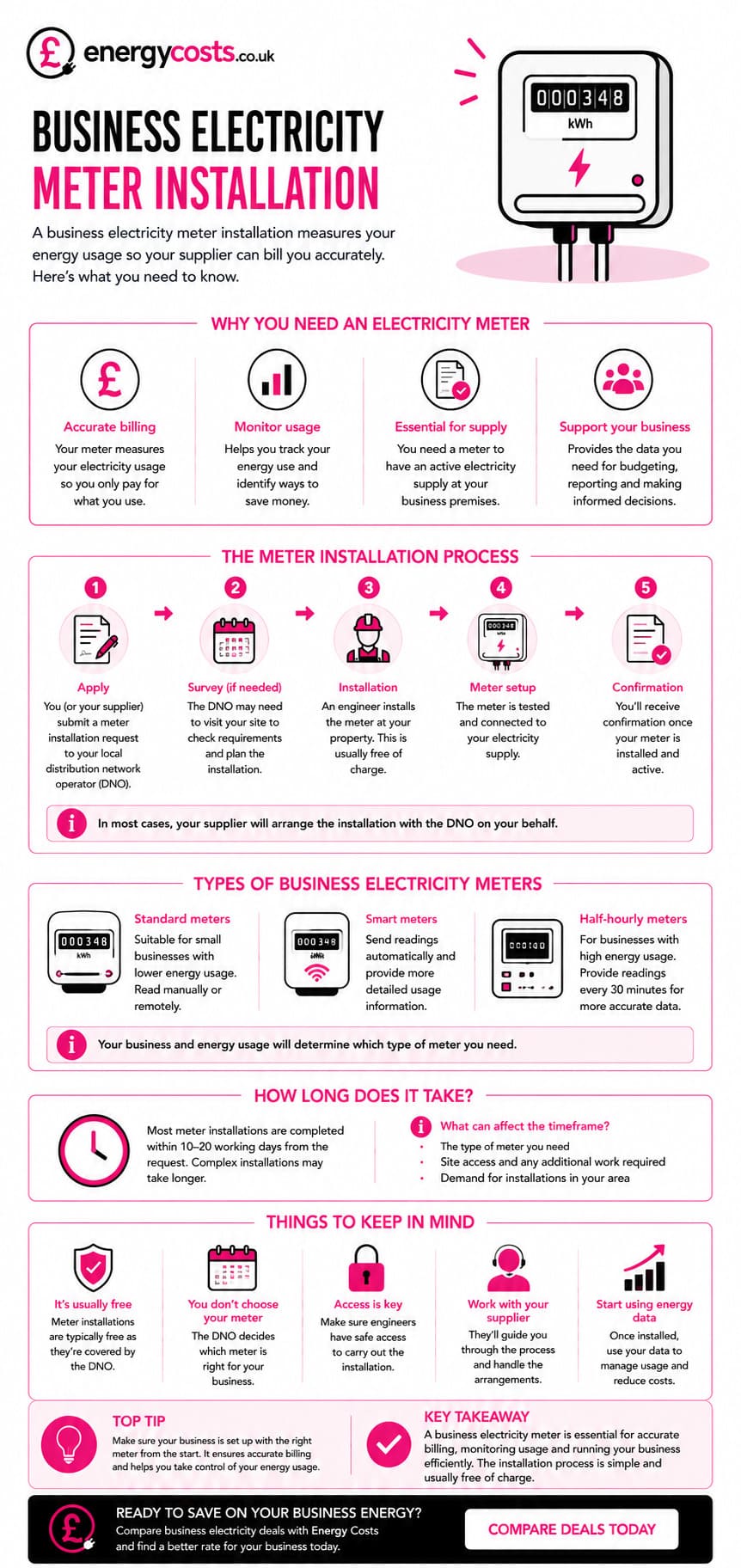
Types of business electricity meters
Choosing the right meter depends on your business size, usage patterns, and tariff type.
| Meter type | Best for | Key features |
|---|---|---|
| Standard single-rate meter | Small offices, shops | Records total electricity usage at one rate |
| Economy 7 or multi-rate meter | Businesses using more energy at night (e.g. bakeries, manufacturing) | Separate day and night tariffs |
| Smart meter | Small and medium businesses | Sends automatic readings; suitable for accurate, monthly billing |
| AMR (Automatic Meter Reading) meter | Medium to large businesses | Remote reading; supports flexible tariffs and consumption tracking |
| Half-hourly meter (HH) | High-usage businesses over 100,000 kWh/year | Records usage every 30 minutes; mandatory for very high users |
Who is responsible for installing business meters?
Three parties are typically involved:
| Role | Responsibility |
|---|---|
| Distribution Network Operator (DNO) | Installs and maintains the power supply cables, fuses, and connection point |
| Meter Operator (MOP) | Supplies and installs the electricity meter itself |
| Energy supplier | Arranges contracts, billing, and sometimes books the meter installation on your behalf |
For high-usage businesses, you may need to appoint your own Meter Operator and Data Collector separately.
How to arrange a business electricity meter installation
How to get a business electricity meter installed
- Choose your electricity supplier and tariff
Before installation, you must agree a business energy contract. The supplier will then request your meter installation based on your tariff and load requirements.
- Arrange supply connection (if needed)
If your property does not yet have an electricity supply, contact your local DNO to install the service cable, service head, and main fuse.
- Site preparation
Ensure your meter location is accessible, safe, dry, and compliant with electrical installation standards (usually near the supply entry point).
- Meter installation appointment
Your Meter Operator or supplier will send an engineer to install and commission the meter. Installation can take from one to four hours, depending on complexity.
- Testing and certification
The engineer will test the meter, activate it for billing, and confirm compliance. You will receive a Meter Point Administration Number (MPAN) if assigned.
Typical costs of business meter installation
Installation costs vary depending on your business size, meter type, and whether a new supply connection is required.
| Installation type | Typical cost range |
|---|---|
| Standard smart meter upgrade | £0 – £150 (often free) |
| Replacement single or multi-rate meter | £150 – £400 |
| New AMR meter | £200 – £500 |
| Half-hourly meter (MOP and data services) | £200 – £600 setup plus £100 – £300 per year |
| New supply connection by DNO | £1,500 – £5,000+ depending on capacity and distance |
Many suppliers offer smart meter installations free of charge under UK smart meter rollout programmes.
How long does installation take?
| Task | Typical time |
|---|---|
| Initial DNO supply connection | 2–12 weeks |
| Meter booking lead time | 1–3 weeks |
| Installation appointment | 1–4 hours |
| Switching supplier with smart meter | 2–5 working days |
Plan ahead, especially for new developments, as delays in installation can impact your move-in date.
Compliance and safety standards
Business electricity meters must comply with:
- Electricity at Work Regulations 1989
- Metering Codes of Practice
- UK Smart Meter Installation Code of Practice
- BS 7671 wiring regulations
Only accredited engineers are permitted to install business meters.
Tips for a smooth installation
- Confirm your agreed supply capacity (kVA) before installation.
- Provide photos and site details to your supplier or Meter Operator.
- Make sure someone with authority is present on installation day.
- Allow space for future upgrades and maintenance access.
- Keep your MPAN and meter serial number on file for billing and support.
Next steps after installation
Once your meter is live, you can:
- Monitor usage through smart reports or supplier dashboards.
- Switch to a better tariff if your usage pattern changes.
- Consider renewable or flexible energy procurement.
- Track consumption for energy efficiency and ESOS compliance.
Installing the right business electricity meter gives your company accurate billing, valuable consumption insights, and access to competitive tariffs. Understanding the process helps you plan effectively, avoid unnecessary expenses, and ensure compliance with UK regulations.
FAQ
A business electricity meter is designed to handle higher loads and more complex tariffs, such as multi-rate and half-hourly billing. It supports detailed usage monitoring and complies with strict commercial standards, whereas domestic meters are intended for lower residential consumption and simpler tariff structures.
You will need a new meter if you are moving into a new commercial premises, upgrading your supply, switching from a domestic to business tariff, installing a half-hourly or smart meter, or your existing equipment is faulty or non-compliant with industry standards.
Installation lead times vary. Booking an installation usually takes one to three weeks, and the actual fitting takes one to four hours. If a new power supply connection is required from the Distribution Network Operator, it can take between two and twelve weeks.
Your energy supplier often arranges the installation, but high-usage businesses may need to appoint a Meter Operator and Data Collector. If your site does not yet have a supply, you must first contact your local Distribution Network Operator to install the connection.
A basic smart meter upgrade is often free or up to £150. Standard multi-rate or AMR meters typically cost between £200 and £500. Half-hourly meters can cost £200 to £600 to install, plus ongoing annual charges of £100 to £300 for data services. New supply installations can exceed £1,500.
In many cases, yes. You can choose between standard, smart, AMR, or half-hourly meters based on your usage, tariff, and business needs. However, half-hourly meters are mandatory for businesses using more than 100,000 kWh per year.
Smart meters are not legally required for all businesses, but suppliers are rolling them out nationwide. Most small and medium businesses are eligible, and installation is often free. Larger businesses may need AMR or half-hourly meters instead.
An MPAN (Meter Point Administration Number) is a unique reference number for your electricity supply point. It identifies your premises on the electricity network and is used when switching suppliers, arranging installations, or dealing with billing.
Installation usually causes minimal disruption, but in most cases the power supply needs to be temporarily shut down for safety. For small meters, downtime may last thirty to sixty minutes. For larger or more complex installations, it can take longer.
Yes, once the meter is registered on the national database and fully commissioned, you can switch suppliers. This usually takes two to five working days, or longer for half-hourly meters due to data setup requirements.