
When managing business energy, especially when switching suppliers or using a broker, paperwork is often required. One of the most important documents in this process is a letter of authority (LOA). It allows a third party to act on your behalf, helping you access better tariffs, handle contracts, or resolve billing issues. But what exactly is an LOA, how does it work, and why is it important for your business?
What is a letter of authority?
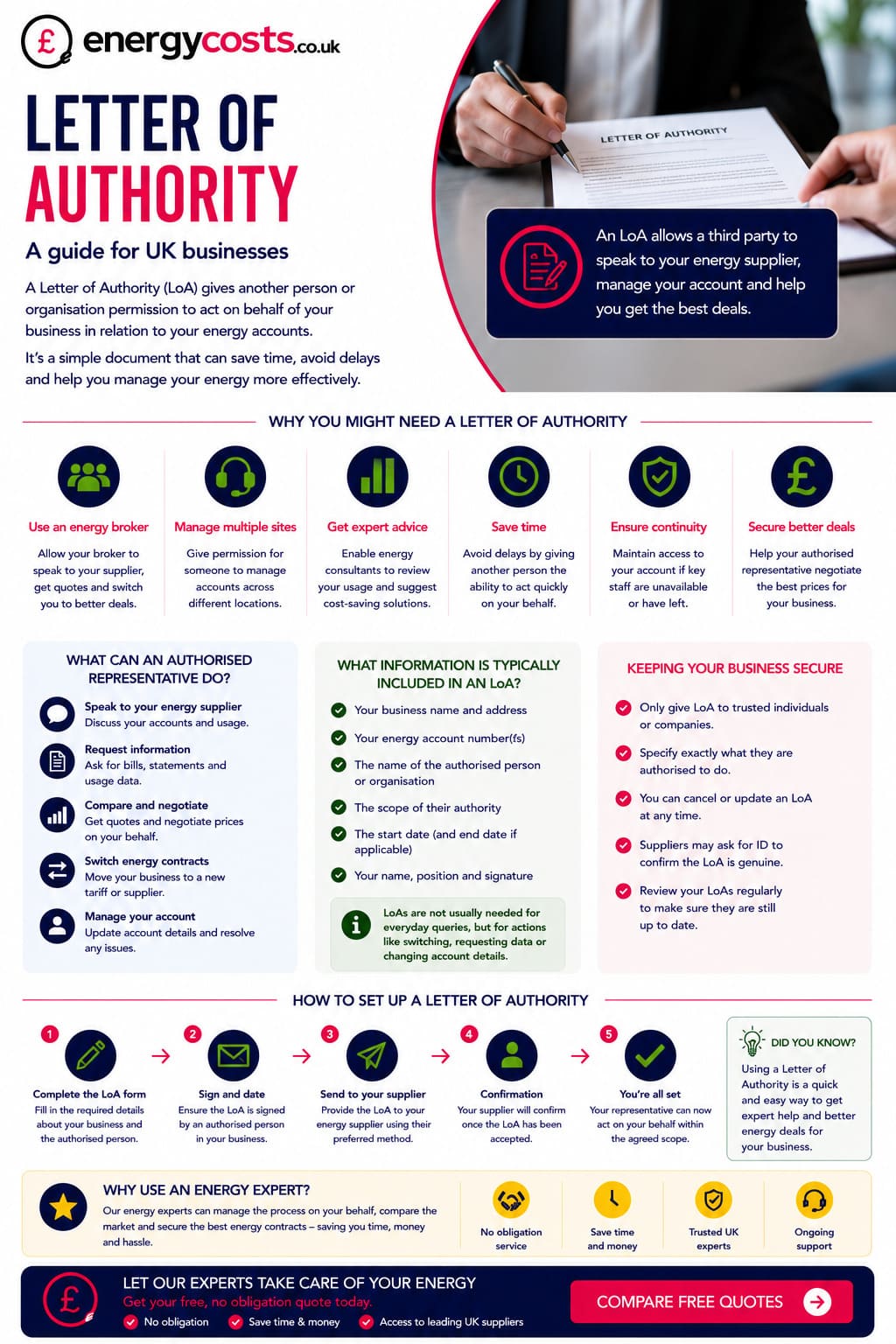
A letter of authority is a legal document that gives permission for a third party, such as an energy broker, consultant, or switching service, to communicate with business energy suppliers on your behalf. It does not transfer legal ownership of your account, nor does it commit you to any financial agreement. Instead, it simply allows authorised parties to access information, negotiate deals, and manage energy-related tasks for your business.
LOAs are commonly used in business energy switching, renewal negotiations, tariff comparisons, and when querying consumption or billing details.
What an LOA allows a third party to do
What an authorised broker or consultant can do depends on the wording of the LOA. A standard business energy LOA usually allows the third party to:
- Request consumption data and contract end dates
- Obtain meter information such as MPAN or MPRN
- Speak to suppliers about pricing and tariffs
- Negotiate contract terms (but not sign them)
- Resolve billing or account queries
Advanced or more detailed LOAs may also allow the signing of contracts, but these are less common and would need explicit permission.
What an LOA does not allow
An LOA does not:
- Commit your business to a supplier or contract
- Give financial or legal control over your account
- Authorise payments or direct debits
- Allow ownership transfer of your meter or supply
You, as the business owner, remain fully responsible for final decisions, contract approvals, and financial commitments.
Why LOAs are important in business energy
Business energy contracts can be complex, with procurement, renewals, and negotiations taking time and expertise. Using a broker or consultant is often helpful, especially for multi-site, high-consumption, or corporate organisations. An LOA gives them the authority they need to gather accurate information and present tailored tariff quotes.
Without an LOA, suppliers will not release confidential data such as usage history, renewal windows, or pricing options. This makes it much harder to compare tariffs or secure better rates.
Types of letter of authority (LOA) in business energy
Not all LOAs are the same. The wording (and the scope you approve) determines what a broker, consultant, or switching service can do on your behalf. In business energy, LOAs typically fall into a few common “types” (or levels), even if the document itself doesn’t use these exact labels.
1. Data-only LOA (sometimes called a “soft” or “level 1” LOA)
This is the most common and lowest-risk option. It allows a third party to request information from your current supplier(s) so they can analyse your situation and obtain accurate quotes.
What it usually covers:
- Consumption history (kWh) and sometimes half-hourly data
- Contract end date and renewal window
- Meter and supply details (MPAN/MPRN and related identifiers)
- Basic billing/account queries needed to validate quotes
Best for: businesses that want market pricing and comparisons, without granting any power to make binding decisions.
2. Quote and negotiation LOA (still non-signing)
This type builds on a data-only LOA by allowing the third party to speak to suppliers about pricing and terms and negotiate a deal for you to review.
What it usually covers:
- Requesting live prices from multiple suppliers
- Negotiating unit rates, standing charges, contract length, and start dates
- Liaising with suppliers to resolve “switching blockers” (for example, account queries)
Important: even with negotiation authority, you still approve and sign the contract separately in most cases.
Best for: businesses that want someone to do the legwork and bring back options, while keeping final control.
3. Contract-signing LOA (sometimes called a “full” or “level 2” LOA)
This is less common and should be treated with extra care. It can allow the third party to enter into contracts on your behalf if (and only if) the LOA explicitly states this authority.
What it may cover:
- Agreeing a supply contract without your separate signature
- Handling renewals/contract changes under the agreed scope
Best for: larger organisations with formal procurement processes and strict internal controls (and only where you’re confident in the third party and the document’s limits).
4. Multi-site or portfolio LOA
This isn’t a different “permission level” so much as a format designed for businesses with multiple sites, meters, or entities. It can be data-only, negotiation, or (rarely) contract-signing — but it should clearly list what’s covered.
What it should include:
- All sites/addresses and meter identifiers (MPAN/MPRN) in scope
- Whether it applies to gas, electricity, or both
- Any limits by site (for example, “site A data-only; site B negotiation”)
Best for: multi-site SMEs, property portfolios, franchises, and groups that want consistent procurement across locations.
Quick tip: match the LOA to your goal
- If you only want pricing visibility: choose data-only / level 1.
- If you want someone to negotiate but you’ll sign: choose negotiation (non-signing).
- Only consider contract-signing / level 2 if you genuinely need it — and the LOA is very specific about limits, duration, and exactly what can be agreed.
How long does an LOA last?
Most business energy LOAs remain valid for 12 months unless otherwise specified. Some suppliers accept up to 24 months, while a few prefer shorter three- or six-month validity. The expiry date should be clearly stated in the document to avoid confusion.
Many brokers request renewal of the LOA before it expires, particularly if they are managing ongoing procurement or contract monitoring.
Who can sign a letter of authority?
The LOA must be signed by someone with legal authority to represent the business. This is usually:
- A director of a limited company
- A partner in a partnership
- The business owner (sole trader)
- An authorised signatory with delegated authority
Suppliers will often verify the signatory’s role to protect against unauthorised access.
What should a business energy LOA include?
A compliant LOA for business energy should cover:
- Business name and registered address
- Company registration number (if applicable)
- Letterhead or logo (recommended but not essential)
- Named third party (broker, consultant, or comparison service)
- Scope of authority (what they can do)
- Start date and expiry date
- Signature of the business representative
Using vague or incomplete LOAs can lead to delays or rejection by suppliers.
Are LOAs safe to use?
Yes. LOAs are widely used across the energy industry and regulated under data protection laws with strict GDPR requirements. As long as you only sign LOAs with trusted and reputable brokers or consultants, the process is secure.
LOAs are designed to provide access to information, not sign contracts or control finances, unless explicitly authorised.
When does your business need an LOA?
You usually need a letter of authority when:
- Comparing business energy tariffs using a broker
- Letting a consultant handle renewal quotes
- Resolving billing disputes with suppliers
- Requesting historical consumption data
- Managing multi-site or group energy portfolios
Benefits of using an LOA
Using an LOA offers several advantages:
- Saves time by letting experts manage communications
- Helps secure more competitive procurement and renewal rates
- Provides access to market data not publicly available
- Reduces admin burden for business owners
- Ensures contract compliance and accurate billing
Final thoughts
A letter of authority is a simple yet vital document for any business looking to manage energy costs efficiently. It helps trusted third parties gather essential information, negotiate with suppliers, and streamline contracts, all without transferring financial or legal control.
If you’re planning to switch business energy suppliers or want better procurement outcomes, an LOA is usually the first step towards saving time and money.
FAQ
A letter of authority is a document that allows a third party, such as an energy broker or consultant, to speak to suppliers on your behalf and request information about your energy contracts, usage, and pricing options.
Not usually. Standard LOAs only allow a broker to gather information and negotiate quotes. They do not permit contract signing unless you explicitly authorise this in writing.
Most business energy LOAs are valid for 12 months, although some suppliers may accept shorter or longer durations. The expiry date is normally stated in the document.
It must be signed by an authorised representative of the business, such as a director, business owner, partner, or someone with delegated authority.
Yes, it is legally recognised, but it does not commit your business to any contract. It only permits information access and communication, not financial agreements.
They can access meter data, MPAN/MPRN numbers, consumption history, contract end dates, renewal windows, and billing queries, depending on the scope defined in the LOA.
If you are using a broker or switching service, you will usually need an LOA so they can communicate with suppliers and secure quotes on your behalf.
Yes, as long as it is with a trusted and reputable broker. LOAs are regulated under UK data protection laws, including GDPR, and do not give financial control.
Yes. You can withdraw or cancel an LOA at any time by notifying the broker or supplier in writing. Once revoked, the third party will no longer have access.
No. An LOA does not change your existing contract or supplier. It only allows authorised parties to request information or help prepare for renewal.