
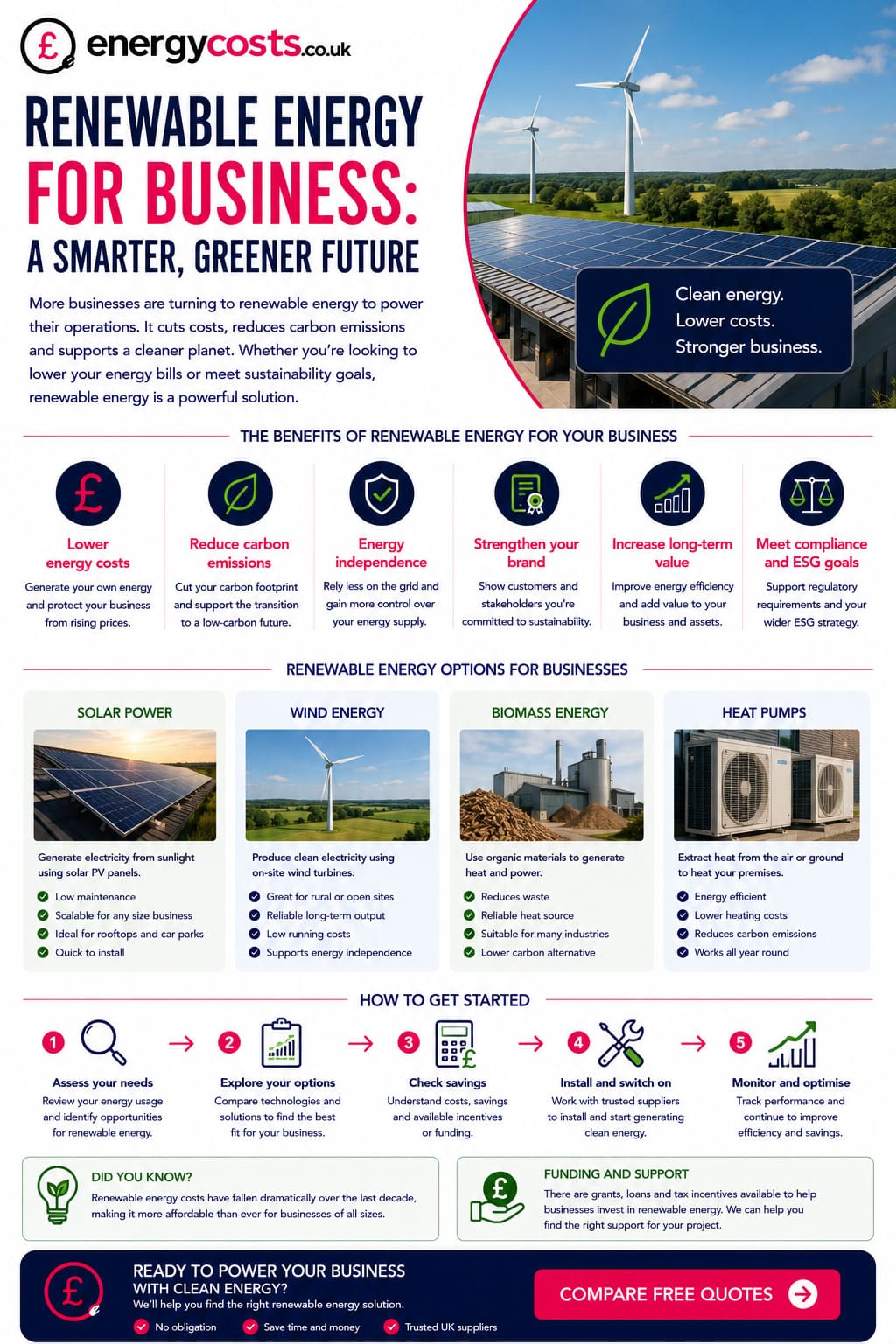
Renewable energy is no longer just a sustainability trend; it has become a core part of commercial energy strategy for thousands of UK businesses.
With rising electricity and gas prices, pressure to meet ESG targets, and growing customer demand for greener operations, renewable energy presents both cost-saving and reputational benefits.
Our guide explains the main types of commercial renewable energy, how your business can implement them, costs, funding incentives, and the financial and environmental impact for organisations of all sizes.
What counts as renewable energy for businesses?
Renewable energy is produced from naturally replenishing sources such as sunlight, wind, water and bio-based materials. In a commercial context, the most commonly used renewable technologies include:
- Solar photovoltaic (PV) panels
- Solar thermal systems (hot water)
- Wind turbines (on-site or off-site)
- Biomass boilers
- Ground-source and air-source heat pumps
- Hydroelectric systems
- Renewable energy tariffs from suppliers
Why businesses are switching to renewable energy
UK businesses are increasingly adopting renewable energy for three primary reasons:
- Lower energy bills: Solar panels, heat pumps and biomass systems can cut electricity and heating costs by up to 60% depending on technology and usage.
- Protection from price volatility: Self-generation helps businesses reduce exposure to steep wholesale price changes and future energy market uncertainty.
- ESG and compliance pressure: Scope 1 and Scope 2 emissions reporting, SECR, and sustainability targets are pushing businesses to adopt cleaner energy alternatives.
Comparing types of commercial renewable energy
| Renewable energy type | Best for | Typical upfront cost | Average savings | ROI timeline | Key considerations |
|---|---|---|---|---|---|
| Solar PV panels | Offices, retail, warehouses | £15k–£60k | 40–60% electricity reduction | 5–8 years | Works best with high daytime electricity use |
| Air-source heat pump | Small offices, retail, hospitality | £8k–£25k | 30–55% heating cost reduction | 6–10 years | Requires good insulation |
| Ground-source heat pump | Industrial, agriculture, large buildings | £20k–£60k | 40–60% heating savings | 8–12 years | Higher efficiency, higher cost |
| Biomass boiler | Manufacturing, hospitality, farms | £15k–£70k | 45–65% heating savings | 6–9 years | Needs fuel storage |
| Commercial wind turbine | Farms, rural sites, industrial estates | £50k–£250k | 50–75% energy reduction | 7–15 years | Requires planning consent |
| Hydroelectric turbine | Rivers, estates, rural sites | £80k–£500k | 60–85% energy reduction | 8–15 years | Needs usable water flow |
On-site generation vs renewable tariffs
Businesses do not need to install renewable technology to benefit from green energy. You can also purchase 100% renewable electricity tariffs from suppliers, sourced from solar, wind, hydro and biomass generation.
| Option | Pros | Cons |
|---|---|---|
| On-site generation | Long-term savings, carbon reduction, energy independence | High upfront cost, site suitability required |
| Renewable tariff | No installation needed, quick to switch | Less control, prices depend on supplier |
| Hybrid approach | Optimised savings and sustainability | Requires energy strategy planning |
Government grants and funding options
Several UK schemes support the adoption of commercial renewable energy systems, including:
- Smart Export Guarantee (SEG) – Allows businesses to earn income from exporting unused electricity back to the grid.
- Industrial Energy Transformation Fund (IETF) – Grants for energy efficiency and cleaner production for high-energy organisations.
- Boiler Upgrade Scheme (BUS) – Provides up to £7,500 for heat pump and £5,000 for biomass boiler installations.
Enhanced Capital Allowances (ECA)– Tax relief for energy-efficient and low-carbon technologies (No longer available since 1 April 2020, see below.)
See our detailed guide to business energy grants.
Tax relief for renewable energy equipment (ECA update)
Older guides sometimes refer to Enhanced Capital Allowances (ECAs) for energy-saving products listed on the Energy Technology List (ETL) and Water Technology List (WTL). In practice, that specific 100% first-year ECA scheme ended from April 2020 (from 1 April 2020 for companies and 6 April 2020 for unincorporated businesses).
Today, most businesses claim tax relief for renewable and energy-efficiency investments through standard capital allowance rules instead, for example:
- Annual investment allowance (AIA): available to most businesses and can provide up to 100% relief on qualifying plant and machinery, up to the annual limit (commonly used by SMEs for items such as equipment and certain building-integral installations).
- Full expensing (companies only): a 100% first-year allowance for qualifying new and unused “main rate” plant and machinery (for Corporation Tax). It comes with eligibility rules (for example, exclusions around cars and assets bought to lease), but it’s designed to give immediate relief in the year of purchase.
- 50% first-year allowance (companies, special rate assets): a 50% first-year allowance for qualifying new and unused “special rate” plant and machinery, with the remainder going into the special rate pool for relief over time. HMRC guidance notes that special rate assets can include integral features and may include items such as solar panels.
Tax rules can be nuanced (and depend on business structure and what, exactly, is being installed), so it’s worth checking with an accountant if you’re unsure how a specific renewable energy system should be treated.
How businesses can implement renewable energy
- Energy usage assessment: Analyse existing electricity and heating consumption.
- Technology suitability survey: Assess roof space, land availability, and energy type requirements.
- Financial modelling: Compare installation cost, running cost, payback time and potential export income.
- Planning and compliance: Some technologies may require planning consent (e.g. wind turbines, biomass).
- Installation and monitoring: Install, commission, and integrate with energy management systems.
- Ongoing optimisation: Track output, energy savings, and system performance.
How much can businesses save with renewable energy?
Savings vary widely depending on technology, consumption profile, and location. A small business using 25,000 kWh annually and investing in solar could save around £3,000–£4,500 per year. A larger manufacturing site using 250,000 kWh and installing a wind turbine could save £25,000–£35,000 per year.
Carbon reduction potential
Switching to renewable energy can significantly reduce business emissions:
| Business size | Annual energy use | Typical carbon reduction | Equivalent impact |
|---|---|---|---|
| Small office | 15,000 kWh | 3.5 tonnes CO₂ | 17 trees planted per year |
| Medium retail unit | 50,000 kWh | 11.6 tonnes CO₂ | 56 trees planted per year |
| Large manufacturer | 300,000 kWh | 69.8 tonnes CO₂ | 340 trees planted per year |
Is renewable energy right for your business?
Renewable energy is suitable for most businesses, but its practicality depends on:
- Site space and building structure
- Energy demand type (electricity, heating, both)
- Budget and payback expectations
- Planning and regulatory constraints
Businesses without physical capacity for on-site generation can still greatly benefit from renewable electricity tariffs.
Summary
Investing in commercial renewable energy enables businesses to lower bills, reduce emissions, enhance sustainability credentials and future-proof operations against energy market volatility. Whether through self-generation or green tariffs, renewable energy is increasingly essential for cost management and corporate responsibility in the modern business landscape.
FAQ
It refers to energy generated from sustainable sources such as wind, sunlight, biomass and heat pumps, used by businesses to power buildings and reduce reliance on fossil fuels.
Most commercial solar installations range from £15,000 to £60,000 depending on system size, roof space and energy demands.
Solar panels usually do not require planning permission, but wind turbines, biomass boilers and hydroelectric systems often do.
Yes. Through the Smart Export Guarantee, surplus electricity generated by solar or wind can be sold back to the National Grid.
Renewable tariffs supply electricity generated from wind, solar, hydro and biomass sources, but they work similarly to standard tariffs and can be compared on price.
Switching to renewable energy can significantly reduce Scope 1 and 2 emissions and help meet sustainability and compliance targets.
Most renewable systems have a payback period of 5 to 12 years, depending on the technology, site suitability and usage levels.
Eligibility varies. Smaller businesses often qualify for heat pump and solar incentives, while energy-intensive industries can apply for IETF support.
Yes. Hybrid systems such as solar plus battery storage or biomass and heat pumps are increasingly common for optimised efficiency.
EnergyCosts.co.uk allows businesses to compare renewable electricity tariffs alongside standard pricing to find the best contract.