
Salons are steady but often high energy users due to the regular use of hairdryers, styling tools, heated water, lighting, air conditioning, and washing equipment.
Long opening hours and high-powered electrical appliances make electricity the dominant cost, with gas often used only for heating and hot water.
Our data-rich guide explains how much salons typically pay per month and why usage varies across hair, beauty, and spa-focused businesses.
Typical monthly energy costs for salon businesses
Most salons in the UK spend between £250 and £1,400 per month on energy, depending on size, equipment mix, number of styling stations, and opening hours.
Typical monthly energy spend by salon type
| Salon type | Electricity (kWh/month) | Gas (kWh/month) | Monthly electricity cost | Monthly gas cost | Total estimated monthly cost |
|---|---|---|---|---|---|
| Small boutique hair salon (1–3 chairs) | 800–2,000 | 200–800 | £170–£450 | £20–£70 | £200–£520 |
| Mid-size hair salon (4–8 chairs) | 2,000–4,500 | 300–1,200 | £420–£950 | £25–£110 | £450–£1,050 |
| Beauty salon / nail studio | 1,200–3,500 | 200–700 | £250–£740 | £20–£60 | £300–£800 |
| Barber shop (3–6 chairs) | 1,500–3,000 | 100–600 | £315–£630 | £15–£55 | £330–£685 |
| Spa or wellness salon | 3,500–7,500 | 1,200–3,000 | £740–£1,580 | £110–£260 | £850–£1,400 |
Assumptions used:
- Electricity unit rates: 21–24p/kWh
- Gas unit rates: 6.5–8.2p/kWh
- Standing charges: 45–70p/day (electricity) and 27–45p/day (gas)
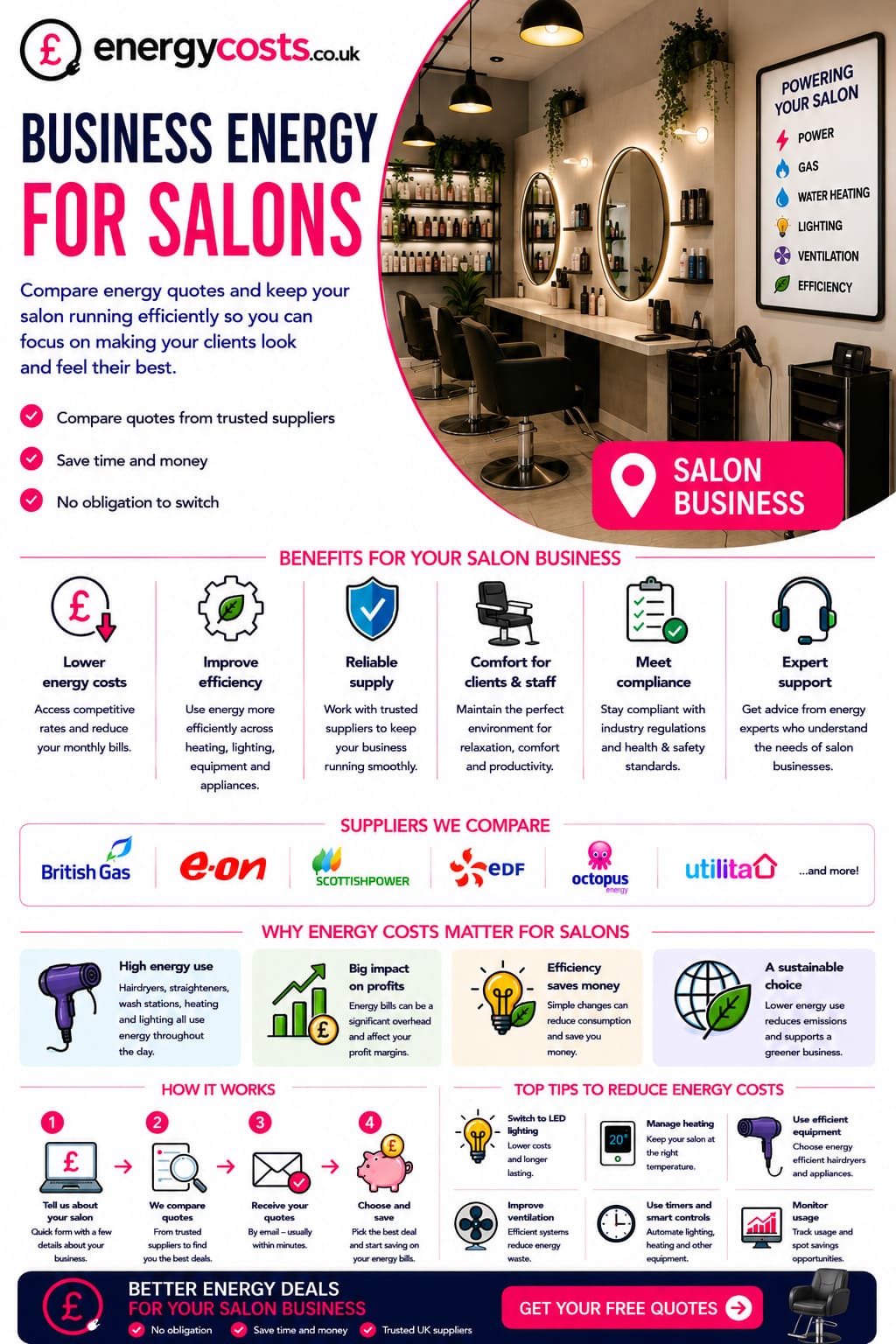
Typical unit rates and standing charges used in our salon cost examples
The monthly cost ranges for salon businesses are calculated by applying typical UK business tariff assumptions (unit rates and standing charges) to the estimated kWh usage ranges for different salon types. This matters because the same level of usage can produce very different monthly bills depending on what you pay per kWh, plus the fixed daily charges for being connected.
Salons are usually electricity-led businesses. Styling tools, lighting, laundry and ventilation are all powered by electricity, while gas (where present) is more commonly used for space heating and hot water. In many cases, electricity accounts for the majority of the total bill, particularly in hair salons with frequent hairdryer and hot-water use.
Electricity pricing assumptions (salon businesses)
Electricity is the main driver for most salon types because high-wattage appliances are used continuously throughout the working day (and sometimes during prep/clean-down). The cost calculations use the following typical pricing bands:
- Electricity unit rate: 21–24p per kWh
- Electricity standing charge: 45–70p per day
Why electricity tends to dominate salon bills: High-heat styling equipment (hairdryers, straighteners, curling tongs), hot water heating, washers/dryers, lighting and (where installed) air conditioning can all stack up. Even when equipment isn’t running at full load constantly, the combined “small power” draw across multiple chairs/stations can be substantial across a month.
A common hidden cost is out-of-hours baseload (standby power, CCTV, fridges, chargers). Overnight usage can be small in kWh terms, but it still adds a noticeable monthly amount over time.
Gas pricing assumptions (salon businesses)
Gas usage in salons is typically lower than electricity usage, but it becomes more significant in colder months (heating) and in premises with higher hot-water needs (for example, frequent towel washing or spa-style treatment rooms). The cost calculations use the following typical pricing bands:
- Gas unit rate: 6.5–8.2p per kWh
- Gas standing charge: 27–45p per day
Why gas costs can vary a lot between salon types: Barber shops often have minimal hot-water demand and may only use gas for basic space heating, while spas and wellness salons can have much higher heating and hot-water loads (and may run energy-intensive equipment such as heated beds, steam rooms or hot tubs, depending on the setup).
Standing charges: why they matter for smaller salons
Standing charges are daily fixed fees applied even on days when energy usage is low. They can be a meaningful proportion of the bill for small salons with relatively modest monthly kWh consumption, which is why they’re included in the estimate assumptions rather than focusing only on the per-kWh price.
Important note on real-world variation
Actual quotes and monthly costs can move materially depending on:
- Number of chairs/stations and how intensively they’re used (appointments per day)
- Equipment mix (hairdryers and hot water vs nail/beauty tools; presence of air conditioning)
- Laundry throughput (washer/dryer cycles) and hot water strategy (instant vs stored hot water)
- Opening hours (including late nights and weekends)
- Building fabric and heating approach (draughts, insulation, thermostat control, electric vs gas heating)
- Contract length, renewal timing, supplier pricing, region, and meter setup (all of which can change the unit-rate/standing-charge balance)
The figures above are included to show the pricing assumptions behind the cost ranges, rather than represent a guaranteed market rate for every salon business.
Where salons use the most energy
Salons rely on consistent electricity use across multiple appliance types.
| Equipment / usage type | Typical share of total energy consumption | Notes |
|---|---|---|
| Styling tools (dryers, straighteners, curling tools) | 25–40% | High-power electrical devices, often in constant use. |
| Water heating (gas or electric) | 15–25% | Shampooing, treatments, spa baths, laundry. |
| Lighting (task and display) | 15–25% | Bright lighting needed for colouring and styling accuracy. |
| Air conditioning and heating (HVAC) | 10–20% | Long opening hours increase usage in both summer and winter. |
| Laundry (towels, gowns, spa linen) | 5–10% | Washing machines and tumble dryers, especially in spas. |
| Reception, Computers, POS | 2–4% | Minor load but always on. |
Impact of salon type on energy use
Different types of salon businesses have unique energy profiles.
| Salon type | Energy usage pattern | Cost impact |
|---|---|---|
| Hair salons | High-power blow-dryers, straighteners, hot water | Medium to high |
| Nail studios | Lower heat usage, moderate lighting, ventilation | Low to medium |
| Barber shops | Regular hairdryers, less water and laundry | Low |
| Beauty salons | Wax pots, UV lamps, steamers, heated beds | Medium |
| Spa and wellness | Hot tubs, saunas, steam rooms, constant hot water | High to very high |
Spa businesses can spend 35–60% more than standard hair salons due to hot water and heating requirements.
Electricity vs gas use in salons
| Salon type | Electricity heavy? | Gas usage? | Notes |
|---|---|---|---|
| Hair salon | Very high | Low to moderate | Electric styling tools dominate use. |
| Barber shop | High | Minimal | Gas used mainly for space heating. |
| Nail / beauty salon | Moderate | Minimal | Mostly electricity for treatment tools. |
| Spa salon | High | Moderate to high | Hot water systems raise gas bills. |
Nearly 80% of salon energy bills come from electricity, particularly where styling tools and lighting are intensive.
Typical daily usage profile
Salons often run high energy loads throughout the working day:
- 08:00–09:30: Water heating, laundry, lights and HVAC begin
- 10:00–14:00: Styling tools and hot water in peak use
- 14:00–17:00: Consistent use of dryers, radiators, lighting
- 17:00–19:00: Evening appointments maintain full energy load
- Overnight: Minimal load, usually only CCTV, fridges, and standby (1–3 kWh)
Overnight electricity usage often adds £20–£45 per month.
Example equipment energy use
| Equipment | Typical usage (kWh/h) | Approx hourly cost |
|---|---|---|
| Hairdryer | 1.5–2.0 | £0.32–£0.42 |
| Straighteners / curling tongs | 0.6–1.0 | £0.13–£0.21 |
| Hot water boiler | 3.0–5.0 | £0.63–£1.05 |
| Washer/dryer | 1.2–2.5 | £0.25–£0.55 |
| UV nail lamp | 0.1–0.2 | £0.02–£0.04 |
| Air-conditioning | 1.0–4.0 | £0.21–£0.84 |
How to calculate your salon’s monthly energy bill
- Check your monthly electricity kWh usage.
- Multiply usage by your tariff unit rate.
Example: 2,800 kWh × 23p = £644 - Add standing charges:
Electricity: 60p/day ≈ £18/month - Add gas (if used):
900 kWh × 7p = £63 - Total estimated monthly bill: £725 (plus VAT)
Ways salons can reduce energy costs
- Replace halogen lamps with LEDs – saves 30–55% on lighting.
- Use timed hot water or on-demand heating instead of constant heaters.
- Encourage staff to switch off styling tools between appointments.
- Install smart thermostats to maintain temperature without over-heating.
- Upgrade tumble dryers to heat-pump dryers for 30–40% savings.
- Compare tariffs regularly using EnergyCosts.co.uk; savings of 10–20% are common.
Summary
Salon energy costs typically range from £250 to £1,400 per month, with electricity accounting for most of the bill due to styling tools, lighting, hot water, and HVAC systems. Hair salons and spas incur the highest costs, whereas barber shops and nail studios pay substantially less. With efficient tools, heating controls, and active tariff management, many salons can reduce monthly bills without affecting customer service standards.
Frequently asked questions
A typical mid-size hair salon with 4–8 chairs usually spends between £450 and £1,050 per month, mainly driven by hairdryers, hot water, straighteners, lighting, and air conditioning.
Most salons spend significantly more on electricity. In many cases, 80–90% of the total energy bill comes from electricity due to heating tools, lighting, and HVAC, while gas is mainly used for water and space heating.
Spa and wellness salons have the highest energy bills, often spending £850–£1,400 per month due to hot tubs, steam rooms, heated beds, and laundry equipment used for towels and linens.
Most salons use between 1,200 and 4,500 kWh of electricity per month, depending on equipment volume, number of stylists, and opening hours. Spa-focused salons may exceed 7,500 kWh per month.
Hairdryers use around 1.5–2 kWh per hour, costing approximately 32p–42p per hour at 2026 electricity rates. Straighteners and curling tools use 0.6–1.0 kWh per hour, costing 13p–21p per hour.
Yes. Water heating accounts for 15–25% of salon energy consumption. In spa and beauty salons, it can rise to 30–40%, especially when running multiple basins, steamers, and laundry systems.
Salons open for 8–10 hours a day, five or six days a week, typically use 25–30% more electricity than shorter-hour retail businesses due to extended use of styling tools and HVAC.
Even when closed, salons typically consume 1–3 kWh overnight for CCTV, security systems, refrigeration of beauty products, and standby power, adding £20–£45 per month to bills.
Simple practices like switching off styling tools when not in use, reducing thermostat settings by 1–2°C, using LED lighting, and better timing water heating can reduce energy usage by 10–20%.
Yes. Salons switching tariffs via comparison services often save 10–20% on bills, especially those on out-of-contract or variable-rate tariffs.