

Vehicle repair garages use substantial energy for heating, workshop equipment, compressed air, lighting, MOT bays, lifts, office areas, battery chargers, spraying booths and ventilation systems.
Energy demand varies depending on workshop size, heating type, operating hours and services offered, such as diagnostics, tyre fitting or paint spraying.
Understanding typical energy usage and associated cost helps garage owners plan overheads, compare tariffs and improve energy efficiency in one of the UK’s most energy-intensive service sectors.
Typical energy consumption in vehicle repair garages and MOT centres
Electricity usage is driven by lighting, air compressors, lifts, power tools, EV chargers and office equipment. Gas is often used for heating, spray booth dryers, space heaters and hot water.
| Garage type | Electricity (kWh/month) | Gas (kWh/month) |
|---|---|---|
| Small (one-bay or mobile) | 1,800–3,500 | 1,000–3,000 |
| Medium (two to four bays, diagnostics) | 3,600–7,500 | 3,500–8,000 |
| Large (MOT, service, bodywork and paint) | 8,000–14,000+ | 8,500–16,000+ |
Garages with bodywork or paint spraying facilities use significantly more energy due to heated drying booths and extraction units. EV service centres may have additional electricity demand for charging systems.
Monthly commercial energy cost for garages and MOT centres
A medium-sized garage usually spends between £1,925 and £3,840 per month on energy, combining electricity and gas. This depends on whether it includes body repair, diagnostics, paint spraying and the type of heating used in the main bay area.
| Garage size | Electricity cost | Gas cost | Total monthly energy cost |
|---|---|---|---|
| Small | £500–£975 | £300–£675 | £800–£1,650 |
| Medium | £975–£1,950 | £950–£1,890 | £1,925–£3,840 |
| Large | £2,080–£3,640+ | £1,215–£2,430+ | £3,295–£6,070+ |
Costs include typical standing charges and reflect average usage of space heating, compressed air systems and electrical tooling.
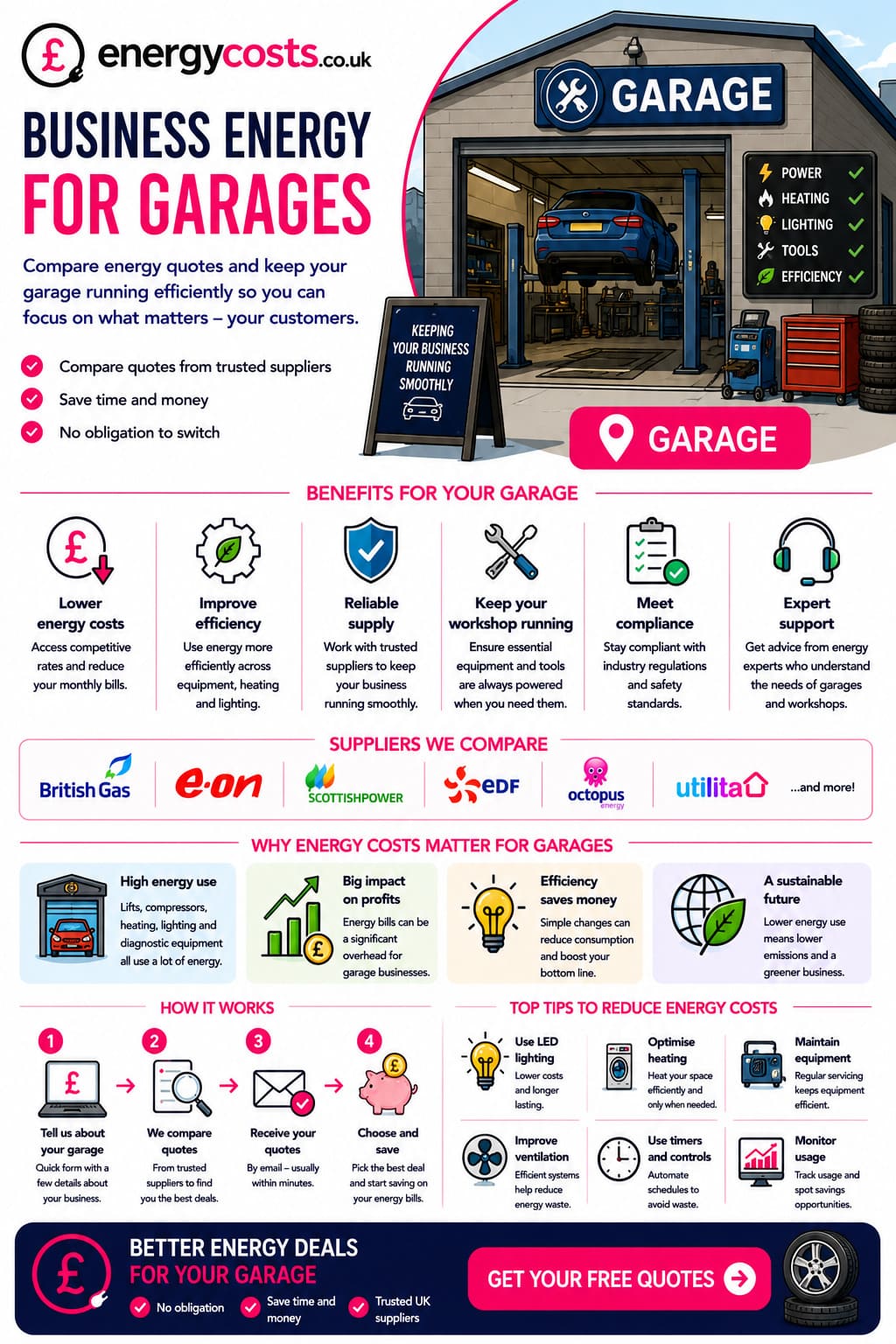
Which garage equipment uses the most energy?
| Equipment or activity | Electricity (kWh/month) | Gas (kWh/month) |
|---|---|---|
| Space heating (gas or oil heater) | 200–500 | 4,000–10,000 |
| Spray booths and drying units | 800–3,000 | 1,500–5,000 |
| Air compressors and pneumatic tools | 600–2,200 | N/A |
| Vehicle lifts and hoists | 120–450 | N/A |
| MOT testing and diagnostic equipment | 150–500 | N/A |
| Lighting and ventilation | 400–1,200 | N/A |
| Office and customer areas | 200–600 | 150–400 |
| EV charger (fast charge) | 450–1,000 | N/A |
Spray booths, drying ovens and large heating systems contribute the most to business energy bills in body repair garages.
Typical unit rates and standing charges used in our garage cost examples
To make the monthly cost ranges on this page easier to interpret, the estimates use typical UK fixed-rate business tariff pricing for vehicle repair garages and MOT centres. Garages can be electricity-heavy (compressors, lighting, tooling and diagnostics) and often gas-heavy in winter due to space heating and (where fitted) spray booth dryers.
Electricity pricing assumptions (garages)
- Electricity unit rate: ~26p/kWh is used in the example calculations shown on this page.
- Electricity standing charge: standing charges vary by region and meter setup, but typical SME fixed-tariff standing charges are often around ~50p to 70p per day.
Gas pricing assumptions (garages)
- Gas unit rate: typical SME fixed-tariff gas quotes are often around ~6p to 8p/kWh, depending on usage band, region, credit and contract length.
- Gas standing charge: typical SME standing charges are often around ~22p to 35p per day, varying by supplier, region and meter type.
Important note on real-world variation
Garage quotes can move materially based on winter heating demand, opening hours, whether you run spray booths/bodywork dryers, compressed air runtime and air leaks, EV charging load, and meter type (including half-hourly where applicable). Energy costs can also rise sharply in winter, which can increase total spend by around 35% to 50% for some sites due to space heating requirements.
Key energy cost drivers
- Heating a large space: Workshops often have poor insulation and large open doorways, causing substantial heat loss. Gas usage is highest in winter due to space heating.
- Compressed air usage: Air compressors run for long periods and are one of the most energy-intensive electricity consumers, especially if used for air tools, spray guns and tyre inflation.
- Lighting and ventilation: Garages need bright lighting for safety and accuracy, leading to high electricity consumption, often 300–800 kWh per month in lighting alone.
- Spray booths and bodywork dryers: Used in body repair centres, these can use 3,000 kWh of electricity and 5,000 kWh of gas monthly depending on production volume.
- EV servicing and charging: Electric vehicle charging can add 12–18 kWh per charging cycle, increasing monthly demand by 500–1,000 kWh in hybrid service centres.
Seasonal cost variation
Garages can see energy costs rise by 35% to 50% in winter due to additional space heating requirements. Diesel or LPG heaters can be more expensive than gas and may increase total energy costs beyond typical estimates.
How to reduce commercial garage energy costs
| Strategy | Saving potential | Notes |
|---|---|---|
| Install infrared or zoned heating | 15–25% | Focus heat in work areas, not whole workshop |
| Repair insulation and seal roller doors | 10–20% | Reduces heat loss and gas demand |
| Replace fluorescent lighting with LEDs | 8–12% | Effective for large workshop areas |
| Service compressors and reduce air leaks | 15–30% | Air leaks can waste huge energy |
| Smart timers for heaters and machinery | 10–15% | Avoids unnecessary off-hour consumption |
| Switch to fixed business tariff | 8–12% | Suitable for high-usage premises |
Why energy management matters in vehicle workshops
Energy represents between 8% and 20% of operating costs in garage businesses. Paint shops, MOT centres and EV repair facilities can exceed 25% if poorly insulated or using outdated equipment.
Efficient energy usage helps drive profitability, especially for sites with multiple service bays or extended opening hours.
Best energy tariff options for garages
Garages often benefit from dual fuel tariffs, fixed business energy contracts or time-of-use plans, particularly if energy use peaks early morning or during daytime production cycles. Some business energy suppliers offer industry-specific tariffs for workshops and service centres.
Save money on your garage energy bills with EnergyCosts.co.uk
Vehicle repair garages, MOT centres and body shops are energy-intensive by nature. Accurately tracking consumption and choosing a suitable tariff can help reduce monthly costs. Use EnergyCosts.co.uk to compare commercial energy suppliers offering deals designed for commercial automotive workshops and service businesses.
FAQ
A medium-sized garage usually spends between £1,925 and £3,840 per month on energy, combining electricity and gas. This depends on whether it includes body repair, diagnostics, paint spraying and the type of heating used in the main bay area.
A standard repair garage with two to four service bays usually consumes between 3,600 and 7,500 kWh of electricity per month. High-consumption equipment includes compressors, lifts, lighting, EV chargers and office appliances. At 26p per kWh, this costs roughly £935 to £1,950 including standing charges.
Garages offering MOT, servicing and repairs tend to spend more on electricity, while those with bodywork, paint spraying or large heating systems spend more on gas. Heating alone can use 4,000 to 10,000 kWh of gas monthly, making it the largest single cost in winter.
Spray booths, drying ovens, space heaters and air compressors are among the most energy-intensive items. Spray booths alone can use up to 3,000 kWh of electricity and 5,000 kWh of gas per month, especially in bodywork or paint finishing centres.
Winter energy costs can increase by 35% to 50% due to heavy reliance on space heating. Garages with roller shutter doors or poorly insulated walls experience greater heat loss and higher gas bills during colder months.
Yes. Simple steps such as fixing air leaks in compressors, sealing roller doors, installing LED lighting, using smart timers or zoning heaters can reduce overall energy use by 10% to 25% without major investment.
A single EV charge can consume 12 to 18 kWh. A garage offering 30 vehicle charges per month adds roughly 400 to 600 kWh to total usage, costing an additional £100 to £160 on electricity bills.
Yes. Fixed business energy tariffs help garage owners reduce risk from price fluctuations and improve cost forecasting. High-usage businesses typically save 8% to 12% annually by switching to fixed-rate contracts.
Spray booths typically use between 800 and 3,000 kWh of electricity and up to 5,000 kWh of gas monthly. Usage depends on drying temperatures, run times, insulation and the number of bodywork jobs completed.
Energy usually accounts for 8% to 20% of operating costs for garages, and up to 25% for paint and body shops with heated drying systems and extraction units. This percentage increases during winter.