

Newcastle upon Tyne is one of the North East’s most important commercial centres, home to a diverse mix of SMEs across technology, manufacturing, professional services, retail, hospitality, healthcare, transport, and education. With an expanding digital sector, strong universities and major regeneration projects, the city continues to attract business investment.
One of Newcastle’s advantages is its competitive regional energy pricing, which is notably lower than the national average.
Our detailed location guide uses EnergyCosts.co.uk’s 2026 modelling dataset to explain business energy prices in Newcastle, including estimated unit rates, annual bills and practical opportunities for SMEs to reduce their electricity and gas costs.
What SMEs typically pay for gas and electricity in Newcastle
To ensure consistent comparisons across all major UK cities, our model uses the same representative SME consumption profile:
- 25,000 kWh of electricity per year
- 20,000 kWh of gas per year
These usage levels reflect typical consumption among Newcastle’s broad SME community, including offices, clinics, workshops, retail units, creative studios, leisure businesses, and service providers.
Newcastle’s regional pricing position
Newcastle benefits from one of the lowest regional energy pricing adjustments in the UK, with a –3% discount relative to the national average.
This reflects the cost-efficient nature of the North East’s electricity distribution network and the region’s lower overall supply-chain overheads.
Estimated SME unit rates in Newcastle are:
- Electricity: 26.1p/kWh
- Gas: 6.98p/kWh
Estimated annual and monthly bills for Newcastle SMEs
By applying these rates to our SME consumption profile, we estimate:
- Annual electricity cost: £6,719
- Annual gas cost: £1,526
- Combined annual energy bill: ~£8,245
- Combined monthly energy cost: ~£687
This places Newcastle among the cheapest major cities in the UK for business energy, significantly below southern cities such as Southampton, Brighton and Reading, and noticeably cheaper than Birmingham or Nottingham.
Why business energy prices in Newcastle are lower than average
Several long-standing regional and network characteristics contribute to Newcastle’s advantageous pricing.
1. Efficient North East distribution network
The region benefits from:
- Lower typical network reinforcement costs
- Good transmission infrastructure
- Predictable maintenance requirements
- Balanced industrial and commercial demand
This results in lower electricity distribution charges, which directly reduces unit rates for businesses.
2. Lower supplier operating costs
Staffing, office space and operational costs for suppliers are considerably lower in Newcastle compared to London and much of the South East. These structural savings help keep tariffs competitive.
3. Strong market competition
Newcastle’s business community (ranging from startups to multi-site firms) creates healthy demand for energy services. Suppliers remain highly competitive across both fixed and flexible tariffs.
4. Stable regional demand patterns
Newcastle does not experience the extreme demand peaks seen in highly concentrated urban centres, helping to maintain cost stability.
How Newcastle businesses can reduce energy bills further
Even with favourable regional pricing, SMEs in Newcastle can take further steps to reduce overall expenditure on business energy bills.
1. Switch suppliers at the end of your contract
Many SMEs unknowingly remain on expensive rollover or deemed tariffs, which can cost 20–40% more than negotiated rates. Switching at renewal remains one of the simplest and most effective ways to cut costs.
2. Use accurate consumption data for quotes
Providing precise usage information — ideally from smart meter readings — ensures quotes reflect actual consumption rather than inflated estimates.
3. Reduce electricity usage, especially during working hours
Electricity accounts for most SME energy spend. Newcastle businesses can lower costs by:
- Installing LED lighting
- Using occupancy sensors in low-traffic areas
- Maintaining heating and HVAC equipment
- Reducing standby power usage
- Scheduling heavy equipment use outside peak hours, where possible
These measures consistently deliver strong ROI across all sectors.
4. Improve heating efficiency
Gas usage is often high in older buildings common across central Newcastle. SMEs can reduce consumption by:
- Improving insulation
- Upgrading old boilers or unit heaters
- Installing thermostatic controls or zoning systems
- Eliminating draughts
- Using smart thermostats
5. Install smart meters across all sites
Smart meters offer detailed insights into usage patterns, helping SMEs identify inefficiencies and manage energy more strategically.
How Newcastle compares with other major UK cities
Newcastle is one of the cheapest cities for SME energy costs.
- Cheaper than: London, Reading, Southampton, Brighton, Bristol, Birmingham, Nottingham
- Similar to: Glasgow, Edinburgh, Cardiff, Belfast, Swansea
- Slightly cheaper than: Manchester and Leeds, though only by £10–£15 per month
This reinforces that Newcastle is one of the most cost-efficient major locations for business energy in England.
Comparing business energy suppliers in Newcastle
Every major UK business energy supplier serves Newcastle, alongside specialist providers supporting industrial, retail, education and hospitality sectors. SMEs benefit from comparing:
- Fixed-rate contracts (12–36 months)
- Variable tariffs suited to fluctuating usage
- Standing charges, which differ widely between suppliers
- Renewable-backed energy options
- Multi-site tariffs for businesses with premises across Gateshead, Sunderland, North Tyneside or Durham
Comparing multiple suppliers is essential because pricing can vary significantly between contracts and between businesses with different usage patterns.
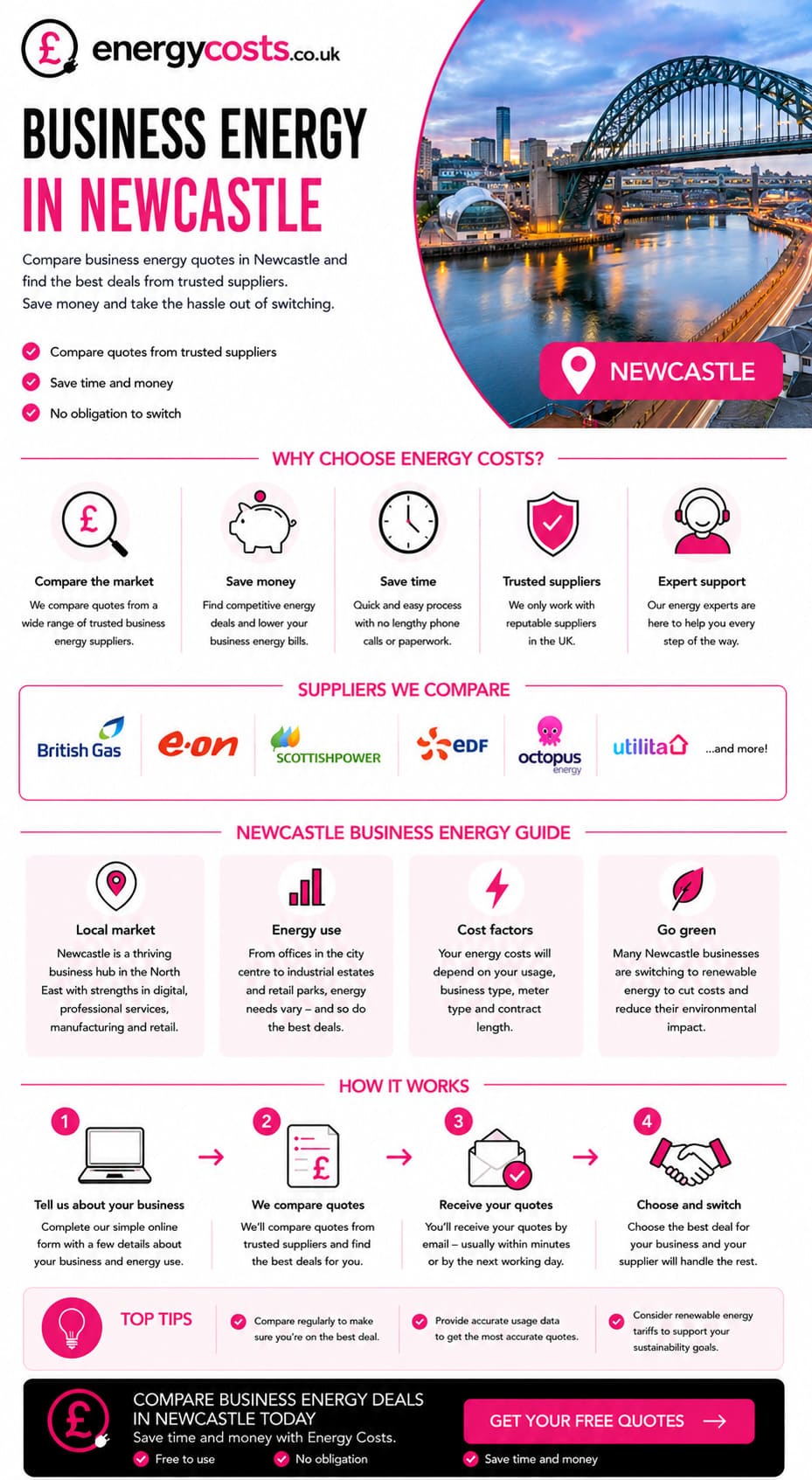
Get business energy quotes for Newcastle
To benchmark your current usage and identify cost-saving opportunities, use EnergyCosts.co.uk to compare live business energy prices in Newcastle. Enter your postcode and annual consumption to receive tailored quotes from leading suppliers, helping your business secure a competitive tariff and reduce overheads.