

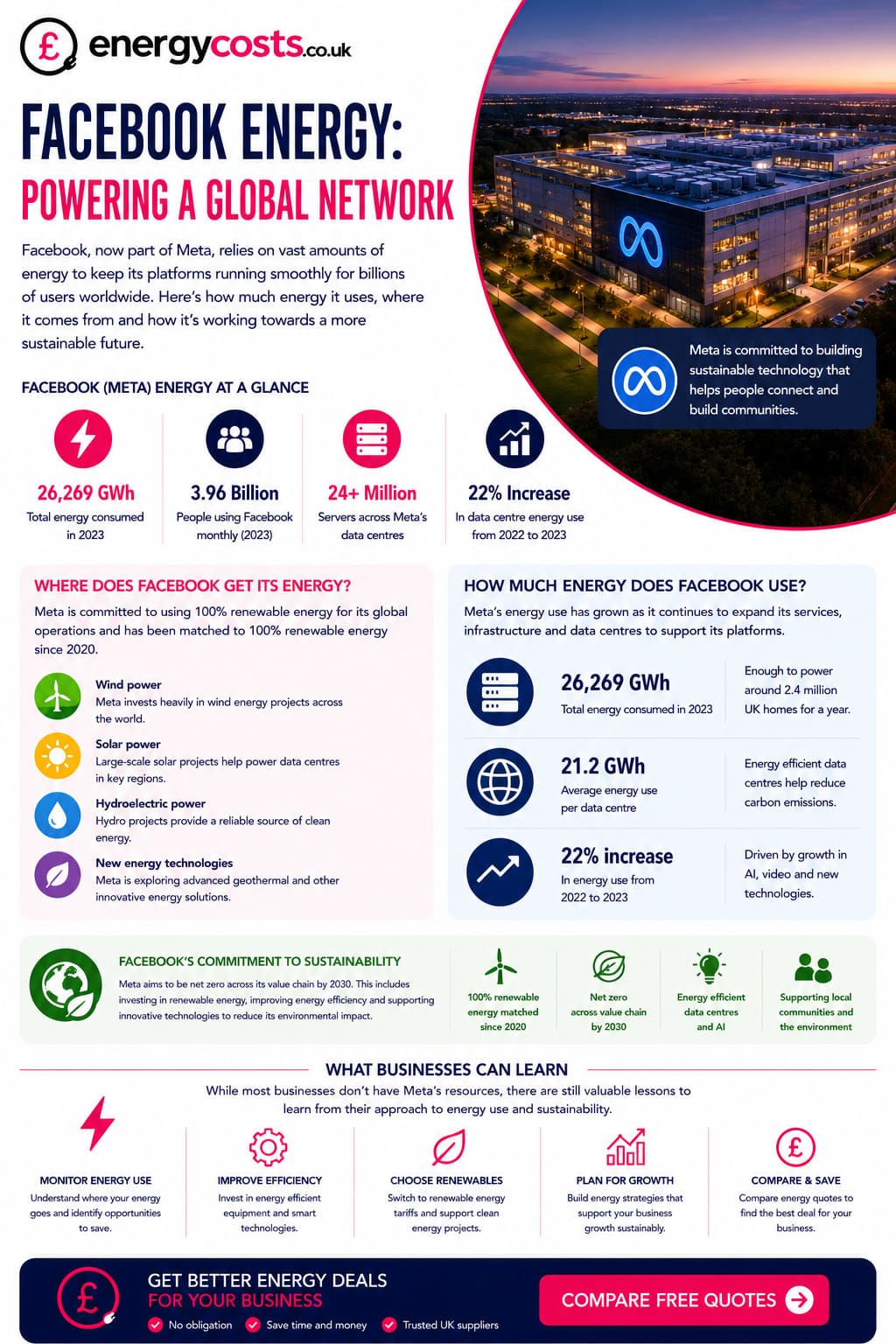
Facebook’s exact standalone energy use is not publicly disclosed, because Facebook is now part of Meta’s wider infrastructure, which also supports Instagram, WhatsApp, Messenger, Threads, Meta Quest, advertising systems, recommendation engines and AI workloads.
The best available answer is therefore based on Meta’s total operational electricity consumption. On that basis, Meta used 18.42TWh of electricity in 2024, including 18.06TWh from data centres. That means almost all of the electricity behind Facebook and Meta’s other services is used in data centres rather than offices.
Summary answer
| Question | Best available answer |
|---|---|
| Does Meta publish Facebook-only energy use? | No |
| Meta’s total electricity use in 2024 | 18.42TWh |
| Meta data centre electricity use in 2024 | 18.06TWh |
| Share of Meta electricity used by data centres | Around 98% |
| Meta office electricity use in 2024 | 0.36TWh |
| Meta total energy consumption in 2024 | 67.12 million GJ, equal to around 18.64TWh |
| Meta’s average electricity demand across 2024 | Around 2.1GW |
| Equivalent UK household electricity use | Around 6.8 million typical homes |
| Meta’s reported electricity intensity | 5.5kWh per daily active person per year |
Meta says its total electricity consumption rose from 15.33TWh in 2023 to 18.42TWh in 2024, a rise of around 20%. Its data centre electricity use rose from 14.98TWh to 18.06TWh over the same period.
Why Facebook’s energy use cannot be separated exactly
Facebook is no longer operated as a separate company with a separate public energy footprint. Meta reports electricity consumption at the company level and by facility type, not by individual app or product.
This matters because the same Meta infrastructure can support multiple services at the same time, including:
| Meta product or function | Why it uses energy |
|---|---|
| News Feed, video, photos, groups, messages, marketplace, comments and recommendations | |
| Reels, Stories, image hosting, video processing and recommendations | |
| WhatsApp and Messenger | Messaging, media storage, encryption-related processing and notifications |
| Threads | Posts, recommendations, accounts and media hosting |
| Advertising systems | Ad auctions, targeting, measurement and reporting |
| AI systems | Ranking, moderation, translation, image recognition, chatbots and generative AI |
| Meta Quest and Reality Labs | Cloud services, accounts, updates and some product-related infrastructure |
Because these systems overlap, any claim that “Facebook alone uses exactly X TWh” would be an estimate rather than a figure published by Meta.
Meta electricity consumption by year
Meta’s electricity use has grown sharply in recent years. The company reported 7.17TWh of electricity consumption in 2020 and 18.42TWh in 2024, meaning reported electricity use was more than two and a half times higher in 2024 than in 2020.
| Year | Meta total electricity use | Data centre electricity use | Office electricity use |
|---|---|---|---|
| 2020 | 7.17TWh | 6.97TWh | 0.20TWh |
| 2021 | 9.42TWh | 9.12TWh | 0.30TWh |
| 2022 | 11.51TWh | 11.17TWh | 0.34TWh |
| 2023 | 15.33TWh | 14.98TWh | 0.35TWh |
| 2024 | 18.42TWh | 18.06TWh | 0.36TWh |
The main trend is clear: Meta’s energy footprint is overwhelmingly a data centre footprint. In 2024, data centres accounted for around 98% of the company’s electricity consumption.
How much electricity do Meta data centres use?
Meta reported 18,061,781MWh of data centre electricity consumption in 2024. That is equal to 18.06TWh.
To put that into context, Ofgem estimates that a typical household in England, Scotland and Wales uses 2,700kWh of electricity per year. On that basis, Meta’s 2024 data centre electricity consumption was equivalent to the annual electricity use of around 6.7 million typical UK homes.
| Meta 2024 electricity use | kWh equivalent | Equivalent typical UK homes |
|---|---|---|
| Total electricity use | 18.42 billion kWh | 6.8 million homes |
| Data centres | 18.06 billion kWh | 6.7 million homes |
| Offices | 0.36 billion kWh | 134,000 homes |
This does not mean Meta literally takes power from the UK grid. It is a scale comparison using UK household electricity consumption.
What is Meta’s average power demand?
Electricity use is usually measured in kWh, MWh or TWh over a period of time. Power demand is different: it measures how much electricity is being used at a particular moment.
If Meta’s 18.42TWh of 2024 electricity use is spread evenly over the year, it equals an average power demand of roughly 2.1GW.
| Electricity use | Average power demand |
|---|---|
| 18.42TWh per year | Around 2.1GW |
| 18.06TWh data centre electricity | Around 2.06GW |
| 0.36TWh office electricity | Around 41MW |
This is only an average. Actual demand will vary by site, workload, time of day, season, cooling conditions and server utilisation.
How much energy does Facebook use per user?
Meta reports an electricity intensity figure of 0.0055MWh per daily active person for 2024. That is equal to 5.5kWh per daily active person per year. Spread across a year, that works out at around 15Wh per daily active person per day.
| Metric | Approximate figure |
|---|---|
| Meta electricity per daily active person per year | 5.5kWh |
| Meta electricity per daily active person per month | 0.46kWh |
| Meta electricity per daily active person per day | 15Wh |
This is not a measure of one Facebook session, one post, one video view or one message. It is a company-wide intensity figure spread across Meta’s daily active people. It includes all Meta operational electricity, not just Facebook.
Meta said its family daily active people figure was 3.35 billion on average for December 2024, covering users of Facebook, Instagram, Messenger and WhatsApp.
How much energy does one Facebook action use?
Meta does not publish energy figures for specific actions such as viewing a post, scrolling the News Feed, uploading a photo, watching a Reel, sending a message or refreshing notifications.
In practice, the electricity used by a single Facebook action would depend on:
| Action | Energy factors |
|---|---|
| Reading a text post | Low data transfer and processing requirement |
| Uploading a photo | Storage, processing, compression and distribution |
| Watching video | Higher data transfer, caching and device energy use |
| Scrolling the feed | Recommendation systems, ad systems and content loading |
| Using Facebook Marketplace | Search, images, messaging and recommendations |
| Using AI-generated features | Potentially higher computing demand |
For most individual users, the direct energy use of one Facebook action is likely to be very small. The bigger issue is scale: billions of users, billions of daily interactions, large volumes of video, advertising systems, recommendation algorithms and AI processing.
Where Meta’s electricity is used
Meta provides electricity consumption by facility. In 2024, its largest reported electricity-consuming data centre categories and sites included leased data centre facilities, Prineville, Altoona, Sarpy, Stanton Springs, Los Lunas, Eagle Mountain, Fort Worth and Clonee.
| Facility or category | 2024 electricity use |
|---|---|
| Leased data centre facilities | 3.07TWh |
| Prineville, Oregon | 1.73TWh |
| Altoona, Iowa | 1.59TWh |
| Sarpy, Nebraska | 1.26TWh |
| Stanton Springs, Georgia | 1.18TWh |
| Los Lunas, New Mexico | 1.14TWh |
| Eagle Mountain, Utah | 1.12TWh |
| Fort Worth, Texas | 1.11TWh |
| Clonee, Ireland | 1.08TWh |
| Henrico, Virginia | 0.95TWh |
| Huntsville, Alabama | 0.87TWh |
This shows why Facebook’s energy footprint is best understood as a data centre issue. The electricity is not mainly used at Meta’s corporate offices; it is used to store, process and deliver digital services.
Does Meta use renewable energy?
Meta reports that it matched 100% of its electricity consumption with renewable energy from 2020 to 2024. In its 2025 sustainability reporting, Meta also says it has supported wind and solar projects adding almost 29GW of clean and renewable energy to grids globally.
However, “matched with renewable energy” does not mean every Facebook post, video or data centre process is physically powered by renewable electricity at every moment. Meta’s data shows that more than 99% of its electricity came from the grid in 2024, while its renewable claim is based on matching electricity consumption with renewable energy procurement and energy attribute certificates.
| Term | What it means |
|---|---|
| Grid electricity | Electricity physically supplied through local power grids |
| Renewable matching | Buying or contracting enough renewable electricity or certificates to match annual consumption |
| 24/7 carbon-free energy | Matching consumption with clean power hour by hour, which is harder than annual matching |
| Energy attribute certificates | Instruments used to claim the environmental attribute of renewable electricity generation |
Meta says it procures and retires one energy attribute certificate for every MWh of electricity used to power global operations.
How efficient are Meta’s data centres?
Meta reports a 2024 data centre Power Usage Effectiveness, or PUE, of 1.08. PUE measures how efficiently a data centre uses electricity, with 1.0 representing a theoretical ideal where all electricity goes directly to IT equipment rather than cooling, power conversion and other overheads.
| Year | Meta reported PUE |
|---|---|
| 2020 | 1.10 |
| 2021 | 1.09 |
| 2022 | 1.08 |
| 2023 | 1.08 |
| 2024 | 1.08 |
A PUE of 1.08 is efficient by data centre standards. It suggests that for every 1kWh used by IT equipment, roughly another 0.08kWh is used for supporting systems such as cooling and power delivery. That does not make the total footprint small; it means the facilities are relatively efficient for the amount of computing they provide.
Why Meta’s energy use is rising
Meta’s electricity use is rising for several reasons:
| Driver | How it increases energy use |
|---|---|
| More users | More posts, messages, photos, videos and interactions |
| More video | Video requires more storage, processing and data transfer than text |
| AI recommendations | Ranking and personalisation systems require large computing infrastructure |
| Generative AI | AI assistants, image tools and model training can add major computing demand |
| Advertising systems | Real-time ad auctions and measurement require constant processing |
| Data retention and backups | Stored content needs servers, storage systems and redundancy |
| Global expansion | More regions, data centres and leased infrastructure |
Meta’s own financial reporting shows how important infrastructure has become. In its 2025 results, Meta reported $72.22 billion of capital expenditure for 2025 and guided for $115–135 billion of capital expenditure in 2026, with year-on-year growth driven by investment to support Meta Superintelligence Labs and the core business.
This suggests Meta’s electricity demand could continue rising as the company builds more AI and data centre capacity.
How AI could change Facebook’s energy footprint
Facebook began as a social networking website, but Meta’s infrastructure is increasingly shaped by AI. AI is used for content ranking, recommendations, moderation, advertising, translation, image recognition and generative tools.
AI can increase energy use in two ways:
| AI energy use | What it means |
|---|---|
| Training | Building large AI models using huge datasets and computing clusters |
| Inference | Running AI models whenever users interact with recommendations, chatbots or generative features |
The energy impact of AI depends on model size, query volume, hardware, cooling, utilisation and how often advanced AI features are used. A simple ranking decision may be tiny in energy terms, but the combined effect of billions of AI-driven recommendations and interactions can be substantial.
Recent data centre investment shows the direction of travel. Reuters reported that Meta has been securing new long-term power sources for data centres and is building several gigawatt-scale data centres in the US.
Meta, data centres and power infrastructure
Meta’s future energy demand is not just a sustainability issue. It is also becoming a power infrastructure issue.
Reuters reported in April 2026 that Entergy increased its four-year capital spending plan to $57 billion, largely because of energy infrastructure needed to serve Meta data centres. The report also said Entergy had agreed to build seven new natural gas-fuelled combined-cycle power plants totalling more than 5.2GW to supply Meta data centres in Louisiana.
That does not mean Facebook itself used 5.2GW in 2024. It shows that the next stage of Meta’s data centre build-out could require power infrastructure on the scale normally associated with major industrial growth.
What is included in Meta’s energy footprint?
Meta’s reported operational electricity includes electricity used by its data centres and offices. Scope 2 emissions include purchased energy such as electricity powering data centres, while Scope 1 emissions cover direct operations such as natural gas, transport fuel and refrigerants.
However, a full “Facebook energy footprint” would be wider than Meta’s operational electricity. It could include:
| Energy use | Usually included in Meta operational electricity? |
|---|---|
| Meta data centres | Yes |
| Meta offices | Yes |
| Electricity used by users’ phones and laptops | No |
| Home Wi-Fi routers used to access Facebook | No |
| Mobile network energy | No |
| Third-party internet infrastructure | Generally not as Meta operational electricity |
| Manufacturing servers and hardware | Not operational electricity, but may appear in value-chain emissions |
| Manufacturing smartphones used to access Facebook | Not part of Meta’s own operational electricity |
This distinction matters. If someone asks “how much energy does Facebook use?”, they may mean the electricity Meta uses to operate Facebook. But the wider digital ecosystem also uses energy through devices, telecoms networks and third-party infrastructure.
Is Facebook’s energy use large?
Yes, in absolute terms. Meta’s 2024 electricity consumption of 18.42TWh is very large for a single company. It is equivalent to the annual electricity use of millions of typical UK homes.
However, the per-user figure looks much smaller because Meta serves billions of people. Meta’s own electricity intensity figure of 5.5kWh per daily active person per year is less than the electricity used by many household appliances over the same period.
The key point is scale. One Facebook interaction is small; a global platform operating continuously for billions of users is not.
What does this mean for businesses?
For businesses, Facebook’s energy use matters for three reasons.
First, companies that advertise on Facebook, Instagram or WhatsApp may increasingly face questions about the digital carbon footprint of their marketing activity. Most small businesses will not be able to calculate this precisely, but large advertisers may begin asking for more granular sustainability data.
Second, Meta’s infrastructure growth shows how data centres are becoming a major new source of electricity demand. This can affect power markets, grid investment and long-term energy planning, particularly where large data centre campuses are built.
Third, AI-driven digital services are likely to make electricity demand from technology companies grow faster. That may eventually affect network charges, grid connection queues and power infrastructure investment in markets with heavy data centre development.
Final verdict
Facebook’s standalone energy use is not publicly reported, because Facebook is part of Meta’s wider app and data centre ecosystem. The best available figure is Meta’s total operational electricity consumption.
In 2024, Meta used 18.42TWh of electricity, of which 18.06TWh was used by data centres. That is equivalent to the annual electricity use of around 6.8 million typical UK homes. Meta’s own electricity intensity figure works out at around 5.5kWh per daily active person per year, or roughly 15Wh per daily active person per day.
The main energy story is therefore not the energy used by one Facebook post, like, comment or message. It is the enormous scale of the data centre infrastructure needed to run Facebook, Instagram, WhatsApp, Messenger, advertising systems and Meta’s expanding AI services.
FAQ
No. Meta publishes company-wide electricity and energy data, but it does not split energy consumption by Facebook, Instagram, WhatsApp, Messenger or Threads.
Meta reported total electricity consumption of 18,423,634MWh in 2024, equivalent to 18.42TWh. Its data centres accounted for 18.06TWh of this total.
Meta’s reported electricity intensity for 2024 was 0.0055MWh per daily active person, equal to 5.5kWh per year or around 15Wh per day. This is a Meta-wide figure, not a Facebook-only figure.
Probably, yes. Video generally requires more data transfer, storage and processing than text or still images. Meta does not publish a per-video energy figure, so the exact electricity use of watching a Facebook video is not publicly known.
Meta says it matches 100% of its electricity use with renewable energy. However, most of its electricity is physically supplied from the grid, and the renewable claim is based on annual matching and energy attribute certificates.
Meta’s electricity use is rising because of more data centre capacity, more video, more users, more advertising infrastructure and growing AI workloads. The company is also sharply increasing capital expenditure to support AI and core infrastructure.
Yes, but the electricity used by your phone, home broadband router or mobile network is not included in Meta’s operational electricity figure. Meta’s reported electricity mainly covers its own data centres and offices.
Meta reported a 2024 PUE of 1.08, which indicates efficient data centre operation. However, efficient data centres can still consume very large amounts of electricity because the total computing workload is so large.