
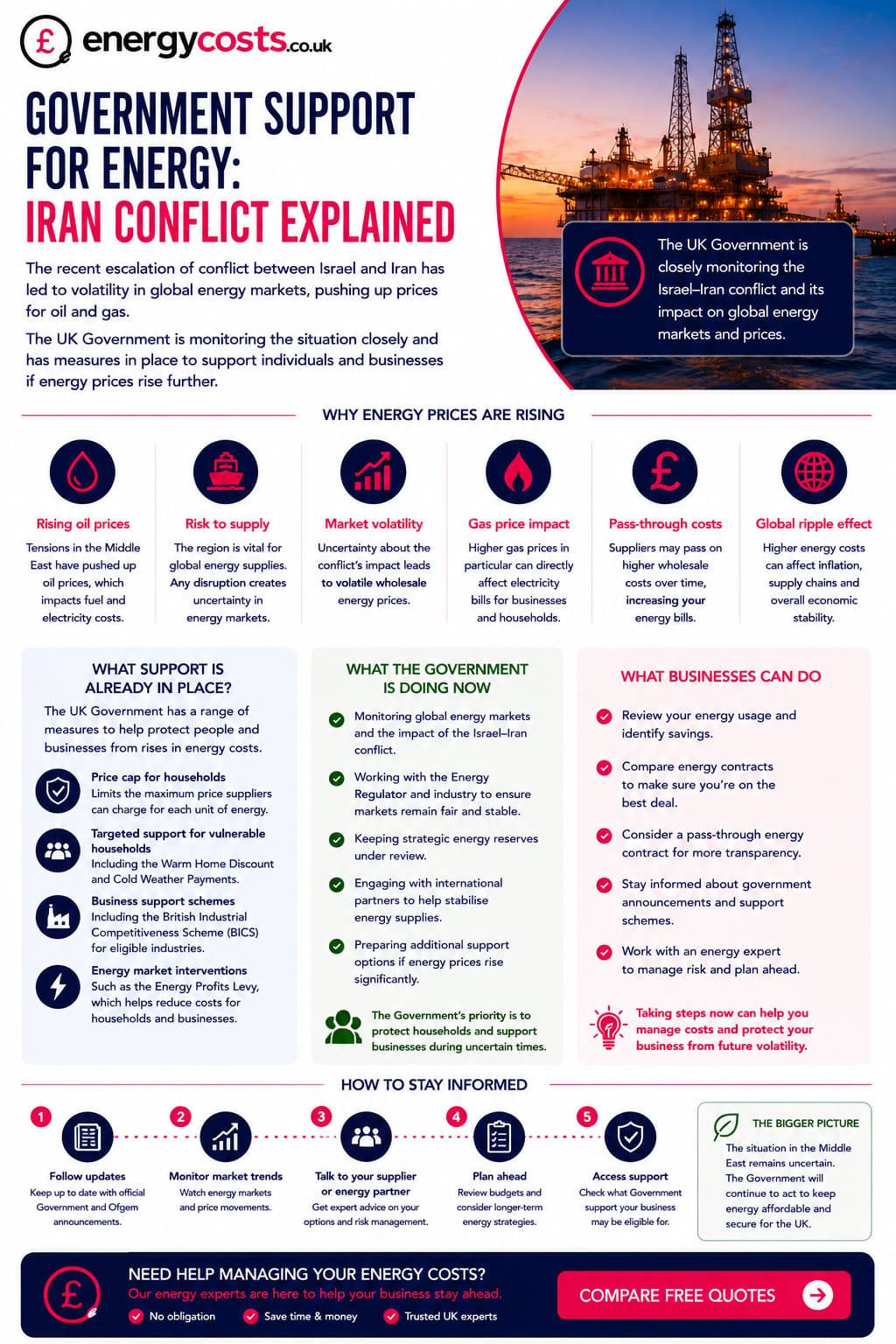
UK businesses are once again facing uncertainty over energy prices, with the war in Iran and wider Middle East conflict pushing up oil prices, disrupting shipping routes and increasing volatility in global gas and electricity markets.
Ofgem has warned that wholesale energy costs remain volatile and will continue to be affected by the situation in the Middle East, although many businesses may only feel the impact when they renew or renegotiate fixed contracts.
The short answer is: yes, there is some UK government support available, but it is limited, targeted and not the same as the broad business energy bill support schemes used during the 2022–2024 energy crisis.
There is currently no universal UK government scheme that automatically compensates all businesses for higher energy costs caused by the war in Iran. Most SMEs, retailers, hospitality businesses, offices and service-sector companies will not receive a direct discount simply because wholesale prices have risen.
However, some support is available for specific types of businesses, especially manufacturers, energy-intensive industries and firms investing in energy efficiency.
Quick answer for UK businesses
| Question | Answer |
|---|---|
| Is there a universal business energy support scheme? | No. The Energy Bills Discount Scheme has closed. |
| Is there a new Iran war energy support scheme? | No dedicated scheme has been announced for all businesses. |
| Are manufacturers getting support? | Some will, through the British Industrial Competitiveness Scheme. |
| Are energy-intensive industries getting help? | Yes, eligible firms can benefit from enhanced electricity cost support. |
| Are SMEs covered by the domestic energy price cap? | No. Businesses are not protected by the household price cap. |
| Can businesses get grants? | Possibly, but mainly for energy efficiency, equipment, decarbonisation or local business support. |
| What should businesses do now? | Check contract end dates, avoid deemed rates, speak to suppliers early and assess eligibility for targeted schemes. |
Why the Iran conflict is affecting business energy costs
The war in Iran has affected global energy markets because of the importance of the Middle East to oil and liquefied natural gas supply routes. Reuters reported that disruptions around the Strait of Hormuz are fuelling volatility in oil and LNG prices and increasing freight, insurance and logistics costs.
For UK businesses, this does not always mean an instant increase in the unit rate on the next bill. Many commercial energy contracts are fixed, and suppliers often buy gas and electricity in advance. Ofgem says many non-domestic customers are currently protected by fixed contracts, but higher wholesale costs may feed through when contracts end or are renegotiated.
This means the businesses most exposed are likely to include:
- companies renewing fixed gas or electricity contracts in 2026
- businesses on deemed, variable or out-of-contract rates
- high-consumption manufacturers
- firms using large volumes of gas, electricity, LPG, diesel or heating oil
- businesses with energy-intensive refrigeration, heating, production, baking, drying, cooling or processing needs
- firms affected by wider supply chain and transport cost increases
Is the Energy Bills Discount Scheme still available?
No. The Energy Bills Discount Scheme, often shortened to EBDS, is no longer available.
The Energy Bills Discount Scheme ran from 1 April 2023 to 31 March 2024 and has now closed. It replaced the earlier Energy Bill Relief Scheme, which supported businesses and organisations between 1 October 2022 and 31 March 2023.
This is important because many business owners still search for “business energy bill support”, “Energy Bills Discount Scheme” or “government support for business energy bills” expecting to find an active scheme. In practice, the broad, automatic support used during the earlier energy crisis has ended.
The previous Energy Bill Relief Scheme was much more generous. It set supported wholesale prices of £211 per MWh for electricity and £75 per MWh for gas for eligible non-domestic customers, but that scheme closed in 2023.
Is there a business energy price cap?
No. There is no business energy price cap equivalent to the household energy price cap.
Ofgem states that the price cap does not protect customers with non-domestic energy contracts, including businesses and charities.
This means a business energy customer may pay very different rates depending on:
- when the contract was signed
- wholesale market conditions at renewal
- contract length
- credit risk
- meter type
- annual consumption
- region
- whether the business uses a broker
- whether the site is on a fixed, flexible, deemed or out-of-contract tariff
The lack of a price cap makes contract timing especially important during periods of geopolitical volatility.
What government support is available now?
Although there is no universal energy bill discount for all businesses, several forms of support may still be relevant.
British Industrial Competitiveness Scheme
The most significant new support is the British Industrial Competitiveness Scheme, or BICS.
The government announced in April 2026 that electricity bills would be cut by up to 25% for more than 10,000 manufacturers through the scheme. Support is due to start from April 2027, with a one-off additional payment in 2027 to cover support firms would have received from April 2026.
BICS is not a general SME support scheme. It is aimed at eligible manufacturing and industrial businesses, including sectors such as automotive, aerospace, steel, pharmaceuticals, metal fabrication, recycling, plastics, nuclear fuel processing, and cooling and ventilation equipment manufacturing.
The scheme works by exempting eligible businesses from the indirect costs of three electricity schemes:
| Electricity cost component | BICS treatment |
|---|---|
| Renewables Obligation | Eligible businesses can receive exemption |
| Feed-in Tariffs | Eligible businesses can receive exemption |
| Capacity Market | Eligible businesses can receive exemption from later in 2027 |
The government says this support is worth around £35–£40 per MWh and is expected to be worth up to £600 million per year from April 2027.
Who can benefit from BICS?
BICS is expected to help both large businesses and SMEs where the site meets the eligibility rules. Support is applied site by site, based on the share of electricity used to manufacture eligible products. Sites using less than 25% eligible electricity receive no exemption; sites using 25% to less than 50% eligible electricity receive a 50% exemption; and sites using 50% or more eligible electricity receive a 100% exemption.
Does BICS help with gas bills?
No, not directly. BICS is focused on electricity costs, particularly policy costs added to electricity bills. It does not provide a general discount on wholesale gas, LPG, heating oil or diesel.
British Industry Supercharger and network charge support
A second area of support is the British Industry Supercharger, including the Network Charging Compensation Scheme for eligible energy-intensive industries.
The government has committed to increasing the level of relief offered through the Network Charging Compensation Scheme from 60% to 90%, with the uplift taking effect from 1 April 2026.
This support is aimed at the most energy-intensive sectors, not ordinary commercial energy users. Eligible businesses can receive compensation for certain electricity network charges, but the scheme works in arrears. The government says eligible energy-intensive industries can expect their first uplifted compensation payments after April 2027.
For businesses that qualify, the support can be significant. For businesses that do not qualify, it does not reduce bills.
Climate Change Agreements
Some energy-intensive businesses may also reduce energy-related tax through a Climate Change Agreement, often shortened to CCA.
A CCA is a voluntary agreement where eligible facilities commit to reducing energy use or emissions. In return, they can pay reduced rates of the Climate Change Levy, which is added to many business energy bills.
From 1 April 2026, the main Climate Change Levy rates for electricity and natural gas are £0.00801 per kWh. Businesses in a Climate Change Agreement pay a reduced percentage of the main rate: 8% for electricity and 11% for natural gas.
This means CCA eligibility can be valuable for qualifying energy-intensive businesses, although it is not designed as emergency support for the Iran conflict.
Energy efficiency grants and local schemes
For businesses that do not qualify for industrial energy support, the most realistic form of government-related help is often through energy efficiency grants, loans or local business schemes.
Ofgem says many government schemes offer loans, grants or subsidised energy-saving measures for small businesses, usually covering areas such as energy efficiency, efficient equipment, waste reduction and sustainable development.
These schemes vary by region and may be run by:
- local councils
- combined authorities
- devolved administrations
- local enterprise bodies
- sector-specific programmes
- net zero or sustainability grant schemes
- supplier-led efficiency funds
Typical funded measures may include:
| Energy-saving measure | Possible benefit |
|---|---|
| LED lighting | Lower electricity use, especially in retail, warehouses and offices |
| Solar panels | Reduced grid electricity consumption |
| Heat pumps | Lower-carbon heating where suitable |
| Insulation | Lower heating demand |
| Efficient refrigeration | Lower electricity costs for food, retail and hospitality businesses |
| Variable speed drives | Lower motor and pump electricity use |
| Energy monitoring | Better control of peak demand and waste |
| Building controls | Reduced heating, cooling and ventilation waste |
These grants usually do not pay existing energy bills. They are designed to reduce future usage.
Supplier payment plans and hardship support
If a business is struggling to pay its energy bills, the first step is usually to speak to the supplier as soon as possible.
Ofgem says suppliers may be able to agree a payment plan, review debt repayments, offer more time to pay, provide payment breaks or reductions, or give access to hardship funds.
This is not the same as a government subsidy, but it can help with short-term cash flow. Businesses should also check whether they are being billed from actual meter readings rather than estimated usage, especially if energy costs have risen suddenly.
What support is not available?
The following forms of support are not currently available as broad schemes for all UK businesses:
| Support type | Current position |
|---|---|
| Universal business energy bill discount | Not available |
| Energy Bills Discount Scheme | Closed |
| Energy Bill Relief Scheme | Closed |
| Business energy price cap | Does not exist |
| Automatic Iran war energy compensation | Not available |
| General wholesale gas price subsidy | Not available |
| Automatic support for deemed rates | Not available |
| Automatic support for fixed contract renewals | Not available |
What should businesses do now?
Businesses concerned about energy cost increases linked to the war in Iran should not assume that government support will cover the increase. The most practical steps are commercial, contractual and operational.
Check your contract end date
The biggest risk point is often the contract renewal date. A business that signed a fixed deal before the latest market shock may be protected temporarily, while a business renewing now may face much higher offers.
Avoid deemed and out-of-contract rates
Deemed and out-of-contract rates are often more expensive than negotiated fixed contracts. Ofgem says around 10–12% of businesses are currently on deemed contracts, with more expected to renegotiate during spring and summer 2026.
Ask for several quotes
Rates can vary significantly between suppliers. Businesses should compare more than one quote and check the standing charge, unit rate, contract term, pass-through charges, termination clauses and broker commission arrangements.
Do not rush into a long contract
Ofgem advises businesses not to feel pressured into signing and warns there is no cooling-off period for business energy contracts, so terms and fees should be checked before agreeing.
Check eligibility for targeted support
Manufacturers and energy-intensive businesses should check whether they may qualify for:
- British Industrial Competitiveness Scheme support
- British Industry Supercharger support
- Network Charging Compensation Scheme relief
- Climate Change Agreement reduced CCL rates
- local energy efficiency funding
- sector-specific decarbonisation grants
Reduce consumption before renewal
Lowering usage before a renewal can improve budget certainty and may make a business more attractive to suppliers. Practical actions include LED upgrades, smart controls, refrigeration servicing, voltage optimisation, compressed air leak checks, boiler optimisation, heat recovery and staff energy-saving processes.
Conclusion
There is some UK government support available for business energy costs, but there is no broad emergency support scheme for all businesses affected by energy price increases caused by the war in Iran.
The most important new help is targeted at manufacturers and energy-intensive businesses through the British Industrial Competitiveness Scheme and the British Industry Supercharger. These schemes may reduce electricity costs materially for eligible firms, but they are not immediate, universal or focused on ordinary SMEs.
For most businesses, the best approach is to check contract exposure, avoid expensive deemed rates, compare renewal options early, speak to suppliers if bills become unaffordable, and look for grants that reduce future energy use rather than expecting a direct government payment.
FAQ
No dedicated UK government scheme has been announced for all businesses facing energy cost increases caused by the war in Iran. Current support is mainly targeted at manufacturers, energy-intensive industries and energy efficiency projects.
Most SMEs cannot claim a universal business energy bill discount. Some may qualify for local grants, supplier support, energy efficiency funding or targeted schemes if they operate in eligible industrial sectors.
Yes. The Energy Bills Discount Scheme ran from 1 April 2023 to 31 March 2024 and is now closed. It replaced the earlier Energy Bill Relief Scheme, which also closed.
No. The household energy price cap does not apply to non-domestic contracts. Businesses, charities and other non-domestic customers are not protected by the Ofgem domestic price cap.
BICS stands for British Industrial Competitiveness Scheme. It is a targeted electricity cost support scheme for eligible manufacturers, designed to reduce bills by exempting qualifying sites from certain electricity policy costs.
BICS is due to reduce bills from April 2027, with a one-off additional payment in 2027 to reflect support that eligible firms would have received from April 2026.
No. BICS is focused on electricity policy costs. It does not provide a general discount on business gas, LPG, heating oil or diesel.
Check the current contract end date, compare renewal offers early, avoid deemed rates where possible, submit accurate meter readings and assess whether the business qualifies for energy efficiency grants or targeted industrial support.