

TikTok does not publish a clear, platform-wide electricity consumption figure, so there is no official answer for exactly how many kWh, MWh or TWh TikTok uses each year.
The best available answer is that TikTok’s energy use is likely very large, mainly because it is a video-heavy platform running at global scale, but the company does not disclose enough data to calculate its full electricity footprint precisely.
The most useful public evidence comes from three areas:
- TikTok’s data centre investments in Europe
- ByteDance’s carbon neutrality and renewable electricity commitments
- third-party carbon footprint estimates, including analysis by Greenly reported by The Guardian and Fortune
Summary answer
| Question | Best available answer |
|---|---|
| Does TikTok publish total electricity use? | No |
| Does TikTok publish energy per video view? | No |
| Main energy driver | Short-form video storage, streaming, recommendations and data centres |
| Publicly stated global user base | More than 1 billion monthly users |
| Estimated TikTok emissions per minute | 2.921g CO2e, according to Greenly analysis |
| Estimated emissions per average user per year | 48.49kg CO2e, according to Greenly analysis |
| Greenly’s estimated 2023 emissions in US, UK and France | Around 7.6 million tonnes CO2e |
| Greenly’s estimated global TikTok emissions | Around 50 million tonnes CO2e |
| TikTok’s Norway data centre capacity | 90MW currently online, with potential to scale to 150MW |
| Annual electricity use of 90MW running continuously | Around 0.79TWh before any additional PUE adjustment |
| TikTok’s target | Operational carbon neutrality by 2030 |
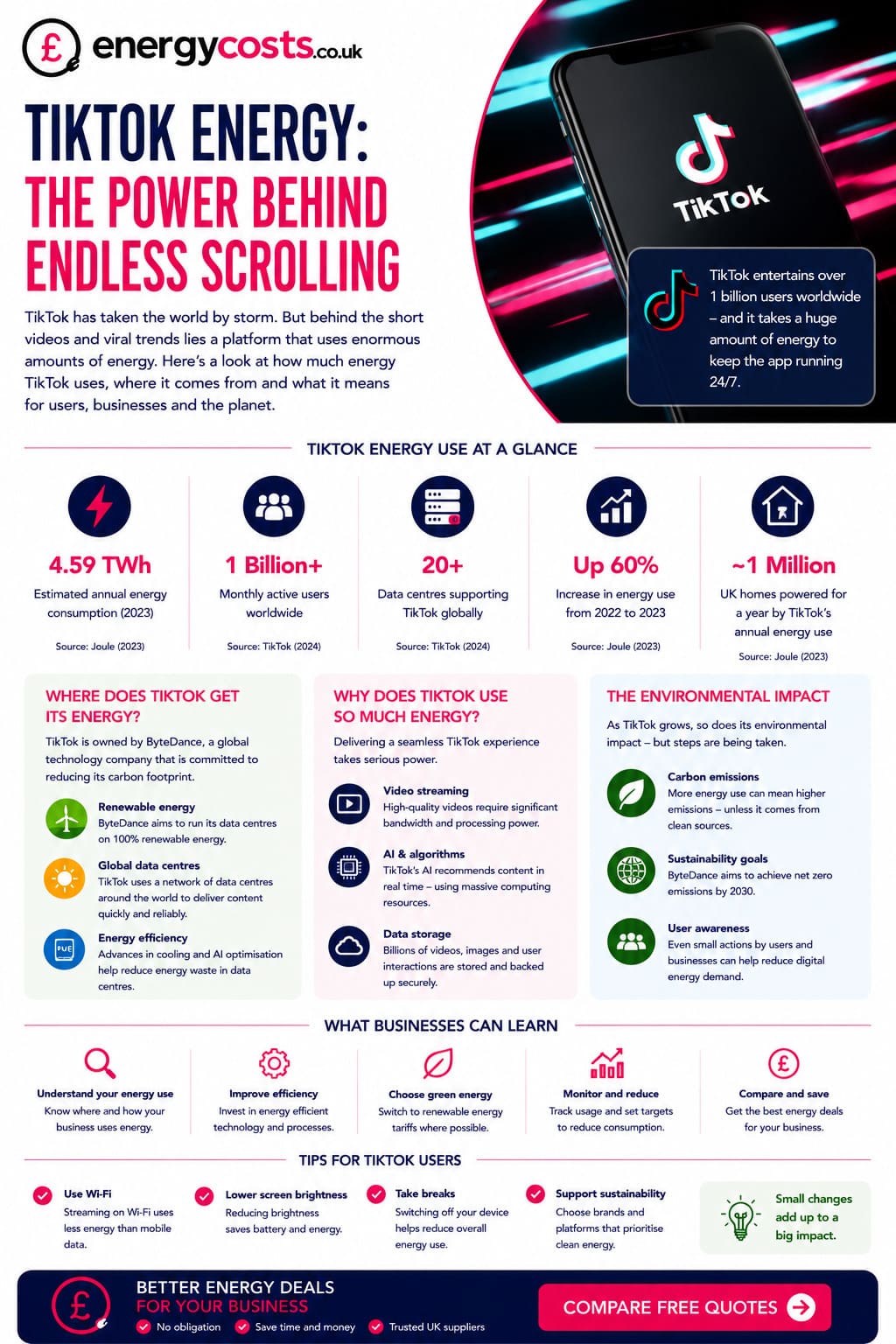
TikTok says more than 1 billion people use the platform each month. ByteDance has committed to operational carbon neutrality by 2030 and says it aims to reduce operational emissions by at least 90% by 2030, with the remainder addressed through offsets. It has also committed to sourcing 100% renewable electricity for global operations by 2030.
Why TikTok’s energy use is difficult to calculate
TikTok is owned by ByteDance, and ByteDance does not publish a detailed public energy breakdown for TikTok in the same way that Meta publishes environmental data for its wider operations. That means there is no official public figure for TikTok-only electricity use, TikTok data centre electricity use, or electricity per TikTok video view.
TikTok’s energy use depends on several factors:
| Factor | Why it matters |
|---|---|
| Video streaming volume | TikTok is dominated by short-form video, which is more data-heavy than text |
| Time spent on the app | Longer daily usage increases server, network and device energy |
| Recommendation algorithms | The “For You” feed requires constant ranking and personalisation |
| Video storage | Uploaded videos must be stored, replicated and delivered quickly |
| Content processing | Video compression, moderation, transcription and effects all use compute |
| Data centres | Servers, storage, networking and cooling require electricity |
| User devices | Phones, tablets and routers use energy while users scroll |
| Network infrastructure | Mobile and broadband networks use energy to deliver video |
| Power source | The carbon impact depends on whether electricity comes from renewables, gas, coal, nuclear or mixed grids |
For this reason, it is better to treat all published TikTok energy figures as estimates unless they come directly from ByteDance or TikTok and are independently audited.
What TikTok uses energy for
TikTok’s energy footprint is not just the electricity used by someone’s phone while watching videos. The larger energy use sits behind the scenes.
| Activity | Energy use involved |
|---|---|
| Uploading videos | Data transfer, processing, storage and backup |
| Watching videos | Data centre serving, content delivery networks, mobile networks and device power |
| Recommendation feed | Machine learning systems ranking videos for each user |
| Content moderation | Automated and human review systems, including AI tools |
| Video effects | Filters, editing tools, AR features and rendering |
| Advertising | Ad auctions, targeting, measurement and analytics |
| TikTok Shop | Product listings, video commerce, messaging, payments and logistics data |
| Live streaming | Real-time video delivery, comments, gifts and moderation |
| Data security | Regional data storage, access controls and monitoring |
The individual energy use of one swipe or one short video may be small, but TikTok’s global scale makes the total impact significant.
How much electricity could TikTok’s Norway data centre use?
TikTok’s most visible energy footprint in Europe is its Project Clover data centre programme.
TikTok says its Norwegian data centre in Hamar is now fully online. Green Mountain, the data centre operator, says the facility has three buildings in operation, with 90MW of total capacity, and TikTok is the sole tenant. The same site has the potential to expand to five 30MW buildings, or 150MW.
If a 90MW data centre ran continuously for a full year, it would use:
| Data centre power | Annual electricity use at 100% continuous load | Equivalent typical UK household electricity use |
|---|---|---|
| 30MW | 0.26TWh | Around 97,000 homes |
| 50MW | 0.44TWh | Around 162,000 homes |
| 90MW | 0.79TWh | Around 292,000 homes |
| 128MW | 1.12TWh | Around 415,000 homes |
| 150MW | 1.31TWh | Around 487,000 homes |
These are scale estimates, not confirmed annual consumption figures. Actual use depends on utilisation, IT load, cooling overheads and how the facility’s stated capacity is defined.
The household comparison uses Ofgem’s typical electricity consumption value of 2,700kWh per year for a medium household in England, Scotland and Wales. (Ofgem)
What about data centre efficiency?
Data centre efficiency is often measured using PUE, or Power Usage Effectiveness. A PUE of 1.2 means that for every 1kWh used by IT equipment, the total site uses about 1.2kWh after adding cooling, power distribution and other overheads.
TikTok says its Norway data centre will have a PUE of less than 1.2, while Green Mountain and related reporting describe the Hamar site as a renewable-powered data centre with an average PUE around 1.2.
If the 90MW figure refers to IT capacity, then a PUE of 1.2 would imply a possible total site load of around 108MW at full use. That would equal about 0.95TWh per year if running continuously at full capacity.
| Assumption | Approximate annual electricity use |
|---|---|
| 90MW total site load | 0.79TWh |
| 90MW IT load with PUE 1.2 | 0.95TWh |
| 150MW total site load | 1.31TWh |
| 150MW IT load with PUE 1.2 | 1.58TWh |
This shows why definitions matter. A “90MW data centre” can mean different things depending on whether the figure refers to IT power, grid capacity or total facility demand.
TikTok’s new Finland data centres
TikTok is also expanding in Finland. Reuters reported in April 2026 that TikTok plans to invest €1 billion in a second Finnish data centre in Lahti, with an initial capacity of 50MW and total potential capacity of 128MW. Reuters also reported that TikTok’s first Finnish data centre in Kouvola is due to be operational by the end of 2026, with the second expected by 2027.
At full continuous use, the Lahti project alone could involve substantial electricity demand:
| Lahti capacity scenario | Annual electricity use at 100% continuous load |
|---|---|
| 50MW initial capacity | 0.44TWh |
| 128MW potential capacity | 1.12TWh |
Again, these are power-capacity-based estimates, not confirmed annual consumption figures. They show the scale of electricity demand involved in TikTok’s European data localisation programme.
How much energy does one minute of TikTok use?
TikTok does not publish electricity use per minute. However, Greenly’s analysis, reported by The Guardian, estimated that one minute on TikTok produces 2.921g CO2e, with data centres accounting for about 99% of the footprint in its methodology. The same analysis estimated that the average TikTok user generates 48.49kg CO2e per year from using the platform.
Carbon is not the same as energy. The amount of electricity behind 2.921g CO2e depends on the carbon intensity of the power used. For illustration:
| Assumed electricity carbon intensity | Electricity implied by 2.921g CO2e |
|---|---|
| 100g CO2e/kWh | 29.2Wh per minute |
| 200g CO2e/kWh | 14.6Wh per minute |
| 300g CO2e/kWh | 9.7Wh per minute |
| 500g CO2e/kWh | 5.8Wh per minute |
This table should not be treated as a measured TikTok electricity figure. It simply shows how a carbon estimate can translate into different electricity estimates depending on the assumed grid mix.
How much energy does an average TikTok user use per year?
Using Greenly’s reported estimate of 48.49kg CO2e per average user per year, the implied electricity use again depends heavily on the carbon intensity assumption.
| Assumed electricity carbon intensity | Implied electricity per user per year |
|---|---|
| 100g CO2e/kWh | 485kWh |
| 200g CO2e/kWh | 242kWh |
| 300g CO2e/kWh | 162kWh |
| 500g CO2e/kWh | 97kWh |
These estimates are very uncertain because TikTok’s real footprint includes data centres, networks, devices, different countries, different power mixes and different usage patterns. They are useful for showing scale, not for producing a definitive electricity-per-user figure.
What did Greenly estimate about TikTok’s carbon footprint?
Greenly’s analysis, reported by The Guardian, estimated that TikTok’s emissions in the US, UK and France were around 7.6 million tonnes CO2e in 2023. Because those three markets made up just under 15% of TikTok’s global user base in the analysis, Greenly estimated that TikTok’s global footprint could be around 50 million tonnes CO2e.
Fortune reported that TikTok disputed Greenly’s findings, with a TikTok spokesperson saying that ByteDance’s 2023 total carbon emissions, covering all operations beyond TikTok, were less than 20% of Greenly’s estimate. Fortune also reported that ByteDance completes a carbon footprint assessment aligned with the Greenhouse Gas Protocol, including emissions from third-party colocation data centres.
That dispute is important. Greenly’s estimate is not the same thing as an official TikTok disclosure.
| Source | What it says |
|---|---|
| TikTok / ByteDance | No full public TikTok electricity dataset; carbon neutrality and renewable electricity commitments |
| Greenly analysis | Very high estimated emissions, driven by video use and time spent on the app |
| TikTok response reported by Fortune | Disputes Greenly’s estimate and says ByteDance’s 2023 emissions were much lower |
| Public data centre announcements | Confirm major power capacity for European data storage |
Why TikTok may use more energy than some other social platforms
TikTok is built around continuous video. That can make it more energy-intensive than platforms based mainly on text, static images or lower-engagement browsing.
| Feature | Energy impact |
|---|---|
| Autoplay video | Constant data transfer and server activity |
| Infinite scroll | Encourages long sessions |
| Personalised recommendations | Requires machine learning and real-time ranking |
| High upload volume | Requires video processing, storage and moderation |
| Live streaming | Requires low-latency delivery and moderation |
| Short videos | Individual videos are short, but total viewing time can be very high |
| TikTok Shop | Adds ecommerce, product feeds, payments and tracking data |
| Creator tools | Editing, filters, effects and analytics add compute demand |
The Guardian’s reporting of Greenly’s analysis noted that the average TikTok user spent 45.5 minutes a day on the app, compared with 30.6 minutes for Instagram in that analysis. Longer average usage is one reason TikTok can have a high footprint per user even when the emissions per minute are similar to other video-heavy platforms.
TikTok versus YouTube, Instagram and Facebook
Greenly’s analysis, as reported by The Guardian, estimated very similar emissions per minute for TikTok, YouTube and Instagram:
| Platform | Estimated CO2e per minute |
|---|---|
| YouTube | 2.923g CO2e |
| TikTok | 2.921g CO2e |
| 2.912g CO2e |
The more important difference is time spent. If users spend longer on TikTok, annual emissions per user can be higher even if the per-minute figure is similar. The same Greenly analysis estimated annual emissions of 48.49kg CO2e for the average TikTok user, compared with 40.17kg for YouTube and 32.52kg for Instagram.
Is TikTok powered by renewable energy?
ByteDance says it has committed to sourcing 100% renewable electricity for global operations by 2030. It also says it aims to achieve operational carbon neutrality by 2030 and reduce operational emissions by at least 90%.
TikTok says its Norway data centre aligns with this target and will run on 100% renewable electricity. The company also says the facility has potential for heat reuse, with most of the energy generated transformed into low-temperature heat that could be used locally.
However, there is an important distinction between:
| Term | Meaning |
|---|---|
| Renewable-powered facility | A specific site uses renewable electricity |
| Renewable matching | A company buys renewable energy or certificates to match annual consumption |
| Operational carbon neutrality | Operational emissions are reduced and remaining emissions are offset |
| Full value-chain net zero | Wider emissions, including suppliers, devices and networks, are addressed |
TikTok’s renewable data centre investments are significant, but they do not prove that every TikTok video is physically delivered using renewable electricity at every moment.
TikTok and European data centres
TikTok’s European data centre build-out is partly about data security and regulatory pressure, but it is also an energy story because the sites require large grid connections.
Project Clover is TikTok’s European data security programme. TikTok says European user data is stored by default in a dedicated European enclave hosted across data centres in Norway, Ireland and the US, with independent oversight from NCC Group.
The energy significance is that data localisation can increase regional data centre investment. TikTok’s Norway, Ireland and Finland infrastructure means more electricity demand in Europe, even if some of that demand uses low-carbon Nordic power.
Could TikTok affect electricity grids?
Yes, at local level. A single data centre campus can require as much power as a major industrial site.
The most direct example is TikTok’s Norway data centre. The Hamar campus has 90MW online and potential to scale to 150MW. Green Mountain says the site is used by TikTok to store and process data for European users.
Data centre energy demand can affect:
- local grid capacity
- connection queues
- network reinforcement
- industrial competition for electricity
- local planning debates
- heat reuse opportunities
- demand for renewable power purchase agreements
For businesses, the wider lesson is that digital platforms are not “weightless”. Video apps, cloud services, AI systems and ecommerce platforms all rely on physical electricity infrastructure.
How TikTok fits into wider data centre energy demand
TikTok is part of a much larger trend: rapid growth in data centre electricity demand.
The International Energy Agency says data centres accounted for around 415TWh, or about 1.5% of global electricity consumption, in 2024. Its base case projects data centre electricity use rising to around 945TWh by 2030, just under 3% of global electricity consumption.
TikTok is not the only driver of this growth. AI, cloud computing, video streaming, ecommerce, online gaming, business software and digital advertising all contribute. But TikTok is a useful example because its product is highly video-focused and extremely engaging.
Does watching TikTok use more energy than posting text?
Almost certainly, yes.
Watching and uploading video generally requires more energy than reading or posting text because video needs:
- more data transfer
- more storage
- more processing
- more caching
- more content delivery capacity
- more device screen time
- more moderation and recommendation activity
A text post may involve a few kilobytes. A video can involve many megabytes, especially if watched by thousands or millions of people. TikTok reduces this through compression and content delivery optimisation, but video remains more energy-intensive than text.
What about the energy used by your phone?
Your phone’s electricity use is only part of the picture. If you watch TikTok for an hour, your device uses battery power, but the platform also uses energy in data centres, mobile networks, Wi-Fi routers and content delivery infrastructure.
Greenly’s analysis, reported by The Guardian, said data centres made up about 99% of the footprint in its calculation, with device charging also included.
That estimate may be debated, but the broader point is clear: the biggest energy issue is usually the infrastructure behind the app, not only the electricity used to recharge a phone.
What does TikTok’s energy use mean for businesses?
TikTok’s energy use matters to businesses in several ways.
First, companies that advertise on TikTok may increasingly be asked about the carbon footprint of digital advertising. A TikTok ad campaign uses energy through video hosting, delivery, ad auctions, targeting and analytics.
Second, TikTok shows how consumer digital behaviour can become a major electricity infrastructure issue. Short videos look small on a phone screen, but global video platforms require large data centres.
Third, TikTok’s European data centre expansion shows how digital regulation and data sovereignty can drive new electricity demand. When platforms are required or encouraged to store data regionally, more local data centre capacity is needed.
Fourth, the growth of data centres can affect energy markets, grid connections and network investment. This is especially relevant to businesses planning electrification, EV charging, solar, batteries or large power upgrades.
Can businesses reduce the carbon footprint of TikTok marketing?
A business cannot control TikTok’s data centre energy mix, but it can make its own digital marketing more efficient.
| Action | Why it helps |
|---|---|
| Avoid unnecessary video uploads | Reduces storage and processing demand |
| Reuse creative assets intelligently | Cuts repeated production and upload cycles |
| Compress video properly | Reduces file sizes and delivery bandwidth |
| Target campaigns carefully | Reduces wasted impressions |
| Shorten videos where appropriate | Reduces viewing and data transfer time |
| Measure performance by outcome | Avoids low-value high-volume campaigns |
| Use greener production methods | Reduces the footprint of filming and editing |
| Ask platforms for sustainability data | Encourages better disclosure |
For most SMEs, TikTok energy use will not be a major Scope 3 calculation item today. However, larger brands and agencies may increasingly need to account for the carbon impact of digital media buying.
How TikTok could reduce its energy use
TikTok and ByteDance could reduce energy consumption and emissions through:
| Method | How it helps |
|---|---|
| More renewable electricity | Reduces carbon impact of data centre power |
| Better data centre PUE | Reduces cooling and overhead electricity |
| Heat reuse | Uses waste heat for local purposes |
| More efficient video compression | Reduces data transfer and storage needs |
| Efficient recommendation models | Reduces compute per feed action |
| Cleaner content delivery networks | Reduces emissions from edge infrastructure |
| Regional data efficiency | Avoids unnecessary long-distance data movement |
| Transparent reporting | Allows external scrutiny and better comparisons |
| Supplier decarbonisation | Reduces value-chain emissions |
| Device efficiency features | Reduces battery drain for users |
TikTok’s challenge is that efficiency improvements can be offset by growth. If more people spend more time watching more video, total energy use can still rise even if energy per video falls.
What is the most realistic estimate?
Because TikTok does not disclose full electricity use, the safest conclusion is a range-based one:
| Area | What can be said confidently |
|---|---|
| One video view | No official electricity figure |
| One minute of TikTok | No official electricity figure; Greenly estimated 2.921g CO2e per minute |
| One average user per year | No official electricity figure; Greenly estimated 48.49kg CO2e per year |
| TikTok’s Norway data centre | 90MW online, potentially 150MW; 90MW continuous load equals 0.79TWh per year |
| TikTok’s wider global operations | Not publicly disclosed in enough detail |
| Carbon impact | Highly disputed; Greenly estimated around 50 million tonnes CO2e globally, while TikTok disputed the figure |
The key point is that TikTok’s exact electricity use is unknown, but its visible data centre capacity and video-heavy usage model show that it is likely a very large energy user.
Final verdict
TikTok does not publish a full electricity-use figure, so no one outside the company can say exactly how much energy TikTok uses each year.
However, the available evidence suggests that TikTok’s energy footprint is substantial. The platform has more than 1 billion monthly users, is built around continuous video streaming, and is investing billions in large data centres across Europe. Its fully online Norway data centre has 90MW of capacity, which would equal around 0.79TWh per year if operated continuously at full load before any further PUE-related adjustment.
Third-party estimates are more controversial. Greenly’s analysis, reported by The Guardian, estimated TikTok emissions at around 7.6 million tonnes CO2e in the US, UK and France in 2023 and around 50 million tonnes CO2e globally. TikTok has disputed those findings, with Fortune reporting that the company said ByteDance’s total 2023 emissions were less than 20% of Greenly’s estimate.
The most accurate answer is therefore: TikTok’s precise energy use is not publicly known, but it is likely very large, mainly because short-form video at global scale requires major data centre, network and device energy.
FAQ
TikTok does not publish a full electricity-use figure. Publicly available evidence includes data centre capacity, renewable electricity commitments and third-party carbon estimates, but not a complete TikTok-wide kWh or TWh figure.
TikTok does not publish energy use per video view. The figure would vary depending on video length, quality, device, network, caching, location and how many times the video is watched.
TikTok does not publish electricity use per minute. Greenly’s analysis, reported by The Guardian, estimated 2.921g CO2e per minute, but that is a carbon estimate rather than a direct electricity measurement.
TikTok is video-heavy, personalised and used at large scale. Energy is needed for data centres, storage, content delivery, recommendation algorithms, video processing, moderation, advertising systems, user devices and network infrastructure.
Per minute, Greenly’s analysis estimated TikTok and YouTube emissions to be almost identical: 2.921g CO2e for TikTok and 2.923g CO2e for YouTube. However, TikTok’s average annual user footprint was estimated to be higher because users spend a long time on the app.
ByteDance has committed to sourcing 100% renewable electricity for global operations by 2030. TikTok’s Norway data centre is described as running on renewable energy, but that does not mean every TikTok interaction worldwide is physically powered by renewable electricity at every moment.
Green Mountain says TikTok’s Hamar data centre has 90MW of capacity in operation. A 90MW facility running continuously at full load would use around 0.79TWh per year, before any additional adjustment depending on how the capacity figure is defined.
TikTok’s European data centre programme is part of Project Clover, which is intended to store European user data in a dedicated European enclave with additional security controls and independent oversight.
Not directly for most businesses. However, TikTok is part of the wider growth in data centre electricity demand, which can affect grid capacity, network investment and long-term electricity infrastructure planning.
The main issue is scale. A single TikTok video is small, but billions of video views, long user sessions, constant recommendations and major data centre investments can create a very large total electricity footprint.