
Good Energy is a well-known name in the UK energy sector, particularly for its focus on renewable energy solutions. For businesses that prioritise sustainability, Good Energy offers a range of business tariffs and features aimed at reducing their carbon footprint while providing competitive pricing. Here we provide a comprehensive review of Good Energy business tariffs, prices, and the unique features that set it apart from other providers.
Good Energy overview
Good Energy is a UK supplier with a strong focus on 100% renewable electricity and ethical energy provision. While better known in the domestic market, it also provides business energy contracts that appeal to organisations prioritising sustainability and clean energy sourcing.
Supplier snapshot:
- Supplier type: Independent UK energy supplier
- Fuel supplied: Electricity (renewable) and gas (optional dual fuel)
- Target customers: Small to medium-sized businesses and value-led organisations
- Tariff types: Fixed and flexible business contracts
- Smart metering: Supported
- Customer focus: Renewable procurement and ethical energy
Key numbers at a glance
Good Energy’s business proposition now centres on 100% renewable electricity, 3,000+ independent British generators, at least 90% real-time matching, a number one ranking in the Matched Clean Power Index, fixed contracts from 12 to 24 months, and a wider company Trustpilot score of 4.8 out of 5 from more than 14,000 reviews.
| Metric | Figure |
|---|---|
| Renewable electricity supply track record | 25+ years |
| Independent renewable generators | 3,000+ |
| Hourly matching performance | 90%+ real-time matching |
| Transparency ranking | #1 in the Matched Clean Power Index |
| Trustpilot score | 4.8/5 |
| Trustpilot review volume | 14,000+ |
| Fixed contract lengths | 12–24 months |
| Flex contract lengths | 12–36 months |
| Typical threshold for large business supply | 200,000+ kWh electricity per year |
Good Energy business prices list: commercial rates per kWh
Good Energy’s pricing can vary significantly based on factors such as location, business size, and energy usage. Although exact prices are usually customised, here is an indicative pricing table for Good Energy’s business tariffs to provide a rough idea of what you might expect. Keep in mind that these rates can fluctuate, so it is always best to request a quote for the most accurate pricing.
| Tariff Type | Unit Rate (per kWh) | Standing Charge (per day) |
|---|---|---|
| Fixed-rate electricity | 25p – 32p | 35p – 45p |
| Variable-rate electricity | 24p – 30p | 30p – 42p |
| 100% renewable gas | 6p – 8p | 20p – 30p |
Notes:
- Fixed-rate tariffs generally offer higher unit rates but provide price stability, which is beneficial for long-term budgeting.
- Variable-rate tariffs can vary according to market conditions, which means rates might be lower or higher depending on energy market fluctuations.
- Standing charges cover the cost of maintaining the supply infrastructure, and these fees can differ based on the business’s location and energy provider’s costs.
For an accurate and tailored pricing structure, it’s recommended to contact Good Energy directly or use our business energy comparison tool.
Good Energy contract options
Good Energy’s current business range now spans fixed contracts, index-linked contracts, Corporate PPAs and Flex contracts, with different structures for budget certainty, wholesale exposure, and long-term ESG-led procurement. Good Energy also states that its business contracts can be tailored to customer needs and highlights no volume tolerance charges within its flexible contract offer.
| Contract type | Best for | Meter type | Term length | Pricing structure | Notice / flexibility |
|---|---|---|---|---|---|
| Fixed price | Businesses that want budget certainty | Half-hourly and non-half-hourly | 12–24 months | Price fixed for the full contract term | Stable pricing for the agreed term |
| Index-linked | Businesses that want market-linked pricing | Half-hourly only | Variable | Tracks the day-ahead wholesale market | 30-day notice period |
| Corporate PPA | Businesses seeking long-term price stability and stronger ESG evidence | Business sites with more sophisticated procurement needs | Long-term | Long-term offtake with hourly matching from generation to delivery | Designed for price stability and reduced hedging exposure |
| Flex contracts | Larger organisations with high consumption and more complex buying strategies | Half-hourly and non-half-hourly | 12–36 months | Energy purchased in tranches to respond to market moves | Greater strategic flexibility |
| Hourly matching | Organisations that want more credible carbon reporting | Multi-site and larger business customers | Add-on insight layer | Live matching data against renewable generation | Focused on reporting, visibility and decarbonisation |
Who Good Energy is best for
Good Energy is strongest for organisations that want to prove where their electricity comes from, rather than simply buy a conventional green tariff backed by annual certificate matching. Its offer is especially well suited to ESG-led businesses, larger half-hourly sites that want index-linked or more advanced procurement structures, multi-site organisations that need dedicated account support, and companies that want one provider for supply, solar, export and carbon reporting.
For businesses whose main priority is the very lowest unit price, Good Energy may not always be the cheapest option. For businesses that value renewable traceability, hourly data, dedicated account management and integrated renewable services, it has a much clearer differentiation than many mainstream suppliers.
Customer service and support data
Good Energy says all business customers receive a dedicated account manager, which is a useful operational point to surface much more prominently. As a wider supplier benchmark, Citizens Advice currently gives Good Energy an overall customer service score of 3.46 out of 5, including 4.0 out of 5 for complaints, 3.0 out of 5 for waiting time, 3.4 out of 5 for billing and metering, and 3.0 out of 5 for customer commitments, ranking the supplier 7th in the table for October to December 2025.
| Service indicator | Figure |
|---|---|
| Dedicated account manager for business customers | Yes |
| Trustpilot score | 4.8 / 5 |
| Trustpilot review count | 14,000+ |
| Citizens Advice overall rating | 3.46 / 5 |
| Citizens Advice complaints score | 4.0 / 5 |
| Citizens Advice contact waiting time score | 3.0 / 5 |
| Citizens Advice billing and metering score | 3.4 / 5 |
| Citizens Advice customer commitments score | 3.0 / 5 |
| Citizens Advice rank | 7th |
What you need to get a quote
Good Energy’s business quote form asks for a practical set of details, so readers can be told exactly what to prepare before starting the switch process. The current form requests a contact name, email address, business name, phone number, address, company registration number, and estimated annual consumption in kWh.
Before requesting a quote, have the following ready:
- business name
- company registration number
- site address
- contact name
- phone number
- email address
- estimated annual electricity consumption in kWh
- meter details if available
- current contract end date
Renewable services beyond supply
Good Energy is no longer just a supply-only choice. The wider business offer includes commercial solar, export payments, Power Purchase Agreements, FIT portfolio services, Hourly Matching Credits and green gas. That matters because businesses comparing suppliers increasingly want to know whether the supplier can also help reduce usage, generate on site, export power, and improve Scope 2 reporting.
| Service | What it adds | Useful data point |
|---|---|---|
| Commercial solar | Lower-cost on-site generation and better energy independence | Typical levelised cost of energy of around 7p/kWh |
| Solar ROI | Faster payback than many buyers expect | Payback can be as little as 3–5 years |
| Long-term solar value | Reduced exposure to wholesale prices | 20+ years of effectively free renewable electricity after payback |
| Export and PPAs | Monetises surplus generation | Good Energy buys power from 3,000+ renewable generators |
| FIT administration | Better return from existing generation assets | Good Energy says some portfolios can boost annual FIT earnings by up to 10% |
| Hourly matching credits | Rewards better alignment with renewable generation | Designed to reduce third-party charges when usage aligns |
| Green gas | Adds a lower-carbon gas option | Uses British biogas and certified global projects |
A typical commercial solar installation with a 77kW peak output would save around 11 tonnes of CO2 per year compared with importing electricity from the grid, which is the kind of concrete comparison figure worth adding to a supplier page.
Example savings and case study figures
Real project data helps turn Good Energy from a generic “green supplier” into a measurable commercial option. Good Energy currently publishes example savings figures across manufacturing, education, leisure, healthcare and other sectors.
| Customer / sector | Annual savings | Annual CO2 reduction | Installation size |
|---|---|---|---|
| Bridec – manufacturing and warehousing | £57,000 | 40 tonnes | 257.07kW solar array + 104kW battery |
| Deceuninck – manufacturing and warehousing | £158,000 | 498 tonnes | 1.3MWp |
| E-ACT – education | £272,000 | 226 tCO2e | 1.32MWp |
| Riversmeet Leisure Centre – retail and leisure | £57,000 | 141 tonnes | 252kWp |
| North Kesteven Council – public sector | £22,500 | 14 tonnes | 102.7kWp |
| Abbey Farm – agriculture | £12,250 | 14 tCO2e | 85.4kWp |
| Aldbury Care Home – healthcare | £33,855 | 42.9 tonnes | 85.86kWp |
Good Energy deemed and out-of-contract rates
Good Energy does publish business deemed pricing. For non-half-hourly business sites, the latest business deemed tariff located is effective from 1 May 2025 and excludes VAT. For half-hourly import customers, Good Energy’s current published deemed and out-of-contract rate is 35p/kWh with a standing charge of £25.00 per day, effective from 1 April 2026. Good Energy also says distribution network charges are passed through separately for half-hourly import customers, and it may reconcile TNUoS and Capacity Market charges annually.
Across the published non-half-hourly business deemed tariff, single-rate electricity runs from 27.48p/kWh to 30.93p/kWh depending on region, with a standing charge of 168.52p/day. Day/night electricity runs from 28.75p/kWh to 32.55p/kWh on the day rate and 22.05p/kWh to 23.44p/kWh on the night rate, again with a standing charge of 168.52p/day. Gas runs from 8.11p/kWh to 8.93p/kWh with a standing charge of 79.43p/day.
Business deemed electricity rates – profile class 03
The table below shows Good Energy’s published single-rate business deemed electricity tariff for profile class 03 sites, effective 1 May 2025. Prices exclude VAT.
| Region | Region no. | Standing charge (p/day) | Anytime rate (p/kWh) |
|---|---|---|---|
| East England | 10 | 168.52 | 28.79 |
| East Midlands | 11 | 168.52 | 28.01 |
| London | 12 | 168.52 | 27.77 |
| North Wales & Merseyside | 13 | 168.52 | 30.38 |
| West Midlands | 14 | 168.52 | 27.67 |
| North East England | 15 | 168.52 | 27.74 |
| North West England | 16 | 168.52 | 29.89 |
| North Scotland | 17 | 168.52 | 30.93 |
| South Scotland | 18 | 168.52 | 27.94 |
| South East | 19 | 168.52 | 28.95 |
| Southern | 20 | 168.52 | 28.27 |
| South Wales | 21 | 168.52 | 28.43 |
| South West | 22 | 168.52 | 28.55 |
| Yorkshire | 23 | 168.52 | 27.48 |
Business deemed electricity rates – profile class 04 day/night
The table below shows Good Energy’s published day/night business deemed electricity tariff for profile class 04 sites, effective 1 May 2025. Prices exclude VAT.
| Region | Region no. | Standing charge (p/day) | Day rate (p/kWh) | Night rate (p/kWh) |
|---|---|---|---|---|
| East England | 10 | 168.52 | 30.30 | 22.37 |
| East Midlands | 11 | 168.52 | 29.34 | 22.15 |
| London | 12 | 168.52 | 28.95 | 22.05 |
| North Wales & Merseyside | 13 | 168.52 | 32.07 | 22.74 |
| West Midlands | 14 | 168.52 | 28.97 | 22.17 |
| North East England | 15 | 168.52 | 29.08 | 22.22 |
| North West England | 16 | 168.52 | 31.39 | 22.05 |
| North Scotland | 17 | 168.52 | 32.55 | 23.44 |
| South Scotland | 18 | 168.52 | 29.43 | 22.14 |
| South East | 19 | 168.52 | 30.48 | 22.35 |
| Southern | 20 | 168.52 | 29.89 | 22.05 |
| South Wales | 21 | 168.52 | 30.09 | 22.34 |
| South West | 22 | 168.52 | 30.18 | 22.12 |
| Yorkshire | 23 | 168.52 | 28.75 | 22.50 |
Business deemed gas rates
The table below shows Good Energy’s published business deemed gas tariff, effective 1 May 2025. Prices exclude VAT.
| Region | Region no. | Standing charge (p/day) | Anytime rate (p/kWh) |
|---|---|---|---|
| East England | 10 | 79.43 | 8.17 |
| East Midlands | 11 | 79.43 | 8.11 |
| London | 12 | 79.43 | 8.53 |
| North Wales & Merseyside | 13 | 79.43 | 8.26 |
| West Midlands | 14 | 79.43 | 8.44 |
| North East England | 15 | 79.43 | 8.24 |
| North West England | 16 | 79.43 | 8.18 |
| North Scotland | 17 | 79.43 | 8.20 |
| South Scotland | 18 | 79.43 | 8.20 |
| South East | 19 | 79.43 | 8.44 |
| Southern | 20 | 79.43 | 8.51 |
| South Wales | 21 | 79.43 | 8.53 |
| South West | 22 | 79.43 | 8.93 |
| Yorkshire | 23 | 79.43 | 8.24 |
Half-hourly import deemed and out-of-contract rates
For profile class 00 half-hourly import customers, Good Energy’s current published deemed and out-of-contract charges are the same: 35p/kWh with a standing charge of £25.00/day, effective from 1 April 2026. Good Energy also states that distribution network charges are passed through as separate line items, and TNUoS and Capacity Market charges may be reconciled annually.
| Customer type | Unit rate | Standing charge | Effective from | Notes |
|---|---|---|---|---|
| Half-hourly import customers | 35p/kWh | £25.00/day | 1 April 2026 | DNO charges passed through separately; TNUoS and Capacity Market may be reconciled annually |
Good Energy deemed tariff small print
Good Energy’s published deemed tariff states that the tariff is variable and prices may change with prior notice. It also says micro business customers’ contracts end automatically when a switch takes effect, while non-micro business customers can cancel at any time by giving at least 30 days’ written notice, provided they have paid what they owe and started receiving supply from another supplier. Prices exclude VAT, with business customers generally charged 20%, and de minimis customers and registered charities charged 5%.
Overview of Good Energy business energy tariffs
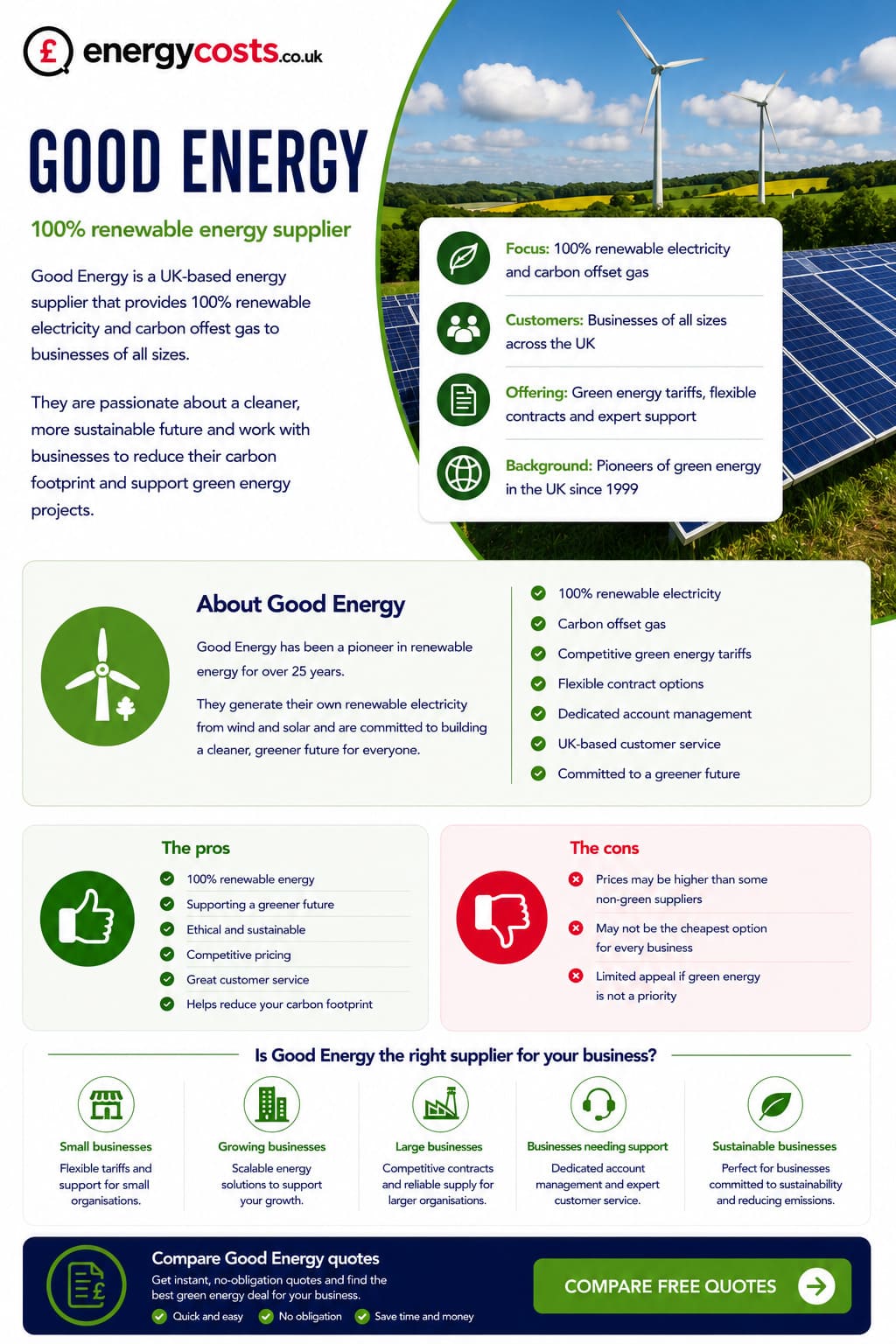
Good Energy is dedicated to providing 100% renewable electricity sourced from wind, solar, hydro, and bioenergy. Their business energy tariffs are designed to cater to companies of all sizes, from small enterprises to large corporations. The main tariffs available for business customers include:
- Fixed-rate tariffs: These tariffs lock in the energy price for a specified period, usually ranging from one to three years. Fixed-rate plans offer budget predictability, which is ideal for businesses looking to avoid market fluctuations in energy costs.
- Variable-rate tariffs: With variable-rate tariffs, the cost of energy fluctuates based on market conditions. This type of tariff can be suitable for businesses that are willing to take the risk of potential price increases in exchange for the possibility of lower costs when energy prices fall.
- 100% renewable gas: In addition to electricity, Good Energy also offers renewable gas options for businesses. This involves carbon offsetting or the use of biogas, which supports a greener approach to energy consumption.
Key features of Good Energy business tariffs
Good Energy’s business tariffs are not just about pricing; they come with a range of features designed to support sustainability and energy efficiency:
- 100% renewable electricity: Good Energy ensures that all the electricity supplied to its business customers comes from certified renewable sources. This makes it easier for companies to meet their sustainability goals and reduce their carbon footprint.
- Flexible contract lengths: Good Energy offers a variety of contract lengths, providing businesses with the flexibility to choose the term that best fits their energy needs and budget. Whether a business prefers a short-term commitment or a long-term arrangement, there is an option available.
- Green gas options: Good Energy’s green gas is partially made up of biogas, produced from organic matter, which helps reduce reliance on fossil fuels. The rest of the gas supply is offset through verified carbon reduction schemes.
- Personalised energy solutions: For larger businesses, Good Energy provides bespoke energy solutions that include tailored tariffs, energy efficiency advice, and even options for on-site renewable generation. This level of customisation can help businesses optimise their energy use and control costs.
- Support for self-generators: If your business generates its own renewable energy, Good Energy offers a buy-back tariff, enabling you to sell excess electricity back to the grid. This feature is particularly attractive to businesses investing in solar panels or other renewable energy sources.
Fuel mix and sustainability credentials
Sustainability is central to Good Energy’s business model — one of its key differentiators in the UK market.
100% renewable electricity
Good Energy supplies electricity exclusively backed by certified renewable generation (such as wind, solar and hydro). Unlike many suppliers that match consumption via certificates, Good Energy’s approach is to procure renewable generation directly, which can mean a higher degree of traceability for business customers with ambitious environmental targets.
What this means for emissions reporting
For businesses concerned about Scope 2 emissions, choosing Good Energy’s renewable electricity can support environmental reporting and ESG commitments. Reports and certificates provided with contracts help businesses evidence their renewable sourcing.
Gas and hybrid options
While Good Energy is known primarily for electricity, it also offers gas tariffs. Businesses focused on decarbonisation often pair Good Energy’s renewable electricity with carbon-offsetting or green-linked gas products to reduce net carbon impact.
Beyond supply — energy efficiency support
Good Energy emphasises energy efficiency and offers tools and guidance to help businesses reduce consumption, which further supports sustainability goals while helping control costs.
Good Energy customer service and reliability insights
For business energy buyers, service quality and ease of account management are just as important as price and sustainability.
Dedicated business support
Good Energy provides business customers with tailored support channels, including dedicated business helplines and online account portals. These tools help with billing queries, meter readings, contract questions and general account management.
Independent satisfaction data
Smaller, sustainability-led suppliers like Good Energy often perform well on customer satisfaction in independent surveys, particularly around communication, transparency and responsiveness. Regulatory data — such as Ofgem complaint reporting — can offer objective insight into how Good Energy compares with other suppliers on service performance.
Service transparency
Good Energy publishes information about its service standards and complaint handling procedures, giving prospective customers clarity about what to expect if issues arise. For businesses without dedicated energy specialists, clear escalation routes and accessible support can be an important part of supplier selection.
Pros and cons of choosing Good Energy for your business
Pros
- Sustainability focus: Good Energy’s commitment to providing 100% renewable electricity is a significant advantage for businesses aiming to operate sustainably and reduce their carbon emissions.
- Flexible contract options: With both fixed-rate and variable-rate tariffs available, Good Energy offers flexibility to suit different business needs and risk tolerances.
- Green gas alternatives: The availability of biogas and carbon offset options is a plus for companies looking to minimise their environmental impact across both electricity and gas supplies.
- Customisable solutions: Larger businesses benefit from personalised energy plans and advice on energy efficiency, which can lead to cost savings and improved sustainability practices.
Cons
- Pricing transparency: Good Energy’s pricing is not always as transparent as some competitors. Businesses may need to request a quote to get specific details, which can slow down the decision-making process.
- Higher rates for renewables: While renewable energy tariffs are a great choice for sustainability, they can sometimes be priced higher than traditional energy tariffs, which may deter cost-conscious businesses.
- Limited availability of green gas: Although Good Energy provides renewable gas options, the percentage of biogas in the supply is still relatively low compared to the entire gas offering, with the remainder relying on carbon offsets.
Comparing Good Energy business prices with competitors
Good Energy’s focus on sustainability can sometimes mean its prices are higher than those of traditional business energy providers. However, when comparing business energy tariffs, it’s essential to consider the added value of renewable energy and the potential long-term savings from reduced carbon costs and enhanced corporate responsibility.
Businesses that prioritise green credentials may find that the slight premium on Good Energy’s tariffs is offset by the reputational benefits and potential for future savings through energy efficiency initiatives. Furthermore, fixed-rate contracts help mitigate the impact of market volatility, providing stability in energy costs over time.
Is Good Energy the right choice for your business?
Good Energy is a strong contender for businesses that are serious about sustainability and willing to invest in renewable energy solutions. Its tariffs and features are designed to support environmentally responsible practices, making it a suitable choice for companies looking to align their energy consumption with green values.
However, if budget is the primary concern, it may be worthwhile to compare Good Energy’s prices with those of other green energy providers or explore fixed-rate options that offer more predictable costs. Businesses that do not prioritise sustainability might find more cost-effective alternatives with providers that do not focus solely on renewables.
Conclusion: Good Energy business prices review
Good Energy offers a compelling range of business energy tariffs that cater to companies seeking to reduce their carbon footprint through 100% renewable electricity and green gas options. While the costs may be slightly higher than standard energy tariffs, the benefits of sustainability, flexible contract options, and bespoke solutions make it a valuable choice for eco-conscious businesses.
When considering Good Energy as your business energy provider, weigh the importance of sustainability against your budget constraints and long-term energy goals. For companies that view green energy as a priority, Good Energy’s offerings are well worth the investment.
For more, visit the Good Energy website, and see our guides to cheap business gas and electricity.
FAQ: Good Energy business pricing
Good Energy’s green gas currently consists of up to 10% biogas, with the remainder offset through certified carbon reduction projects. This percentage aims to increase as biogas production becomes more prevalent, supporting a greener alternative for businesses looking to lower their carbon footprint.
Yes, Good Energy offers businesses up to 25% savings for investing in on-site renewable energy generation projects like solar panels or wind turbines. These savings come from reduced energy bills and the ability to sell excess electricity back to the grid through their buy-back tariffs.
For businesses on fixed-rate contracts, Good Energy’s termination fee can range from £20 to £150, depending on the remaining contract length and energy usage. Early termination fees are in place to cover any financial losses incurred due to the early exit from the agreed terms.
Good Energy’s buy-back tariff for excess energy can pay businesses between 5p and 8p per kWh. The actual rate depends on market conditions and the amount of renewable energy generated, making it an attractive option for businesses producing their own electricity.
Good Energy offers fixed-rate contracts up to 5 years for business customers. Longer contracts typically provide more stable pricing, with unit rates generally starting from 25p per kWh, ensuring that businesses can avoid the impact of energy market fluctuations over a more extended period.