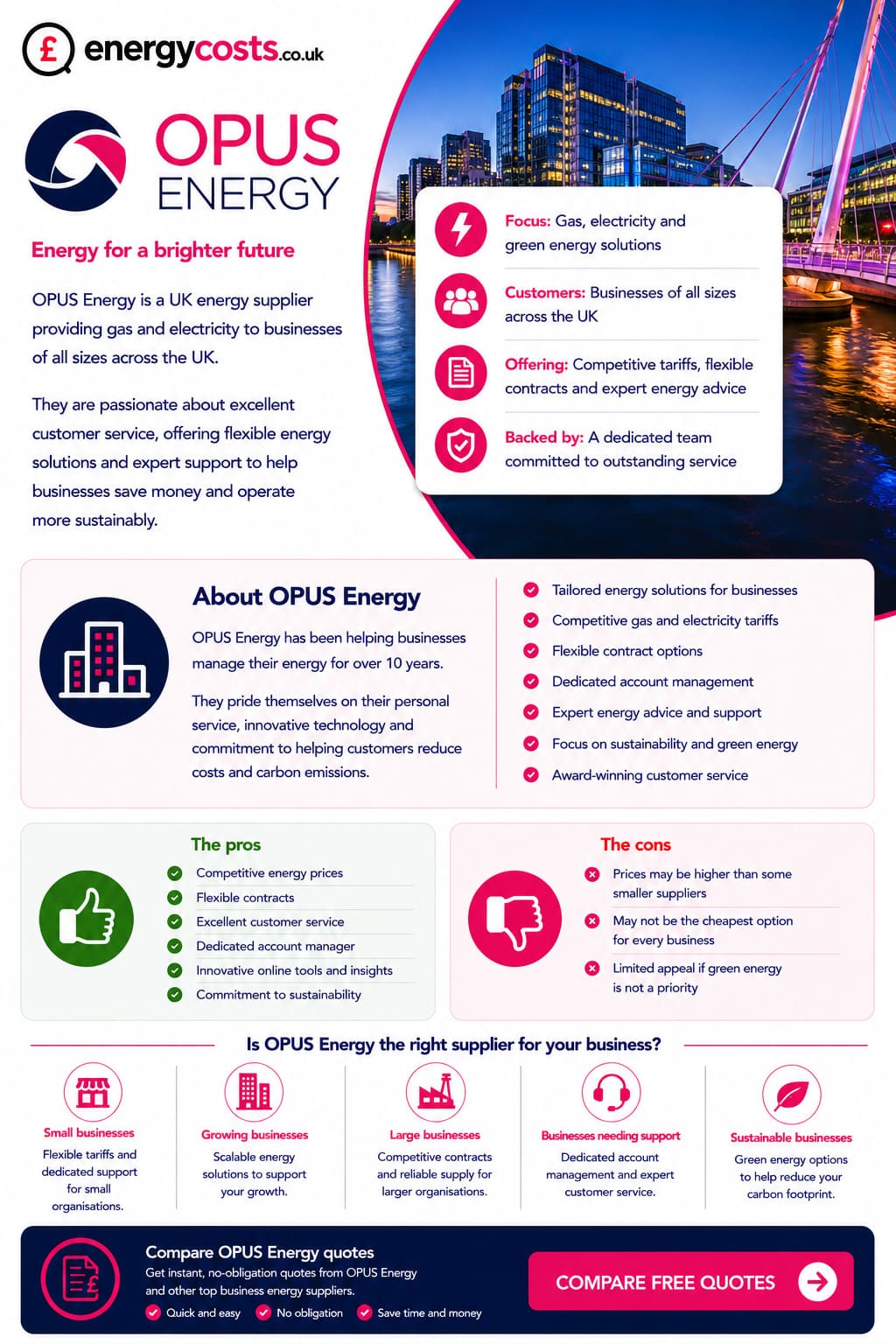
Opus Energy is no longer a live option for UK businesses comparing suppliers. The company’s own website now states that it is permanently closed and no longer responding to enquiries. That means this is no longer a standard supplier-review story about tariffs, customer service and quotes. Instead, the useful question for business readers is what happened to Opus Energy, where its customers went, and what former customers should do now.
At the bottom of this page, our original Opus Energy review has been preserved for archival purposes.
Is Opus Energy still trading?
No. Opus Energy says on its homepage that it is “permanently closed” and is no longer responding to enquiries. For that reason, businesses cannot treat Opus as an active supplier in the same way as EDF, British Gas, E.ON Next or other live business energy brands.
What happened to Opus Energy?
Opus Energy had been part of Drax since 2017. In June 2024, Drax said it had reached agreement for the sale of about 90,000 Opus Energy SME customer meter points to EDF Energy Customers Limited, as part of a wider reshaping of the business. Drax said this followed a strategic review and reflected a decision to focus more tightly on its core industrial and commercial energy activities rather than the SME supply market.
Drax’s 2024 full-year results then confirmed that the asset sale completed on 1 September 2024. According to that filing, Drax received £9.6 million from EDF for the transferred meter points and related customer contracts, plus £4.3 million relating to the provision of REGOs linked to the transferred contracts. Drax also said the restructuring reflected the reduced size of the Opus business after the sale and its focus on industrial and commercial customers and renewables services.
The process did not end there. In its half-year results published on 31 July 2025, Drax said the sale of the majority of Opus Energy’s meter points had completed in September 2024 and the remaining meter-point sale was completed in May 2025. The same filing says the residual SME customer meter points and related receivables were sold to Pozitive Energy Limited, confirming that Drax had completed its exit from the non-core SME segment.
Who took over Opus Energy customers?
EDF says a large majority of Opus Energy small business customers joined EDF. EDF’s own customer information page explains that Opus made the strategic decision to exit supplying many of its small business customers and that EDF would take over those supplies where customers had been contacted about the move. EDF’s 2024 annual accounts also say the acquisition of Opus Energy’s small business portfolio made EDF the second-largest supplier in the UK SME segment by number of meters.
That means the most accurate way to describe what happened is this: most Opus small business customers were transferred to EDF during 2024, while the remaining residual SME meter points were sold later as Drax completed its withdrawal from that market. In other words, Opus did not continue as a meaningful live SME supplier after the transfer programme.
What did the transfer mean for former customers?
EDF said that fixed Opus tariffs would be honoured for the duration of the contract. For customers on variable tariffs, EDF said they would move on to an EDF tariff matched to the closest EDF equivalent, with new prices and terms where applicable. EDF also said both supplier and customer would still need to honour the remaining term of any fixed contract where that applied.
EDF also said supply would continue without interruption during the transfer process. It explained that direct debit instructions could be moved across automatically, that credit balances would transfer after final billing, and that unpaid debit balances could also migrate across. For customers whose fixed Opus product included renewable electricity certificates, EDF said those certificates would continue for the duration of the fixed product.
There was also an important exception for customers who had already started switching away before the transfer. EDF said those transfers could still go ahead, so businesses that had already arranged a move to another supplier were not necessarily forced to stay.
What was Opus Energy known for before closure?
Before it closed, Opus positioned itself as a business-only energy supplier and used the strapline “Renewable energy for business” on its website. Drax’s own materials also described Opus as part of its energy-supply activities before the SME exit. That gives some useful context for why the brand built recognition among UK business customers even though it is no longer operating as a live supplier.
Should businesses still compare Opus Energy?
Not as a live supplier. Businesses researching Opus today are usually looking for one of three things: confirmation that the company has closed, information on where former customers were moved, or help comparing alternatives now that Opus is no longer available. For new business energy contracts, the sensible next step is to compare active suppliers instead of looking for an Opus quote. That follows directly from Opus’s closure notice and Drax’s completed exit from the SME supply market.
FAQ for Opus Energy closure
No. Opus Energy’s own website says the company is permanently closed and is no longer responding to enquiries.
EDF says a large majority of Opus Energy small business customers joined EDF, following Opus’s decision to exit supplying many of those customers.
EDF said it would honour fixed Opus tariffs for the duration of the contract, including the agreed prices and terms and conditions.
EDF said variable-tariff customers would move to an EDF tariff matched to the closest EDF equivalent, with EDF prices and terms applying after the transfer.
EDF said gas and electricity supply would continue and remain uninterrupted during the transfer process.
The majority of Opus SME meter points were sold to EDF in a transaction completed on 1 September 2024, and Drax later said the remaining residual SME meter points were sold to Pozitive Energy Limited in May 2025.
No, because Opus is closed. Businesses looking for a new contract should compare active business energy suppliers instead.
Below is our original Opus Energy review, published while the energy company was still operational. We have retained it here for archival purposes.
Who is Opus Energy?
Opus Energy is part of the Drax Group, a major player in the UK energy market, focusing on renewable and low-carbon energy sources. They supply gas and electricity to businesses of all sizes, from small enterprises to large corporate clients. Opus Energy prides itself on delivering competitive rates and tailored energy solutions while supporting a more sustainable energy future.
Opus Energy business prices list – rates per kWh
Please note that actual prices can vary depending on factors such as your business’s location, energy usage, and market conditions.
| Tariff Type | Electricity Unit Rate (per kWh) | Gas Unit Rate (per kWh) | Standing Charge (per day) |
|---|---|---|---|
| Fixed-rate tariff | 18p – 22p | 4p – 5p | 25p – 35p |
| Variable-rate tariff | 20p – 26p | 5p – 6p | 20p – 30p |
| Green energy tariff | 19p – 24p | 4.5p – 5.5p | 22p – 32p |
These prices are estimates and can fluctuate based on the current energy market, the length of your contract, and the specific needs of your business. For the most competitive rates, consider negotiating directly with Opus Energy or compare with other suppliers.
Opus Energy business tariffs explained
Opus Energy offers a variety of business tariffs designed to cater to the needs of different organisations. Whether you’re a start-up, an SME, or a large enterprise, there is likely to be a plan that matches your consumption and budget requirements. Here’s a breakdown of the main types of business tariffs they offer:
1. Fixed-rate tariffs
Fixed-rate tariffs from Opus Energy allow businesses to lock in their energy prices for a set period, typically ranging from one to three years. The main benefit of this tariff is protection against energy market fluctuations. If wholesale energy prices rise, your rates stay the same, providing stability in budgeting and forecasting.
Key features:
- Predictable energy costs for the contract duration
- Ideal for businesses looking to manage their long-term energy expenses
- Protection against market volatility
2. Variable-rate tariffs
Variable-rate tariffs mean that the cost of your energy can fluctuate based on market conditions. While this type of tariff can lead to lower costs when market prices drop, it also means that your rates could increase if energy prices rise.
Key features:
- Rates that reflect the current energy market conditions
- Flexibility to take advantage of falling prices
- Suitable for businesses willing to take on some level of risk
3. Green energy tariffs
Opus Energy’s green energy tariffs are designed for businesses committed to sustainability. These tariffs ensure that a significant portion of the electricity you use is sourced from renewable energy. It’s a great way to enhance your company’s green credentials and demonstrate a commitment to reducing its carbon footprint.
Key features:
- Energy sourced from renewable sources like wind, solar, and hydro
- Helps your business achieve sustainability goals
- Supports the transition to a low-carbon economy
Key features of Opus Energy business services
Opus Energy goes beyond just supplying gas and electricity to its business customers. Here are some of the additional features and services they offer:
Smart metering
Opus Energy provides smart meters to its business customers, enabling more accurate billing and real-time tracking of energy consumption. This technology allows businesses to monitor their energy usage patterns, identify opportunities for savings, and optimise their energy efficiency.
Benefits:
- Automated meter readings for precise billing
- Insight into energy consumption trends
- Improved control over energy usage
Energy efficiency support
Understanding the importance of reducing energy consumption, Opus Energy offers advice and support on how businesses can improve their energy efficiency. Their team provides tips and strategies tailored to your company’s energy usage to help lower your overall costs and reduce your environmental impact.
Customer support
Opus Energy is known for its dedicated customer service, providing comprehensive support to its business clients. They offer a range of communication channels, including phone and email, ensuring that any issues or queries are resolved promptly.
Customer support highlights:
- Multiple contact options for easy access
- Quick response times
- A reputation for friendly and knowledgeable support staff
Opus Energy business prices overview
The exact cost of Opus Energy’s tariffs can vary significantly depending on several factors, including your business size, energy usage, and location. However, they are generally competitive in the market, offering a range of prices that cater to different needs.
Factors influencing business energy prices
- Contract length: Longer contracts often come with lower rates due to the stability they provide to the energy supplier.
- Usage patterns: Businesses with higher energy consumption may be able to negotiate better rates.
- Market conditions: Energy prices can fluctuate due to changes in the wholesale market, geopolitical factors, and seasonal demand.
How to get a quote
To get the most accurate pricing for your business, it’s best to use our business energy price comparison. This way, you can ensure that the tariff you choose aligns perfectly with your budget and energy requirements. You can usually do this through their website or by contacting their customer service team.
Pros and cons of choosing Opus Energy for your business
Pros
- Flexible tariff options: A variety of plans to suit different business sizes and energy needs.
- Green energy options: Supports businesses that prioritise sustainability.
- Smart metering technology: Helps improve energy management and efficiency.
- Strong customer service: Well-regarded for its support and responsiveness.
Cons
- Variable rates can be unpredictable: If you choose a variable tariff, you might face increased costs if energy prices rise.
- Exit fees on fixed contracts: Cancelling a fixed-term contract before its end date could result in exit fees.
Is Opus Energy right for your business?
Opus Energy is a solid choice for businesses looking for competitive energy prices, flexibility in tariffs, and a commitment to green energy. Whether you’re a small business aiming to lock in stable rates or a larger enterprise seeking to optimise energy costs, Opus Energy’s range of tariffs and features are worth considering.
However, it’s always wise to compare business energy providers to ensure you’re getting the best deal for your specific needs. Taking the time to assess your energy consumption, future business growth, and sustainability goals can help you choose the right provider that aligns with your objectives.
Conclusion: Opus Energy business prices review
Opus Energy offers a comprehensive range of tariffs and services tailored to the needs of UK businesses. With options for fixed, variable, and green energy tariffs, they provide the flexibility to manage costs and support sustainability efforts. Combined with their focus on customer support and smart technology, Opus Energy is a competitive option worth exploring for your business energy needs.
Make sure to conduct a thorough comparison with other providers to find the energy solution that best fits your company’s requirements. For more, see the Opus Energy website.
FAQ: Opus Energy business pricing
Opus Energy charges a late payment fee of £15 for each overdue invoice. In addition to this, they may apply interest at 8% above the Bank of England base rate on any outstanding amount, depending on the length of the delay.
Opus Energy does not typically offer standard discounts for early payments on their tariffs. However, some bespoke agreements for large enterprises might include incentives, such as a reduction of up to 2% on your bill for early settlement.
Standing charges for Opus Energy business accounts generally range from 20p to 35p per day. While these charges are usually fixed, businesses with high energy consumption may be able to negotiate lower rates as part of a customised contract.
Opus Energy charges exit fees ranging from £50 to £150 per fuel, depending on the contract’s duration and the size of the business. Early termination costs can vary, so it’s advisable to confirm specific fees when entering into a fixed-rate agreement.
Standard meter installations by Opus Energy typically cost between £50 and £100 for business customers. However, for smart meters or more complex setups, charges can go up to £250, depending on the specific requirements of your business premises.