
Ruby Energy is making a name for itself in the UK business energy sector, offering a range of tariffs and services aimed at small to medium-sized enterprises (SMEs). This article provides a comprehensive review of Ruby Energy business prices, tariff options, and key features to help business owners make an informed decision.
Overview of Ruby Energy
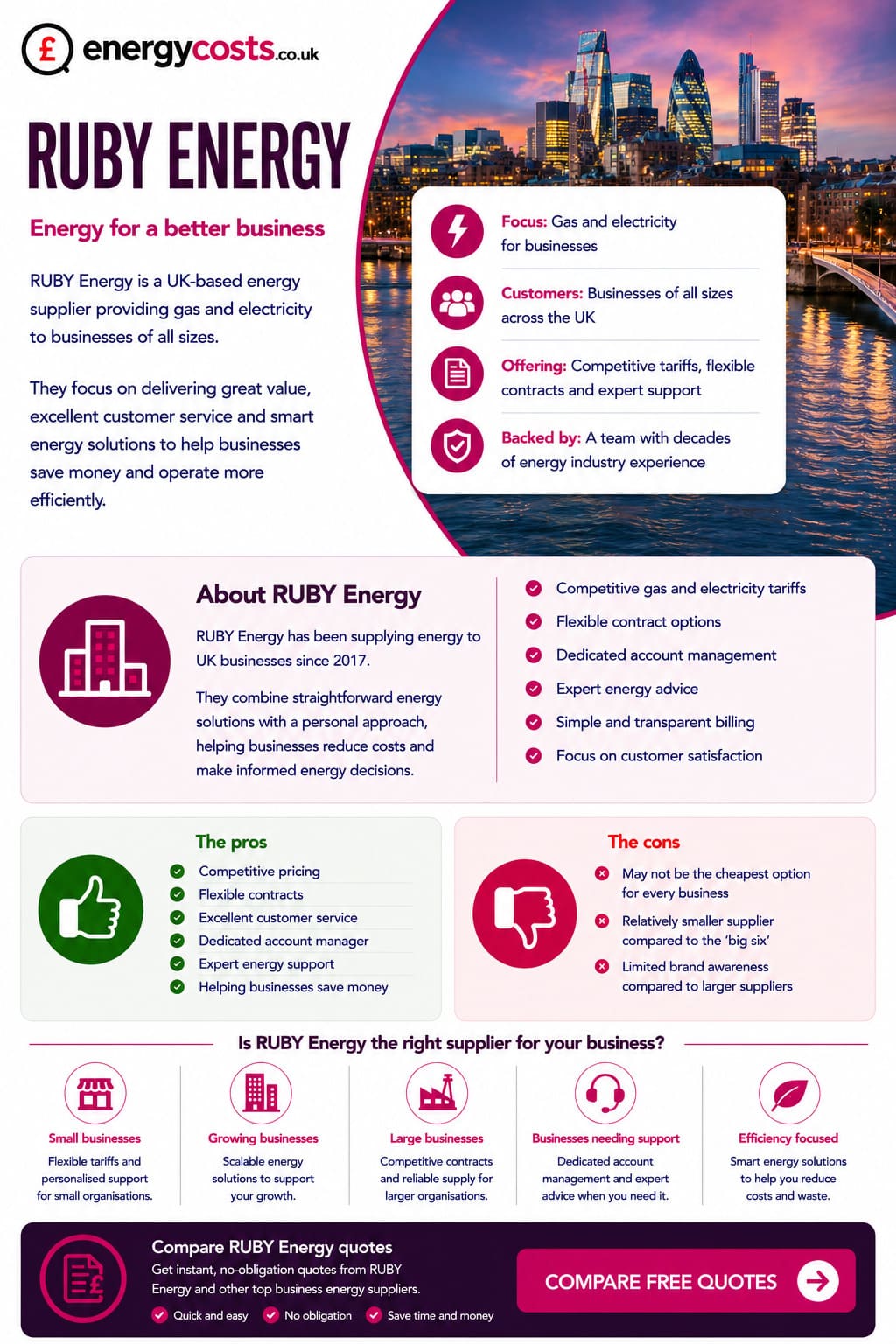
Ruby Energy is an independent business energy supplier with a focus on providing transparent and cost-effective energy solutions to businesses in the UK. Their aim is to offer simple and competitive pricing structures, backed by strong customer support and flexible plans tailored to meet the needs of various businesses.
Ruby Energy was formerly named BES Utilities, but re-branded as Ruby Energy in August 2024.
Ruby Energy business prices list: commercial rates per kWh
Please note that actual rates may vary based on location, business size, and energy consumption. It’s always best to get a tailored quote for precise pricing.
| Tariff Type | Standing Charge (per day) | Unit Rate (per kWh) | Contract Length |
|---|---|---|---|
| Fixed-rate tariff | 25p – 40p | 17p – 22p | 1 – 3 years |
| Variable-rate tariff | 20p – 35p | 19p – 24p | Rolling contract |
| Green energy tariff | 28p – 42p | 18p – 23p | 1 – 2 years |
Notes:
- Standing Charge: This is a daily fee for being connected to the energy network, regardless of your usage.
- Unit Rate: The cost per kilowatt-hour (kWh) of electricity consumed.
- Prices can vary based on factors such as business location, size, and energy usage.
- Fixed-rate tariffs provide price stability, while variable-rate tariffs can change in response to market fluctuations.
- Green energy tariffs may have slightly higher rates due to the cost of sourcing renewable energy.
Ruby Energy products
Ruby Energy supplies both business electricity and business gas, with products aimed mainly at SMEs. For electricity, Ruby says it offers fixed-price contracts alongside an Electricity Market Tracker option. For gas, Ruby says it offers fixed-price, variable and Budget Payment Plan options. Ruby also notes that its products are subject to compulsory third-party costs, including government, regulatory and network-related charges.
Electricity products
Ruby’s electricity range is designed for businesses that either want price certainty or are comfortable with periodic price reviews linked to wider market movements. Its fixed-price product is positioned as the straightforward option, while its Market Tracker product reviews prices annually against changes in wholesale energy, green levies, distribution, transmission and metering costs.
| Electricity product | How it works |
|---|---|
| Fixed Price | Unit rates and standing charges are fixed for the agreed contract term, giving more certainty over monthly budgeting. |
| Electricity Market Tracker | Prices are reviewed annually and can rise, fall or stay the same depending on movements in wholesale energy, levies, distribution, transmission and metering costs. |
Source: Ruby Energy product and FAQ pages.
Gas products
Ruby’s gas range is broader. Alongside a standard fixed-price deal, it offers a variable-price contract and a Budget Payment Plan. Ruby says the Budget Payment Plan is available to customers with an AQ below 293,000 kWh and works by spreading predicted annual gas usage across 12 equal monthly payments.
| Gas product | How it works |
|---|---|
| Fixed Price | Designed for businesses that want a locked-in price for the contract term. |
| Variable Price | Prices may change during the contract if wholesale market conditions or other costs change. |
| Budget Payment Plan | For eligible lower-usage gas customers, expected annual consumption is divided into 12 equal monthly payments to help smooth seasonal costs. |
Source: Ruby Energy FAQ and product pages.
Ruby Energy deemed, out-of-contract and non-DD prices
One of the most useful things Ruby publishes is its out-of-contract pricing. These rates matter if you move into premises supplied by Ruby without agreeing a contract, come to the end of a contract without renewing or switching, cancel your Direct Debit, or refuse a smart meter where one was part of the contract conditions. Ruby states clearly that these rates are generally higher than contracted rates.
Deemed contract rates
If you move into a property where Ruby is already the supplier and no new contract is yet in place, Ruby says you will be billed on a deemed contract until you agree terms or switch away.
| Fuel / meter type | Standing charge | Unit rate |
|---|---|---|
| Electricity non-half-hourly (PC 01–08) | 300p/day | 46.2p/kWh |
| Electricity half-hourly (PC 00) | 500p/day | 42.7p/kWh |
| Gas AQ 0–73,200 kWh | 450p/day | 11.96p/kWh |
| Gas AQ 73,201–293,000 kWh | 600p/day | 7.86p/kWh |
| Gas AQ 293,001 kWh and above | 850p/day | 7.86p/kWh |
Source: Ruby Energy deemed contract FAQ.
Default out-of-contract rates
If a previous Ruby contract has ended and the customer has not renewed or switched supplier, Ruby says supply continues on its default out-of-contract prices. The published rates currently mirror the deemed rates shown above.
| Fuel / meter type | Standing charge | Unit rate |
|---|---|---|
| Electricity non-half-hourly (PC 01–08) | 300p/day | 46.2p/kWh |
| Electricity half-hourly (PC 00) | 500p/day | 42.7p/kWh |
| Gas AQ 0–73,200 kWh | 450p/day | 11.96p/kWh |
| Gas AQ 73,201–293,000 kWh | 600p/day | 7.86p/kWh |
| Gas AQ 293,001 kWh and above | 850p/day | 7.86p/kWh |
Source: Ruby Energy out-of-contract pricing FAQ.
Non-DD rates
Ruby states that Direct Debit is the only payment method available to its customers. If a customer agreed contracted pricing on the condition of paying by Direct Debit and then cancels the Direct Debit, Ruby says non-DD rates apply until the Direct Debit is reinstated.
| Fuel / meter type | Standing charge | Unit rate |
|---|---|---|
| Electricity PC 1–4 | 200p/day | 45p/kWh |
| Electricity MD/HH | 300p/day | 45p/kWh |
| Gas | 500p/day | 23p/kWh |
Source: Ruby Energy non-DD FAQ.
Non-smart rates
Ruby says all of its electricity contracts include a free smart meter where possible. It also says that if a customer agreed a contract on the basis that a smart meter could be installed and then refuses one, non-smart rates apply until a smart meter is successfully fitted.
| Fuel / meter type | Standing charge | Unit rate |
|---|---|---|
| Electricity PC 1–4 | 200p/day | 67p/kWh |
| Electricity MD/HH | 300p/day | 67p/kWh |
| Gas | 500p/day | 23p/kWh |
Source: Ruby Energy non-smart customer FAQ. (Ruby Energy)
How Ruby Energy bills and takes payment
Ruby says Direct Debit is its only payment option for live customer accounts. That is important for businesses comparing suppliers, because it means card payments are not the standard payment method for ongoing contracted supply. Ruby also warns that customers without an active Direct Debit may face additional charges.
Ruby publishes a back-billing policy stating that where the customer is not at fault for undercharging, it will limit the back-billing period to a maximum of 12 months. It also says it will aim to offer repayment options that suit the customer’s needs where a back bill must be issued.
For refunds, Ruby says customers with live accounts who believe they are in credit should contact customer services so the balance can be verified and, where appropriate, refunded. Ruby also notes that customers on its Gas Budget Payment Plan often build up credit during summer months, which is then used down in winter, so a refund may not always be appropriate in those cases.
Smart meters and siteworks
Ruby says all electricity contracts include a free smart meter installation where possible. It says smart meters give it regular usage data, which can support more accurate invoices and help businesses understand their consumption more clearly.
Beyond supply contracts, Ruby also has a dedicated siteworks service. On its siteworks page, it highlights support for new electricity meters where a new MPAN is visible on ECOES, new gas meters where a live MPRN is visible on Xoserve, de-energised ECOES discrepancies, related MPAN issues, and help acquiring new MPANs or MPRNs where needed.
For businesses moving into new premises, fitting out sites, reopening dormant supplies or dealing with meter registration issues, that extra operational support may be useful. Ruby lists a dedicated siteworks email address and phone number for these enquiries.
Customer service and complaints
Ruby’s main customer contact line is 0344 5678 427, and it says its customer service team is available Monday to Friday from 8:30am to 5pm. Ruby also publishes a general customer service email address, plus specialist addresses for LOAs, account terminations, picture reads and business energy claims.
Ruby also publishes a three-stage complaints process. It says complaints can be raised by live chat, phone, email or post, and lists [email protected] as the dedicated complaints email address. Its specialist customer services team is listed as available Monday to Friday, 8:30am to 5:30pm.
As an external benchmark, Citizens Advice ranked Ruby Energy 8th in its non-domestic supplier performance table for October to December 2025, with a score of 266.3, compared with 297.6 in July to September 2025. That places Ruby in the upper half of the table for that quarter, ahead of EDF, SmartestEnergy, SSE and several others.
Renewable electricity and fuel mix
Ruby promotes a 100% renewable electricity option as part of its wider business energy offer. That may appeal to businesses that want a greener electricity contract or need support for internal ESG goals.
At the same time, Ruby’s published fuel mix disclosure for April 2023 to March 2024 shows that the supplier’s disclosed overall electricity mix was 14% coal, 70% natural gas, 4% nuclear, 6% renewable and 6% other. Ruby also published CO2 emissions of 452g/kWh versus a UK average of 205g/kWh for the same disclosure period.
That distinction is worth understanding. A supplier can offer a renewable electricity product while its overall disclosed supply mix remains much more carbon-intensive than the national average. Businesses comparing green credentials should therefore look at both the specific tariff being quoted and the supplier’s published annual fuel mix.
Company background
Ruby Energy is the trading identity used for Ruby Electricity Ltd and Ruby Gas Ltd. Ofgem states that BES rebranded its energy supply companies to Ruby Electricity Ltd and Ruby Gas Ltd in August 2024. Ofgem also describes Ruby as a UK-based non-domestic utilities supplier based in Lancashire.
Companies House shows Ruby Electricity Ltd was incorporated on 21 April 2009 and Ruby Gas Ltd on 2 April 2002. Companies House also shows the previous company names were BES Commercial Electricity Ltd and Business Energy Solutions Ltd respectively.
Ruby’s registered office and published postal address are Parkside Stand, Fleetwood Town Football Club, Park Avenue, Fleetwood, FY7 6TX.
What can change your Ruby Energy costs
Ruby says its products are subject to compulsory third-party costs such as government, regulatory and industry requirements. It has also published an April 2026 update explaining that standing charges are rising because of changes to Transmission Network Use of System charges. In that update, Ruby says the fixed TNUoS element is expected to increase by around 94% year on year for 2026/27.
For most small businesses, that matters because standing charges are payable per meter per day regardless of usage. A supplier quote should therefore be judged on both the unit rate and the standing charge, not the pence-per-kWh figure alone.
Regulatory note
Ofgem opened an investigation on 25 September 2023 into BES and its compliance with Standard Licence Condition 7.3. Ofgem says that, after the August 2024 rebrand to Ruby, it expanded the scope of the investigation on 23 September 2025 to include Standard Licence Condition 0A, which relates to treating non-domestic customers fairly. Ofgem also states that neither the opening nor the expansion of the investigation implies that findings have been made.
Additional features and services
Ruby Energy offers several additional features and services that help set them apart from other energy suppliers in the UK. Some of these include:
1. Online account management
Ruby Energy provides a comprehensive online portal that allows businesses to manage their energy accounts easily. Through this platform, users can view their bills, track usage, submit meter readings, and make payments—all from a single dashboard.
2. Smart meter installation
To help businesses track their energy consumption more accurately, Ruby Energy offers smart meter installations as part of their service. Smart meters provide real-time information about energy usage, helping businesses identify areas for improvement and cost savings.
3. Dedicated customer support
Ruby Energy is known for its dedicated customer support team, which is available to assist with any queries or issues businesses may have regarding their energy accounts. This focus on customer service helps ensure that businesses receive timely and helpful responses to their concerns.
Benefits of choosing Ruby Energy for your business
1. Competitive pricing
- Ruby Energy aims to offer some of the most competitive business energy rates in the market, making it a cost-effective choice for SMEs. Their straightforward pricing approach and lack of hidden fees are attractive to budget-conscious businesses.
2. Flexible contract options
- The variety of tariff plans and contract lengths available means businesses can choose a solution that best fits their needs. Whether you’re looking for a fixed-rate plan for stability or a variable-rate option for flexibility, Ruby Energy provides tailored options.
3. Commitment to sustainability
- Ruby Energy’s focus on green energy tariffs aligns well with businesses aiming to reduce their environmental impact. Choosing a renewable energy plan can also enhance a company’s reputation by demonstrating its commitment to sustainable practices.
Drawbacks to consider
While Ruby Energy offers several benefits, there are a few potential drawbacks to keep in mind:
- Limited market presence: As a relatively new player in the market, Ruby Energy may not yet have the same level of experience or resources as some of the larger, established suppliers.
- Potential for price volatility: Businesses on variable-rate tariffs may face unexpected cost increases if market prices rise sharply.
How to switch to Ruby Energy
Switching to Ruby Energy is a straightforward process. Businesses can get a quote directly from their website by providing details about their energy usage. Ruby Energy’s team will handle the switching process, ensuring a seamless transition without any disruption to your energy supply.
Steps to switch:
- Request a quote: Visit the Ruby Energy website and submit your business details to receive a personalised quote.
- Compare tariffs: Review the tariff options and choose the one that best suits your business needs.
- Complete the switch: Ruby Energy will manage the switch from your current supplier to their service, typically within 14-21 days.
Is Ruby Energy a good choice for businesses?
Ruby Energy is likely to be most relevant to smaller and medium-sized businesses that want a commercial energy supplier focused on the non-domestic market, need both gas and electricity options, or may benefit from extras such as siteworks support and smart meter installation. Its published out-of-contract information is more transparent than many suppliers’, and its Citizens Advice non-domestic ranking is respectable rather than poor.
The main points to weigh up are Ruby’s strict Direct Debit model, the potentially expensive deemed/default/non-smart rates if you fall outside normal contract terms, and the fact that there is an ongoing Ofgem investigation relating to legacy BES/Ruby compliance questions. As with any business energy supplier, it is sensible to compare both the contracted rates and the fallback charges before signing.
For more, visit the Ruby Energy website, or check our guide to the cheapest business energy providers.
FAQ – Ruby Energy business pricing
Yes, Ruby Energy provides discounted rates for businesses with high energy consumption. Typically, businesses using over 50,000 kWh annually can receive unit rates as low as 15p per kWh, and standing charges may be reduced to around 20p per day, depending on the contract terms.
Ruby Energy applies early exit fees based on the remaining contract length. Fees typically range from £30 to £100 per fuel type (electricity or gas). For example, leaving a two-year contract after one year might incur a fee of £60 per fuel.
Ruby Energy’s fixed-rate tariffs do not include seasonal adjustments. However, for variable-rate tariffs, unit rates could rise to 25p per kWh during peak demand periods in the winter, while dropping to as low as 18p per kWh during lower demand periods, such as in the summer.
No, Ruby Energy typically provides smart meter installations free of charge for their business customers. However, for non-standard installations or specific requests, additional charges may apply, starting from £50 depending on the complexity of the setup.
Ruby Energy charges a late payment fee of £40 for overdue accounts, plus interest on the outstanding balance at 4% above the Bank of England’s base rate. Businesses are encouraged to contact Ruby Energy to arrange payment plans to avoid these additional charges.
Yes, Ruby Energy offers bespoke pricing plans for businesses operating multiple sites. Multi-site businesses consuming over 100,000 kWh annually can receive unit rates as low as 14p per kWh, with standing charges starting at 18p per day, depending on the sites’ energy usage profiles.
Ruby Energy passes on government levies directly to customers. The Climate Change Levy (CCL), currently set at 0.775p per kWh for electricity, is added to business energy bills unless the business qualifies for an exemption, such as being in a climate-conscious industry or using renewable energy sources.
For fixed-rate contracts, Ruby Energy guarantees no price changes for the duration of the contract. However, businesses on variable tariffs may see fluctuations. These adjustments are capped at a maximum increase of 5p per kWh within any single six-month period, according to their terms and conditions.
Ruby Energy offers flexible payment options, including direct debit, standing order, or bank transfer. Businesses choosing direct debit may benefit from reduced standing charges of 2p-3p per day compared to other payment methods, as it reduces administrative costs for Ruby Energy.
Yes, Ruby Energy offers advanced usage data analytics for businesses using smart meters. For a subscription starting at £10 per month, businesses can access detailed consumption reports and forecasts, allowing them to optimise their energy usage and potentially save up to 5% on energy costs annually.
Ruby Energy’s lowest unit rate for business energy tariffs starts at approximately 17p per kWh for fixed-rate plans. This rate is competitive for businesses seeking long-term price stability, though the actual price may depend on factors like location and contract length.
Ruby Energy’s standing charges range from 20p to 42p per day, depending on the specific tariff chosen. These daily charges cover the cost of maintaining your energy supply and infrastructure, ensuring businesses stay connected to the network at all times.
Yes, Ruby Energy may offer discounted rates for businesses with high energy consumption, typically reducing unit rates by up to 5% for large-volume contracts. This can make their tariffs even more competitive for companies that rely heavily on electricity for their operations.
Ruby Energy charges an early termination fee of up to £30 per fuel if a business decides to exit a fixed-term contract before its end date. The exact amount can vary depending on the length remaining on the contract and the tariff chosen.
Ruby Energy’s green energy tariffs are generally 2p-3p per kWh more expensive than their standard fixed-rate tariffs, reflecting the cost of sourcing renewable electricity. However, these rates are still competitive when compared to other suppliers’ renewable energy options.