
British Gas and Octopus Energy are two of the best-known energy suppliers serving UK businesses. Both provide electricity and gas contracts for SMEs, support multi-site organisations and offer lower-carbon energy products, but their approaches differ considerably.
British Gas is the UK’s largest business energy supplier, serving more than 350,000 organisations. Its proposition includes conventional fixed contracts, a 30-day rolling plan, the online-only British Gas Lite service, flexible wholesale purchasing, renewable electricity and gas, commercial solar, export payments, smart-meter analysis and commercial metering.
Octopus Energy has built its business proposition around transparent direct sales, smart tariffs and low-carbon technology. Its services include fixed and flexible supply, Shape Shifters time-of-use tariffs, seasonal pricing, a no-standing-charge option, commercial export tariffs, joint multi-site management and more advanced services such as Electric Match and Wind Works.
Neither company can be declared universally cheaper. Business prices are calculated individually according to the premises, meter, location, consumption, credit profile and contract dates.
However, Octopus is likely to be particularly attractive to businesses that can change when they use or export electricity. British Gas may be more suitable for organisations wanting conventional fixed terms, telephone-based support, commercial gas options or advanced wholesale procurement for large energy portfolios.
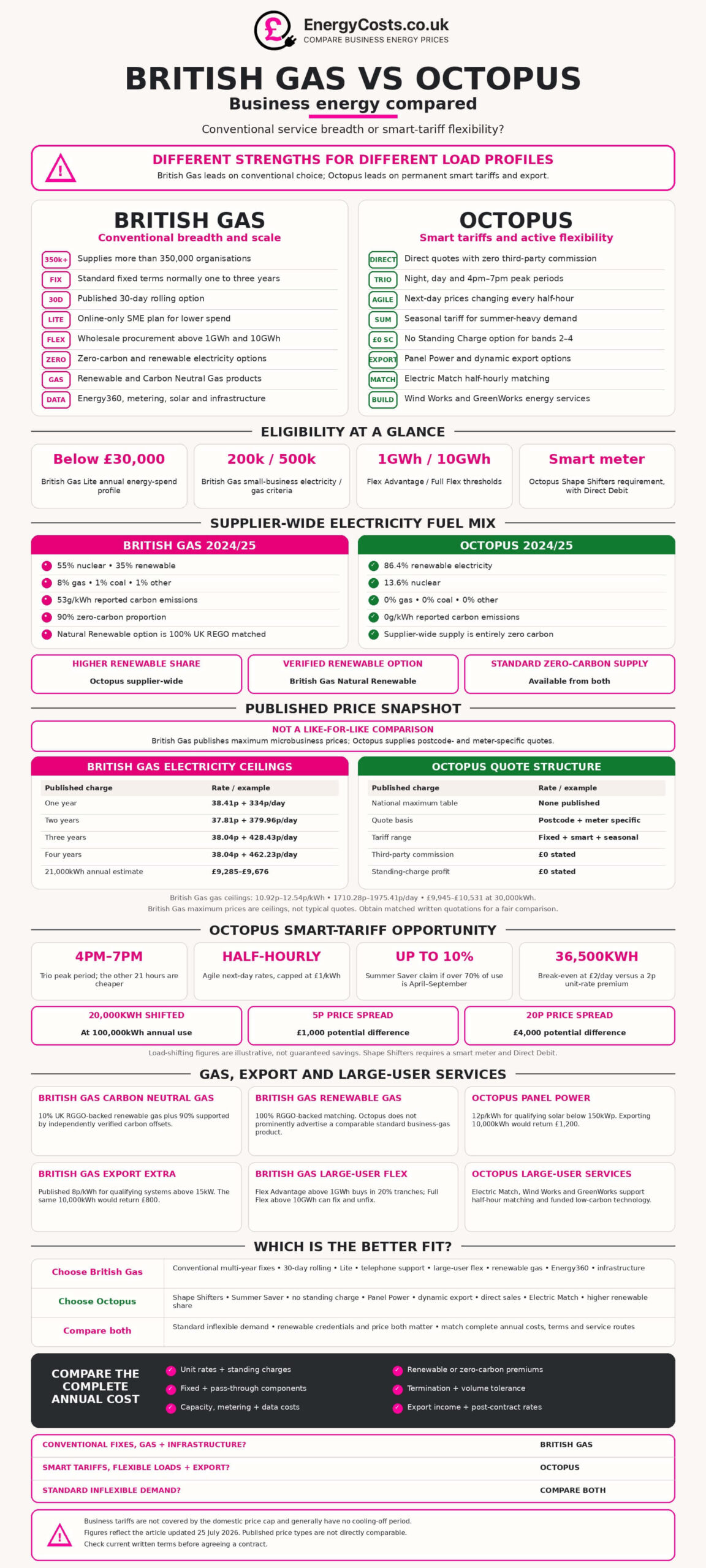
British Gas vs Octopus at a glance
| Feature | British Gas Business | Octopus Energy for Business |
|---|---|---|
| Business electricity | Yes | Yes |
| Business gas | Yes | Yes |
| SME supply | Yes | Yes |
| Large-business supply | Yes | Yes |
| Public national contract rates | Maximum microbusiness prices published | Postcode- and meter-specific quotations |
| Fixed electricity contracts | Normally one to three years; some published schedules include four years | Fixed and flexible quotations |
| Short rolling contract | 30-day Rolling Energy Plan | Standard variable options |
| Online-only SME product | British Gas Lite | Direct online quotation and account service |
| Time-of-use business tariff | Limited smart-meter events and multi-rate contracts | Shape Shifters Trio and Agile |
| Seasonal tariff | No prominent equivalent | Summer Saver |
| Zero-standing-charge tariff | No prominent standard equivalent | Available for qualifying bands 2–4 |
| Large-user flexible purchasing | Flex Advantage above 1GWh and Full Flex above 10GWh | Bespoke large-commercial arrangements |
| Standard fixed electricity credentials | Zero carbon, backed by renewable and nuclear generation | Zero-carbon electricity |
| Renewable-only option | Natural Renewable Electricity | No separate renewable-only standard product prominently advertised |
| Supplier-wide renewable share | 35% in 2024/25 | 86.4% in 2024/25 |
| Supplier-wide nuclear share | 55% | 13.6% |
| Renewable business gas | Carbon Neutral Gas and Renewable Gas products | No directly comparable prominent standard product |
| Commercial solar export | Smart Export Guarantee options | Panel Power and Shape Shifters: Export |
| Published commercial export rate | 8p/kWh on an eligible Export Extra arrangement | 12p/kWh through Panel Power |
| Multi-site management | Yes | Joint portfolio service |
| Consumption data | Energy360 DataView | Online dashboard and smart-tariff tools |
| Direct renewable matching | Renewable certificates and reporting | Electric Match within half an hour |
| Funded on-site generation | Centrica commercial energy solutions | Wind Works and GreenWorks |
| Best suited to | Businesses wanting broad conventional and infrastructure services | Flexible businesses using smart meters, batteries, EVs or solar |
Which businesses can apply?
Both suppliers can serve companies ranging from small independent traders to large multi-site organisations.
British Gas eligibility
British Gas provides different services according to business size.
British Gas Lite is primarily intended for companies that:
- spend less than £30,000 a year on energy;
- manage their account online;
- pay by monthly Direct Debit; and
- have, or agree to install, a smart meter.
The standard British Gas Business service provides fixed, rolling and bespoke contracts for SMEs and larger organisations.
British Gas defines a small business using Ofgem’s current criteria. A company may qualify if it meets at least one of these conditions:
- it uses no more than 200,000kWh of electricity annually;
- it uses no more than 500,000kWh of gas annually; or
- it has fewer than 50 employees and meets the relevant turnover or balance-sheet threshold.
British Gas’s flexible purchasing products are aimed at larger organisations:
| Product | Typical minimum annual consumption |
|---|---|
| Flex Advantage | More than 1GWh |
| Full Flex | More than 10GWh |
One gigawatt-hour is equal to one million kilowatt-hours.
Octopus eligibility
Octopus provides a direct online quotation journey for electricity, gas or dual-fuel business supply.
Its standard business services are suitable for SMEs, while large-commercial customers can access specialist products including:
- Electric Match;
- Wind Works;
- GreenWorks;
- multi-site supply;
- commercial export services; and
- tailored energy arrangements.
Octopus emphasises that it sells business energy directly rather than through brokers or price-comparison intermediaries. It says this helps avoid third-party commissions being incorporated into the tariff.
Eligibility examples
| Example organisation | Annual electricity use | Likely options |
|---|---|---|
| Small shop | 12,000kWh | British Gas Lite, standard British Gas or Octopus |
| Office | 60,000kWh | Fixed quote from either supplier |
| Restaurant | 150,000kWh | Fixed or smart tariff; load pattern should be examined |
| Seasonal visitor attraction | 200,000kWh | Octopus Summer Saver may be relevant |
| EV depot | 500,000kWh | Octopus Shape Shifters may suit overnight charging |
| Manufacturer | 2GWh | Both; British Gas Flex Advantage may be available |
| National retailer | 12GWh | Multi-site service from either; British Gas Full Flex may be relevant |
| Large company seeking hourly matching | Several GWh | Octopus Electric Match may be particularly relevant |
Eligibility depends on more than annual consumption. The supplier may also assess meter type, creditworthiness, premises use, payment history and the proposed contract structure.
Which supplier is likely to be cheaper?
There is no national Octopus-versus-British Gas unit rate that applies to every business.
A quotation normally depends on:
- electricity MPAN or gas MPRN;
- postcode and distribution region;
- annual consumption;
- meter profile;
- half-hourly consumption data;
- DUoS residual band;
- agreed electricity capacity;
- number of premises;
- credit history;
- payment method;
- contract start date;
- contract duration;
- wholesale market prices; and
- the selected environmental product.
The annual cost should be calculated as:
- Annual consumption × unit rate
- daily standing charge × 365
- capacity charges
- metering and data charges
- network and policy costs
- environmental product costs
- VAT and Climate Change Levy where applicable
− export income and other credits
A low unit rate does not necessarily provide the lowest total cost. This is particularly important where British Gas or Octopus offers different combinations of unit rates and standing charges.
How rate differences affect annual expenditure
| Annual consumption | Value of 0.5p/kWh | Value of 1p/kWh | Value of 3p/kWh | Value of 5p/kWh |
|---|---|---|---|---|
| 10,000kWh | £50 | £100 | £300 | £500 |
| 25,000kWh | £125 | £250 | £750 | £1,250 |
| 50,000kWh | £250 | £500 | £1,500 | £2,500 |
| 100,000kWh | £500 | £1,000 | £3,000 | £5,000 |
| 250,000kWh | £1,250 | £2,500 | £7,500 | £12,500 |
| 1GWh | £5,000 | £10,000 | £30,000 | £50,000 |
| 10GWh | £50,000 | £100,000 | £300,000 | £500,000 |
Standing charges can have a greater proportional effect on small premises and businesses with multiple meters.
| Daily standing-charge difference | Annual difference per meter | Difference across ten meters |
|---|---|---|
| 25p | £91.25 | £912.50 |
| 50p | £182.50 | £1,825 |
| £1 | £365 | £3,650 |
| £2 | £730 | £7,300 |
| £5 | £1,825 | £18,250 |
British Gas maximum microbusiness prices
British Gas publishes the maximum unit rates and standing charges that qualifying microbusinesses will pay when entering or renewing a Fixed Price Energy Plan.
These are upper limits, not representative average quotations. An individual company may receive lower prices.
The rates below were published as current on 27 May 2026 and exclude VAT, Climate Change Levy and other applicable costs.
Single-rate electricity
| Contract term | Maximum standing charge | Maximum unit rate | Published estimated contract cost |
|---|---|---|---|
| One year | 334p per day | 38.41p/kWh | £9,285 |
| Two years | 379.96p per day | 37.81p/kWh | £18,654 |
| Three years | 428.43p per day | 38.04p/kWh | £28,657 |
| Four years | 462.23p per day | 38.04p/kWh | £38,702 |
British Gas bases the electricity estimates on annual consumption of 21,000kWh.
The approximate average cost per year is:
| Contract term | Approximate average annual cost |
|---|---|
| One year | £9,285 |
| Two years | £9,327 |
| Three years | £9,552 |
| Four years | £9,676 |
The two-year tariff has the lowest published unit-rate ceiling, but the one-year option has the lowest standing charge.
Day-and-night electricity
| Contract term | Maximum day rate | Maximum night rate | Standing charge |
|---|---|---|---|
| One year | 40p/kWh | 31.76p/kWh | 334p per day |
| Two years | 39.37p/kWh | 31.17p/kWh | 379.96p per day |
| Three years | 39.61p/kWh | 31.42p/kWh | 428.43p per day |
| Four years | 39.61p/kWh | 31.42p/kWh | 462.23p per day |
A two-rate tariff becomes more attractive as the proportion of night-time use increases.
Using the two-year maximum prices:
| Night-time proportion | Weighted average unit rate |
|---|---|
| 10% | 38.55p/kWh |
| 25% | 37.32p/kWh |
| 50% | 35.27p/kWh |
| 75% | 33.22p/kWh |
The standing charge must be added before determining the complete annual cost.
Evening-and-weekend electricity
British Gas also publishes tariffs with a cheaper evening-and-weekend rate and a more expensive weekday daytime rate.
| Contract term | Evening and weekend | Weekday daytime | Standing charge |
|---|---|---|---|
| One year | 31.66p/kWh | 42.27p/kWh | 334p per day |
| Two years | 31.17p/kWh | 41.20p/kWh | 379.96p per day |
| Three years | 31.48p/kWh | 40.80p/kWh | 428.43p per day |
| Four years | 31.48p/kWh | 40.80p/kWh | 462.23p per day |
This may suit a hospitality, leisure or entertainment business using a significant proportion of its electricity outside weekday office hours.
Maximum gas prices
| Contract term | Maximum standing charge | Maximum unit rate | Published estimated contract cost |
|---|---|---|---|
| One year | 1,710.28p per day | 12.54p/kWh | £10,005 |
| Two years | 1,784.47p per day | 11.44p/kWh | £19,891 |
| Three years | 1,862.57p per day | 10.92p/kWh | £30,223 |
| Four years | 1,975.41p per day | 11.07p/kWh | £42,125 |
The gas estimates assume annual consumption of 30,000kWh.
These standing charges are unusually high because the table publishes maximum prices rather than a typical quote. Businesses should obtain an actual quotation before drawing conclusions about British Gas’s competitiveness.
Octopus business tariff pricing
Octopus does not publish one national maximum-price table equivalent to British Gas’s microbusiness schedule.
Its quotation system uses the business’s postcode and supply information to generate the available rates. Existing customers can see their current unit rates and standing charges through the online dashboard.
Octopus says it sells directly and does not pay brokers or comparison websites to acquire its business customers. It identifies the third-party commission element of its direct tariffs as zero.
The company also states that it does not make a profit from the standing charge, instead passing through the underlying costs.
Octopus offers several pricing structures:
- conventional fixed business tariffs;
- flexible tariffs;
- Shape Shifters Trio;
- Shape Shifters Agile;
- Summer Saver;
- a No Standing Charge Tariff;
- postcode-specific deemed and out-of-contract rates; and
- bespoke commercial arrangements.
Because prices vary by meter and region, the business must enter its details to obtain a reliable comparison.
British Gas fixed contracts
The standard British Gas Fixed Price Energy Plan normally offers terms of one, two or three years, although its current maximum-price schedule also contains four-year options.
Fixed contracts provide:
- a known unit rate;
- a known standing charge;
- protection from wholesale price increases;
- greater budget certainty;
- Direct Debit discounts where applicable; and
- notification before the contract ends.
The business’s bill will still change according to consumption. Fixing a rate does not mean fixing the total amount paid.
The disadvantage is that a business may be unable to benefit from falling market prices until the contract expires. Early termination costs may also apply.
British Gas Lite
British Gas Lite is a digital-first service for smaller businesses.
Its main features include:
- fixed electricity and gas prices;
- online account management;
- monthly Direct Debit;
- automatic smart-meter readings;
- a free smart meter for eligible customers; and
- support through webchat.
Lite may suit a company that wants a conventional fixed tariff with minimal administration.
It may be less appropriate where the business wants:
- telephone customer service;
- complex multi-site billing;
- extensive procurement advice;
- a flexible wholesale contract; or
- a natural renewable electricity upgrade.
British Gas’s Natural Renewable Electricity opt-in does not normally cover British Gas Lite.
British Gas 30-day rolling plan
The 30-day Rolling Energy Plan is intended for businesses that do not want a long fixed commitment.
Its prices can rise or fall, but the customer can move onto a fixed plan without waiting several years for an existing term to expire.
It may be suitable where:
- the business expects to leave the premises;
- future consumption is uncertain;
- the company is being sold;
- operations may close or change significantly; or
- management expects wholesale prices to fall.
The trade-off is reduced budget certainty.
Octopus Shape Shifters
Octopus has a significant advantage for SMEs that can alter when they use electricity.
Shape Shifters is a 12-month business electricity contract requiring:
- a working smart meter;
- payment by Direct Debit; and
- an account that is up to date.
There are two versions.
Shape Shifters Trio
Trio divides the day into three prices:
- a night rate;
- a day rate; and
- a peak rate from 4pm to 7pm.
Octopus says this gives customers 21 hours of cheaper electricity each day compared with the peak period.
The rates remain fixed within their time bands, so a company knows in advance when electricity will be cheaper.
Potential users include:
- electric vehicle depots;
- workshops that can reschedule machinery;
- laundries;
- commercial kitchens;
- businesses with battery storage;
- cold-storage operators; and
- organisations able to pre-heat or pre-cool buildings.
Shape Shifters Agile
Agile changes its unit rate every half hour in line with wholesale market prices.
Prices for the next day are made available in advance, allowing the business to schedule equipment or charging.
Octopus caps the rate at £1 per kWh. This provides a ceiling, but the maximum remains considerably higher than a normal fixed rate.
Agile can provide greater savings when wholesale prices are low, but it also exposes the business to expensive periods.
It may be suitable for companies with:
- automated energy-management systems;
- battery storage;
- flexible industrial processes;
- large controllable loads;
- overnight EV charging; or
- staff able to monitor day-ahead prices.
A business that cannot change its operating hours may gain little from the product.
Potential savings from shifting consumption
Suppose a company uses 100,000kWh of electricity annually and can move 20% away from the peak period.
The company would shift 20,000kWh.
| Difference between peak and cheaper rate | Illustrative annual saving |
|---|---|
| 3p/kWh | £600 |
| 5p/kWh | £1,000 |
| 10p/kWh | £2,000 |
| 15p/kWh | £3,000 |
| 20p/kWh | £4,000 |
These are mathematical examples rather than guaranteed Octopus savings.
Octopus has stated that a Shape Shifters Agile customer using 50,000kWh could potentially save up to £3,500 by shifting consumption to off-peak periods. Actual results depend on location, tariff rates and the amount of demand that can be moved.
Octopus Summer Saver
Summer Saver is intended for businesses that use most of their electricity between April and September.
It has:
- a cheaper summer unit rate from April to September; and
- a more expensive winter rate from October to March.
Octopus says businesses using more than 70% of their annual electricity during the summer period could save up to 10% over the year.
Potential users include:
- campsites;
- visitor attractions;
- outdoor leisure businesses;
- seaside hospitality venues;
- seasonal cafés;
- wedding venues; and
- summer events companies.
A company should analyse its meter data before applying. A business that uses more electricity than expected during winter could pay more overall.
Octopus No Standing Charge Tariff
Octopus also advertises a 12-month electricity tariff with no standing charge for qualifying businesses in consumption bands 2, 3 or 4.
The grid-related costs that would normally be collected through a daily charge are incorporated into the unit rate instead.
This may suit a business that:
- uses relatively little electricity within its assigned band;
- operates only part of the year;
- has several low-use meters;
- wants costs to track consumption more closely; or
- dislikes paying a fixed daily amount while a site is closed.
It is not automatically cheaper. A higher unit rate can outweigh the removed standing charge where consumption is substantial.
Break-even calculation
Suppose a standard tariff has:
- a standing charge of £2 per day; and
- a unit rate 2p/kWh below the no-standing-charge tariff.
The annual standing charge is £730.
The break-even consumption is:
£730 ÷ £0.02 = 36,500kWh
Below 36,500kWh, the no-standing-charge tariff may be cheaper. Above that point, the lower standard unit rate may produce a lower total cost.
The actual calculation must use the rates in the company’s quotation.
British Gas PeakSave for Business
British Gas has tested smart-meter promotions under PeakSave for Business.
Eligible customers are invited to move consumption into specified lower-demand periods and receive discounted electricity during the event hours.
PeakSave is different from Shape Shifters because it is generally an invitation-based trial or promotional event rather than a permanent time-of-use tariff applying every day.
The British Gas model may suit a company that wants occasional rewards without changing its underlying fixed contract.
Octopus provides a more comprehensive permanent smart-tariff proposition for businesses that routinely control their consumption.
British Gas flexible procurement
British Gas has the stronger public proposition for large organisations that want to trade or hedge wholesale energy.
Flex Advantage
Flex Advantage is aimed at businesses using more than 1GWh annually.
It allows customers to:
- purchase energy in 20% tranches;
- view market-reflective prices;
- make purchasing decisions through an online portal;
- monitor their procurement position; and
- spread timing risk.
Full Flex
Full Flex is intended for organisations consuming more than 10GWh annually.
It provides greater freedom over:
- trade size;
- timing;
- fixing and unfixing energy;
- market exposure;
- purchasing strategy; and
- portfolio reporting.
Flexible procurement does not guarantee savings. It allows the customer to decide when to buy energy rather than fixing the whole forecast at one moment.
For a business using 10GWh, a movement of 1p/kWh changes annual cost by £100,000.
| Average commodity price | Cost for 10GWh |
|---|---|
| 18p/kWh | £1.8 million |
| 19p/kWh | £1.9 million |
| 20p/kWh | £2 million |
| 21p/kWh | £2.1 million |
| 22p/kWh | £2.2 million |
A flexible customer should have a defined risk policy, authorised decision-makers and reliable consumption forecasts.
Octopus services for large businesses
Octopus’s large-commercial proposition is more focused on clean-energy technology and matching than traditional wholesale trading.
Electric Match
Electric Match traces the customer’s electricity to green generation within half-hourly periods.
This gives a more granular connection between:
- when electricity is consumed; and
- when renewable electricity is produced.
It can support companies pursuing:
- 24/7 carbon-free energy;
- detailed Scope 2 reporting;
- sustainability audits;
- science-based targets;
- investor reporting; and
- supply-chain environmental requirements.
Wind Works
Wind Works allows Octopus to fund, build and operate renewable technology at a customer’s premises.
The business then buys electricity generated directly by the installation, potentially reducing its long-term dependence on grid prices.
An arrangement of this type requires detailed examination of:
- contract duration;
- land or roof rights;
- maintenance responsibilities;
- minimum electricity purchases;
- indexation;
- equipment ownership;
- treatment when the property is sold; and
- termination liabilities.
GreenWorks
GreenWorks is designed to provide low-carbon technology without requiring the customer to pay the entire capital cost upfront.
The project may use revenue or savings from the equipment to meet its costs.
This may suit companies that have suitable premises but cannot justify a major immediate capital investment.
Comparing renewable electricity
Both suppliers describe their standard business electricity as zero carbon, but neither supplier’s disclosed company-wide mix is renewable-only.
Octopus fuel mix
Octopus’s disclosed fuel mix for 1 April 2024 to 31 March 2025 was:
| Source | Octopus | UK average shown by Octopus |
|---|---|---|
| Renewables | 86.4% | 42.1% |
| Nuclear | 13.6% | 16.2% |
| Gas | 0% | 33.3% |
| Coal | 0% | 5.9% |
| Other | 0% | 2.5% |
| Carbon emissions | 0g/kWh | 154g/kWh |
| High-level radioactive waste | 0.0010g/kWh | 0.0011g/kWh |
Octopus’s mix is therefore entirely zero carbon but contains nuclear generation.
It also manages approximately 4GW of renewable capacity across more than 240 projects in ten countries, with a combined asset value of around £6 billion.
British Gas fuel mix
British Gas’s supplier-wide mix for the same reporting year was:
| Source | British Gas | UK average shown by British Gas |
|---|---|---|
| Renewables | 35% | 42% |
| Nuclear | 55% | 16% |
| Gas | 8% | 33% |
| Coal | 1% | 6% |
| Other | 1% | 3% |
| Carbon emissions | 53g/kWh | 205g/kWh |
| High-level radioactive waste | 0.0038g/kWh | 0.0011g/kWh |
| Zero-carbon share | 90% | 58% |
British Gas’s overall mix contains substantially more nuclear generation and a small proportion of fossil fuels.
However, British Gas offers separate product-specific options.
British Gas zero-carbon and renewable products
British Gas says newly agreed and renewed fixed business electricity plans are zero carbon as standard.
Its current price-plan page describes this electricity as backed by:
- 72% renewable electricity; and
- 28% nuclear generation.
This is a current product commitment and should not be confused with the historical supplier-wide fuel mix.
British Gas’s separate 2024/25 product disclosure reported that its Zero Carbon Energy for Business product had been:
- 21% renewable; and
- 79% nuclear.
The difference demonstrates that certificate allocation and product backing can change between reporting periods.
Natural Renewable Electricity
Businesses wanting renewable-only backing can opt for Natural Renewable Electricity.
British Gas states that:
- 100% of consumption is matched with UK REGOs;
- eligible sources include wind, solar and hydro;
- the allocation process is verified by the Carbon Trust;
- customers receive a certificate for carbon reporting; and
- it is available at the same price as standard zero-carbon electricity.
The option excludes British Gas Lite and non-contracted customers, and availability can vary.
Which supplier is greener?
The answer depends on the definition used.
Octopus has the stronger supplier-wide renewable mix:
- Octopus: 86.4% renewable;
- British Gas: 35% renewable.
British Gas nevertheless allows eligible contracted customers to opt into a separately verified 100% renewable product.
Octopus may appeal more to a company that values:
- a much higher renewable proportion across the supplier;
- extensive renewable investment;
- smart tariffs that reward off-peak consumption;
- half-hourly matching; and
- direct renewable infrastructure services.
British Gas may appeal more where the company wants:
- a Carbon Trust-verified renewable product;
- a formal renewable certificate;
- the choice between renewable and nuclear-backed zero carbon; or
- renewable electricity integrated with gas, solar and metering services.
Comparing business gas
Both suppliers provide business gas, but their environmental propositions differ.
British Gas gas products
British Gas provides three broad options.
Conventional business gas
The standard supply does not automatically mean the gas is renewable or carbon neutral.
Carbon Neutral Gas
British Gas states that:
- 10% of consumption is matched with UK Renewable Gas Guarantees of Origin; and
- 90% is supported by approved carbon-offsetting projects.
Renewable Gas
Under this option, 100% of the company’s gas consumption is matched with RGGOs from UK renewable gas production.
The physical gas delivered through the network remains a mixture from different sources. The certificates show that an equivalent amount of biomethane has been placed into the system.
Octopus business gas
Octopus provides business gas quotations but does not prominently advertise a standard gas product directly comparable with British Gas’s 10% or 100% RGGO-backed options.
A business considering Octopus should ask:
- whether renewable gas certificates are available;
- whether any emissions are offset;
- which project standards are used;
- whether an environmental premium applies; and
- what evidence will be supplied for reporting.
British Gas currently has the clearer product range for companies seeking an explicitly defined renewable or carbon-neutralised gas contract.
Solar export tariffs
Both suppliers can pay businesses for electricity exported from solar panels.
Octopus Panel Power
Panel Power pays eligible businesses 12p for every kWh exported.
The business must:
- have solar panels;
- have generation capacity below 150kWp;
- have a working smart meter or compatible export meter;
- not receive Feed-in Tariff export payments; and
- buy its imported energy from Octopus Energy for Business.
Panel Power pays a flat rate regardless of the time of export.
British Gas Export Extra
British Gas publishes an 8p/kWh Export Extra rate for qualifying systems above 15kW.
Other British Gas export rates may apply according to system size, supply status and the type of account.
The two tariffs do not have identical eligibility rules, but an illustrative comparison at the published rates is:
| Annual electricity export | Octopus at 12p/kWh | British Gas at 8p/kWh | Difference |
|---|---|---|---|
| 5,000kWh | £600 | £400 | £200 |
| 10,000kWh | £1,200 | £800 | £400 |
| 25,000kWh | £3,000 | £2,000 | £1,000 |
| 50,000kWh | £6,000 | £4,000 | £2,000 |
| 100,000kWh | £12,000 | £8,000 | £4,000 |
Octopus Panel Power provides the higher published flat rate for a qualifying business below 150kWp.
Dynamic export with Octopus
Shape Shifters: Export changes its payment rate every half hour according to wholesale market conditions.
It is designed principally for businesses with:
- battery storage;
- solar panels;
- controllable exports; or
- the ability to store cheap electricity and export it later.
Prices are often highest around the 4pm to 7pm peak period.
A business with solar but no battery may prefer Panel Power’s fixed 12p rate because daytime solar generation does not necessarily coincide with the highest wholesale prices.
A business with batteries may achieve more through dynamic export by retaining electricity until the grid needs it most.
British Gas does not currently advertise an equivalent mainstream half-hourly dynamic business export tariff as prominently.
Multi-site account management
Both suppliers can manage several premises.
Octopus multi-site
Octopus’s joint portfolio service combines:
- switching;
- contract renewals;
- bills;
- online account administration;
- specialist support; and
- multiple sites under one portfolio.
This may suit growing SMEs and medium-sized groups wanting a simple central account.
British Gas multi-site services
British Gas provides:
- multi-site plans;
- consolidated account management;
- Energy360 DataView;
- half-hourly information;
- commercial landlord services;
- flexible procurement;
- new connections; and
- complex metering support.
British Gas is likely to have an advantage for a very large or technically complex portfolio. Octopus may be attractive where the priority is simpler management combined with smart tariffs and renewable technology.
Energy data and account management
British Gas Energy360 DataView
Energy360 DataView enables eligible customers with working smart meters to:
- access half-hourly consumption data;
- identify daily and weekly patterns;
- monitor out-of-hours use;
- download historical information;
- schedule reports; and
- compare sites.
This can help locate wasted consumption from lighting, heating, refrigeration, machinery or chargers.
Octopus dashboard and pricing tools
Octopus provides online account management and additional tools for smart-tariff customers.
Shape Shifters Agile customers can examine the following day’s half-hourly rates and decide when to operate equipment.
Octopus’s platform may therefore be more useful for actively responding to prices, while Energy360 has a broader focus on consumption analysis and reporting.
Customer support models
British Gas offers several service models:
- telephone and online support for standard business accounts;
- webchat-only support for British Gas Lite;
- specialist teams for large organisations;
- procurement support for flexible customers; and
- metering and connections project management.
Octopus offers direct support by telephone and email alongside an online dashboard. Its direct-sales model avoids broker involvement in standard business sign-ups.
British Gas may be preferable where a company wants a choice between online-only and more traditional support.
Octopus may suit businesses that prefer dealing directly with one supplier rather than negotiating through a broker.
Contract renewal and termination risks
Business energy agreements do not have the same protections as domestic tariffs.
The domestic energy price cap does not apply, and most business contracts do not provide an automatic 14-day cooling-off period.
British Gas says it normally contacts customers around 70 days before the contract expires. A customer that does not agree a replacement may move onto a variable tariff.
Octopus’s terms also state that it will contact the business before the end date. Without a contract renewal or valid termination, the account can move onto a standard variable tariff under a deemed arrangement.
Both suppliers may charge for early termination.
Costs can depend on:
- estimated remaining consumption;
- time left on the contract;
- wholesale energy purchased for the customer;
- market prices when the agreement ends;
- administrative charges; and
- metering or disconnection costs.
Before accepting either quotation, review:
- unit rates;
- standing charges;
- contract dates;
- termination notice period;
- early cancellation formula;
- volume-tolerance provisions;
- payment requirements;
- security deposits;
- metering charges;
- capacity charges;
- environmental certificates;
- broker or commission costs;
- deemed rates; and
- renewal procedures.
British Gas advantages and disadvantages
Advantages
- Supplies more than 350,000 UK businesses.
- Offers electricity and gas to companies of every size.
- Provides fixed terms, rolling contracts and flexible procurement.
- British Gas Lite offers a low-administration online service.
- Fixed electricity is zero carbon for qualifying contracts.
- Natural Renewable Electricity is available at the same price for eligible customers.
- Carbon Trust verification supports renewable reporting.
- Carbon Neutral Gas and Renewable Gas options are available.
- Flex Advantage supports businesses above 1GWh.
- Full Flex supports major users above 10GWh.
- Energy360 DataView provides half-hourly analysis.
- Offers commercial solar, metering, connections and EV services.
- Publishes maximum prices for microbusiness transparency.
- Provides telephone support outside the Lite service.
Disadvantages
- Published maximum microbusiness standing charges are high.
- The maximum gas-price schedule is particularly expensive.
- British Gas Lite is supported through webchat rather than telephone.
- Standard zero-carbon electricity can contain nuclear generation.
- The supplier-wide mix includes gas and coal.
- A renewable-only product may need to be selected separately.
- Flexible procurement can expose businesses to market increases.
- The number of tariffs and options can make comparison complicated.
- Its published 8p export rate is below Octopus Panel Power’s 12p.
- Event-based PeakSave incentives are less comprehensive than Octopus’s permanent smart tariffs.
Octopus advantages and disadvantages
Advantages
- Supplies electricity and gas directly to SMEs.
- Direct sales avoid third-party broker commissions.
- Offers Shape Shifters Trio and Agile.
- Trio provides 21 hours outside the daily peak period.
- Agile provides half-hourly prices linked to wholesale costs.
- Summer Saver is designed for highly seasonal companies.
- A No Standing Charge Tariff is available for qualifying meters.
- Panel Power pays a published 12p/kWh.
- Dynamic export is available for businesses with batteries.
- Supplier-wide electricity was 86.4% renewable and 100% zero carbon.
- Multi-site accounts can be managed as one portfolio.
- Electric Match supports half-hourly traceability.
- Wind Works and GreenWorks can fund low-carbon infrastructure.
- Strong proposition for EV charging, batteries and flexible loads.
Disadvantages
- No national table of standard contract rates is published.
- Agile prices can be volatile and are capped at a high £1/kWh.
- Smart tariffs require a compatible working meter.
- Shape Shifters requires Direct Debit and an up-to-date account.
- A business unable to move its consumption may gain little from time-of-use pricing.
- Octopus’s disclosed mix includes nuclear generation.
- It does not prominently advertise a standard 100% renewable-only business supply option.
- Its business gas environmental options are less clearly defined than British Gas’s.
- A no-standing-charge tariff may carry a higher unit rate.
- British Gas has a broader conventional wholesale procurement service for major users.
Which supplier is better for different companies?
| Business type or requirement | Likely better fit | Reason |
|---|---|---|
| Small conventional shop | Compare fixed quotes | Total annual price is likely to decide |
| Digital-first small company | British Gas Lite or Octopus | Both provide online account management |
| Company wanting telephone support | Standard British Gas or Octopus | British Gas Lite is webchat-only |
| Business wanting a 30-day contract | British Gas | Published rolling plan |
| Business with flexible operating hours | Octopus | Shape Shifters |
| EV fleet charging overnight | Octopus | Time-of-use prices can reward overnight charging |
| Business with battery storage | Octopus | Agile import and dynamic export |
| Seasonal summer attraction | Octopus | Summer Saver |
| Low-use meter in band 2–4 | Octopus may suit | No Standing Charge Tariff |
| Company wanting 100% renewable certification | British Gas Natural Renewable | Carbon Trust-verified option |
| Company wanting a high-renewable supplier mix | Octopus | 86.4% renewable supplier-wide mix |
| Business accepting nuclear-backed zero carbon | Both | Both disclosed zero-carbon electricity products |
| Business seeking renewable gas | British Gas | 100% RGGO-backed product available |
| Solar installation below 150kWp | Octopus | Panel Power pays 12p/kWh |
| Solar and battery installation | Octopus | Dynamic export may reward peak-time sales |
| Multi-site SME | Octopus | Joint portfolio service |
| Large national estate | British Gas may have an advantage | Data, metering and procurement breadth |
| Business using more than 1GWh | British Gas may suit | Flex Advantage |
| Business using more than 10GWh | British Gas may suit | Full Flex |
| Company seeking half-hourly renewable matching | Octopus | Electric Match |
| Company seeking funded on-site generation | Compare both | Octopus Wind Works and Centrica solutions |
Final verdict: British Gas vs Octopus
British Gas and Octopus are both credible suppliers for UK businesses, but their strongest features address different needs.
British Gas is likely to be the better choice where the company wants:
- a conventional fixed contract lasting several years;
- a 30-day rolling alternative;
- an online-only SME option;
- telephone support on a standard account;
- large-user wholesale purchasing;
- formal renewable electricity certification;
- renewable or carbon-neutralised gas;
- commercial metering and connections; or
- a broad energy-management package.
Octopus is likely to be the stronger option where the business can actively manage when it uses or exports electricity.
Its principal advantages are:
- Shape Shifters Trio and Agile;
- Summer Saver;
- the No Standing Charge Tariff;
- Panel Power at 12p/kWh;
- dynamic battery export;
- a much higher supplier-wide renewable proportion;
- Electric Match;
- Wind Works; and
- a direct-sales model without broker commissions.
Price must still be assessed through written quotations.
British Gas’s published maximum microbusiness figures cannot be directly compared with a typical Octopus quote. British Gas’s figures represent the highest eligible rates, while Octopus displays regional and meter-specific prices during its quotation journey.
A fair comparison should require both suppliers to price:
- the same meter;
- the same annual consumption;
- identical contract dates;
- the same payment method;
- equivalent environmental credentials;
- all standing and capacity charges;
- metering and data costs;
- any pass-through charges;
- early termination liability;
- export income;
- renewal and out-of-contract rates; and
- the complete expected annual cost.
For most businesses, the conclusion is:
- choose British Gas for conventional tariff choice, large-user procurement, gas products and infrastructure services;
- choose Octopus for permanent smart tariffs, solar export, battery optimisation and flexible consumption;
- compare British Gas Natural Renewable Electricity with Octopus where environmental credentials are central; and
- choose whichever written quotation produces the lowest realistic annual cost where the company has a conventional, inflexible energy profile.
FAQ
It depends on the individual quotations. British Gas publishes maximum microbusiness prices, while Octopus provides postcode- and meter-specific rates. Total annual cost should be compared rather than headline unit prices.
Yes. Both provide business gas quotations. British Gas also offers explicitly defined Carbon Neutral Gas and 100% RGGO-backed Renewable Gas products.
Octopus’s 2024/25 supplier-wide mix was 86.4% renewable, compared with 35% for British Gas. British Gas nevertheless offers an optional Carbon Trust-verified 100% renewable product.
Octopus’s disclosed 2024/25 mix was 86.4% renewable and 13.6% nuclear. It was 100% zero carbon but not renewable-only.
Not automatically. Qualifying fixed contracts are zero carbon and can include nuclear electricity. Eligible customers can opt into Natural Renewable Electricity backed entirely by REGOs.
Octopus. Shape Shifters Trio and Agile are permanent tariffs designed around time-of-use pricing. British Gas’s PeakSave offers are generally limited events or trials.
Octopus Summer Saver may suit a company using more than 70% of its annual electricity between April and September. Octopus advertises potential annual savings of up to 10%.
Octopus may have the advantage where vehicles can charge overnight or outside 4pm to 7pm. British Gas may be preferable where the company also needs charging equipment and infrastructure support.
Octopus Panel Power pays eligible businesses 12p/kWh. British Gas publishes an 8p/kWh Export Extra rate for certain eligible systems. The qualification rules differ.
Most tariffs include one, but Octopus offers a No Standing Charge Tariff for qualifying businesses in bands 2, 3 and 4. The removed charge is recovered through the unit rate.
British Gas offers more extensive conventional wholesale procurement through Flex Advantage and Full Flex. Octopus may be better where the priority is renewable matching or funded low-carbon generation.
Yes. British Gas offers multi-site plans and portfolio data services. Octopus combines switching, renewals, billing and support under a joint portfolio.
No. The domestic energy price cap does not apply to ordinary non-domestic energy contracts.
Usually not without potential cost. Business contracts generally have no automatic cooling-off period, and early termination charges may apply.