

What is a business energy broker?
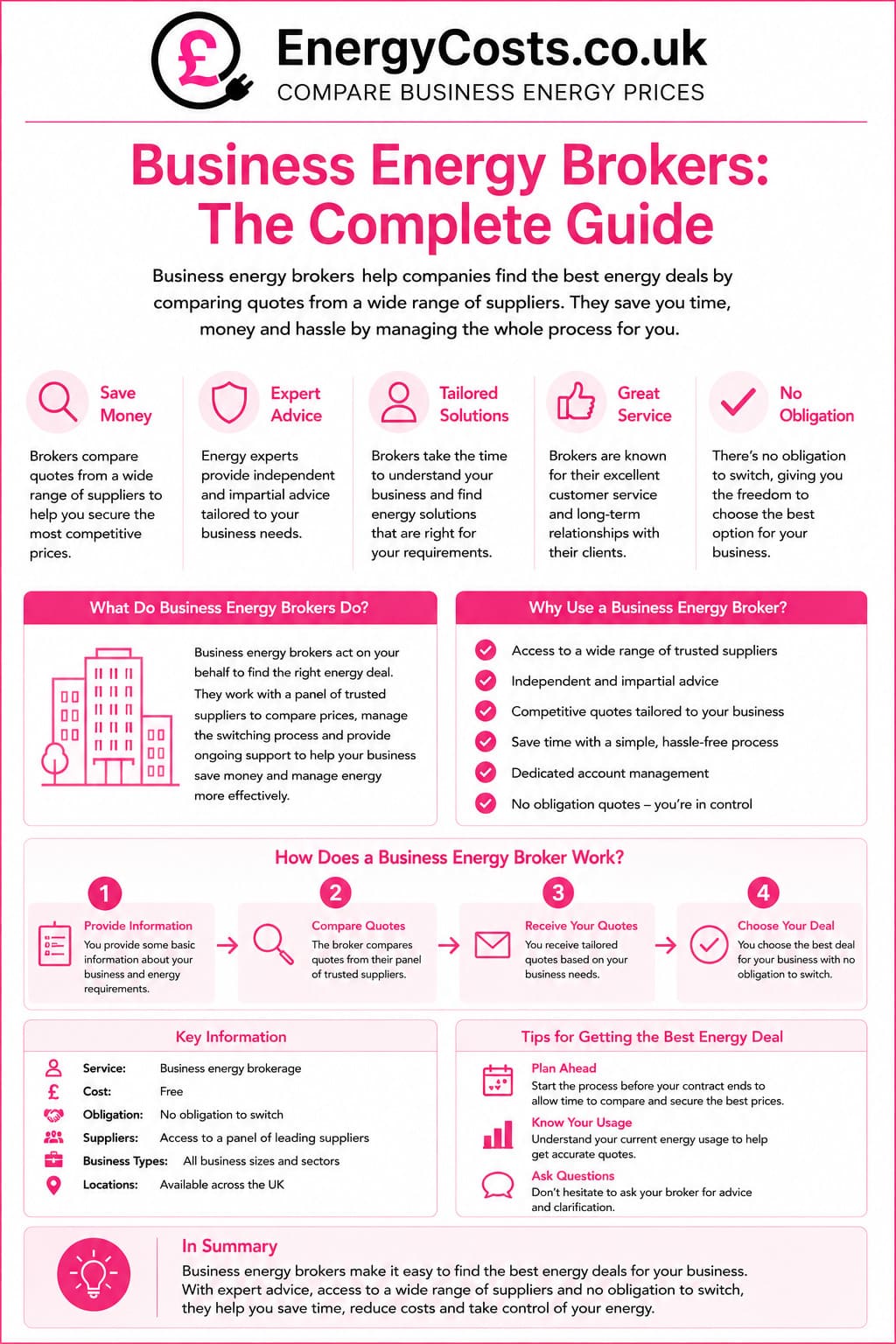
A business energy broker is a third-party intermediary that helps companies compare, negotiate or arrange gas and electricity contracts. Some brokers only introduce a business to a supplier, while others provide a wider energy management service covering contract renewals, billing checks, meter queries, energy efficiency advice and help with supplier disputes.
For many businesses, using a broker can be useful because commercial energy contracts are more complicated than domestic tariffs. Business energy prices are usually quoted individually, contract terms can vary significantly, and suppliers may price differently depending on usage, meter type, credit profile, sector, location and contract length.
Ofgem says businesses can arrange an energy contract directly with a supplier or use a third party such as an energy broker, and brokers charge a fee for their service. That fee might be paid upfront, or it might be included within the unit rate or standing charge on the supplier bill.
Compare business energy brokers in the UK
Below we compare some of the best-known business energy brokers and energy consultancies in the UK, with a focus on what each is best suited for.
Quick comparison of leading UK business energy brokers
| Broker | Best for | Typical customer | Main strengths | Key checks before signing |
|---|---|---|---|---|
| Bionic | Small business switching | SMEs and independent businesses | Broad small business comparison service covering energy and other essentials | Ask whether fees are built into the unit rate |
| Love Energy Savings | Fast online comparison | SMEs wanting a quick digital switch | Online comparison, live quotes and online switching | Check aftercare and commission disclosure |
| Utility Bidder | Multi-utility comparison | SMEs comparing energy, water and telecoms | Supplier panel, account management and wider utility support | Confirm whether the comparison is whole-market |
| Northern Gas and Power | Larger and multi-site businesses | High-usage firms, multi-site users and corporates | Procurement, energy management and market tracking | Ask for full fee disclosure and contract flexibility |
| Inenco | Energy-intensive organisations | Large businesses, public sector and complex users | Strategic procurement and business energy consultancy | Best suited to larger or more complex requirements |
| Inspired PLC | Corporate energy strategy | Commercial, industrial and public sector users | Procurement, risk management, green energy and compliance | May be more consultancy-led than simple switching |
| Advantage Utilities | Bespoke energy consultancy | SMEs, property businesses and larger organisations | Contract strategy, renewables and ongoing support | Ask for clear pricing and scope of service |
| Auditel | Procurement and carbon support | Organisations wanting energy, cost and carbon advice | Energy procurement, cost reduction and net zero support | Check whether a named consultant or team is assigned |
| Consultiv Utilities | SME broker support | SMEs wanting energy and wider utility services | Energy, water, waste and communications support | Confirm supplier panel, commission and complaint route |
| Troo | Ongoing energy support | SMEs wanting contract help plus efficiency advice | Contracts, efficiency, generation and compliance support | Check contract terms and service boundaries |
How we selected these brokers
This comparison is based on several practical criteria that matter to UK businesses:
| Selection factor | Why it matters |
|---|---|
| Market presence | Larger or more established brokers may have wider supplier relationships |
| Service range | Some businesses need more than a one-off switch |
| Suitability by business size | A microbusiness and a large manufacturer need different support |
| Transparency | Broker fees, commission and contract terms should be clearly explained |
| Supplier access | A wider supplier panel can increase the chance of competitive pricing |
| Aftercare | Billing, renewal and complaint support can be as important as the initial quote |
| Sustainability support | Many businesses now want renewable energy, carbon reporting or efficiency advice |
| Public feedback | Review volumes and ratings can provide useful signals, though they should not be treated as guarantees |
Ofgem confirmed that broker fees must be clearly shown in a contract’s principal terms for non-domestic contracts signed from 1 October 2024, and suppliers must make this information available on request. That means businesses should now expect clearer disclosure than was common in the past.
Best business energy brokers in the UK
1. Bionic
Best for: Small businesses wanting a guided comparison service
Bionic is one of the best-known business comparison services in the UK. It positions itself as a comparison site for small businesses, covering business energy as well as other services such as insurance, broadband and finance. Bionic says it has been helping British business owners for nearly 20 years and refers to 200,000 businesses getting support through its platform.
For business energy customers, Bionic is likely to suit SMEs that want a simple way to compare gas and electricity contracts without contacting suppliers individually. It is particularly relevant for small companies that also want help comparing other essential services.
| Bionic overview | Details |
|---|---|
| Best for | Small business energy comparison |
| Useful for | Shops, offices, cafés, trades, small warehouses and independent firms |
| Services | Business energy comparison, switching and renewals |
| Strengths | Recognisable brand, SME focus, wider business comparison services |
| Possible drawback | Businesses should confirm broker fees and whether the supplier panel covers the whole market |
Bionic is a strong fit for businesses that value speed and convenience. However, as with any broker, customers should ask for the broker commission in writing and compare the final annual cost, not just the headline unit rate.
Read our Bionic review.
2. Love Energy Savings
Best for: Fast online business energy comparison
Love Energy Savings is a business energy comparison service that emphasises speed and online switching. Its business energy page says businesses can compare quotes in 30 seconds, choose a deal from its supplier panel and complete the switch online without a long phone call. The company also states that it has 17 years of experience, has helped more than 500,000 businesses, and has delivered more than £150 million in customer bill savings.
This makes Love Energy Savings particularly suitable for SMEs that want to see quotes quickly and prefer an online-first process.
| Love Energy Savings overview | Details |
|---|---|
| Best for | Online comparison and quick switching |
| Useful for | SMEs, small retailers, offices and service businesses |
| Services | Business gas and electricity comparison, online switching, renewal support |
| Strengths | Fast digital journey, live quotes, large customer base |
| Possible drawback | Businesses should check the level of support after the contract is live |
Love Energy Savings may appeal to businesses that want less phone-based selling and more control over the comparison process. However, it is still important to check the broker’s role, fees, supplier panel and complaint process before agreeing to a contract.
See our Love Energy Savings review.
3. Utility Bidder
Best for: Businesses wanting energy and other utilities in one place
Utility Bidder is a business utility comparison service covering commercial gas, electricity, water and telecoms. Its website states that it has helped 90,000 businesses, works with leading UK energy and utility suppliers, and compares live prices for business customers.
Utility Bidder may be especially useful for SMEs that want support across several overheads rather than only energy. Its service may also suit businesses that want an account-managed switching process.
| Utility Bidder overview | Details |
|---|---|
| Best for | Multi-utility comparison |
| Useful for | SMEs comparing gas, electricity, water and telecoms |
| Services | Business energy comparison, utility switching, account support |
| Strengths | Wider utility focus, supplier relationships, account management |
| Possible drawback | Ask how many suppliers were compared for your specific quote |
Utility Bidder says it works with top energy and utility suppliers, but businesses should still ask which suppliers were included in their comparison and how broker fees are recovered.
See our Utility Bidder review.
4. Northern Gas and Power
Best for: Larger businesses and more complex procurement
Northern Gas and Power is a commercial energy broker and consultancy offering energy procurement, energy management, targeting and reduction services. Its website describes the company as working with 20,000 clients across three continents and offering specialist procurement and energy management support.
The company’s procurement page says it tracks market fluctuations and analyses trends to help customers choose energy contracts over a suitable period with an appropriate supplier.
| Northern Gas and Power overview | Details |
|---|---|
| Best for | Larger or more complex business energy procurement |
| Useful for | High-usage businesses, multi-site firms and growing companies |
| Services | Procurement, energy management, market tracking, targeting and reduction |
| Strengths | Larger consultancy model, international activity, market monitoring |
| Possible drawback | Businesses should carefully check contract length, fees and aftercare |
Northern Gas and Power is likely to suit businesses that want more than a simple price comparison. It may be particularly relevant where energy spend is material enough to justify ongoing procurement support.
See our Northern Gas and Power review.
5. Inenco
Best for: Large energy users and complex utility management
Inenco is an energy procurement and consultancy specialist. Its website says it helps organisations manage the purchasing of anything related to business energy, and supports customers with changes in markets, policy and utility costs.
Inenco is likely to be a better fit for businesses with complex requirements than for very small firms looking for a quick online switch. It may suit companies with high consumption, multiple meters, complex non-commodity charges or public sector-style procurement needs.
| Inenco overview | Details |
|---|---|
| Best for | Complex procurement and energy consultancy |
| Useful for | Large businesses, public sector bodies, multi-site users and energy-intensive firms |
| Services | Energy procurement, utility management, consultancy and market support |
| Strengths | Strategic approach, consultancy-led support, policy and market expertise |
| Possible drawback | May be more than a small low-usage business needs |
Inenco should be considered by businesses that want a structured procurement strategy rather than only a supplier quote.
Read our Inenco review.
6. Inspired PLC
Best for: Corporate energy procurement and risk management
Inspired PLC describes itself as a leading commercial energy procurement consultant. Its procurement services include support with fixed, flexible and collective procurement, market insight, green energy and compliant procurement frameworks for public sector organisations.
Inspired also states that it has 30 TWh under management and can conduct a broad market search, using supplier relationships to negotiate for clients.
| Inspired PLC overview | Details |
|---|---|
| Best for | Corporate energy strategy and procurement |
| Useful for | Commercial, industrial and public sector energy users |
| Services | Energy procurement, risk management, market insight, green energy, compliance |
| Strengths | Large-scale procurement capability, public sector frameworks, sustainability support |
| Possible drawback | More suited to larger or strategically complex energy users |
Inspired is likely to suit organisations that need energy procurement to be part of a wider risk, budgeting and sustainability strategy.
Read our Inspired PLC review.
7. Advantage Utilities
Best for: Bespoke energy consultancy and ongoing support
Advantage Utilities positions itself as a specialist business energy consultancy. Its website says it provides guidance on selecting the best contract type, offers 24/7 support, dedicated account management, flexible contract options, continuous market monitoring and transition support. It also states that it has more than 20 years of trade and has been trusted with more than £2 billion of contracts.
| Advantage Utilities overview | Details |
|---|---|
| Best for | Bespoke energy and sustainability consultancy |
| Useful for | Property firms, SMEs, larger businesses and organisations wanting renewable options |
| Services | Procurement, contract management, renewables, market monitoring, energy strategy |
| Strengths | Bespoke support, sustainability focus, contract management |
| Possible drawback | Businesses should confirm exactly what support is included |
Advantage Utilities may be a good fit for businesses that want ongoing guidance rather than a one-off transaction.
Read our Advantage Utilities review.
8. Auditel
Best for: Energy procurement, cost control and carbon reduction
Auditel describes itself as a carbon, energy and procurement solutions company. It says it has a network of more than 100 carbon, energy and procurement specialists and has operated since 1994.
Auditel’s energy management page says it brings more than 30 years of experience to energy procurement and management, with a transparent, strategic and client-led approach.
| Auditel overview | Details |
|---|---|
| Best for | Procurement, carbon and cost management |
| Useful for | Organisations wanting energy support linked to net zero or wider procurement |
| Services | Energy procurement, cost management, carbon reduction, net zero support |
| Strengths | Broad procurement expertise, carbon focus, consultant network |
| Possible drawback | Experience may vary depending on the individual consultant assigned |
Auditel is a strong option for organisations that want energy costs assessed alongside other operational costs and carbon reduction plans.
Read our Auditel review.
9. Consultiv Utilities
Best for: SMEs wanting energy and wider utility support
Consultiv Utilities is a business energy broker and utility consultancy. Its website says it has relationships with more than 25 business energy suppliers and can support customers with energy, waste, water and communications. It also highlights sustainability support through energy audits, net zero planning and energy consulting.
| Consultiv Utilities overview | Details |
|---|---|
| Best for | SME energy and wider utility support |
| Useful for | SMEs wanting help with energy, water, waste and telecoms |
| Services | Electricity, gas, water, waste, communications and sustainability support |
| Strengths | Wider utilities service, sustainability advice, supplier relationships |
| Possible drawback | Ask for a clear explanation of commission and total contract cost |
Consultiv may suit businesses that want one broker to review several utility categories, rather than handling energy separately.
Read our Consultiv Utilities review.
10. Troo
Best for: Businesses wanting ongoing energy support and efficiency advice
Troo describes itself as a business energy consultancy helping companies secure contracts, improve efficiency, explore on-site generation and meet compliance needs. Its website says it supports gas, electricity and water contracts, energy efficiency, renewable energy and compliance.
| Troo overview | Details |
|---|---|
| Best for | Ongoing energy consultancy |
| Useful for | SMEs wanting contract advice plus energy efficiency support |
| Services | Energy procurement, water comparison, efficiency advice, generation and compliance |
| Strengths | Long-term support positioning, efficiency and renewable energy focus |
| Possible drawback | Check how contract support and efficiency advice are priced |
Troo is likely to suit companies that want a more supportive, advice-led relationship rather than a basic transactional comparison.
Read our Troo review.
Which business energy broker is best for your company?
There is no single best business energy broker for every company. The right choice depends on the size of your business, how much energy you use, how complicated your meters are, and how much support you want after the contract is signed.
| Business type | Best broker type | Good options to compare |
|---|---|---|
| Small shop, café or office | Fast SME comparison broker | Bionic, Love Energy Savings, Utility Bidder |
| Small business wanting online switching | Digital comparison platform | Love Energy Savings, Bionic |
| Business comparing several utilities | Multi-utility broker | Utility Bidder, Consultiv Utilities |
| Multi-site company | Account-managed broker or consultancy | Northern Gas and Power, Advantage Utilities, Inenco |
| High-usage business | Strategic procurement consultancy | Inspired, Inenco, Northern Gas and Power |
| Public sector or complex procurement | Formal procurement consultant | Inspired, Inenco |
| Business with net zero goals | Energy and sustainability consultancy | Auditel, Inspired, Advantage Utilities, Troo |
| Business wanting efficiency support | Consultancy-led broker | Troo, Auditel, Advantage Utilities |
| Property or facilities management business | Ongoing utility management support | Advantage Utilities, Inenco, Consultiv Utilities |
How business energy brokers work
A typical business energy broker will ask for details such as:
| Information requested | Why it matters |
|---|---|
| Business name and address | Needed to identify the premises and supply point |
| Current supplier | Helps the broker check contract status and renewal options |
| Contract end date | Determines when the business can switch without exit penalties |
| Annual consumption | Used to price electricity and gas contracts |
| Meter numbers | MPAN for electricity and MPRN for gas |
| Recent bills | Helps verify usage, rates, standing charges and contract type |
| Business type | Some sectors are treated differently by suppliers |
| Credit profile | Can affect whether suppliers quote and what terms they offer |
The broker will then approach suppliers or use supplier pricing portals to obtain quotes. They may provide a comparison showing unit rates, standing charges, contract lengths, renewable energy options, billing arrangements and key terms.
Once the business selects a quote, the broker may arrange the contract paperwork or obtain verbal or written authority to place the contract. The actual supply contract is normally between the business and the energy supplier, not between the business and the broker.
What services do business energy brokers provide?
Not every broker offers the same service. Some focus almost entirely on contract switching, while others act more like an energy consultancy.
| Broker service | What it usually involves | Useful for |
|---|---|---|
| Energy price comparison | Comparing business gas and electricity quotes | Businesses approaching renewal |
| Contract negotiation | Seeking better rates or terms from suppliers | Medium and high-usage businesses |
| Renewal management | Tracking contract end dates and avoiding deemed rates | Businesses with multiple sites |
| Bill validation | Checking bills for incorrect rates, VAT, CCL or meter data | Businesses with complex bills |
| Metering support | Helping with MPANs, MPRNs, meter changes or smart meters | Businesses with supply issues |
| Energy efficiency advice | Identifying ways to reduce usage | High-consumption premises |
| Green energy procurement | Comparing renewable electricity or gas options | Businesses with ESG targets |
| Dispute support | Helping challenge billing or switching problems | Businesses with supplier issues |
Ofgem also notes that an energy broker can help businesses understand energy bills, energy grants and energy efficiency options, not just find a contract.
How do business energy brokers make money?
Business energy brokers are usually paid in one of four ways.
| Payment model | How it works | What to check |
|---|---|---|
| Commission built into the unit rate | The supplier pays the broker, with the cost recovered through the p/kWh rate | Ask how many pence per kWh are added |
| Commission built into the standing charge | The broker fee is added as a daily, monthly or annual charge | Ask whether the standing charge includes broker margin |
| Direct fee | The business pays the broker separately | Ask for the fee in writing before agreeing |
| Retainer or consultancy fee | The business pays for ongoing energy management | Check what services are included |
The most common model is a supplier-paid commission or “uplift”, where the broker’s fee is added to the energy contract. This might look small when expressed as pence per kWh, but it can become expensive over a multi-year contract.
For example:
| Annual energy usage | 0.5p/kWh broker fee | 1p/kWh broker fee | 2p/kWh broker fee | 3p/kWh broker fee |
|---|---|---|---|---|
| 10,000 kWh | £50 per year | £100 per year | £200 per year | £300 per year |
| 25,000 kWh | £125 per year | £250 per year | £500 per year | £750 per year |
| 50,000 kWh | £250 per year | £500 per year | £1,000 per year | £1,500 per year |
| 100,000 kWh | £500 per year | £1,000 per year | £2,000 per year | £3,000 per year |
| 250,000 kWh | £1,250 per year | £2,500 per year | £5,000 per year | £7,500 per year |
Over a three-year contract, a 2p/kWh broker fee on 100,000 kWh of annual usage would cost £6,000. This is why businesses should always ask for the broker’s fee in pounds and pence, not just as a small uplift on the unit rate.
Do business energy brokers have to disclose their commission?
Broker fee transparency has improved. Ofgem confirmed that, for contracts signed on or from 1 October 2024, suppliers must ensure a contract’s principal terms clearly display broker fees for all non-domestic customers, and suppliers must make the information available upon request.
Ofgem’s Non-Domestic Market Review decision states that all non-domestic customers should receive third-party intermediary service fees as a cost per unit in their principal terms and upon request. For microbusinesses, Ofgem retained the requirement for the total broker fee across the contract duration to be shown as a lump sum.
This does not mean broker fees must appear on every energy bill. Ofgem clarified that the requirement relates to principal terms and information provided upon request, not a licence requirement to display TPI fees on bills.
Are business energy brokers regulated?
The position is changing. Historically, energy brokers were not directly regulated by Ofgem in the same way as energy suppliers. However, the government’s October 2025 response on third-party intermediaries set out plans for Ofgem to regulate TPIs, including energy procurement intermediaries. The expected framework includes high-level principles, specific rules and registration requirements.
For businesses, this means the broker market is moving towards stronger oversight, but companies should still do their own checks before agreeing to a broker-arranged contract. At present, practical protections include broker fee disclosure in contract terms, dispute resolution access for eligible businesses, and the ability to complain where a broker has misled the business or failed to explain fees properly.
Business energy broker vs going direct to a supplier
A business can arrange a contract directly with a supplier, through a broker, or through a business energy comparison service. The best route depends on the business’s usage, complexity and confidence in assessing contract terms.
| Route | Advantages | Disadvantages |
|---|---|---|
| Direct to supplier | Simple, no broker involved, direct relationship | Limited to that supplier’s own prices |
| Business energy broker | Can compare several suppliers and manage renewals | Broker fees may increase the total cost |
| Energy comparison website | Quick way to see indicative prices | May not suit complex or high-usage sites |
| Energy consultant | More detailed procurement and strategy support | Usually more expensive than basic broking |
A broker is most useful when they provide access to suppliers, terms or support that the business would struggle to secure alone. A broker is less useful if they simply add a margin to a standard supplier quote without providing clear value.
Advantages of using a business energy broker
The main benefit of a broker is convenience. Many businesses do not have the time to contact multiple suppliers, compare quote structures and monitor renewal deadlines. A broker can handle much of this process.
Other potential benefits include:
| Benefit | Why it matters |
|---|---|
| Wider market access | Some brokers have relationships with multiple suppliers |
| Time saving | Reduces the admin involved in collecting quotes |
| Renewal tracking | Helps avoid rolling onto expensive deemed or out-of-contract rates |
| Tariff comparison | Makes it easier to compare unit rates, standing charges and contract length |
| Energy expertise | Useful for businesses with complex metering or high usage |
| Multi-site support | Helps businesses manage several contracts at once |
| Bill checking | Can identify billing mistakes or incorrect contract rates |
Disadvantages and risks of using a broker
The biggest risk is that the cheapest-looking quote may not be the cheapest overall once commission, contract length, pass-through charges and other terms are considered.
| Risk | What it means |
|---|---|
| Hidden or poorly explained fees | A broker’s commission may be built into the rate |
| Limited supplier panel | The broker may not compare the whole market |
| Long contract lock-ins | A cheaper rate may come with a lengthy fixed term |
| Pressure selling | Businesses may be pushed to agree quickly |
| Verbal contracts | Some business energy contracts can be agreed by phone |
| Misleading savings claims | Claimed savings may be based on inflated renewal rates |
| Poor aftercare | Some brokers disappear once the contract is signed |
Citizens Advice says a business might want to complain about a broker if it was misled about a contract, the broker was not clear about fees, or the broker charged more than it said it would.
Questions to ask a business energy broker
Before agreeing to use a broker, ask direct questions and request written answers.
| Question | Why to ask |
|---|---|
| Are you independent or tied to specific suppliers? | Shows whether the broker compares the whole market |
| Which suppliers did you compare? | Helps identify whether the comparison is broad or limited |
| How are you paid? | Reveals whether fees are direct or built into the contract |
| What is your fee in p/kWh and total pounds? | Shows the real cost across the contract |
| Is the fee included in the unit rate or standing charge? | Helps interpret the quote correctly |
| What is the contract length? | Avoids being locked in longer than expected |
| Are rates fixed, variable or pass-through? | Determines exposure to changing non-commodity costs |
| What happens at the end of the contract? | Helps avoid rollover or deemed rates |
| Do you provide post-contract support? | Clarifies whether service continues after signing |
| Which dispute scheme are you registered with? | Important if something goes wrong |
A reputable broker should be willing to answer these questions plainly. If a broker refuses to disclose commission, avoids written explanations or says the fee is “free”, the business should be cautious.
Warning signs of a poor energy broker
Businesses should be careful if a broker:
| Warning sign | Why it matters |
|---|---|
| Says the service is free | Broker fees are often recovered through the energy rate |
| Refuses to disclose commission | Makes it hard to judge value for money |
| Uses high-pressure sales tactics | Can lead to poor contract decisions |
| Claims prices will disappear immediately | May be an artificial urgency tactic |
| Will not confirm quotes in writing | Makes disputes harder later |
| Avoids naming the suppliers compared | Suggests a limited supplier panel |
| Pushes a very long contract | Could increase commission and reduce flexibility |
| Does not explain principal terms | Raises the risk of misunderstanding |
| Is not registered with a dispute scheme | Limits complaint options |
What is a letter of authority?
A letter of authority, often called an LOA, is a document that allows a broker to speak to suppliers on the business’s behalf. It can be useful because suppliers may not release contract or meter information to a third party without permission.
However, businesses should read the LOA carefully. There is a major difference between:
| Type of authority | What it allows |
|---|---|
| Authority to obtain information | The broker can request usage, renewal and meter details |
| Authority to negotiate | The broker can discuss prices and terms |
| Authority to sign | The broker may be able to agree a contract for the business |
Most businesses should be cautious about giving authority to sign unless they are completely comfortable with the broker and have agreed strict limits in writing. A safer approach is to allow the broker to gather quotes, but require final approval before any contract is accepted.
How to compare business energy broker quotes
When comparing broker quotes, do not look only at the headline unit rate. Compare the total annual and total contract cost.
| Cost item | What to compare |
|---|---|
| Unit rate | Pence per kWh for electricity or gas |
| Standing charge | Daily charge for each meter |
| Broker fee | Pence per kWh, standing charge uplift or direct fee |
| Contract length | 12, 24, 36 or 60 months |
| Fixed vs pass-through costs | Whether non-commodity charges can change |
| VAT and CCL | Whether shown correctly for the business |
| Green premium | Any extra cost for renewable energy |
| Exit terms | Whether the contract can be ended early |
| Renewal terms | What happens when the contract expires |
The cheapest unit rate is not always the best deal. A quote with a slightly higher unit rate but lower standing charge may be better for a low-usage business. A quote with a transparent broker fee may be better than a cheaper-looking quote with unclear commission.
Example: how broker commission changes the final rate
A business is quoted an electricity contract with a base supplier rate of 24p/kWh. The broker adds a 1.5p/kWh fee.
| Item | Amount |
|---|---|
| Supplier base unit rate | 24p/kWh |
| Broker fee | 1.5p/kWh |
| Final contract unit rate | 25.5p/kWh |
| Annual usage | 80,000 kWh |
| Annual broker fee | £1,200 |
| Broker fee over 3 years | £3,600 |
The business may only see the final rate of 25.5p/kWh unless the broker fee is clearly disclosed. This is why fee transparency matters: a small-looking uplift can add thousands of pounds to the contract.
Can a business energy broker save your business money?
A broker can save money if they find a better contract than the business could obtain directly, help avoid expensive out-of-contract rates, or identify billing errors. For businesses with high usage or multiple sites, even a small improvement in rates can produce a meaningful saving.
However, a broker does not automatically guarantee the cheapest deal. Savings depend on:
| Factor | Impact |
|---|---|
| Number of suppliers compared | More suppliers usually improves the chance of a competitive quote |
| Broker commission | High commission can cancel out savings |
| Contract timing | Prices change depending on wholesale market conditions |
| Business credit profile | Some suppliers may not quote higher-risk customers |
| Meter type and usage profile | Half-hourly and high-usage sites may need bespoke pricing |
| Contract length | Longer contracts may appear cheaper but reduce flexibility |
The key question is not “does the broker charge?” but “does the broker’s service justify the fee?”
What to do if you have a problem with a business energy broker
If a business has been misled, charged an unexpected fee or placed into a contract it did not properly agree to, it should gather evidence first. This may include emails, signed documents, call notes, quotes, bills, contract terms and copies of the broker’s fee disclosure.
Citizens Advice recommends contacting the supplier or broker straight away, keeping notes of phone calls, and following up in writing so there is a record of the complaint.
Eligible businesses may be able to take unresolved broker complaints to an approved dispute resolution scheme. Citizens Advice says that, if a broker is paid by a supplier, it must be registered with one of the Energy Ombudsman, the Utilities Intermediaries Association or the Dispute Resolution Ombudsman; if the broker is not registered, complaint options may be limited.
The Energy Ombudsman says small businesses can access free dispute resolution support for broker disputes from 19 December 2024, provided they meet eligibility criteria. Its criteria include having fewer than 50 employees and turnover or balance sheet thresholds, or meeting specified annual electricity or gas consumption limits.
Should your business use an energy broker?
A business energy broker can be worthwhile if the broker is transparent, compares a meaningful range of suppliers, explains fees clearly and provides useful support beyond simply arranging a contract.
A broker is more likely to be useful if your business:
| Business situation | Broker value |
|---|---|
| Has high electricity or gas usage | Small rate differences have a bigger cash impact |
| Has several sites | Contract management becomes more complex |
| Has half-hourly meters | Pricing can be more specialist |
| Has limited time to compare suppliers | Broker can reduce admin |
| Wants renewable energy options | Broker can compare green tariffs or PPAs |
| Has had billing problems | Broker may help identify errors |
| Needs renewal reminders | Broker can help avoid deemed rates |
A broker may be less necessary if your business has low usage, simple metering and the time to compare quotes directly. Even then, it can be useful to compare both broker-led and direct supplier quotes to see which offers the best total cost.
Business energy broker checklist
Before agreeing to a broker-arranged contract, check the following:
| Check | Why it matters |
|---|---|
| Broker fee shown in writing | Confirms the true cost |
| Total contract cost calculated | Avoids focusing only on the unit rate |
| Suppliers compared listed | Shows how wide the comparison is |
| Contract end date clear | Prevents accidental long-term lock-in |
| Standing charge included | Important for lower-usage businesses |
| VAT and CCL treatment correct | Helps avoid bill surprises |
| Letter of authority limited | Prevents unwanted contract agreement |
| Complaint scheme confirmed | Gives a route if something goes wrong |
| Final approval retained | Ensures the broker cannot sign without permission |
| Renewal reminder set | Avoids deemed or out-of-contract rates |
Final verdict
Business energy brokers can help companies save time, compare suppliers and manage energy contracts more professionally. They can be especially useful for high-usage businesses, multi-site companies and organisations with complex billing or metering arrangements.
However, brokers are not automatically cheaper. Their fees can be built into the unit rate or standing charge, and those fees can add hundreds or thousands of pounds to the total contract cost. The best approach is to ask for full commission disclosure, compare the total contract cost, avoid pressure selling and keep final control over any contract approval.
A good broker should make business energy procurement clearer. If the broker makes the deal harder to understand, avoids questions about commission or pushes for a rushed decision, it is sensible to look elsewhere.
FAQ
A business energy broker helps companies compare and arrange commercial gas and electricity contracts. Some brokers also provide bill checking, renewal reminders, metering support, energy efficiency advice and help with supplier disputes. The level of service varies, so businesses should check exactly what is included before agreeing.
Business energy brokers are not truly free. Some charge a direct fee, while others receive commission from the supplier. That commission is often recovered through the business’s unit rate or standing charge, meaning the business still pays for the broker through its energy contract.
Broker charges vary widely. Some use a small pence-per-kWh uplift, while others charge larger commissions or fixed consultancy fees. A 1p/kWh broker fee costs £500 per year for a business using 50,000 kWh annually, or £1,500 across a three-year contract.
For contracts signed from 1 October 2024, Ofgem rules require broker fees to be shown in the principal terms for all non-domestic customers, and suppliers must make this information available upon request. Microbusinesses should also receive the total broker cost over the contract duration.
A broker should only be able to sign or agree a contract if the business has given suitable authority. Businesses should be careful with letters of authority and avoid giving authority to sign unless they fully understand the limits, supplier, rates, contract length and total cost.
It depends. A broker may access competitive supplier prices or save the business time, but broker commission can increase the final rate. The fairest comparison is to look at the full annual cost and total contract cost, including unit rates, standing charges and broker fees.
The regulatory framework is changing. The government has set out plans for Ofgem to regulate third-party intermediaries, including energy procurement brokers, with expected principles, rules and registration requirements. Businesses should still check broker fees, dispute scheme membership and contract terms carefully.
Yes, but the route depends on the broker and the business’s eligibility. Citizens Advice says businesses should complain to the broker first and keep written records. If unresolved, eligible businesses may be able to use the Energy Ombudsman, UIA or Dispute Resolution Ombudsman, depending on the broker’s registration.
A broker uplift is an added amount, usually shown as pence per kWh, built into the energy rate. For example, if the supplier’s base rate is 24p/kWh and the broker adds 1p/kWh, the business pays 25p/kWh. The broker then receives the uplift as commission.
Small businesses can benefit from using a broker, especially if they lack time or confidence to compare contracts. However, they should ask for written fee disclosure, avoid pressure selling, compare direct supplier quotes where possible, and check whether the broker is registered with a recognised dispute scheme.