

ScottishPower and British Gas are two of the UK’s largest and most established commercial energy suppliers. Both offer gas and electricity contracts to small businesses, support larger multi-site organisations and provide additional services such as smart meters, commercial solar panels and electric vehicle charging.
Their business propositions nevertheless differ in several important respects.
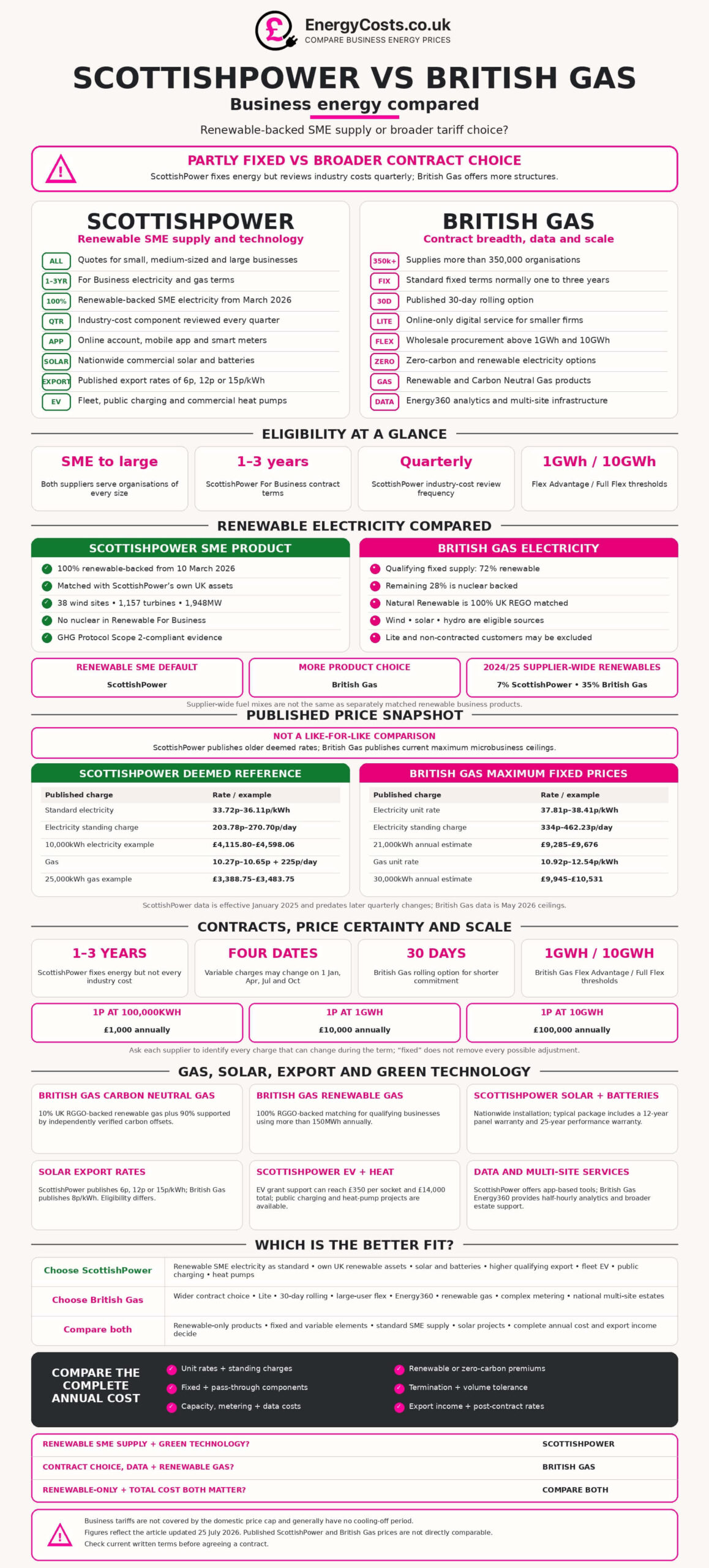
ScottishPower’s current SME electricity products are backed by 100% renewable electricity generated by ScottishPower’s UK renewable assets. Its For Business tariffs are available for one, two or three years and divide the price into a fixed energy component and variable industry charges reviewed every quarter.
British Gas offers a broader selection of contract structures. These include conventional fixed plans, British Gas Lite, a 30-day rolling contract, multi-site arrangements and flexible wholesale purchasing for companies consuming more than 1GWh annually. Its qualifying fixed electricity plans are zero carbon, using a combination of renewable and nuclear-backed electricity, while customers can opt into a renewable-only product.
ScottishPower may therefore appeal to companies that want renewable electricity included within a straightforward SME tariff. British Gas may be more suitable where the business wants greater contract choice, large-user procurement tools, renewable gas or advanced consumption reporting.
Neither supplier can be declared universally cheaper. Business energy prices depend on the individual meter, postcode, consumption, credit profile and proposed contract.
ScottishPower vs British Gas at a glance
| Feature | ScottishPower Business | British Gas Business |
|---|---|---|
| Small-business electricity | Yes | Yes |
| Small-business gas | Yes | Yes |
| Large-business supply | Yes | Yes |
| Standard contracted prices published | No, individual quotation required | Maximum microbusiness prices published |
| Main fixed terms | One, two or three years | Normally one, two or three years; some maximum-price tables include four years |
| Fully fixed tariff | No: energy fixed but industry costs can change quarterly | Fixed-price plans available, subject to contractual non-energy provisions |
| Short rolling tariff | Standard Variable tariff with no fixed term | 30-day Rolling Energy Plan |
| Online-only small-business service | Online account and app | British Gas Lite |
| Flexible wholesale purchasing | No equivalent standard SME product | Flex Advantage above 1GWh and Full Flex above 10GWh |
| SME electricity from March 2026 | 100% renewable-backed | Zero carbon on qualifying fixed plans |
| Renewable-only product | Renewable For Business | Natural Renewable Electricity |
| Nuclear-backed electricity | Not included in Renewable For Business | Included in standard zero-carbon fixed plans |
| Business gas | Conventional business gas | Conventional, Carbon Neutral and Renewable Gas options |
| Smart-meter data | App and online consumption tools | Energy360 DataView with half-hourly information |
| Commercial solar | Nationwide solar and battery installation | Commercial solar through specialist partners |
| Published solar export rates | 6p, 12p or 15p/kWh, subject to eligibility | 8p/kWh for eligible business supply customers |
| Fleet EV charging | Depot, home and public charging options | Communal and commercial charging services |
| Public charger hosting | Fully funded option for suitable sites | Commercial and communal solutions |
| Heat pumps | Bespoke commercial heat solutions | Available through wider Centrica services |
| Best suited to | SMEs wanting UK renewable-backed electricity and green technology | Companies wanting wider tariff choice, procurement tools and renewable gas |
Which companies can apply?
Both suppliers serve SMEs as well as larger commercial organisations.
ScottishPower does not restrict its business quotation service to one narrow consumption band. It says that its tariffs are available to small, medium-sized and large businesses. Companies can request an online quote or speak to its business sales team.
British Gas also supplies organisations of every size. Its standard business service covers SMEs, half-hourly meters, multi-site estates and larger corporate users.
British Gas Lite is designed specifically for smaller businesses that want:
- a fixed-price contract;
- online-only account management;
- monthly Direct Debit;
- automatic smart-meter readings; and
- support through webchat rather than a conventional telephone service.
British Gas’s more advanced flexible contracts are intended for higher consumption levels.
| British Gas product | Typical minimum annual consumption |
|---|---|
| Flex Advantage | More than 1GWh |
| Full Flex | More than 10GWh |
One gigawatt-hour is equal to one million kilowatt-hours.
Example suitability by business size
| Example business | Annual electricity consumption | Potential options |
|---|---|---|
| Independent shop | 12,000kWh | ScottishPower For Business, British Gas or British Gas Lite |
| Small office | 40,000kWh | Fixed quote from either supplier |
| Restaurant | 100,000kWh | Single-rate or multi-rate contract from either |
| Hotel | 350,000kWh | Bespoke or multi-site quotation |
| Manufacturer | 2GWh | Both suppliers; British Gas Flex Advantage may be relevant |
| National retailer | 12GWh | Multi-site service from either; British Gas Full Flex may be considered |
| EV fleet depot | 1GWh | ScottishPower fleet charging or wider British Gas/Centrica services |
| Business with rooftop solar | Any suitable level | Solar, batteries and export tariffs from either supplier |
The supplier may assess the company’s credit history, meter type, premises use and payment record before offering a contract.
Which supplier is cheaper?
There is no national ScottishPower-versus-British Gas business price.
The quotation can depend on:
- electricity MPAN or gas MPRN;
- postcode and distribution region;
- annual consumption;
- meter profile;
- half-hourly usage pattern;
- agreed supply capacity;
- number of sites;
- contract start date;
- contract duration;
- payment method;
- creditworthiness;
- renewable product selection; and
- wholesale market prices.
The most useful comparison is the complete projected annual cost:
- Annual consumption × unit rate
- daily standing charge × 365
- meter and data charges
- capacity charges
- network and policy costs
- environmental product charges
- VAT and Climate Change Levy where applicable
− export income and contractual credits
A lower unit rate does not automatically produce a cheaper tariff if it is accompanied by a higher standing charge.
How small price differences affect annual costs
| Annual consumption | Value of 1p/kWh difference | Value of 3p/kWh difference | Value of 5p/kWh difference |
|---|---|---|---|
| 10,000kWh | £100 | £300 | £500 |
| 25,000kWh | £250 | £750 | £1,250 |
| 50,000kWh | £500 | £1,500 | £2,500 |
| 100,000kWh | £1,000 | £3,000 | £5,000 |
| 250,000kWh | £2,500 | £7,500 | £12,500 |
| 1GWh | £10,000 | £30,000 | £50,000 |
| 10GWh | £100,000 | £300,000 | £500,000 |
Standing charges can be particularly important for low-use meters and multi-site businesses.
| Daily standing-charge difference | Annual difference per meter | Difference across ten meters |
|---|---|---|
| 25p | £91.25 | £912.50 |
| 50p | £182.50 | £1,825 |
| £1 | £365 | £3,650 |
| £2 | £730 | £7,300 |
| £5 | £1,825 | £18,250 |
ScottishPower business tariff structure
ScottishPower’s main contracted products are its For Business tariffs.
The supplier offers one-, two- and three-year contracts. However, these should not be interpreted as fully fixed tariffs in which every charge remains unchanged.
ScottishPower divides the price into two parts.
Fixed energy component
The energy component reflects the cost of purchasing gas or electricity. ScottishPower locks this part in for the duration of the contract.
This protects the customer against increases in the wholesale energy component during the agreed term.
Variable industry-cost component
The second part covers charges that ScottishPower passes through from networks, government policies and other industry bodies.
These can include:
- Renewables Obligation costs;
- Capacity Market charges;
- Balancing Services Use of System charges;
- Distribution Use of System charges;
- Transmission Network Use of System charges;
- smart-meter industry costs;
- the Nuclear Regulated Asset Base levy;
- the Network Charging Compensation Scheme;
- gas transportation costs; and
- the Green Gas Levy.
ScottishPower reviews these elements quarterly. Changes can take effect on:
- 1 January;
- 1 April;
- 1 July; and
- 1 October.
This structure provides protection against wholesale market movements but does not guarantee a completely unchanged unit rate or standing charge.
ScottishPower’s April 2026 industry-cost changes
The exact adjustment varies according to region, meter type and residual charging band.
Examples from ScottishPower’s published April 2026 regional schedules include:
| Region and meter example | Change to day unit costs | Change to night unit costs | Change to standing charge |
|---|---|---|---|
| Eastern Economy 7 | +1.30p/kWh | −0.16p/kWh | +9.49p to +141.69p per day |
| East Midlands Economy 7 | +1.72p/kWh | −0.10p/kWh | +6.84p to +137.32p per day |
| London Economy 7 | +3.62p/kWh | +0.52p/kWh | +2.56p to +133.27p per day |
| South East Economy 7 | +1.83p/kWh | +0.40p/kWh | +10.46p to +150.52p per day |
| South Scotland evening and weekend | +1.86p/kWh daytime | +0.14p/kWh evening/weekend | +10.90p to +162.78p per day |
The wide standing-charge ranges largely reflect the customer’s assigned network residual band.
These are movements in the variable component, not the complete tariff price. They demonstrate why a ScottishPower contract can change during its fixed term even though the wholesale energy element remains protected.
ScottishPower default business prices
ScottishPower places a company on a deemed tariff when it moves into premises already supplied by ScottishPower without agreeing a contract.
Its Standard Variable tariff can apply after a fixed contract expires if the customer does not renew or change supplier.
The supplier warns that both are normally more expensive than an agreed For Business tariff.
The most recent full deemed rate sheets linked from ScottishPower’s current business terms page are marked as effective from 1 January 2025. Businesses should therefore confirm the latest rate directly before relying on them.
The linked electricity schedule shows the following regional ranges:
| ScottishPower deemed electricity charge | Published range |
|---|---|
| Standard unit rate | 33.72p–36.11p/kWh |
| Standard standing charge | 203.78p–270.70p per day |
| Economy 7 day rate | 33.90p–36.12p/kWh |
| Economy 7 night rate | 29.55p–30.59p/kWh |
| Evening and weekend day rate | 34.79p–37.20p/kWh |
| Evening and weekend rate | 30.68p–32.73p/kWh |
| Off-peak rate | 26.16p–27.44p/kWh |
| Off-peak standing charge | 17p per day |
The corresponding gas schedule shows:
| ScottishPower deemed gas charge | Published range |
|---|---|
| Gas unit rate | 10.27p–10.65p/kWh |
| Standing charge | 225p per day |
| Annual standing charge | £821.25 |
The electricity figures exclude VAT and Climate Change Levy. The gas schedule excludes VAT.
Because the schedules carry a January 2025 effective date, they should be treated as public reference data rather than confirmed June 2026 prices.
Illustrative ScottishPower deemed costs
Using the regional ranges in the linked schedules, a standard electricity meter would produce the following approximate costs:
| Annual electricity consumption | Lowest regional total | Highest regional total |
|---|---|---|
| 10,000kWh | £4,115.80 | £4,598.06 |
| 25,000kWh | £9,173.80 | £10,014.56 |
| 50,000kWh | £17,603.80 | £19,042.06 |
| 100,000kWh | £34,463.80 | £37,097.06 |
The calculations include the published standing charge but exclude VAT, CCL and subsequent industry-cost changes.
For gas:
| Annual gas use | Lowest regional total | Highest regional total |
|---|---|---|
| 25,000kWh | £3,388.75 | £3,483.75 |
| 50,000kWh | £5,956.25 | £6,146.25 |
| 100,000kWh | £11,091.25 | £11,471.25 |
| 250,000kWh | £26,496.25 | £27,446.25 |
A negotiated contract may be materially cheaper than a deemed rate.
British Gas maximum microbusiness prices
British Gas publishes the maximum rates that a microbusiness may pay when entering a Fixed Price Energy Plan.
These figures are maximum ceilings, not average prices. Individual quotations may be lower.
The rates were shown as current on 27 May 2026 and exclude VAT, Climate Change Levy and other applicable charges.
Single-rate electricity
| Contract term | Maximum unit rate | Maximum standing charge | Published contract cost |
|---|---|---|---|
| One year | 38.41p/kWh | 334p per day | £9,285 |
| Two years | 37.81p/kWh | 379.96p per day | £18,654 |
| Three years | 38.04p/kWh | 428.43p per day | £28,657 |
| Four years | 38.04p/kWh | 462.23p per day | £38,702 |
The estimated contract costs assume annual consumption of 21,000kWh.
| Term | Approximate average annual cost |
|---|---|
| One year | £9,285 |
| Two years | £9,327 |
| Three years | £9,552 |
| Four years | £9,676 |
Although the two-year option has the lowest maximum unit rate, its higher standing charge means the one-year option has the lowest estimated annual cost in the published example.
Day-and-night electricity
| Contract term | Maximum day rate | Maximum night rate | Standing charge |
|---|---|---|---|
| One year | 40p/kWh | 31.76p/kWh | 334p per day |
| Two years | 39.37p/kWh | 31.17p/kWh | 379.96p per day |
| Three years | 39.61p/kWh | 31.42p/kWh | 428.43p per day |
| Four years | 39.61p/kWh | 31.42p/kWh | 462.23p per day |
Using the two-year rates:
| Electricity used at night | Weighted average rate |
|---|---|
| 10% | 38.55p/kWh |
| 25% | 37.32p/kWh |
| 50% | 35.27p/kWh |
| 75% | 33.22p/kWh |
The daily standing charge must still be added.
Evening-and-weekend electricity
| Contract term | Evening and weekend rate | Weekday daytime rate | Standing charge |
|---|---|---|---|
| One year | 31.66p/kWh | 42.27p/kWh | 334p per day |
| Two years | 31.17p/kWh | 41.20p/kWh | 379.96p per day |
| Three years | 31.48p/kWh | 40.80p/kWh | 428.43p per day |
| Four years | 31.48p/kWh | 40.80p/kWh | 462.23p per day |
This structure may suit hospitality, leisure and entertainment businesses that consume much of their electricity outside conventional weekday working hours.
Maximum gas prices
| Contract term | Maximum gas unit rate | Maximum standing charge | Published contract cost |
|---|---|---|---|
| One year | 12.54p/kWh | 1,710.28p per day | £10,005 |
| Two years | 11.44p/kWh | 1,784.47p per day | £19,891 |
| Three years | 10.92p/kWh | 1,862.57p per day | £30,223 |
| Four years | 11.07p/kWh | 1,975.41p per day | £42,125 |
The gas examples assume annual consumption of 30,000kWh.
The maximum standing charges are unusually high and should not be treated as typical British Gas quotations.
Can the published prices be directly compared?
No.
The ScottishPower table contains linked deemed rates with an effective date of January 2025. The British Gas table contains maximum fixed-contract prices current in May 2026.
The two sets of figures differ in several ways:
| Difference | ScottishPower figures | British Gas figures |
|---|---|---|
| Tariff type | Deemed | Fixed contract maximum |
| Effective date | January 2025, before later quarterly adjustments | May 2026 |
| Purpose | Default price without an agreed contract | Maximum permitted microbusiness contract price |
| Regional variation | Yes | Maximum national schedule |
| Industry-cost treatment | Later quarterly changes may apply | Depends on fixed-contract terms |
| Typical customer price | Not representative | Not representative |
A company should obtain same-day quotations from both suppliers before deciding.
ScottishPower renewable electricity
From 10 March 2026, ScottishPower began supplying 100% renewable-backed electricity as standard across its SME electricity products.
Its Renewable For Business product provides:
- electricity matched entirely with renewable generation;
- Renewable Energy Guarantees of Origin;
- generation from ScottishPower’s own UK renewable assets;
- one-, two- or three-year contracts; and
- GHG Protocol Scope 2-compliant evidence.
ScottishPower reports that it has 38 onshore wind farm sites containing 1,157 turbines, with combined capacity of 1,948MW.
This makes ScottishPower’s current SME proposition relatively straightforward: an electricity customer receives renewable-backed supply rather than having to select a nuclear-containing zero-carbon product.
ScottishPower’s wider fuel mix
ScottishPower’s 2024/25 total supplier fuel mix was:
| Source | ScottishPower total mix | UK mix |
|---|---|---|
| Renewables | 7% | 42% |
| Gas | 70% | 33% |
| Coal | 14% | 6% |
| Nuclear | 4% | 16% |
| Other | 5% | 3% |
This historic supplier-wide mix should not be confused with the current Renewable For Business product.
The total mix covers electricity allocated across ScottishPower’s wider supply portfolio during 2024/25. Its renewable business contracts use REGOs from ScottishPower’s own UK generation to match the customer’s electricity consumption.
British Gas renewable and zero-carbon electricity
British Gas takes a different approach.
Its qualifying fixed-price and fixed-term electricity contracts are zero carbon as standard. The current product description states that the backing consists of:
- 72% renewable electricity; and
- 28% nuclear electricity.
This can support market-based zero-emission reporting, but it is not renewable-only because nuclear power is included.
Natural Renewable Electricity
British Gas customers can opt into Natural Renewable Electricity.
Under this product:
- 100% of consumption is matched with UK REGOs;
- eligible generation includes wind, solar and hydro;
- the product is available at the same price as standard zero-carbon electricity for eligible customers; and
- renewable evidence can support corporate reporting.
British Gas Lite and non-contracted customers may be excluded.
British Gas’s wider fuel mix
British Gas’s supplier-wide 2024/25 fuel mix was:
| Source | British Gas | UK average published alongside it |
|---|---|---|
| Renewables | 35% | 42% |
| Nuclear | 55% | 16% |
| Gas | 8% | 33% |
| Coal | 1% | 6% |
| Other | 1% | 3% |
| Reported carbon emissions | 53g/kWh | 205g/kWh |
The supplier-wide mix has a higher renewable proportion and lower fossil-fuel proportion than ScottishPower’s historic total mix.
However, a customer choosing ScottishPower Renewable For Business or British Gas Natural Renewable Electricity receives a separately matched renewable product rather than the supplier-wide mix.
Which has greener electricity?
The answer depends on which products are compared.
| Comparison | Likely conclusion |
|---|---|
| ScottishPower Renewable For Business vs British Gas standard fixed electricity | ScottishPower is renewable-only; British Gas includes nuclear |
| ScottishPower Renewable For Business vs British Gas Natural Renewable Electricity | Both are 100% renewable-backed |
| Supplier-wide 2024/25 fuel mix | British Gas had the higher renewable and lower fossil-fuel share |
| Direct link to supplier-owned renewables | ScottishPower emphasises matching with its own UK generation |
| Choice between renewable and nuclear | British Gas provides more options |
| Company excluding nuclear power | ScottishPower or British Gas Natural Renewable |
| Company accepting all zero-carbon generation | Either may be suitable |
ScottishPower offers the simpler default SME environmental proposition. British Gas provides greater choice but requires the business to distinguish carefully between zero-carbon and renewable-only electricity.
Comparing business gas
ScottishPower’s For Business gas tariffs are conventional gas supply products. Its public business pages do not advertise a renewable gas option equivalent to British Gas Renewable Gas.
A ScottishPower gas quotation should therefore be assessed as ordinary network gas unless the written terms state otherwise.
British Gas provides three levels of gas supply.
Conventional business gas
This is standard network gas without an automatic renewable or carbon-neutral claim.
Carbon Neutral Gas
British Gas’s Carbon Neutral Gas product is supported by:
| Environmental mechanism | Proportion |
|---|---|
| UK Renewable Gas Guarantees of Origin | 10% |
| Independently verified carbon offsets | 90% |
The certificates and offsets address the reported environmental impact, but burning gas at the premises still produces direct emissions.
Renewable Gas
British Gas offers a Renewable Gas product to businesses using more than 150MWh of gas each year.
Under this arrangement, 100% of consumption is matched with RGGOs from UK biomethane production.
The physical gas delivered through the network remains mixed with gas from other sources. The certificates demonstrate that an equivalent volume of biomethane was placed into the grid.
British Gas is therefore the stronger choice where a business specifically requires renewable-gas certificates.
British Gas contract options
British Gas has the broader selection of supply structures.
Fixed Price Energy Plan
The principal fixed plan normally offers terms of one, two or three years.
Benefits include:
- known unit and standing charges;
- protection from wholesale price increases;
- Direct Debit discounts;
- online account management; and
- renewal notifications.
The maximum-price table also contains four-year options, although availability should be confirmed in the quotation.
British Gas Lite
Lite is designed for small businesses comfortable managing the account online.
It provides:
- fixed-price gas and electricity;
- automatic smart-meter readings;
- Direct Debit;
- online account management; and
- dedicated webchat.
It does not provide normal telephone account support.
Thirty-day rolling contract
British Gas also offers a rolling plan that does not lock the company into a multi-year agreement.
This may suit businesses that:
- expect to move;
- plan to close or sell;
- have uncertain future consumption; or
- do not want a long commitment.
Prices can rise or fall, so it provides less budget certainty.
Flexible procurement
British Gas Flex Advantage is available to companies using more than 1GWh annually. It allows purchases in 20% tranches through an online portal.
Full Flex is intended for larger organisations using more than 10GWh and offers greater freedom over trade timing, fixing and unfixing.
For a 10GWh consumer, a price difference of 1p/kWh is worth £100,000 annually.
| Average purchased unit price | Annual commodity cost at 10GWh |
|---|---|
| 18p/kWh | £1.8 million |
| 19p/kWh | £1.9 million |
| 20p/kWh | £2 million |
| 21p/kWh | £2.1 million |
| 22p/kWh | £2.2 million |
Flexible purchasing can spread market-timing risk but does not guarantee savings.
Which provides greater price certainty?
The answer depends on the definition of “fixed”.
ScottishPower fixes the energy component but reviews variable industry costs every quarter. This means the bill can change because of network and policy charges even during a one-, two- or three-year agreement.
British Gas describes its main product as a Fixed Price Energy Plan. However, companies should still check whether the contract permits changes relating to:
- legislation;
- taxes;
- meter charges;
- capacity;
- third-party costs;
- changes in consumption; or
- regulatory schemes.
A business should ask each supplier to identify every element that can change during the term.
Smart meters and consumption data
Both suppliers offer free smart-meter installation to eligible businesses.
ScottishPower
ScottishPower’s app and online account allow customers to:
- monitor consumption;
- submit readings;
- view bills;
- make payments; and
- manage account information.
A smart meter also supports the installation of solar panels, batteries and EV charging services.
British Gas Energy360 DataView
British Gas offers Energy360 DataView to eligible existing customers with working smart meters.
The platform provides:
- half-hourly consumption graphs;
- daily updates;
- downloadable historical data;
- out-of-hours reporting;
- usage trend analysis; and
- information that can be compared across operating periods.
This may help a business identify:
- overnight baseload;
- inefficient heating schedules;
- equipment left running;
- unusual weekend consumption;
- avoidable demand peaks; and
- changes between sites.
British Gas has the stronger publicly described data-analysis platform. ScottishPower provides a simpler account and app-based management service.
Commercial solar panels
Both suppliers provide end-to-end commercial solar services.
ScottishPower solar
ScottishPower’s commercial solar package can include:
- solar panels;
- battery storage;
- a preliminary proposal;
- site survey;
- tailored system design;
- nationwide installation;
- Distribution Network Operator approval;
- export registration; and
- access to Smart Export Guarantee payments.
Its typical installation package includes:
- a 24-month installer warranty;
- a 12-year panel manufacturer warranty;
- an inverter warranty starting from five years; and
- a 25-year performance warranty.
ScottishPower says commercial panels commonly have a lifespan of 25 to 30 years.
British Gas solar
British Gas works with specialist partners to design and deliver commercial solar projects.
Its proposition includes:
- rooftop and ground-mounted systems;
- tailored project assessment;
- commercial installation;
- export support;
- reduced grid dependence; and
- integration with wider energy services.
British Gas says suitable projects may achieve returns in as little as three years. Its larger commercial service has also advertised possible electricity-cost reductions of up to 30%.
These figures are not guarantees. Payback depends on the installation cost, roof size, self-consumption, financing and electricity price assumptions.
Comparing solar export rates
ScottishPower currently publishes three Smart Export Guarantee rates that are available to eligible people and businesses.
| ScottishPower export tariff | Rate | Principal eligibility |
|---|---|---|
| SmartGen | 6p/kWh | Eligible generator |
| SmartGen Premium | 12p/kWh | ScottishPower supplies electricity at the same address |
| SmartGen Premium Plus | 15p/kWh | ScottishPower supplies the site and installed the solar panels or battery |
The rates are variable and payments are made every 90 days.
British Gas publishes an 8p/kWh rate for eligible business electricity customers with low- or high-capacity systems.
| Annual export | ScottishPower at 6p | British Gas at 8p | ScottishPower at 12p | ScottishPower at 15p |
|---|---|---|---|---|
| 5,000kWh | £300 | £400 | £600 | £750 |
| 10,000kWh | £600 | £800 | £1,200 | £1,500 |
| 25,000kWh | £1,500 | £2,000 | £3,000 | £3,750 |
| 50,000kWh | £3,000 | £4,000 | £6,000 | £7,500 |
| 100,000kWh | £6,000 | £8,000 | £12,000 | £15,000 |
ScottishPower provides the higher published rate where the company meets Premium or Premium Plus eligibility.
British Gas may be preferable where its supply and export conditions fit the business better, or where solar forms part of a broader Centrica commercial project.
Electric vehicle charging
ScottishPower has a particularly broad public EV charging proposition.
Its services include:
- workplace charging;
- depot charging;
- employee home chargers;
- fast chargers;
- rapid chargers;
- ultra-rapid chargers;
- fleet access to public chargers;
- shared charging;
- public charger hosting; and
- a back-office system for access and billing.
ScottishPower states that its business chargers include a three-year maintenance plan and warranty.
Suitable businesses may also qualify for Workplace Charging Scheme support of up to £350 per socket, covering up to 40 sockets and a potential maximum grant of £14,000, subject to government eligibility.
Fully funded public charging
ScottishPower offers to install, own, operate and maintain public chargers at qualifying sites.
The host can receive a share of charger revenue.
A suitable location normally requires:
- a site available for a ten-year lease;
- unrestricted public access;
- a high-traffic location;
- nearby shops or amenities; and
- sufficient electrical capacity.
British Gas provides commercial and communal EV charging, particularly for landlords and shared parking. Its services can combine charging equipment, billing and an energy tariff.
ScottishPower currently has the more detailed public proposition for fleet, workplace and publicly accessible charging. British Gas may be attractive where chargers form part of a larger commercial landlord or Centrica energy solution.
Heat pumps and heating
ScottishPower offers commercial air-source and ground-source heat-pump solutions.
Its service can include:
- site-specific heating design;
- heating, cooling and hot-water systems;
- installation;
- system testing;
- access to a nationwide installer network; and
- guidance on grants or green finance.
British Gas and Centrica can also support commercial heating and decarbonisation, although British Gas’s main business energy website places more emphasis on supply, solar, metering and energy management.
ScottishPower may therefore be the more obvious first contact where a business specifically wants a packaged heat-pump project.
Multi-site management
Both suppliers can serve organisations with several premises.
ScottishPower provides business account management through its app and online service. Its green technology teams can also design solar or EV solutions across suitable sites.
British Gas offers:
- multi-site supply plans;
- Energy360 DataView;
- smart and half-hourly meters;
- commercial landlord tariffs;
- tailored connections;
- wholesale procurement;
- group billing; and
- specialised large-business support.
British Gas is likely to have an advantage for a complex national estate requiring detailed procurement and metering services.
ScottishPower may suit a multi-site SME that wants renewable-backed electricity combined with solar and EV infrastructure.
Contract expiry and default rates
ScottishPower moves customers onto its Standard Variable tariff if they continue taking energy after a contract expires without choosing a new plan or changing supplier.
A deemed tariff applies when the company moves into ScottishPower-supplied premises without agreeing a contract.
British Gas similarly applies deemed rates after a change of tenancy and can move an expired customer onto its Variable Price Plan.
Default and out-of-contract prices are normally higher than negotiated rates. Businesses should begin reviewing renewal options several months before the existing contract ends.
Contract risks to check
Business energy agreements are not protected by the domestic price cap. They also normally have no automatic 14-day cooling-off period.
Before accepting a ScottishPower or British Gas offer, check:
- contract start and end dates;
- unit rates;
- standing charges;
- fixed and variable elements;
- quarterly industry-cost adjustments;
- Direct Debit requirements;
- early termination charges;
- consumption tolerances;
- capacity charges;
- meter and data costs;
- renewable evidence;
- broker commission;
- security deposits;
- renewal notice periods; and
- post-contract rates.
A verbal agreement can be binding, so the company should obtain and review the principal terms before accepting the contract.
ScottishPower advantages and disadvantages
Advantages
- Supplies small, medium-sized and large businesses.
- Offers one-, two- and three-year contracts.
- SME electricity products are backed by 100% renewable electricity.
- Renewable generation is sourced from ScottishPower’s own UK portfolio.
- The product supports GHG Protocol Scope 2 reporting.
- Provides an online account and mobile app.
- Free smart meters are available to eligible businesses.
- Offers nationwide commercial solar and battery installation.
- Published export rates reach 15p/kWh for qualifying customers.
- Provides fast, rapid and ultra-rapid EV chargers.
- Offers depot, home, public and shared fleet charging.
- Can fully fund public chargers at suitable commercial sites.
- Provides bespoke commercial heat-pump solutions.
- Works with the Carbon Trust on business efficiency guidance.
Disadvantages
- Standard contracted rates are not publicly displayed.
- For Business tariffs are not completely fixed.
- Network and policy charges are reviewed every quarter.
- A customer’s unit rate and standing charge can change during the contract.
- Publicly linked deemed rate sheets carry a January 2025 effective date.
- No standard flexible wholesale product comparable with British Gas Flex Advantage is prominently advertised.
- No clearly defined 100% renewable business gas product is offered.
- ScottishPower’s total 2024/25 supplier mix contained a high fossil-fuel share.
- The tariff structure can be difficult to compare with a fully fixed quote.
- ScottishPower’s best export rate requires it to have installed the solar panels or battery.
British Gas advantages and disadvantages
Advantages
- Supplies more than 350,000 businesses.
- Offers fixed, rolling, online-only and flexible contracts.
- British Gas Lite is designed specifically for digital-first SMEs.
- Fixed business electricity is zero carbon for qualifying contracts.
- Customers can opt into 100% Natural Renewable Electricity.
- Flex Advantage is available above 1GWh.
- Full Flex provides greater control for users above 10GWh.
- Offers defined Carbon Neutral Gas and Renewable Gas products.
- Energy360 DataView provides half-hourly consumption analysis.
- Offers commercial solar and SEG export payments.
- Supports multi-site, landlord and complex metering requirements.
- Standard British Gas accounts can access telephone support.
- Supplier-wide 2024/25 electricity had a relatively low fossil-fuel share.
Disadvantages
- Standard zero-carbon electricity includes nuclear generation.
- Renewable-only supply may have to be selected separately.
- British Gas Lite is supported through webchat rather than telephone.
- Maximum published microbusiness standing charges are high.
- Maximum gas standing charges are particularly expensive.
- Flexible procurement creates exposure to wholesale price movements.
- British Gas’s 8p business export rate is below ScottishPower’s Premium rates.
- Its wide product range can make comparison complicated.
- Carbon offsets do not eliminate physical gas combustion emissions.
- Renewable Gas requires qualifying consumption and separate certificate backing.
Which supplier is better for different companies?
| Business type or requirement | Likely better fit | Reason |
|---|---|---|
| Small company wanting renewable electricity | ScottishPower | Renewable backing is standard across current SME electricity products |
| Business wanting a fully understood fixed budget | Compare contracts carefully | ScottishPower passes through quarterly cost changes |
| Online-only microbusiness | British Gas Lite | Dedicated digital product |
| Business wanting a rolling contract | British Gas | Published 30-day option |
| Company using more than 1GWh | British Gas may have an advantage | Flex Advantage |
| Company using more than 10GWh | British Gas may have an advantage | Full Flex |
| Company excluding nuclear power | ScottishPower or British Gas Natural Renewable | ScottishPower’s renewable tariff contains no nuclear backing |
| Business accepting nuclear-backed zero carbon | British Gas | Standard fixed plans combine renewable and nuclear generation |
| Company requiring renewable gas | British Gas | 100% RGGO-backed gas option |
| Company wanting solar and a battery | Compare both | Both provide end-to-end installation |
| Existing ScottishPower solar customer | ScottishPower | Export rate can reach 15p/kWh |
| Existing British Gas solar customer | Compare export terms | Published business supply rate is 8p/kWh |
| EV fleet with depot and home charging | ScottishPower | Detailed fleet proposition |
| Retail site wanting public chargers | ScottishPower | Fully funded hosting may create revenue |
| Commercial landlord | British Gas or ScottishPower | British Gas has landlord tariffs; ScottishPower has shared charging |
| Business needing half-hourly analytics | British Gas | Energy360 DataView |
| Company seeking a commercial heat pump | ScottishPower | Prominent turnkey business service |
| National multi-site portfolio | British Gas may have an advantage | Procurement, data and metering breadth |
Final verdict: ScottishPower vs British Gas
ScottishPower and British Gas are both credible business energy suppliers, but their strongest features suit different types of company.
ScottishPower is likely to be the better fit where the business wants:
- renewable-backed SME electricity as standard;
- electricity matched with ScottishPower’s own UK renewable generation;
- a one-, two- or three-year contract;
- commercial solar and battery installation;
- a potentially higher export rate;
- comprehensive EV fleet charging;
- public charge-point hosting; or
- a packaged commercial heat-pump solution.
British Gas is likely to be stronger where the company wants:
- a wider choice of contract structures;
- British Gas Lite;
- a 30-day rolling plan;
- large-user wholesale purchasing;
- half-hourly consumption analytics;
- renewable or carbon-neutral gas;
- multi-site procurement;
- complex metering; or
- the option to choose between renewable-only and nuclear-backed zero-carbon electricity.
The most important tariff distinction is that ScottishPower’s For Business contract is only partly fixed. Wholesale energy costs are locked in, but industry charges can change every quarter.
A ScottishPower headline quote may therefore appear competitive while still carrying more future non-energy-cost uncertainty than another tariff. Conversely, a British Gas plan described as fixed must also be checked for contractual exclusions and permitted regulatory adjustments.
Businesses should request quotes from both suppliers using identical information and compare:
- annual projected cost;
- unit rates;
- standing charges;
- fixed and variable components;
- quarterly adjustment mechanisms;
- contract length;
- early termination fees;
- renewable and nuclear content;
- gas environmental credentials;
- metering and data charges;
- solar export income;
- customer-service channels; and
- rates after the contract ends.
For most companies, the conclusion is:
- choose ScottishPower for standard renewable-backed SME electricity and a broad package of solar, EV and heat technology;
- choose British Gas for wider tariff choice, advanced procurement, energy data and renewable gas;
- compare ScottishPower Renewable For Business with British Gas Natural Renewable Electricity where renewable-only credentials are essential; and
- select the supplier offering the lowest realistic total cost after allowing for every variable and pass-through charge.
FAQ
It depends on the individual quotation. ScottishPower does not publish standard contracted rates, while British Gas publishes maximum microbusiness prices rather than typical offers. Compare the complete projected annual costs.
Yes. ScottishPower and British Gas both provide electricity and gas contracts for SMEs. British Gas also offers its online-only British Gas Lite service.
Yes. Both can serve larger and multi-site companies. British Gas publicly offers Flex Advantage above 1GWh and Full Flex above 10GWh.
ScottishPower says its SME electricity products have been backed by 100% renewable electricity since 10 March 2026, using REGOs from its own UK renewable generation.
Qualifying fixed contracts are zero carbon but combine renewable and nuclear-backed electricity. Eligible customers can opt into 100% Natural Renewable Electricity.
British Gas’s standard zero-carbon fixed product includes nuclear electricity. ScottishPower’s Renewable For Business product is backed by renewable generation rather than nuclear power.
No. The wholesale energy component is fixed, but industry, network and policy costs are reviewed every quarter and can increase or decrease.
British Gas offers Fixed Price Energy Plans, but companies should check the contract for permitted tax, regulatory, capacity, metering and third-party cost adjustments.
British Gas has the clearer product range. It offers Carbon Neutral Gas and a 100% RGGO-backed Renewable Gas option for qualifying customers.
Both provide commercial solar and battery installation. ScottishPower can pay up to 15p/kWh on its highest eligible export tariff, while British Gas advertises commercial solar returns potentially beginning within three years.
ScottishPower publishes rates of 6p, 12p and 15p/kWh depending on eligibility. British Gas publishes an 8p/kWh rate for eligible business supply customers.
ScottishPower has the more detailed public fleet proposition, covering depot, home and public charging, fast to ultra-rapid chargers and back-office management.
British Gas’s Energy360 DataView provides half-hourly information, daily updates and downloadable reports. ScottishPower provides consumption management through its app and online account.
Business contracts generally have no automatic cooling-off period. Early termination charges may apply, so review the written terms before agreeing.