

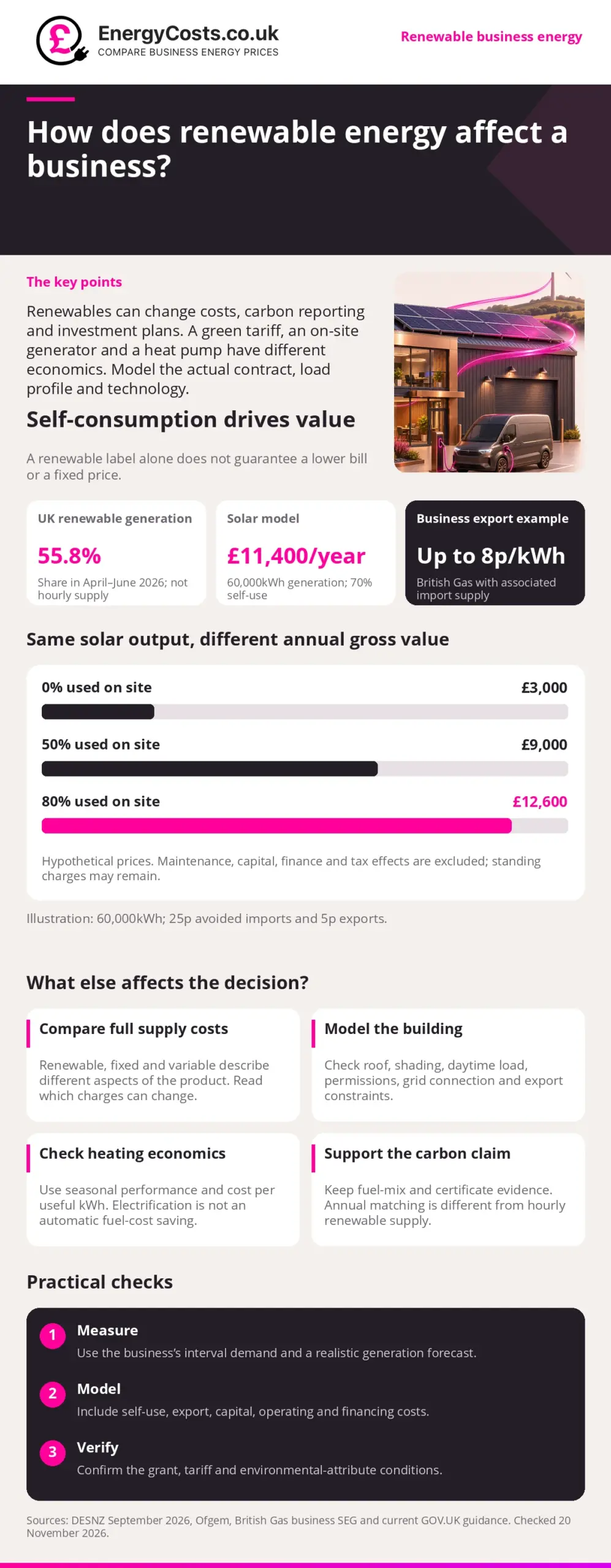
Renewable energy can change a business’s energy costs, carbon reporting, investment plans and exposure to future prices. The financial result depends on the technology, the supply contract and when the business uses energy; a green label alone does not guarantee a cheaper bill.
The main choices are buying a renewable electricity tariff, generating electricity on site, or changing how heat is supplied. Compare these routes separately, using complete costs and a clear explanation of the environmental claim.
How much renewable electricity does the UK generate?
The latest quarterly DESNZ Energy Trends release, published in September 2026 reports that renewables supplied 55.8% of UK electricity generation in April–June 2026, producing 38.3TWh. Wind contributed 27.9% of generation and solar 12.3%. These are generation statistics for that quarter, not a promise about a business’s electricity at every hour.
Renewables, nuclear and low-carbon electricity are different categories. Nuclear is low carbon but is not renewable. A grid with a high renewable generation share can still have electricity prices influenced by gas generation, network costs and the terms suppliers use to purchase power.
Buying renewable electricity versus generating your own
| Route | Financial effect | What to check |
|---|---|---|
| Renewable supply tariff | Changes the price and attributes of imported electricity | Complete annual quotation, fixed or variable components, certificates and fuel mix |
| On-site solar or wind | Can avoid some import costs and earn export income | Generation profile, self-consumption, capital cost, permissions and grid limits |
| Corporate or on-site PPA | Creates a longer-term power purchasing commitment | Volume, shape, balancing, indexation, credit and exit terms |
| Heat pump | Uses electricity to move heat rather than burning fuel on site | Seasonal performance, flow temperatures, electricity price and installation cost |
| Biomass or renewable gas | Changes the heating fuel or its attributed source | Fuel availability, emissions, sustainability criteria and maintenance |
A renewable tariff does not automatically provide greater price stability than a conventional tariff. A fixed contract can fix specified costs, while a variable green tariff can change. Likewise, a fossil-fuelled CHP unit is not automatically renewable; the fuel and accounting basis matter.
Solar savings depend strongly on self-consumption
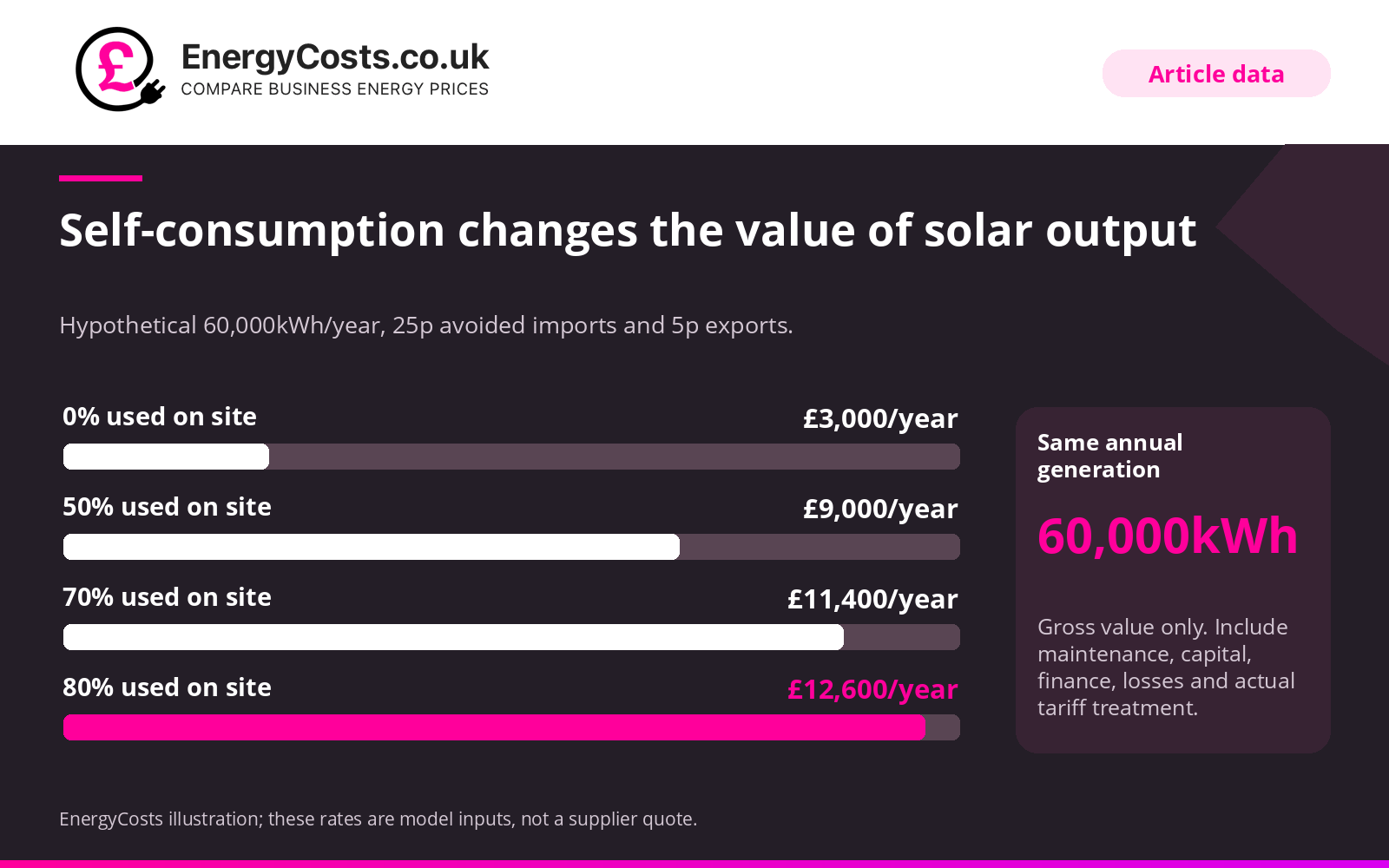
For a transparent illustration, assume 60,000kWh of annual solar generation, an avoided marginal import price of 25p/kWh and an export price of 5p/kWh. These are hypothetical model inputs rather than a supplier quotation. Only generation used at the premises displaces imports.
| Solar electricity used on site | Avoided imports | Export income | Annual gross value |
|---|---|---|---|
| 0% | £0.00 | £3,000.00 | £3,000.00 |
| 50% | £7,500.00 | £1,500.00 | £9,000.00 |
| 70% | £10,500.00 | £900.00 | £11,400.00 |
| 80% | £12,000.00 | £600.00 | £12,600.00 |
At 70% self-consumption, 42,000kWh avoids £10,500 of import charges and 18,000kWh earns £900 from exports: £11,400 a year before costs and other adjustments. The same solar array can have very different economics at a daytime factory and a business that is closed when most power is generated.
Standing charges and agreed capacity often remain. Include maintenance, insurance, inverter replacement, degradation, finance, export restrictions and the actual tariff components avoided. Storage may improve self-consumption, but its capital cost, losses and cycling must be included; a battery does not create extra solar generation.
What can a business earn for exported electricity?
Export rates depend on the named product and eligibility. As checked on 20 November 2026, British Gas business SEG advertises up to 8p/kWh where it supplies the associated import MPAN and 3p/kWh for eligible non-supply customers. Capacity, accreditation, metering and Great Britain location requirements apply. These are business rates, separate from household offers.
For 18,000kWh of eligible annual exports, 3p would give £540 and 8p would give £1,440. That does not establish the best overall supply deal: a higher import tariff can outweigh the extra export income. Compare import and export contracts together and confirm current terms in writing.
Does a heat pump always cost less to run?
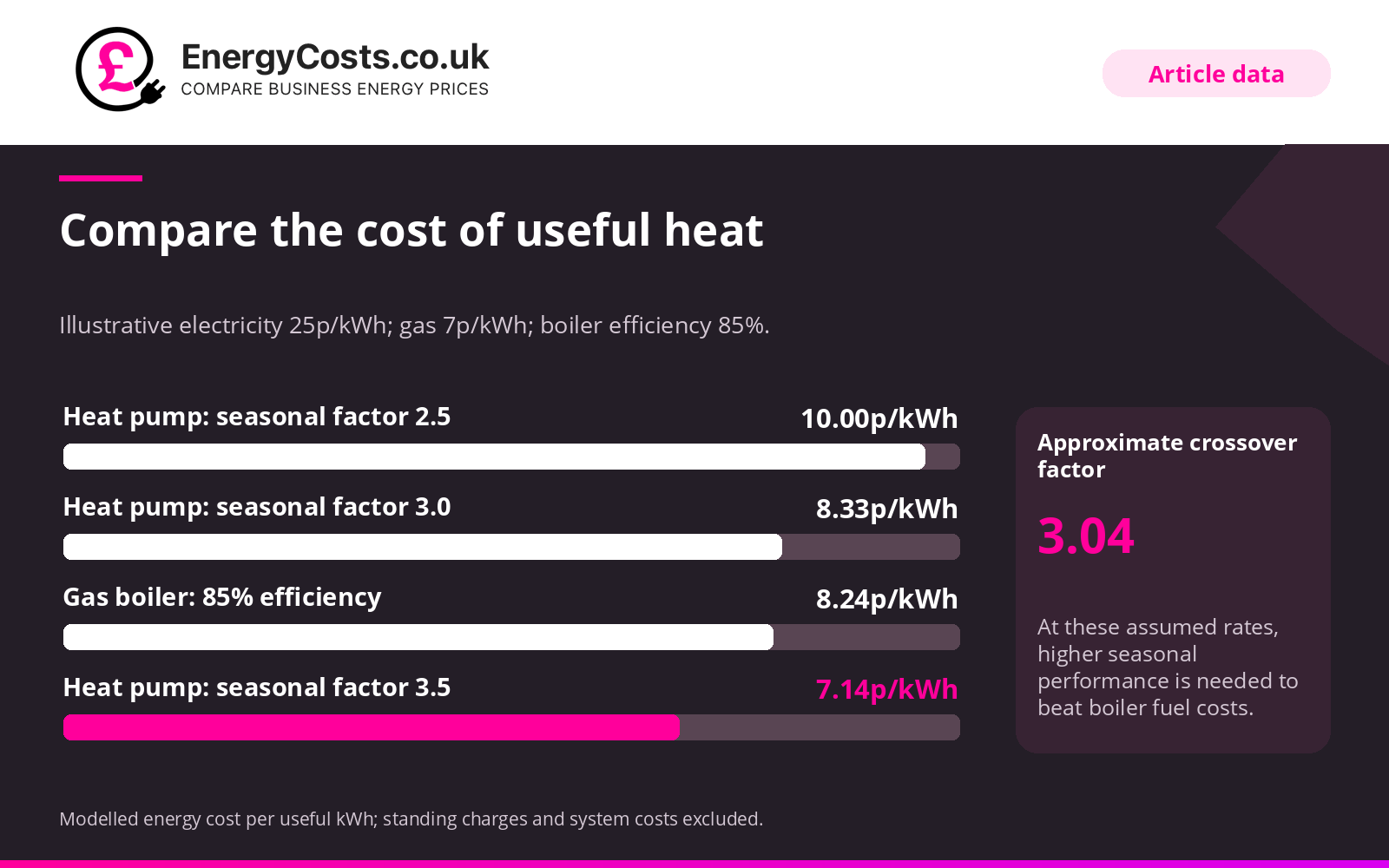
No. Compare the cost of delivered useful heat, not just the price of one kWh of electricity against one kWh of gas. A seasonal performance factor describes useful heat delivered divided by electricity consumed over the relevant period; it is not the same as a favourable laboratory test point.
| Illustrative heat source | Assumptions | Energy cost per useful kWh |
|---|---|---|
| Gas boiler | 7p/kWh gas; 85% seasonal efficiency | 8.24p |
| Heat pump | 25p/kWh electricity; seasonal factor 2.5 | 10.00p |
| Heat pump | 25p/kWh electricity; seasonal factor 3.0 | 8.33p |
| Heat pump | 25p/kWh electricity; seasonal factor 3.5 | 7.14p |
Under those hypothetical rates, the heat pump needs a seasonal factor above about 3.04 to beat the boiler’s fuel cost. Standing charges, maintenance, system design, hot-water needs and capital costs can change the comparison. Electrification is not proof of a lower bill or zero lifecycle emissions.
What does a renewable tariff mean for carbon claims?
Ofgem’s REGO scheme issues certificates for eligible renewable electricity generation. Annual certificate matching is different from proving that a premises is supplied by renewable generation at every moment. Ask whether the product uses annual matching, hourly matching, direct generator purchases or an identified PPA.
Retain the product’s fuel mix, certificates and reporting evidence. Use the appropriate location-based and market-based treatment for your reporting framework. Buying a green tariff does not make metered electricity disappear from energy records, nor does it eliminate emissions from equipment manufacture, transport and the rest of the supply chain.
Grants, tax relief and practical constraints
Support depends on country, property, technology and installation date. The current Boiler Upgrade Scheme guidance for England and Wales includes £7,500 for eligible air-to-water or ground-source heat pumps, £2,500 for eligible air-to-air systems and £5,000 for qualifying biomass. Eligible off-gas oil/LPG replacements can receive an additional £1,500 for an air-source or ground-source heat pump until March 2027. The installer must confirm eligibility and system limits.
Tax relief is different from a grant. Annual Investment Allowance can allow qualifying plant and machinery expenditure to be deducted from taxable profits, subject to the £1 million limit and the detailed rules. Do not assume all installation costs qualify or that tax relief refunds the full purchase price.
Before committing, check roof condition, structural capacity, shading, landlord consent, planning, connection capacity, export limits, warranties and ownership of the environmental attributes. A PPA or leased system can avoid an upfront purchase but introduces a long contractual commitment.
Make a business case for renewable energy
Collect interval consumption data, obtain a generation forecast and model when power will be used or exported. Request an itemised installed price and compare cash purchase, finance and third-party ownership over the same period. Stress-test lower generation, lower export income and a change in import prices.
Start with sensible efficiency measures and use the remaining load to size the project. Our business energy audit guide explains the baseline. Compare complete business electricity quotations alongside the proposed generation or heating investment.
FAQ
No. On-site generation can avoid imports and earn export income, but capital costs, maintenance, finance and self-consumption determine the return. A renewable supply tariff can be cheaper or more expensive than another offer. Compare complete matched quotations and a project-specific cash-flow model.
No. Nuclear generation is normally described as low carbon rather than renewable. A supplier’s Zero Carbon product may include nuclear electricity, whereas a renewable product has a different generation and certificate basis. Read the named product’s fuel mix and reporting evidence before making environmental claims.
The contract determines which costs are fixed, variable, passed through or reconciled. Renewable attributes do not themselves fix the price. Compare the term, daily charges, network and policy costs, volume conditions and termination provisions, alongside the renewable purchasing or certificate arrangements.
It depends on the export product and eligibility. British Gas business SEG advertises up to 8p/kWh with the associated import supply and 3p for eligible non-supply customers. At 18,000kWh, those rates give £1,440 or £540 annually. Confirm current conditions and compare the import contract too.
It can, but the result depends on electricity and fuel prices, seasonal performance, heat demand and system design. In our hypothetical comparison, 25p electricity and 7p gas with an 85% boiler require a seasonal heat-pump factor above about 3.04 to beat the boiler’s fuel cost.
Potentially. Small premises can install solar or other suitable generation where ownership, roof condition, permissions, grid connection and the load profile support it. A small installation is not automatically economical. Assess measured daytime demand, export terms, installed cost, maintenance and the contract before committing.