

Food trucks are unique energy users. They operate in mobile settings, often with limited access to mains electricity or gas, and rely on generators, bottled LPG, and occasionally site-supplied power.
Energy usage depends heavily on the type of food served, equipment used, trading hours, fuel type, and whether the vehicle uses on-board batteries or hybrid systems.
Our guide explores energy cost ranges for UK food trucks in 2026, including real-world spend for different setups.
Typical monthly energy costs for food trucks
Food trucks typically spend £250 to £1,600 per month on energy. Units using LPG burners and fryers are usually at the lower end, while electric-heavy or generator-powered trucks fall at the upper end due to higher per-unit fuel costs (diesel or petrol).
Average estimated monthly energy costs by food truck type
| Food truck type | LPG usage (litres/month) | Electricity usage equivalent (kWh) | Monthly LPG cost | Generator/diesel/electricity cost | Typical monthly total |
|---|---|---|---|---|---|
| Coffee truck / cold food | 0–10 | 200–500 | £0–£25 | £60–£150 | £80–£200 |
| Snack / dessert van | 10–20 | 400–800 | £25–£50 | £140–£240 | £180–£350 |
| Basic street food (burgers, wraps) | 30–60 | 800–1,200 | £75–£150 | £200–£350 | £300–£550 |
| Fish and chips van (fryer-based) | 80–120 | 1,500–2,500 | £200–£330 | £280–£450 | £500–£800 |
| Mixed hot-food catering truck | 100–160 | 2,500–4,000 | £260–£440 | £400–£700 | £700–£1,200 |
| High-electricity food truck (pizza, crepe, electric ovens) | 20–50 | 3,500–5,500 | £50–£125 | £700–£1,200 | £800–£1,600 |
Assumptions used:
- LPG at £0.90–£1.05 per litre
- Diesel generator electricity cost equivalent of 28–37p/kWh
- Gas-based appliances: 65–85% fuel efficiency
- Electric sites (where plugged in): 21–24p/kWh
Comparing energy sources used by food trucks
| Energy source | Cost per kWh (approx) | Common uses | Pros | Cons |
|---|---|---|---|---|
| LPG bottles | 7–9p | Fryers, stoves, tandoors | Low cost, portable | Requires storage and safety checks |
| Diesel generator | 28–37p | Electric ovens, lighting, extraction | Flexible, off-grid | Noisy, expensive, high emissions |
| Petrol inverter generator | 32–45p | Low-power electric kit | Quiet, compact | High running cost |
| Mains electricity (event plug) | 19–24p | Ovens, grills, refrigeration | Cheapest electric supply | Location-dependent |
| Solar + battery | 10–15p | Lighting, fridges, tills | Silent, low cost | Limited capacity, high upfront costs |
Major energy-consuming equipment in food trucks
| Equipment type | Typical energy draw (kWh/h or LPG litres/h) | Approx daily cost |
|---|---|---|
| Deep-fat fryer (gas) | 1.5–2.5 LPG l/h | £1.50–£2.80 |
| Deep-fat fryer (electric) | 5–9 kWh/h | £1.25–£2.25 |
| Electric pizza oven | 6–12 kWh/h | £1.40–£3.00 |
| LPG griddle / grill | 1.0–1.8 LPG l/h | £1.00–£2.00 |
| Refrigerated display unit | 0.1–0.2 kWh/h | £0.25–£0.45 per day |
| Extraction fan | 0.3–0.6 kWh/h | £0.30–£0.70 per day |
| Coffee machine | 2–3.5 kWh/h | £0.40–£0.80 |
| Ice machine | 1.2–1.6 kWh/h | £0.30–£0.50 |
LPG vs generator-powered food trucks
| Cost factor | LPG-powered kitchen | Generator/electric-powered kitchen |
|---|---|---|
| Monthly cost range | £200–£600 | £450–£1,600 |
| Best use case | Fryers, grills, gas hobs | Electric ovens, coffee machines, induction |
| Fuel efficiency | Medium | Low |
| Carbon footprint | Medium | High |
| Noise | Low | High |
| Running during events | Easy for food festivals | Often restricted at events due to noise and emissions |
Typical unit rates and standing charges used in our food truck cost examples
Food trucks don’t always have a standard “business electricity + business gas” setup like fixed-premises SMEs. Instead, energy spend is usually a mix of LPG for cooking plus either mains electricity (event hook-up) or generator fuel (diesel/petrol) to power electric equipment. That’s why the same type of food truck can have very different monthly energy costs depending on whether it’s plugged in or running off a generator.
The cost ranges used in the examples are based on the following pricing assumptions.
LPG pricing assumptions (food trucks)
LPG is commonly used for burners, grills and fryers. Monthly LPG costs are calculated from estimated litres used per month and a typical price band for bottled/bulk LPG used in catering.
- LPG price assumed: £0.90 to £1.05 per litre
- Typical LPG cost equivalent: approximately 7–9p per kWh (shown as a practical rule-of-thumb for comparing fuels).
- Appliance efficiency assumption (gas/LPG): 65% to 85% fuel efficiency, which affects how much useful heat you get from each litre.
Why LPG is often the cheaper “workhorse” fuel in trucks: For high-heat cooking (fryers, burners, grills), LPG tends to deliver lower running costs than generating electricity on-board and then using that electricity for cooking.
Electricity pricing assumptions (mains hook-up vs generators)
Food trucks typically power electric kit in one of three ways: plugging into mains at an event/pitch, using a diesel generator, or using a petrol inverter generator. Because generators produce relatively expensive electricity per kWh, “electric-heavy” trucks can end up at the top end of monthly costs.
A) Mains electricity at events/pitches (when available)
- Electricity unit rate assumed (plug-in sites): 21–24p per kWh
This is usually the cheapest way to run electric ovens, refrigeration, extraction, coffee machines, lighting and EPOS—where a hook-up is available and priced in a straightforward way.
B) Diesel generator electricity (kWh-equivalent cost)
- Diesel generator electricity cost equivalent: 28–37p per kWh
This reflects the reality that generator electricity is typically more expensive per kWh than mains electricity, which is why generator-dependent trucks (especially those using electric ovens or high-power appliances) sit at the upper end of monthly spend.
C) Petrol inverter generator electricity (kWh-equivalent cost)
- Petrol inverter generator cost equivalent: 32–45p per kWh
This tends to be used for lower-power or intermittent loads, but it can become a costly energy source if it’s powering cooking equipment for long periods.
Standing charges and “fixed costs” in food truck energy bills
Unlike fixed premises, many food trucks don’t pay a daily standing charge for a permanent gas supply, and some don’t have a permanent electricity supply either. Instead, the equivalent “fixed cost” often shows up as event hook-up fees, pitch fees, or generator hire/maintenance costs.
Where a truck does operate from a regular serviced pitch (or has a permanent electrical connection at a base unit), standing charges may apply in the normal way—but for many mobile operators, the practical cost driver is the per-kWh equivalent cost of the energy source (LPG vs mains vs generator).
Important note on real-world variation
Actual monthly energy costs for food trucks can vary materially based on:
- Menu and cooking method (fryer-based vs oven-based vs mostly cold preparation)
- Energy source availability (plug-in mains vs generator-only trading)
- Electric cooking equipment (electric pizza ovens and other high-draw appliances can consume several thousand kWh per month in kWh-equivalent terms)
- Trading intensity (number of trading days per week and length of service)
- Refrigeration behaviour (pre-event cooling, refrigerated displays running for long periods, worn door seals)
The figures above are included to show the pricing assumptions behind the cost ranges, rather than represent a guaranteed energy rate for every food truck setup.
Factors that increase food truck energy bills
- Electric deck ovens running over long periods
- Using petrol or diesel generators (high cost per kWh)
- Refrigerated display units running 24/7 for pre-event prep
- Long trading weeks (five or more trading days)
- High-volume deep-fat frying using electric equipment
- Poor insulation or worn seals in refrigerated units
How to calculate your monthly energy bill
- Determine your energy source (LPG, generator, mains).
- Track consumption:
- LPG: multiply litres by average price (£1.00/litre).
- Generator: multiply fuel usage by cost per litre, and convert to kWh.
- Mains power: multiply kWh by unit rate.
- Add standing charges or rental of plug-in power (event fees).
- Apply VAT if applicable (most pay 20% unless domestic use).
Example:
Electric pizza truck using 4,500 kWh per month at 23p:
£1,035 + £20 event plug fee = £1,055 per month.
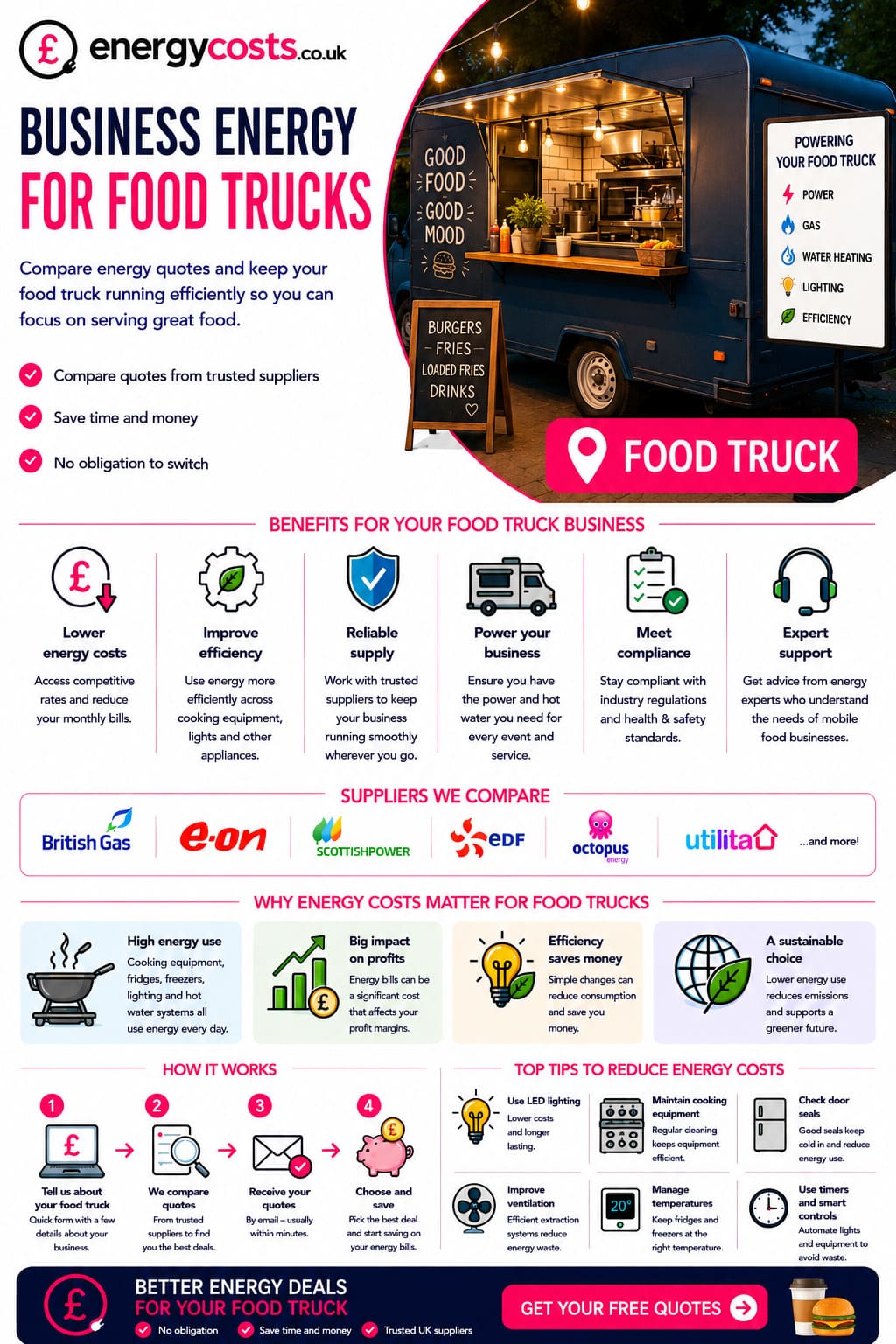
How to reduce energy costs in a food truck
- Switch from electric to LPG for fryers and grills where possible.
- Use hybrid setups: LPG for cooking and battery/inverter for display units.
- Monitor LPG leaks—small leaks can add £40–£100 per month.
- Add thermal insulation around ovens to reduce heat loss by 10–15%.
- Turn off high-draw equipment between service peaks.
- Use solar-charged batteries for lighting, tills, and fridges.
- Compare business electricity tariffs when plugging into fixed locations or trading hubs.
Summary
Food truck energy costs typically range from £250 to £1,600 per month, depending on cuisine, cooking method, fuel type, and equipment efficiency. LPG-fuelled trucks incur lower costs, while generator-reliant or electricity-heavy trucks see much higher monthly bills. By choosing the right energy mix, using efficient equipment, and switching to cheaper tariffs or hybrid LPG-electric systems, food truck operators can cut energy costs without reducing output or performance.
FAQ
Most food trucks spend between £250 and £1,600 per month on energy, depending on the type of food served, the fuel source used, and how many hours the business trades each week.
Pizza trucks, fish and chip vans, and mixed hot-food catering units usually have the highest bills. Electric pizza ovens can consume 3,000–5,000 kWh per month, while fryer-based trucks using large LPG or electric fryers often spend over £700 per month on fuel alone.
Yes. LPG-based kitchens typically cost £200–£600 per month, while generator-powered electric trucks often exceed £800–£1,600 per month. Diesel and petrol generators are far more expensive per kWh than bottled LPG.
Most hot food trucks use between 80 and 160 litres of LPG per month, costing £260 to £440, depending on fryer and burner usage, menu type, and number of trading days.
Generator electricity costs the equivalent of 28–37p per kWh with diesel, and 32–45p per kWh with petrol. This is significantly higher than mains electricity, which typically costs 21–24p per kWh in 2026.
Deep-fat fryers (5–9 kWh/h), electric pizza ovens (6–12 kWh/h), and LPG griddles (1–2 litres per hour) are the biggest energy consumers. Continuous extraction fans also add £25–£60 per month.
Yes. A walk-in freezer or multiple display units can add 3,000–5,000 kWh of usage per month, costing between £630 and £1,050, particularly if powered by a generator.
Most food trucks use 2–6 kWh overnight, powering refrigerated storage, CCTV, and battery charging. This can add £15–£50 per month, depending on the energy tariff or generator use.
Yes. Switching from petrol generators to LPG can reduce cooking energy costs by 30–50%, while using battery-inverter systems for lighting and refrigeration can save an additional 10–20%.
In most cases, yes. Paying a daily fee for mains access is often cheaper than running a generator. Typical event electricity charges range from £15 to £40 per day, depending on load requirements.