

Pubs are energy-intensive businesses due to long trading hours, kitchen operations, cellar cooling, refrigeration, lighting, heating, and in some cases, accommodation.
Energy usage varies depending on whether the pub serves food, has guest rooms, or operates as a wet-led, gastro, or pub-hotel hybrid.
Our guide breaks down typical monthly costs, usage patterns, and key cost drivers for UK pubs in 2026.
Typical monthly energy cost ranges for pubs
Most pubs in the UK spend between £650 and £4,800 per month on combined gas and electricity, depending on size, food service, occupancy, and seasonal demand.
| Pub type | Electricity (kWh/month) | Gas (kWh/month) | Electricity cost | Gas cost | Estimated total monthly cost |
|---|---|---|---|---|---|
| Small wet-led pub (drinks only) | 2,000–4,500 | 2,000–5,000 | £420–£950 | £140–£380 | £650–£1,300 |
| Medium pub with basic food service | 4,000–8,000 | 5,000–12,000 | £840–£1,680 | £350–£900 | £1,200–£2,500 |
| Gastro pub with full kitchen | 7,000–14,000 | 12,000–22,000 | £1,470–£2,940 | £840–£1,650 | £2,300–£4,300 |
| Pub with guest rooms | 10,000–18,000 | 15,000–30,000 | £2,100–£3,780 | £1,050–£2,250 | £3,200–£6,000 |
Assumptions used:
- Electricity: 21–24p/kWh, standing charge £0.50–£1.10/day
- Gas: 6.5–8.2p/kWh, standing charge £0.30–£0.75/day
- Higher usage in winter, especially for accommodation and heated dining areas.
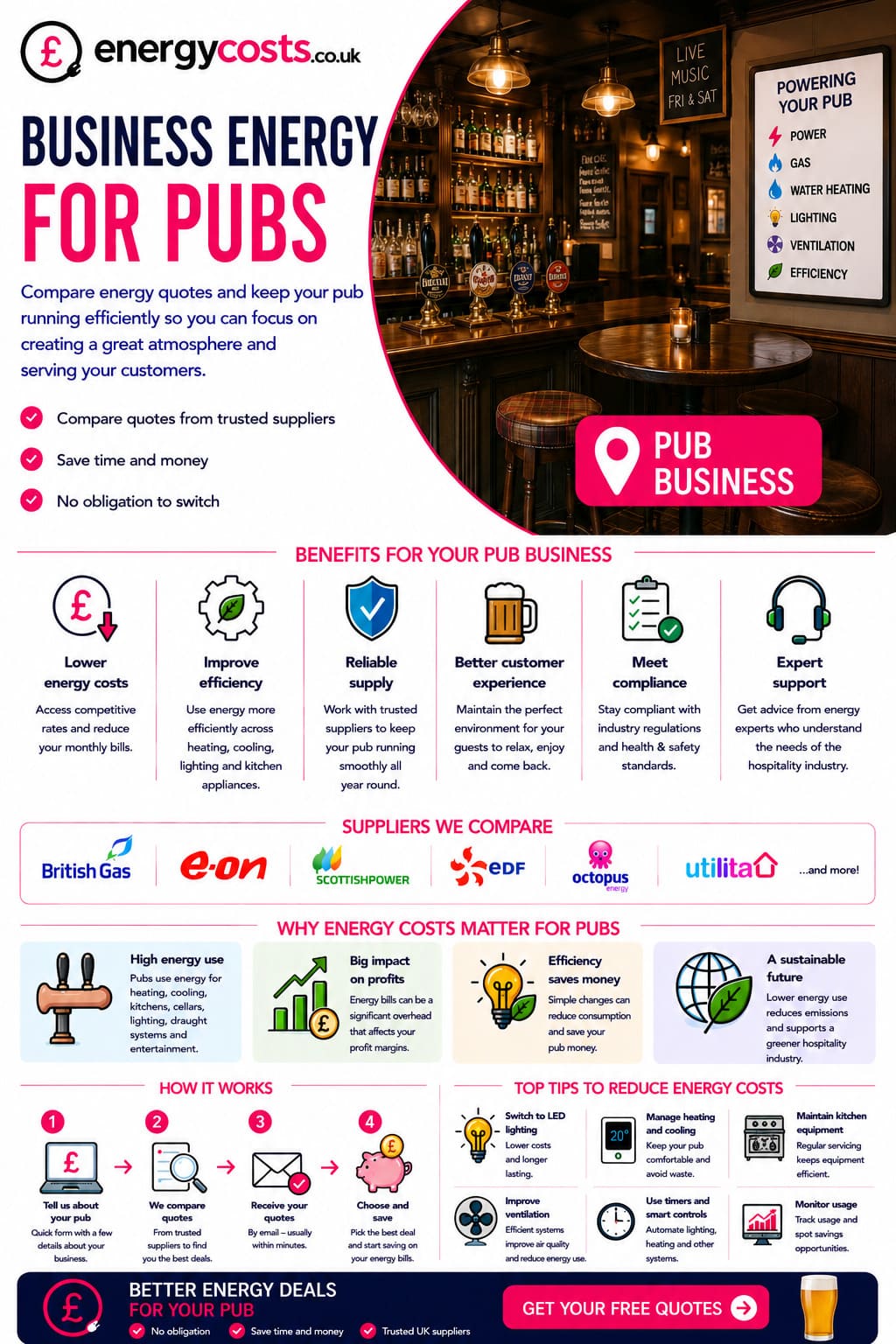
Typical unit rates and standing charges used in our pub cost examples
The monthly cost ranges for pubs are calculated by applying typical UK business tariff assumptions (unit rates and standing charges) to the estimated kWh usage ranges for different pub types. This matters because two pubs with similar consumption can still see different monthly bills depending on how much is paid per kWh, plus the fixed daily charges for maintaining the supply.
Pubs are often energy-intensive because they combine long trading hours with multiple high-consumption loads such as cellar cooling, refrigeration, kitchen equipment (where food is served), lighting, and space heating. Pub-hotel hybrids and pubs with guest rooms typically sit at the higher end of the range due to increased heating and hot water demand.
Electricity pricing assumptions (pubs)
Electricity usage in pubs is commonly driven by cellar cooling, refrigeration, lighting, ventilation/extraction, pumps, and an “always-on” baseload (alarms, security, tills/EPOS, back-of-house equipment). These examples use the following electricity assumptions:
- Electricity unit rate: 21–24p per kWh
- Electricity standing charge: £0.50–£1.10 per day
Why electricity can be a “hidden” driver in pubs: Even wet-led pubs can be electricity-heavy because refrigeration and cellar cooling run for long periods, often beyond opening hours. Food-led pubs tend to add further electrical loads through extraction, dishwashing, and kitchen prep equipment.
Gas pricing assumptions (pubs)
Gas is often the main fuel cost where a pub has a kitchen, larger heated areas, or guest accommodation. It is typically used for space heating, hot water, and cooking (where gas appliances are installed). These examples use the following gas assumptions:
- Gas unit rate: 6.5–8.2p per kWh
- Gas standing charge: £0.30–£0.75 per day
Why gas costs swing seasonally: Gas demand tends to rise sharply in winter, particularly in pubs with large dining areas, open doorways, older building fabric, or guest rooms (where heating and hot water demand increases).
Standing charges: why they matter for pubs
Standing charges are daily fixed fees that apply even on days with lower usage, and they can noticeably affect monthly totals — particularly for smaller pubs, pubs with seasonal trading patterns, or sites that have more than one meter.
Important note on real-world variation
Actual pub quotes and monthly costs can move materially depending on:
- Pub type and offering (wet-led vs food-led vs gastro pub; guest rooms/pub-hotel)
- Trading hours (longer hours increase lighting, heating, refrigeration and equipment runtime)
- Cellar cooling and refrigeration intensity (system age/efficiency, insulation, setpoints, maintenance, door discipline)
- Kitchen intensity (number of covers, equipment mix, extraction runtime, hot water usage)
- Heating strategy and building fabric (draughts, insulation, controls, zoning, thermostat settings)
- Meter type, region, supplier pricing, contract length, credit profile, and renewal timing (all of which affect the unit-rate/standing-charge balance)
The figures above are included to show the pricing assumptions behind the cost ranges, rather than represent a guaranteed market rate for every pub.
What drives pub energy usage?
| Energy driver | Typical share of total usage | Notes |
|---|---|---|
| Heating and hot water | 30–45% | Particularly high in pubs with accommodation or winter trading. |
| Kitchen equipment | 20–35% | Ovens, fryers, grills, extraction fans, dishwashers. |
| Refrigeration and cellar cooling | 15–25% | Beer cooling systems, cellar chillers, bar fridges. |
| Lighting | 8–15% | Dining areas, bar lighting, external signage, ambience lighting. |
| Air conditioning / ventilation | 5–12% | Higher in summer and in pubs with larger indoor seating. |
| Laundry (pub hotels) | 5–10% | Towels, bedding, catering linen, tablecloths. |
Electricity-heavy vs gas-heavy pubs
| Pub type | Majority energy source | Notes |
|---|---|---|
| Wet-led pub | Electricity-heavy | Fridges, cellar chilling, lighting, pumps. |
| Food-led pub | Mixed | Kitchens may use gas, but fridges and extraction rely on electricity. |
| Gastro pub | Gas-heavy | Ovens, boilers, heating, hot water. |
| Pub with guest rooms | Gas-heavy | Heating, showers, hot water, laundry. |
Electricity typically accounts for 55–65% of spend in wet-led pubs, while gas can make up 50–65% of energy use in food-led and pub-accommodation businesses.
Cellar cooling: a major hidden cost
Cellar refrigeration can be one of the highest single loads in a pub.
| Equipment type | Typical usage (kWh/month) | Monthly cost |
|---|---|---|
| Cellar cooler (standard unit) | 500–900 | £105–£210 |
| Bar display fridges (4–8 units) | 300–600 | £65–£140 |
| High-volume cellar with multiple chillers | 1,200–2,500 | £250–£525 |
Most pubs spend £150–£600 per month on refrigeration and cellar cooling alone.
Energy usage in pub kitchens
| Kitchen equipment | Energy consumption | Approx monthly cost |
|---|---|---|
| Gas oven | 4,000–7,000 kWh | £280–£520 |
| Deep-fat fryer (gas) | 3,500–6,500 kWh | £250–£460 |
| Electric combi oven | 500–800 kWh | £105–£190 |
| Extraction fan | 150–400 kWh | £30–£85 |
| Commercial dishwasher | 200–500 kWh | £40–£100 |
Gastro pubs often spend £700–£1,600 per month on kitchen energy alone.
Energy usage per trading hour
| Business hours | Approx daily energy use (kWh) | Estimated monthly cost (30 days) |
|---|---|---|
| 6 hours (drinks-only pub) | 30–50 | £190–£320 |
| 8–10 hours (food-led pub) | 60–90 | £380–£580 |
| 12+ hours (gastro pub or pub with rooms) | 90–150 | £580–£900 |
Longer trading hours increase energy consumption through lighting, heating, and equipment operation.
How to calculate your pub’s monthly energy bill
- Find your monthly kWh usage (from your meter or bills).
- Multiply by your tariff (electricity at 22p, gas at 7p).
e.g. 7,000 kWh electricity × 22p = £1,540 - Add standing charges (£30–£70 per meter per month).
- Add gas usage e.g. 10,000 kWh × 7p = £700
- Total energy bill estimate: £2,240 (plus VAT and CCL)
How pubs can reduce energy costs
- Install cellar insulation and energy-efficient cellar cooling systems (save up to 20%).
- Use cellar temperature optimisers — reduces cooling costs by 8–15%.
- Switch to LED lighting (save 30–65% on lighting costs).
- Upgrade or maintain kitchen extraction and ventilation systems.
- Use timers for external signage, heating, and ambient lighting.
- Compare business energy tariffs using EnergyCosts.co.uk: pubs switching from default tariffs typically save 10–25%.
For more, see: how to reduce business energy costs.
Summary
Typical pub energy costs range from £650 to £4,800 per month depending on size, kitchen use, cellar cooling, and opening hours. Wet-led pubs rely on electricity for refrigeration and lighting, while food-led and pub-hotels are more gas-intensive due to heating and kitchen operations. By managing cellar cooling, optimising heating, and switching to cost-effective tariffs, pubs can reduce energy costs significantly without sacrificing service or comfort.
FAQ
Most pubs spend between £650 and £4,800 per month on combined gas and electricity. Wet-led pubs sit at the lower end, while food-led, gastro pubs, and pubs with guest rooms are at the higher end due to kitchen and heating requirements.
Pubs with kitchens use high-energy equipment such as ovens, fryers, grills, extraction fans, and dishwashers. Kitchen operations typically account for 20–35% of total energy usage, significantly increasing bills compared to wet-led pubs.
Cellar cooling typically uses 500–2,500 kWh per month, costing between £105 and £525 depending on size and refrigeration load. In some pubs, cellar cooling accounts for 15–25% of the entire energy bill.
Wet-led pubs usually spend more on electricity due to refrigeration, lighting, and pumps. Food-led and pub-hotel businesses often have higher gas use because heating, hot water, and kitchens can make up 50–65% of total consumption.
A typical gastro pub spends between £2,300 and £4,300 per month, mainly driven by kitchen activity, heating demand, and long trading hours.
Pubs with accommodation spend considerably more, often £3,200 to £6,000 per month, due to heating, hot water, laundry, and lighting for rooms, corridors, and common areas.
High-usage items include cellar coolers (500–2,500 kWh/month), gas ovens (4,000–7,000 kWh/month), deep-fat fryers (3,500–6,500 kWh/month), and commercial dishwashers (200–500 kWh/month).
Yes. Small changes such as installing LED lighting, adjusting cellar temperatures, using timer controls, servicing extraction fans, and improving insulation can cut energy usage by 10–25%.
Yes. A pub open 12+ hours daily can use 90–150 kWh per day, costing up to £900 per month, compared to £190–£320for a drinks-only pub trading six hours daily.
Absolutely. Many pubs on standard or out-of-contract tariffs save 10–25% by switching suppliers through comparison services such as EnergyCosts.co.uk.