

Energy is a major operational expense for many UK farms, particularly those using machinery, irrigation, heating, refrigeration, livestock housing or automated feeding systems.
Whether operating arable, dairy, poultry, pig, horticultural or mixed farming, energy costs vary widely depending on farm size, activity type, season, and use of specialist equipment.
Farms increasingly rely on both electricity and gas (or LPG/diesel/heating oil) to power their operations and maintain animal welfare standards.
Assumed 30-day farm energy scenarios
| Assumed farm scenario | Electricity kWh/30 days | Mains gas kWh/30 days |
|---|---|---|
| Small arable / mixed | 1,500–4,000 | 1,000–3,000 |
| Medium livestock / dairy | 4,500–9,000 | 3,500–9,000 |
| Large poultry / pig / horticulture | 10,000–25,000 | 10,000–30,000 |
These are assumed planning ranges, not measured farm averages or maximum demands. Heating, ventilation, milk cooling, drying, irrigation and crop/livestock cycles can produce very different profiles. The heating column models mains gas only; it does not price LPG or oil.
Estimated monthly farm energy cost ranges
The medium model uses 4,500–9,000kWh electricity and 3,500–9,000kWh mains gas over 30 days. Its combined cost is £1,763–£3,663 at the stated prices, before VAT, CCL and extra fees. Replace these assumed inputs with actual seasonal demand.
Electricity can support milking, pumping, refrigeration and ventilation. Heating fuel depends on the installed system. On an off-grid farm, substitute a separately calculated LPG, oil, biomass or electrical heating cost; do not add a second fuel model for the same heat demand.
| Scenario | Electricity kWh/30 days | Mains gas kWh/30 days | Electricity cost | Gas cost | Combined model |
|---|---|---|---|---|---|
| Small farm | 1,500–4,000 | 1,000–3,000 | £495.00–£1,245.00 | £118.00–£318.00 | £613.00–£1,563.00 |
| Medium farm | 4,500–9,000 | 3,500–9,000 | £1,395.00–£2,745.00 | £368.00–£918.00 | £1,763.00–£3,663.00 |
| Large farm | 10,000–25,000 | 10,000–30,000 | £3,045.00–£7,545.00 | £1,018.00–£3,018.00 | £4,063.00–£10,563.00 |
Totals include one electricity and one mains-gas standing charge for 30 days. LPG, oil, tank rental, delivery, agricultural vehicle fuels and other separately billed items are excluded. The highest displayed scenario is not a ceiling on intensive farm demand.
Which farming operations use the most energy?
| Activity | What to measure | Operating requirement |
|---|---|---|
| Livestock heating | Fuel input, housing, age and environmental controls | Maintain animal welfare and adequate ventilation. |
| Milk cooling / refrigeration | Continuous input, milk volume and required temperature | Preserve hygiene and cold-chain performance. |
| Milking and pumping | Input, duty, flow, pressure and production | Assess equipment at the required service level. |
| Irrigation | Pump power, head, flow and operating hours | Account for rainfall, crop and abstraction requirements. |
| Grain drying | Fuel and electricity per tonne, moisture removed | Maintain required grain quality and safe drying. |
| Fans and humidity controls | Duty and environmental setpoints | Do not disable essential ventilation. |
| Greenhouse heating | Fuel input, crop, setpoints and weather | Different crops and structures require different models. |
Heat-intensive livestock and horticulture units account for the highest combined electricity and fuel costs.
Prices and assumptions used in this cost model
The cost models on this page use a 30-day month, electricity at 30p/kWh plus £1.50/day and gas at 10p/kWh plus 60p/day. These are rounded planning inputs near November 2026 published quote observations, held constant to isolate the effect of consumption. They are not supplier offers or measured sector averages. Totals exclude VAT, CCL, additional metering/capacity charges and other separately billed items; add only the items applicable to the site.
For dated market context, see November supplier-panel observations for business electricity and business gas. The 1–9 November observations include the publisher’s maximum commission and are not sector averages or a quote for this site.
Apply each time band separately and include every charged day and meter. Check metering, capacity, broker fees, taxes and fixed/pass-through coverage. The model includes one electricity and one mains-gas supply; add additional supplies separately.
LPG and oil need separate delivered-fuel calculations using the current price, supplied units, calorific conversion, tank/delivery fees and useful heat efficiency. There is no universal premium over mains gas. Compare equivalent useful heat and preserve required plant and fuel safety.
Standard business supplies normally attract 20% VAT. Small-quantity and other qualifying supplies have different treatment: during 1 October 2026–30 June 2027, qualifying electricity in Great Britain is temporarily zero-rated; qualifying electricity in Northern Ireland and qualifying gas remain at 5%. The small-quantity tests are applied separately to each fuel and billing supply, not simply to a combined annual bill. Check HMRC’s fuel and power guidance.
The main CCL rate is 0.801p/kWh for electricity and gas from 1 April 2026 to 31 March 2027. Add it only to taxable consumption and only if it is not already included. Small-quantity supplies can be exempt; a renewable tariff alone does not remove CCL.
Key drivers of farm energy costs
- Livestock housing and welfare: Heating, ventilation and lighting for poultry, pig and calf units are major contributors, with temperature control needed year-round.
- Seasonality: Heating costs rise sharply in winter, while electricity peaks in summer months for irrigation, milking cooling and ventilation.
- Fuel type: calculate electricity, mains gas and delivered LPG/oil separately. Compare actual delivered prices, contractual fees and useful heat; a universal 15–30% off-grid premium is not established.
- Equipment performance: use measured consumption at equivalent output. Age alone does not establish a 20–40% efficiency difference, and capital, maintenance and service needs affect replacement economics.
- Automation and technology: Smart farming, robotics, climate control and electric machinery increase electricity demand but can improve production efficiency.
Seasonal impact on energy costs
| Season / activity | Demand to check | Interpretation |
|---|---|---|
| Winter | Livestock and greenhouse heat, lighting | Weather and welfare requirements determine the increase. |
| Summer | Irrigation, cooling and ventilation | Crop, rainfall and operating hours matter. |
| Harvest | Grain moisture, dryer fuel and throughput | Compare kWh per tonne and moisture removed. |
| Spring | Brooding, crop work and weather | Not a universal baseline for every farm. |
How to reduce energy costs on UK farms
| Action | Evidence needed | Operating requirement |
|---|---|---|
| Heating controls | Useful heat, occupied zones and welfare conditions | Retain appropriate livestock/crop temperatures. |
| Pumps and fans | Measured duty, flow and maintenance needs | Maintain ventilation and safe slurry operations. |
| Milk cooling | Temperature, milk throughput and input | Preserve hygiene and milk quality. |
| LEDs | Required light level and lit hours | Maintain safe work and relevant animal/crop needs. |
| Solar / wind | Site yield, matching demand, export and project cost | No fixed percentage saving is assumed. |
| Contract comparison | Complete offers and seasonal demand | Fixed terms do not guarantee the lowest cost. |
Worked farm bill
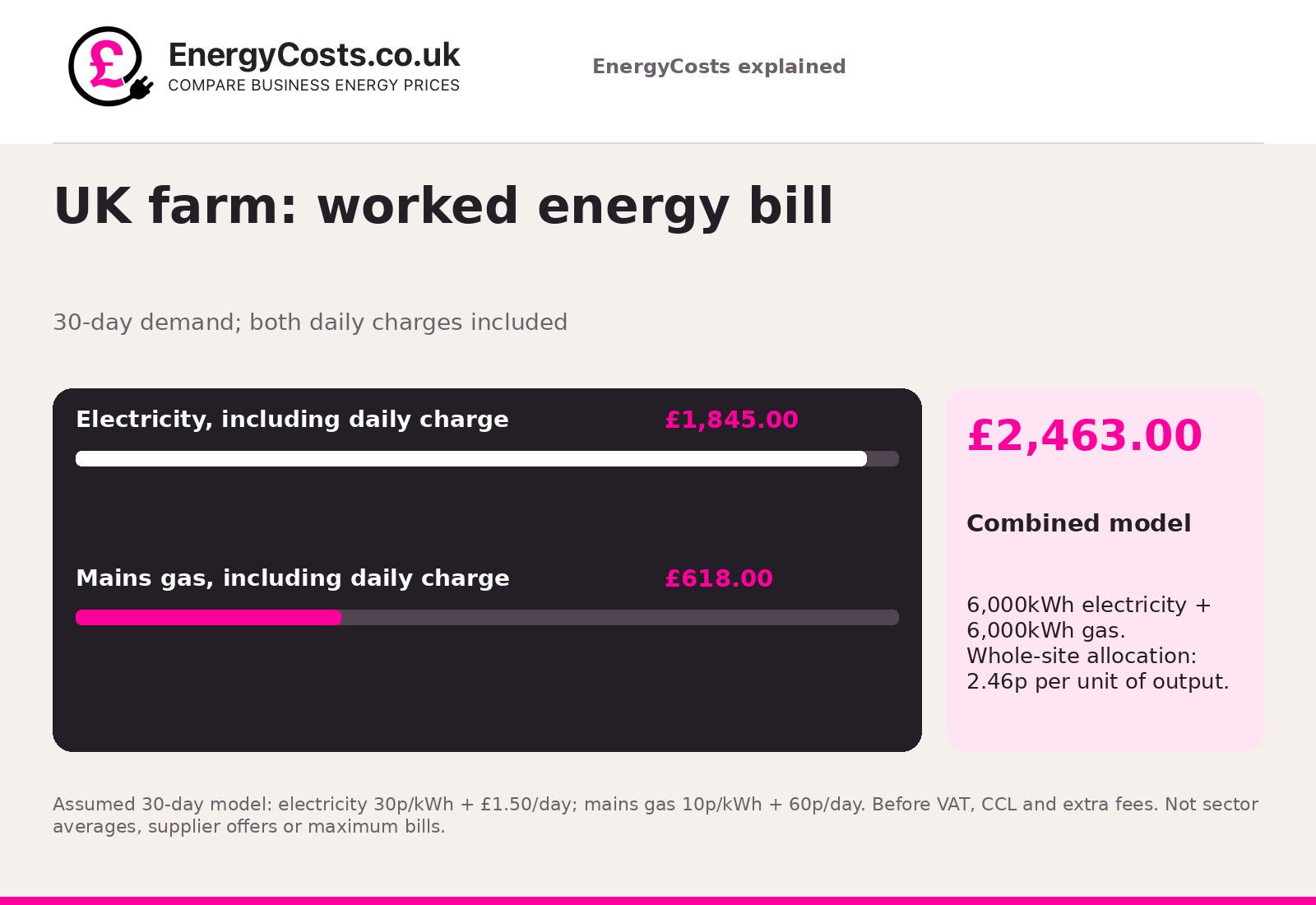
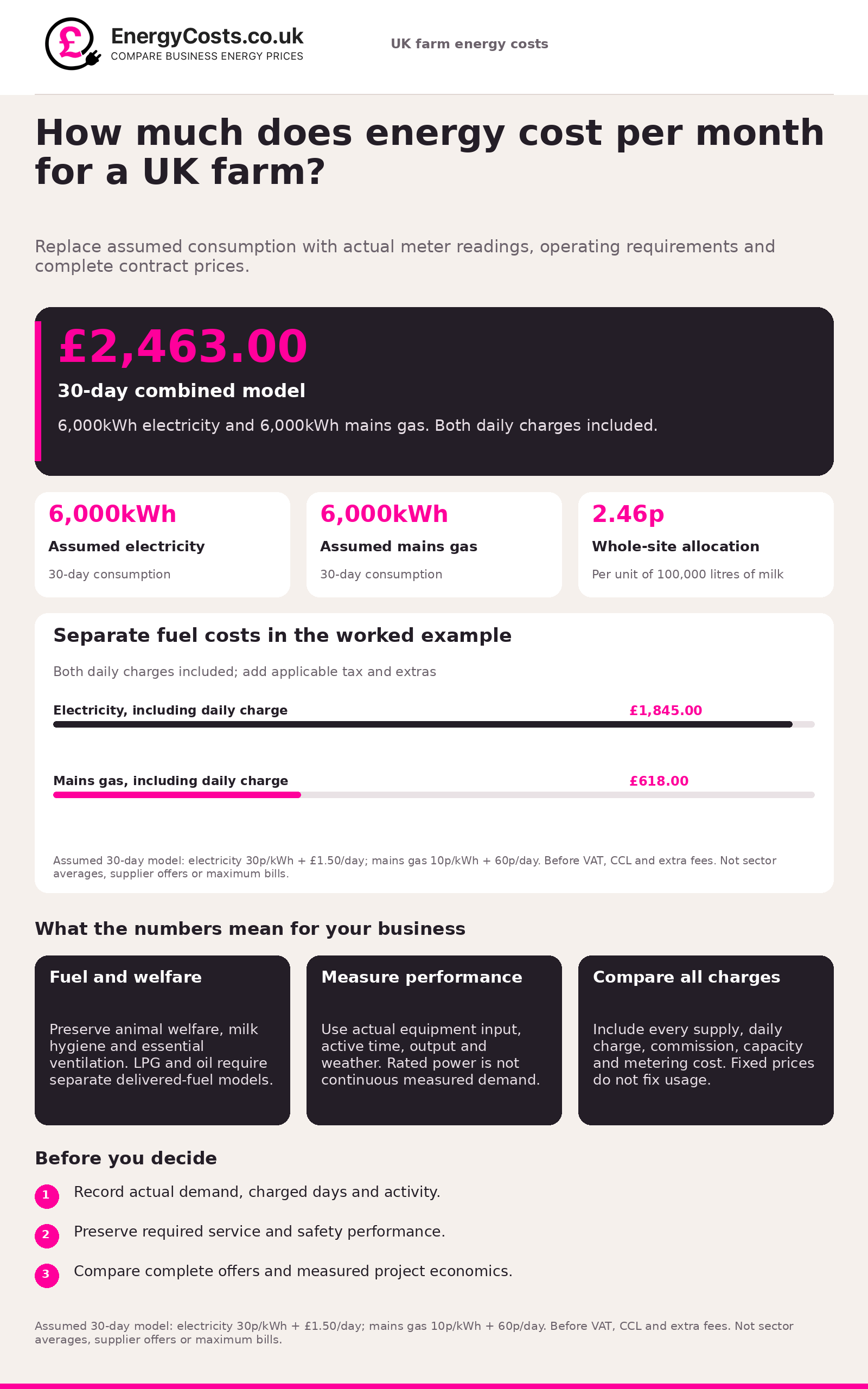
For an assumed 6,000kWh electricity and 6,000kWh mains gas in 30 days, electricity is £1,845 and gas £618: £2,463 combined before VAT, CCL and extra fees. At an assumed 100,000 litres of milk in the same period, that allocates 2.46p per litre across the whole site, not just milking.
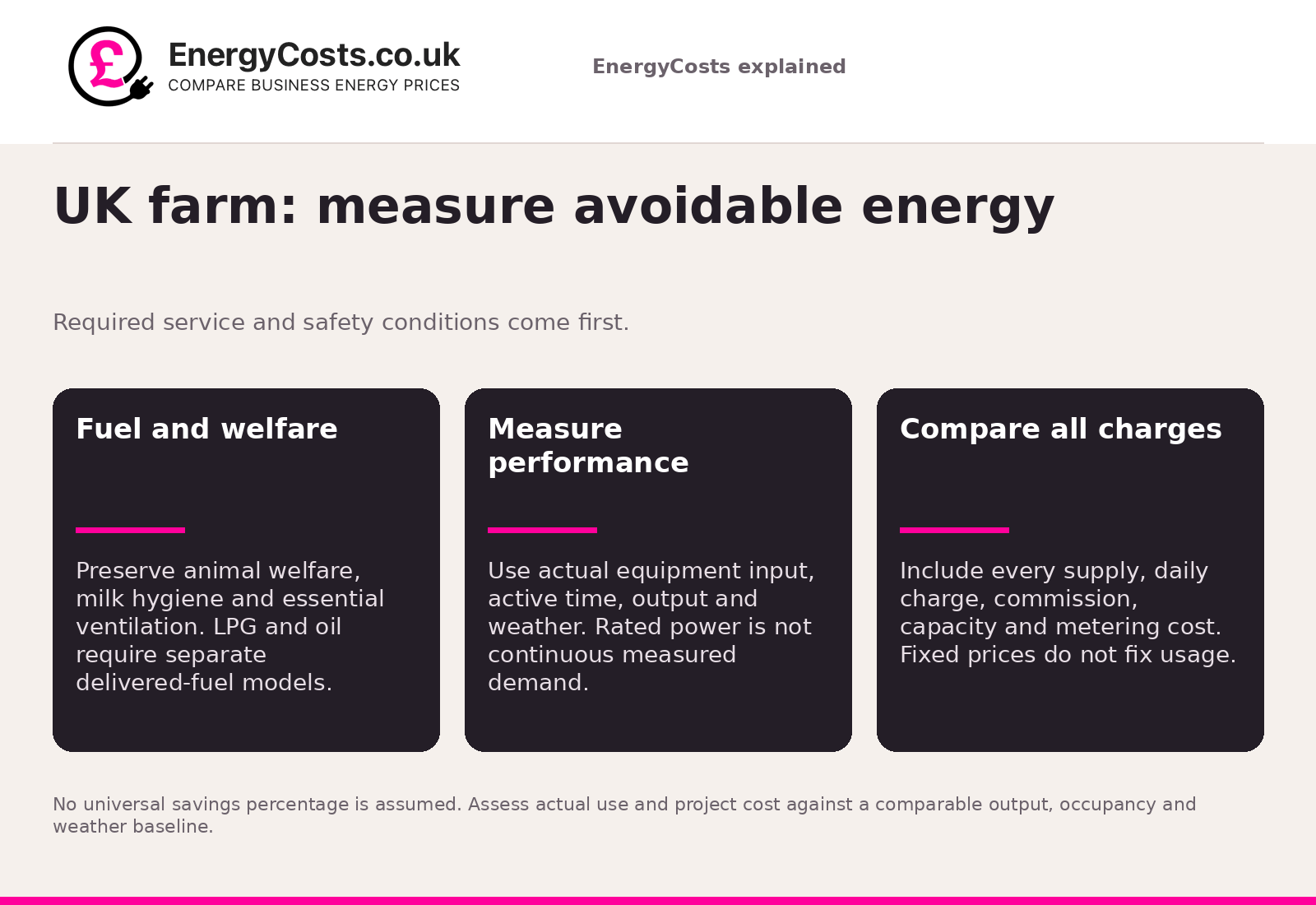
Review controls with competent advisers while preserving animal welfare, ventilation and safe machinery use. HSE livestock guidance covers relevant farm hazards; energy savings must not weaken those controls.
Why energy management matters for UK farms
Calculate energy’s share of farm operating costs from the farm’s own matching-period accounts. No universal 5–18% or 25% ratio is established here. Useful measures include kWh per litre of milk, tonne dried or production unit, with welfare and output quality held constant.
Energy-efficient farming improves margins, enhances animal welfare, supports compliance with sustainability goals, and reduces reliance on volatile fuel markets.
Save money on farming energy bills with EnergyCosts.co.uk
Farm operators can benefit by tracking usage, choosing fixed or seasonal tariffs, installing renewable systems and upgrading heating and cooling systems. Use EnergyCosts.co.uk to compare business energy and find tariffs suitable for agricultural and rural businesses.
FAQ
The medium farm scenario uses 4,500–9,000kWh electricity and 3,500–9,000kWh mains gas over 30 days. At the stated model prices the combined cost is £1,763–£3,663 before VAT, CCL and extra fees. These are assumptions, not surveyed averages, and do not price LPG or oil.
The small-farm scenario assumes 1,500–4,000kWh in 30 days. At 30p/kWh plus £1.50/day that costs £495–£1,245 before tax and extras. Equipment, irrigation, crop/livestock cycles and hours determine actual demand; intensive or seasonal operations may fall outside the example.
It depends on the production system and installed heat source. Measure electricity and each heating fuel separately. The worked 6,000kWh-per-fuel model gives £1,845 electricity and £618 mains gas. Off-grid fuel prices and useful-heat efficiency require a separate comparison rather than a universal gas-versus-electricity rule.
Heating, grain drying, milk cooling, pumping and ventilation can all be important. Compare actual energy at matching production, weather and service requirements. Rated equipment input is not continuous average demand, and essential environmental controls must remain appropriate for animal welfare, crop quality and safe operation.
Use actual heating input, housing, livestock stage and weather. The large scenario assumes 10,000–30,000kWh of mains gas over 30 days, costing £1,018–£3,018 at the stated prices before tax and extras. LPG needs its own delivered-price and fee model; these are not LPG quotes.
Maintenance, suitable controls, leak checks and avoidable-idle reviews may help, depending on the farm. Preserve animal welfare, milk hygiene, ventilation and machinery safety. Measure a comparable baseline and production output before claiming a saving; the guide does not assume a guaranteed 10–25% whole-bill reduction.
Seasonal demand depends on weather, housing, crop and livestock cycles, drying and refrigeration. There is no standard winter percentage for every farm. Use monthly readings and production data; electricity can also peak during summer irrigation or cooling and autumn drying rather than only during cold weather.
They can be worthwhile where yield, matching demand, export, grid approval and project cost support the case. Compare capital, finance, maintenance and replacement costs with avoided imports and export revenue. No universal 40% reduction is assumed, and required backup supply and welfare loads still need planning.
Calculate it from the farm’s actual invoices and operating accounts for matching periods and consistent tax treatment. Production type, staff, rent, feed, machinery and fuel choices affect the ratio, so this guide does not claim one industry-wide percentage. Track relevant kWh-per-output measures alongside total cost.
A suitable fixed contract can protect specified prices, but demand, other charges and volume conditions still matter. Seasonal or time-of-use products help only where actual billed periods and complete costs fit the farm. Compare electricity and heating fuels separately; a dual-fuel bundle is not automatically cheapest.