
Choosing the right commercial energy contract can have a major impact on monthly costs, cashflow predictability and long-term business budget planning. UK suppliers offer two broad categories of tariffs: fixed and variable, and each behaves differently when wholesale prices rise or fall.
Our guide breaks down how both fixed vs variable structures work, what they cost, and when each suits a business.
Overview of fixed business energy tariffs
A fixed tariff locks in a unit rate for electricity and/or gas for a set contract term, usually 12–36 months. The standing charge may also be fixed, depending on the supplier.
Key characteristics
- Stable pricing: Specified rates stay fixed subject to the actual agreement, including any tax, change-in-law or pass-through provisions.
- Typical contract length: 1–3 years; some suppliers offer 4–5 year terms.
- Early exit: The supplier may refuse early cancellation or apply contract-specific charges. There is no reliable standard £50–£300 fee; obtain the termination calculation before committing.
- Best for: Firms wanting predictable monthly budgets or those exposed to tight margins.
Typical fixed tariff prices in 2026
Dated reference quote observations, checked 20 November 2026. They indicate current pricing context, rather than guaranteeing the terms of a particular fixed offer.
| Quote size band | Electricity unit rate | Gas unit rate | Daily electricity charge | Daily gas charge |
|---|---|---|---|---|
| Micro | 29.1p/kWh | 9.7p/kWh | 125.4p | 49.1p |
| Small | 29.5p/kWh | 9.3p/kWh | 157.4p | 57.8p |
| Medium | 29.9p/kWh | 9.3p/kWh | 378.6p | 72.1p |
Dated reference figures cover supplier-panel offers from 1–9 November 2026, including the maximum commission in that dataset. These are not whole-market averages or a quote for a particular site. Electricity and gas size bands differ. Confirm VAT, CCL, other fees and fixed/pass-through terms on any actual offer.
Pros of fixed tariffs
- Budget certainty: Helps with forecasting, especially for high-consumption sectors.
- Protection from spikes: Wholesale price surges will not affect your unit rates.
- Easier procurement: Multi-year deals avoid annual renewal cycles.
Cons of fixed tariffs
- Locked-in pricing: You cannot take advantage of falling wholesale prices.
- Exit fees: Switching early can be costly.
- Higher starting price: Fixed deals sometimes carry a risk premium.
Overview of variable business energy tariffs
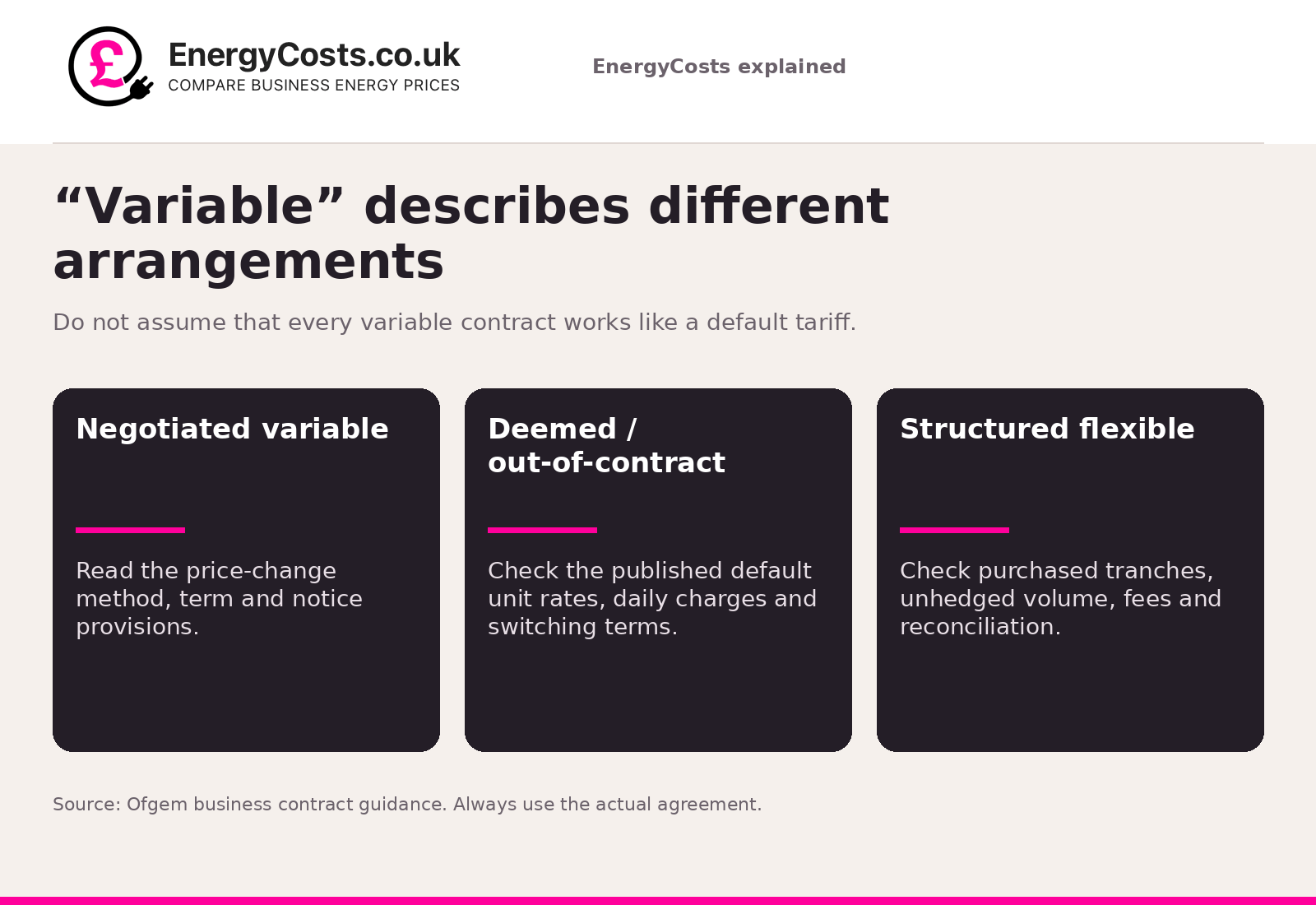
A variable tariff allows specified prices to change during the agreement. An ordinary variable retail tariff, a deemed or out-of-contract supply, and a structured flexible-purchasing contract are different products. Ofgem distinguishes these contract types; the amount of notice, purchasing responsibility and ability to leave depend on the actual agreement.
Key characteristics
- Price movement: Rates may change monthly or quarterly.
- Contract structure: Check duration, notice, fees and exit rights. Deemed and out-of-contract arrangements differ from a negotiated flexible purchasing agreement.
- Volatility: Costs can rise or fall quickly depending on market conditions.
- Best for: Firms comfortable with risk or those expecting falling wholesale prices.
Variable contract types and what to compare
| Arrangement | How the price can change | What to check |
|---|---|---|
| Negotiated variable tariff | Supplier changes the specified rate under the contract | Notice, review method, duration and exit terms |
| Deemed / out-of-contract | Supplier’s published default schedule can change | Current p/kWh, daily charge and switching rights |
| Structured flexible purchasing | Energy bought in tranches or against an index | Unbought volume, market access fees, risk limits and reconciliation |
Pros of variable tariffs
- Exit terms: Check the particular product’s notice, duration and cancellation conditions before assuming it is easy to leave.
- Potential savings: Beneficial when wholesale costs fall.
- Flexibility: Useful for short-term occupancy or seasonal operations.
Cons of variable tariffs
- Unpredictable costs: Harder to budget; vulnerable to seasonal spikes.
- Higher risk exposure: Winter wholesale prices can rise sharply.
- Price exposure: Unfixed prices can rise. Any caps, hedges or other limits depend on the actual product and contract.
Cost comparison: fixed vs variable business energy tariffs in practice
Example 1: typical small business
- Annual electricity usage: 20,000 kWh
- Annual gas usage: 16,000 kWh
Fixed tariff cost (example):
- Electricity at 28p/kWh → £5,600
- Gas at 7p/kWh → £1,120
- Standing charges → £380
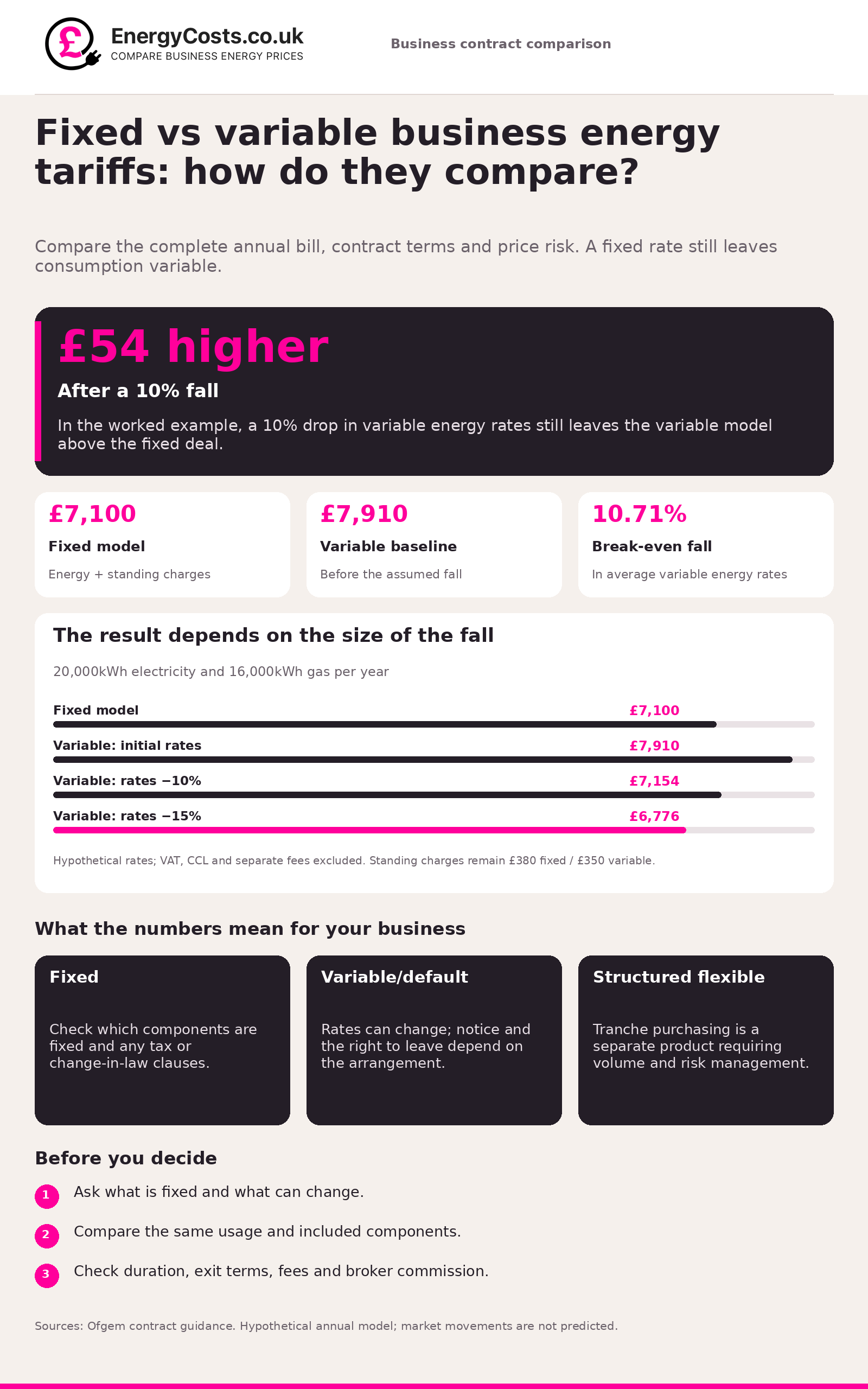
Total annual cost: ~£7,100
Variable tariff cost (example):
- Electricity average 31p/kWh → £6,200
- Gas average 8.5p/kWh → £1,360
- Standing charges → £350
Total annual cost: ~£7,910
Outcome: The fixed model is £810 cheaper than this particular variable-price assumption. That does not prove which offer will win under a different usage profile or future price path. All example totals exclude VAT, CCL and separately billed items.
Example 2: falling wholesale market
Assume a business enters at a time when the market is softening and average variable prices drop by 10% over the year.
- New electricity average: 27.9p/kWh
- New gas average: 7.65p/kWh
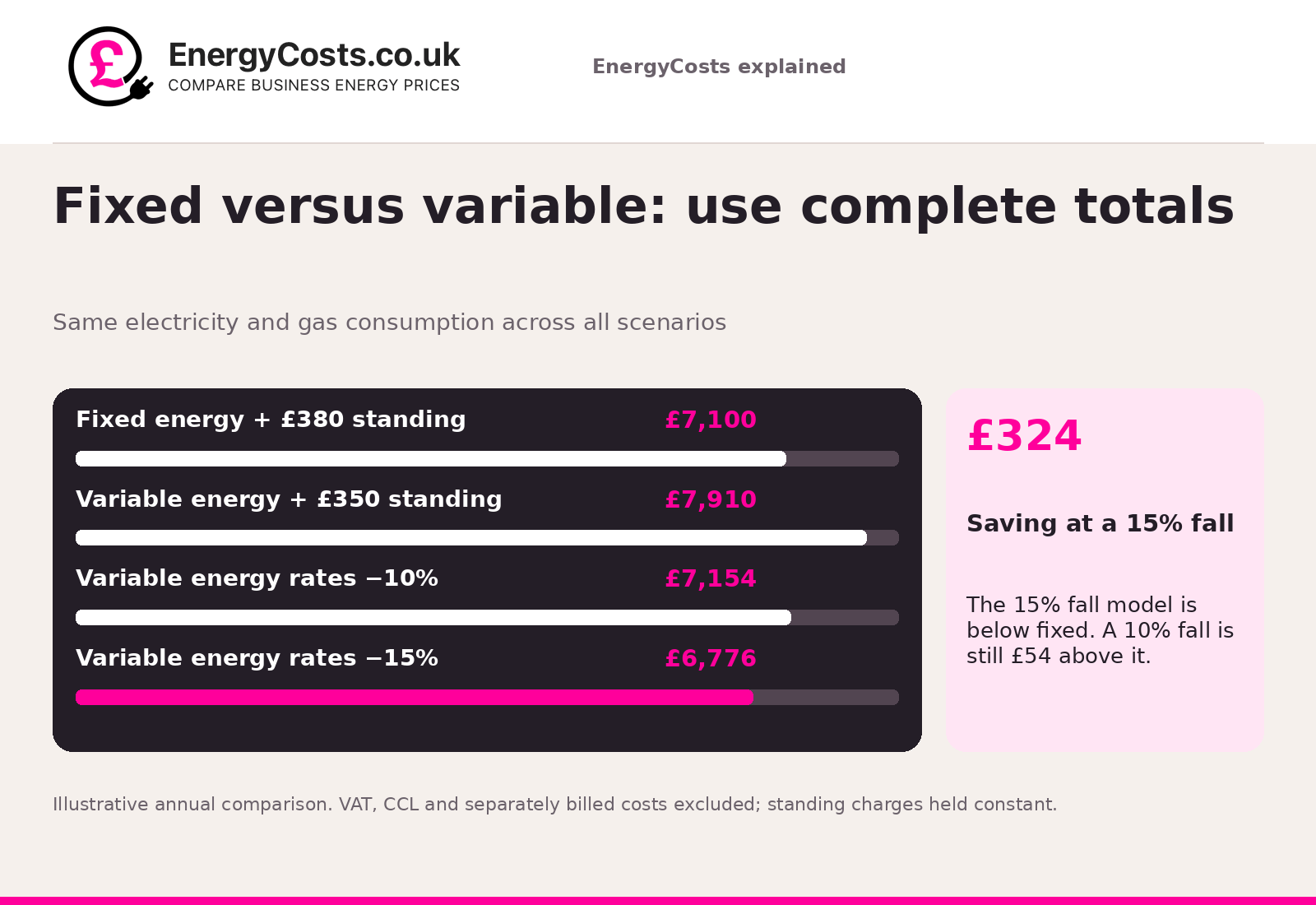
A 10% reduction in the variable energy rates gives £5,580 electricity plus £1,224 gas, with the same £350 standing charges: £7,154 a year. This is still £54 above the £7,100 fixed model. The variable energy rates must fall by about 10.71% on average to break even, with consumption and standing charges unchanged. A 15% fall gives electricity at 26.35p/kWh and gas at 7.225p/kWh: £5,270 + £1,156 + £350 = £6,776, £324 below fixed. These are hypothetical annual average prices, not a forecast.
When should a business choose a fixed tariff?
A fixed tariff is likely to be the better option when:
- You want stable unit rates and standing charges for forecasting, while recognising that the bill still varies with consumption.
- You operate in a high-consumption sector such as manufacturing, hospitality or retail.
- You believe wholesale energy prices are more likely to rise.
- You prefer long-term procurement stability.
When should a business choose a variable tariff?
A variable tariff may be suitable when:
- You expect wholesale prices to fall or remain stable.
- You have short-term premises, such as pop-ups or interim locations, and the proposed contract’s duration, notice and exit terms suit that occupancy.
- You have checked that the particular offer allows the required switching or termination flexibility.
- You are comfortable with volatility.
Additional considerations
Business size and meter type
- Firms with suitable half-hourly data and sufficient purchasing volume may be offered structured procurement. Half-hourly settlement alone does not make every business eligible for a sophisticated flexible contract.
- SMEs usually face simpler variable tariffs with less customisation.
Credit rating
- A stronger credit score often gives access to cheaper fixed rates.
Multi-site portfolios
- Some business energy suppliers offer portfolio fixed rates or blended contracts, allowing mixed fixed and variable positions.
Market timing
- Wholesale costs shift daily; using a business energy comparison website like EnergyCosts.co.uk helps businesses access live rates from multiple suppliers.
Conclusion: fixed vs variable business energy tariffs
Fixed tariffs provide rate certainty for the specified components, while variable structures can benefit from falling prices and expose the business to increases. Choose by total annual cost, operational flexibility and risk tolerance; do not assume every variable product is easy to leave or every fixed offer fixes the complete bill.
If you want accurate quotes tailored to your usage, sector and postcode, comparing live business energy tariffs remains the most reliable route to securing the best deal.