
Luton businesses operate across airport-linked services, logistics, manufacturing, workshops, retail and offices. Energy budgets depend on premises, equipment, hours and the contract agreed for each supply.
Commercial electricity and gas offers for Luton depend on meter details, annual demand, load shape, start date, term, payment method and credit. Comparing complete written offers helps establish the cost for the actual business.
This guide combines dated published reference prices with an explicit planning model. The reference observations are not a Luton-only survey or a fixed local premium or discount; the worked budget is not a supplier quotation.
Business electricity and gas prices in Luton
The following are November 2026 published supplier-panel observations. Electricity and gas use different annual consumption bands; the labels are the publisher’s categories, not legal definitions of a microbusiness.
| Electricity category | Annual usage band (kWh) | Unit rate | Standing charge |
|---|---|---|---|
| Micro | 5,000–15,000 | 29.1p/kWh | 125.4p/day |
| Small | 15,000–25,000 | 29.5p/kWh | 157.4p/day |
| Medium | 25,000–55,000 | 29.9p/kWh | 378.6p/day |
| Large | Above 55,000 | 29.9p/kWh | 467.4p/day |
Gas has a separate reference schedule:
| Gas category | Annual usage band (kWh) | Unit rate | Standing charge |
|---|---|---|---|
| Micro | 5,000–15,000 | 9.7p/kWh | 49.1p/day |
| Small | 15,001–30,000 | 9.3p/kWh | 57.8p/day |
| Medium | 30,001–65,000 | 9.3p/kWh | 72.1p/day |
| Large | Above 65,000 | 9.3p/kWh | 107.6p/day |
Dated reference figures cover supplier-panel offers from 1–9 November 2026, including the maximum commission in that dataset. These are not whole-market averages or a quote for a particular site. Electricity and gas size bands differ. Confirm VAT, CCL, other fees and fixed/pass-through terms on any actual offer. The values are reference inputs rather than an available tariff for every Luton business.
Luton’s network and regional pricing context
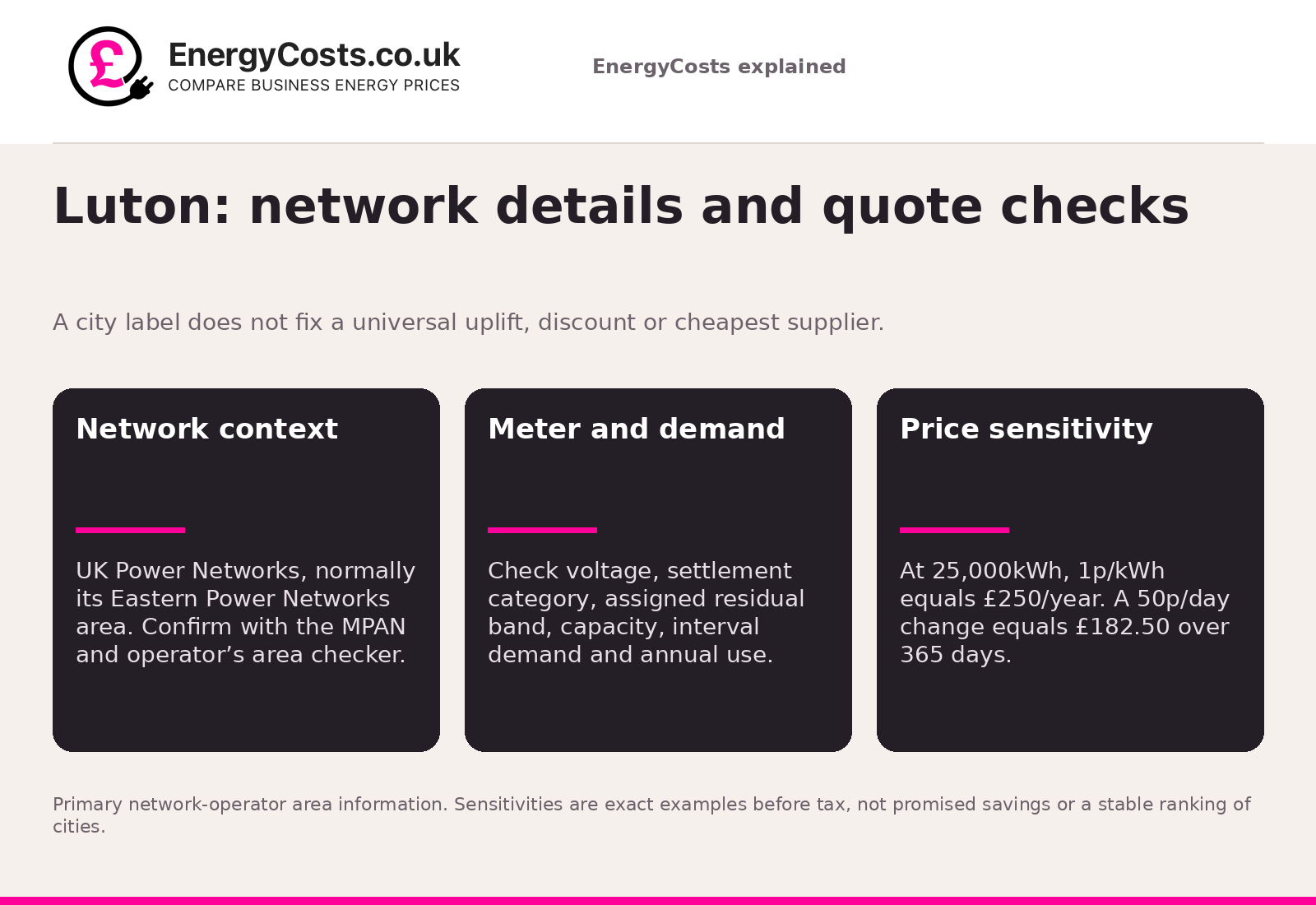
Luton is normally served by UK Power Networks, normally its Eastern Power Networks area. Confirm the actual distributor from the MPAN and the operator’s postcode checker; boundaries and independent networks mean a town name is insufficient for every supply.
Electricity distribution, transmission, time-of-use and residual-band costs can affect quotations. Gas uses separate network and charging arrangements. These factors do not establish a fixed Luton percentage uplift or discount applying to all suppliers, both fuels or every business.
The distributor maintains the local wires and is separate from the retail supplier chosen for the energy contract. A change of supplier does not move the site into another distribution area.
Modelled annual and monthly energy bills for Luton SMEs
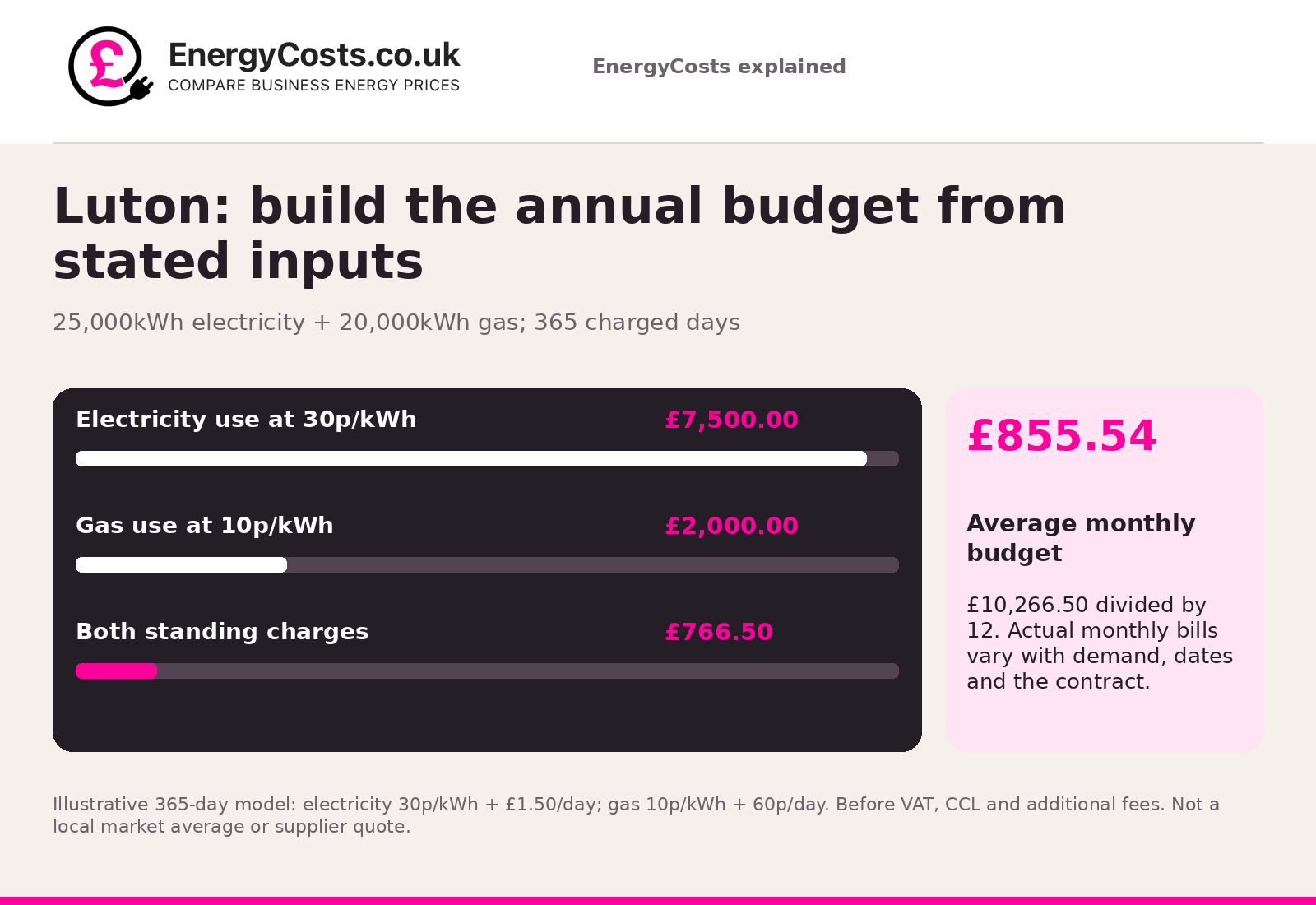
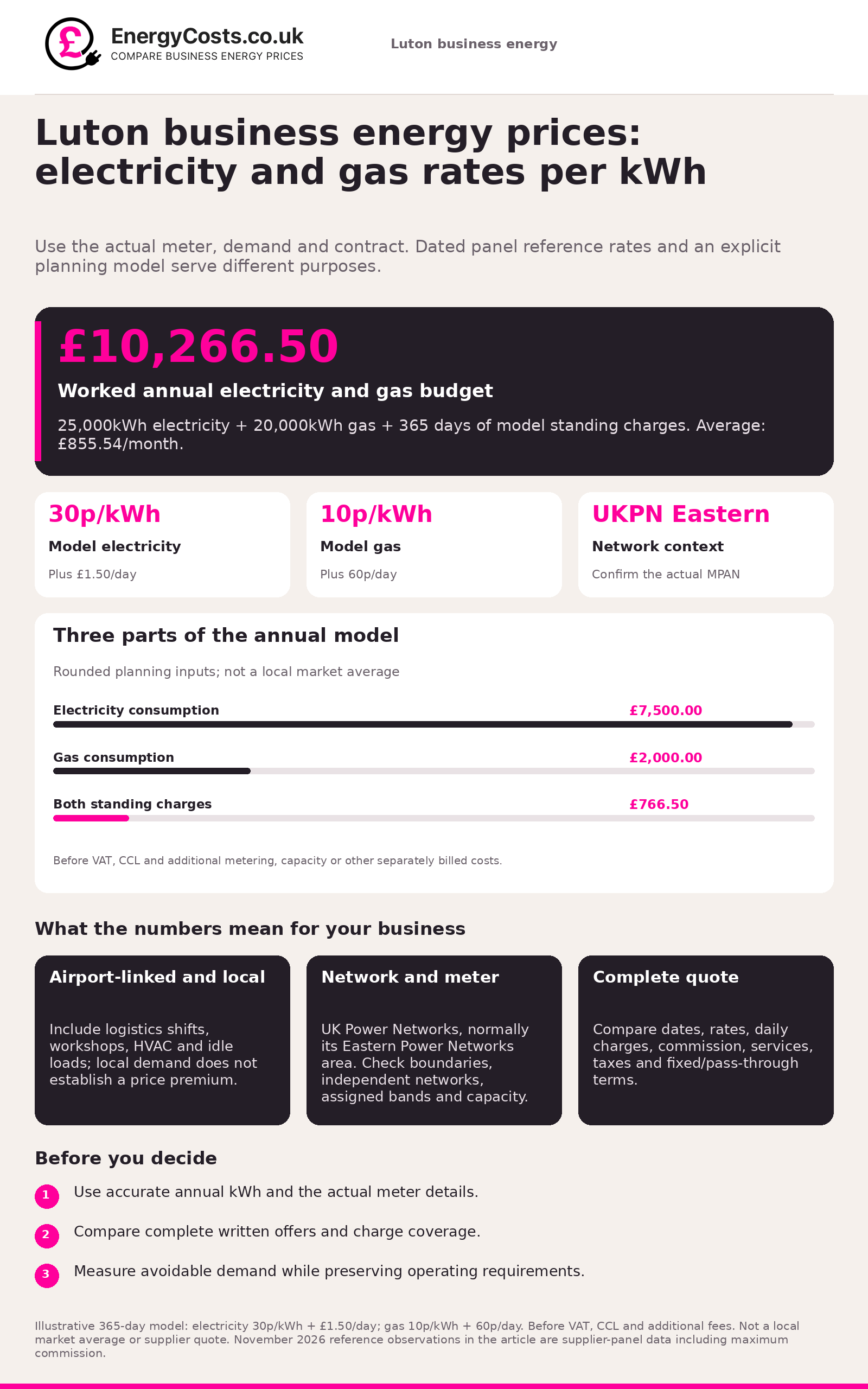
For an explicit budget, assume 25,000kWh electricity and 20,000kWh gas per year, with 365 charged days. Electricity is 30p/kWh plus £1.50/day; gas is 10p/kWh plus 60p/day. These rounded planning inputs are separate from the published size-band observations above.
| Fuel | Assumed annual use | Consumption cost | Annual standing charge | Annual model total |
|---|---|---|---|---|
| Electricity | 25,000kWh | £7,500.00 | £547.50 | £8,047.50 |
| Gas | 20,000kWh | £2,000.00 | £219.00 | £2,219.00 |
| Combined | Two separately metered fuels | £9,500.00 | £766.50 | £10,266.50 |
The combined annual model is £10,266.50, equivalent to £855.54 per month when divided by 12. Real bills vary with actual consumption, charged days, seasonal demand and the contract. This is not a measured Luton average or a quotation.
All model totals exclude VAT, CCL, additional metering, capacity, reactive power and other separately billed charges. Add applicable items only once. Standard business supplies normally attract 20% VAT. Small-quantity and other qualifying supplies have different treatment: during 1 October 2026–30 June 2027, qualifying electricity in Great Britain is temporarily zero-rated; qualifying electricity in Northern Ireland and qualifying gas remain at 5%. The small-quantity tests are applied separately to each fuel and billing supply, not simply to a combined annual bill. Check HMRC’s fuel and power guidance. The main CCL rate is 0.801p/kWh for electricity and gas from 1 April 2026 to 31 March 2027. Add it only to taxable consumption and only if it is not already included. Small-quantity supplies can be exempt; a renewable tariff alone does not remove CCL.
What affects business energy prices in Luton
1. Electricity network and meter details
Use the actual MPAN, voltage, settlement/meter category, assigned residual band and agreed capacity. The network operator’s area information helps confirm the distributor; the supplier’s full schedule determines how these costs reach the bill.
2. Supplier coverage and quote timing
Suppliers assess meter, consumption, credit and proposed start date. Their prices and eligibility can differ. Check which suppliers a comparison service covers and how it is paid; local business activity alone does not prove a standard discount or surcharge.
3. Complete contract costs
Compare unit and daily charges, included network/policy costs, commission, environmental products, meter services, capacity and taxes. For multi-site businesses, calculate each meter before combining the portfolio. Check the contract’s exceptions and change-in-law clauses.
4. Usage and operating hours
Equipment duty, building fabric, heating, refrigeration, shifts and output determine demand. Use actual readings and interval data where available. A lower annual bill can result from using less energy even when the quoted unit price is higher.
How Luton businesses can reduce energy bills
Businesses in Luton can assess both contract costs and avoidable demand. Prioritise changes using the site’s actual readings, equipment and operating requirements.
1. Switch suppliers at contract renewal
Review renewal and current default rates promptly. A negotiated offer can be cheaper, but the saving is the measured difference between complete annual costs for the same use and dates. No universal switching percentage is assumed.
2. Provide accurate usage data
Smart meter data or validated meter readings allow suppliers to quote accurately. Businesses relying on estimated usage often overpay.
3. Reduce electricity consumption
Moving the same kWh between hours changes the unit-rate charge only where the tariff prices those periods differently. Check time bands and any demand/capacity effects. Reducing unnecessary kWh can lower consumption costs under either a single-rate or a time-of-use contract, while fixed charges may remain.
Identify the site’s largest cost and avoidable loads from actual readings. Electricity-led and heat-led premises can have different priorities. Suitable measures include:
- Installing LED lighting
- Using occupancy sensors in staff areas
- Maintaining HVAC and refrigeration equipment
- Reducing equipment use outside business hours
- Shifting high-load operations away from peak demand periods
4. Improve gas heating efficiency
Older or larger commercial spaces, common in Luton’s industrial corridors, can reduce gas consumption by:
- Upgrading boilers or warm-air systems
- Using programmable thermostats
- Introducing heating zones
- Improving insulation and draught-proofing
- Reducing heating during evenings and weekends
5. Install smart meters
Smart or advanced meter data can help track demand and improve billing, but data interval and dashboard delay depend on the meter, permissions and service. Check access and latency rather than assuming every smart meter provides live controls.
How Luton compares with other major UK cities
A useful city comparison needs matched quote dates, meter types, consumption, terms and charge coverage. An assumed national model cannot establish a stable ordering of Luton, London, Manchester, Birmingham, Scotland, Wales or Northern Ireland. Northern Ireland also has a separate retail market.
| Illustrative price difference | Effect at the stated demand | Annual change before tax |
|---|---|---|
| 0.5p/kWh electricity | 25,000kWh × £0.005 | £125.00 |
| 1p/kWh electricity | 25,000kWh × £0.01 | £250.00 |
| 2p/kWh electricity | 25,000kWh × £0.02 | £500.00 |
| 50p/day standing charge | 365 × £0.50 | £182.50 |
These are exact sensitivity calculations, not promised savings or evidence that one city is always cheaper. Use Ofgem’s business-contract guidance and actual written offers to compare terms.
Comparing business energy suppliers in Luton
Many suppliers offer business contracts in Luton, subject to meter, credit, consumption and product criteria. A broker or comparison service may cover a panel rather than the whole market. Ask which suppliers and fees are included.
- Contract lengths (12–36 months)
- Unit rates and standing charges
- Fixed vs. variable tariff structures
- Renewable or green tariff options
- Multi-site contracts for businesses operating across Hertfordshire and Bedfordshire
- Sector-specific tariffs for logistics, aviation, retail, hospitality or professional services
Businesses in Luton can assess both contract costs and avoidable demand. Prioritise changes using the site’s actual readings, equipment and operating requirements.
Get business energy quotes for Luton
Use EnergyCosts.co.uk to compare available business electricity and gas offers for Luton. Provide the postcode, meter details and accurate annual usage, then review the complete quotation and contract terms.