

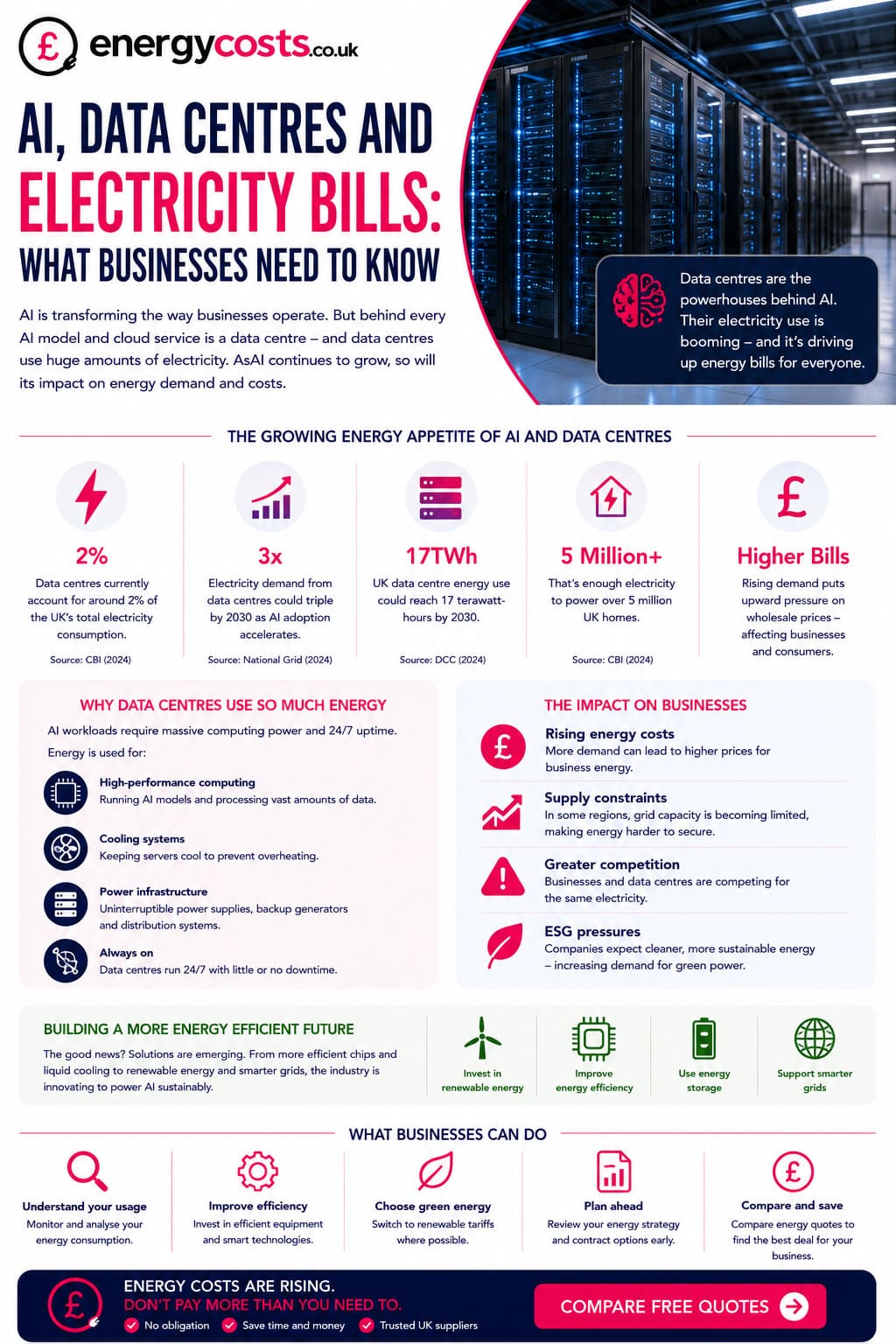
AI data centres are becoming one of the biggest new sources of electricity demand in the UK. That does not mean every business electricity bill will automatically rise because of AI, but it does mean data centres are likely to become an increasingly important factor in wholesale electricity demand, grid investment, network charges and connection queues.
The short answer is: yes, AI data centres could add upward pressure to UK electricity bills, especially business electricity bills, but the size of the effect will depend on where they are built, how they are connected, whether they fund their own infrastructure, and how quickly the grid expands.
Why AI data centres are in the news
Artificial intelligence needs computing power. That computing power sits in data centres, which require electricity for servers, cooling, networking equipment, back-up systems and building services. Traditional data centres already use large amounts of power, but AI workloads can be much more electricity-intensive because they rely on high-density servers, graphics processing units and accelerated computing hardware.
The UK Government’s Compute Roadmap forecasts that the UK will need at least 6GW of AI-capable data centre capacity by 2030, which it describes as a threefold increase on current UK data centre capacity. It also says demand could exceed that baseline if AI capabilities and adoption accelerate.
That is a very large amount of power. To put it in context, if 6GW of capacity operated continuously at full output for a year, it would consume around 52.6TWh of electricity. In practice, data centres do not necessarily run at full capacity all the time, but even at 70% utilisation, 6GW would represent around 36.8TWh per year.
| AI-capable data centre capacity | Assumed average utilisation | Approximate annual electricity use |
|---|---|---|
| 6GW | 50% | 26.3TWh |
| 6GW | 60% | 31.5TWh |
| 6GW | 70% | 36.8TWh |
| 6GW | 80% | 42.0TWh |
| 6GW | 90% | 47.3TWh |
| 6GW | 100% | 52.6TWh |
These figures are not bill forecasts. They simply show the scale of electricity demand that could be involved if the UK builds out the level of AI data centre capacity now being discussed.
How much electricity do UK data centres use already?
UK data centre demand is already material. A National Grid DSO data centre impact study said that, according to NESO, data centres accounted for around 2.4GW of capacity from grid-connected facilities in 2024 and consumed an estimated 7.6TWh, equivalent to around 2% of GB electricity demand. The same study said NESO’s Future Energy Scenarios 2025 modelled data centre demand rising from 7.6TWh in 2024 to 20–41TWh by 2035.
That means AI is not starting from zero. The UK already has a sizeable data centre sector, especially around London and Slough, but the AI boom could push the sector from being a relatively specialised electricity user to one of the most important new demand categories on the power system.
Why AI uses so much electricity
There are two main types of AI computing demand:
| AI workload | What it means | Energy impact |
|---|---|---|
| AI training | Building or improving large AI models using huge datasets | Very power-intensive, often requiring clusters of advanced chips running for long periods |
| AI inference | Running the model when users ask it questions or businesses use it in software | Individually smaller, but can become very large at scale because millions or billions of prompts are processed |
AI training gets much of the attention because it can involve enormous computing runs. However, AI inference may become just as important for electricity demand because it scales with everyday usage. If AI becomes embedded into search engines, office software, customer service tools, coding platforms, accounting systems, marketing software, logistics platforms and business analytics, the number of AI requests could grow extremely quickly.
The International Energy Agency says global data centre electricity consumption is projected to roughly double from 485TWh in 2025 to 950TWh in 2030, reaching around 3% of global electricity demand. It also says electricity consumption from AI-focused data centres is expected to grow faster, tripling over that period.
Will AI data centres directly increase business electricity prices?
AI data centres do not directly appear as a separate line on a normal business electricity bill. A café, warehouse, office, manufacturer or shop will not see a charge called “AI data centre cost”.
However, AI data centres can affect the wider electricity system in ways that feed through to bills. The impact is likely to come through five main routes:
| Route | How it could affect bills | Likely impact on businesses |
|---|---|---|
| Higher electricity demand | More demand can increase wholesale prices, especially at peak times or during tight supply periods | Higher unit rates on fixed and flexible electricity contracts |
| Grid reinforcement | Large power users may require new substations, cables and transmission upgrades | Higher network charges if costs are socialised across billpayers |
| Connection queues | Data centres compete with factories, EV charging hubs, battery sites and renewable projects for grid capacity | Delays and higher costs for businesses needing new or upgraded connections |
| Balancing costs | Large, concentrated loads can make the electricity system harder to balance | Potentially higher balancing and system operation charges |
| Capacity and resilience costs | More demand may require more backup capacity, storage, flexibility or generation | Higher policy and system costs over time |
The effect will not be uniform. A data centre built where the grid already has spare capacity may create less pressure than one built in a constrained area. A data centre that funds its own high-voltage connection or signs a long-term power purchase agreement may have a different impact from one that relies heavily on shared network upgrades.
Why network charges matter as much as wholesale electricity
Business electricity bills are not just made up of wholesale energy. They also include network charges, balancing costs, metering, supplier costs, policy costs and taxes. This matters because AI data centres are not just an electricity consumption issue; they are also a grid infrastructure issue.
Cornwall Insight has forecast that by 2026, non-commodity charges will make up nearly 60% of a typical business electricity bill, driven by rising transmission costs, new bill components and support schemes for energy-intensive users.
This means business customers can see bills rise even when wholesale prices soften. If AI data centres add pressure to transmission and distribution investment, the effect may not show up only in the wholesale unit rate. It could also appear through higher non-commodity charges, especially on electricity contracts where third-party costs are passed through.
Why the location of data centres is important
Location is critical. A large data centre is not like a normal office block. Some proposed AI campuses may need hundreds of megawatts of capacity. The UK Compute Roadmap says the Government wants a group of nationally significant AI Growth Zone sites, each capable of serving at least 500MW of demand by 2030, with at least one AI Growth Zone scaling to more than 1GW.
A 500MW data centre campus is an enormous electricity load. At full continuous use, 500MW equals 4.38TWh per year. Even at 70% utilisation, it would consume around 3.1TWh per year.
| Data centre site size | Annual use at 70% utilisation | Annual use at 90% utilisation |
|---|---|---|
| 100MW | 0.61TWh | 0.79TWh |
| 250MW | 1.53TWh | 1.97TWh |
| 500MW | 3.07TWh | 3.94TWh |
| 1GW | 6.13TWh | 7.88TWh |
The more concentrated the demand, the more important local grid capacity becomes. Building several large AI campuses in areas with strong transmission links, spare capacity, nearby generation or access to private-wire power could reduce pressure. Building them in already constrained areas could increase the need for expensive upgrades.
The connection queue problem
The grid connection system is already under pressure. Ofgem has said the demand connection queue is large and growing, includes a significant number of likely non-viable projects, and lacks mechanisms to prioritise strategically important demand projects. Ofgem is therefore working with Government, NESO and network companies on reforms based around “Curate, Plan and Connect”.
The Government has also said the queue for demand connections to the transmission network grew by 460% in the six months to June 2025, contributing to waits of up to 15 years for some projects to connect. It said reforms would prioritise strategically important projects, including AI data centres, AI Growth Zones, EV charging hubs and electrified industrial sites.
This is important for ordinary businesses because data centres are not the only organisations asking for more electricity. Manufacturers, warehouses, logistics firms, cold storage operators, hospitals, universities, EV charging operators, heat networks and renewable energy projects all need grid capacity too.
If AI data centres are given priority access to capacity, that could help the Government deliver its AI strategy. But it may also raise questions about whether other businesses face longer waits, higher connection costs or fewer viable sites for expansion.
Could data centres pay for their own grid upgrades?
One way to reduce the impact on other billpayers is to make data centre developers pay more of the cost of connecting their facilities. The Government has said it is exploring ways for AI Growth Zone developers to build their own high-voltage grid infrastructure, including high-voltage lines and substations, rather than waiting for network operators to do it.
This could reduce pressure on shared network investment, but it does not remove every cost. Even privately funded infrastructure still needs to connect to the wider grid, and large new loads can still affect system balancing, generation requirements and long-term network planning.
The key question for billpayers is how costs are divided between:
| Cost type | Who might pay? |
|---|---|
| Site-specific connection assets | The data centre developer |
| Wider local reinforcement | Developer, network company or wider billpayers, depending on charging rules |
| Transmission upgrades | Often recovered through network charges across users |
| Balancing and system operation costs | Usually spread across electricity users |
| New generation or storage | Investors, consumers or taxpayers, depending on the support model |
The more costs are paid directly by the data centre developer, the lower the risk that ordinary businesses indirectly subsidise AI infrastructure. The more costs are spread across the system, the more likely it is that other electricity users contribute through higher charges.
Could AI data centres lower electricity costs?
It is possible, but it depends on how they are designed.
In theory, large data centres could support the electricity system if they:
- locate near areas with abundant renewable generation
- use long-term power purchase agreements to fund new clean energy projects
- use batteries or backup systems to reduce demand at peak times
- shift some computing tasks to periods of cheaper electricity
- provide flexibility services to the grid
- recover waste heat for local heat networks
- pay directly for their own grid connections and reinforcements
Some AI workloads may be flexible. For example, some training runs could potentially be scheduled when electricity is cheaper or renewable output is high. However, not all AI workloads are flexible. AI services used by customers in real time need reliable, low-latency computing, and many data centres are designed to operate continuously.
So, while AI data centres could become flexible grid participants, businesses should not assume that will happen automatically. It depends on regulation, commercial incentives, connection agreements, software design and the willingness of data centre operators to alter when and how they consume power.
How AI demand could affect different types of business
| Business type | Possible exposure to AI data centre-driven energy costs |
|---|---|
| Small offices and shops | Mostly indirect exposure through higher unit rates and standing charges |
| Restaurants, cafés and pubs | Indirect exposure through electricity prices, plus continued gas and food supply chain pressure |
| Warehouses and logistics firms | Higher electricity costs may combine with EV charging and refrigeration demand |
| Manufacturers | Higher exposure because of large electricity use and possible competition for grid connections |
| Cold storage businesses | High exposure due to continuous electricity demand and limited ability to reduce consumption |
| Farms and rural businesses | Less direct exposure from data centres, but possible exposure through grid constraints and electrification costs |
| EV fleet operators | Potential competition for high-capacity grid connections |
| Tech and SaaS companies | Direct exposure through cloud hosting, AI software costs and data processing charges |
For most SMEs, the impact will not be that a nearby data centre immediately increases the next bill. The bigger risk is that electricity system costs rise over time, making business electricity more expensive than it would otherwise have been.
Example: what a small increase in electricity charges means
Even small increases in electricity unit costs can be significant for businesses with high annual consumption.
| Annual electricity use | Extra 0.5p/kWh | Extra 1p/kWh | Extra 2p/kWh |
|---|---|---|---|
| 20,000kWh | £100/year | £200/year | £400/year |
| 50,000kWh | £250/year | £500/year | £1,000/year |
| 100,000kWh | £500/year | £1,000/year | £2,000/year |
| 500,000kWh | £2,500/year | £5,000/year | £10,000/year |
| 1,000,000kWh | £5,000/year | £10,000/year | £20,000/year |
These are not predictions of the AI data centre impact. They simply show why business groups pay close attention to relatively small changes in pence per kWh. For an energy-intensive business, a 1p/kWh increase can be worth thousands or tens of thousands of pounds per year.
Why this matters more for business bills than household bills
Household customers are protected by Ofgem’s domestic price cap, although that cap can still move up or down. Business energy customers do not have the same protection. Commercial electricity contracts are usually negotiated individually, and prices vary depending on consumption, meter type, credit profile, contract length, location, supplier, broker arrangement and pass-through charges.
That makes business customers more exposed to changes in wholesale markets and non-commodity costs. It also means two companies using the same amount of electricity can pay very different prices depending on when they renew and how their contract is structured.
Energy UK has argued that UK businesses already face some of the highest electricity costs in the developed world, with industrial prices nearly two-thirds above the median of IEA countries and the highest among G7 members. It also says medium-sized UK businesses pay around double the EU median.
AI data centre demand therefore arrives at a time when UK business electricity costs are already a competitiveness issue.
What should businesses do?
Businesses cannot control how quickly AI data centres are built, but they can reduce their own exposure to rising electricity costs.
1. Check how much of the contract is pass-through
Some business electricity contracts include pass-through elements for network charges, balancing costs and policy charges. These can change during the contract period. A fixed headline unit rate may not mean the total bill is fully fixed.
2. Compare renewal timing carefully
Businesses renewing during periods of market uncertainty can lock into higher prices. It is worth comparing offers well before the renewal window closes, rather than accepting a supplier’s out-of-contract or rollover rates.
3. Reduce peak demand
If a business pays capacity charges, demand charges or time-of-use rates, reducing peak usage can cut costs. This may include staggering equipment start times, shifting EV charging, using building management systems or installing batteries.
4. Consider solar and battery storage
On-site solar can reduce grid electricity purchases during daylight hours. Batteries can help businesses use more of their own solar generation and avoid some peak-time costs. Suitability depends on roof space, load profile, capital budget and contract length.
5. Review grid capacity before expanding
Businesses planning new machinery, EV chargers, heat pumps, refrigeration or production lines should check available grid capacity early. Connection delays can be a bigger obstacle than the electricity price itself.
6. Monitor non-commodity charges
Businesses should not focus only on wholesale prices. Network and policy costs are becoming a larger part of the bill, and they can change even when wholesale electricity markets are stable.
Final verdict: will AI data centres increase UK electricity bills?
AI data centres are likely to place upward pressure on the UK electricity system because they add large, concentrated and often continuous demand. The risk is highest where data centres require major grid upgrades, compete for scarce connection capacity or increase balancing and network costs that are spread across other users.
However, the effect is not inevitable or uniform. Data centres that are built in the right locations, pay for their own infrastructure, contract directly with new renewable generation, use flexible demand and support grid stability could reduce the impact on other billpayers.
For UK businesses, the main point is that AI is no longer just a technology story. It is becoming an energy-cost story. As AI adoption grows, data centre electricity demand is likely to become one of the factors shaping future business electricity prices, network charges and grid access. Businesses should therefore treat AI-related electricity demand as part of the wider risk picture when reviewing contracts, planning expansion and investing in energy efficiency.
FAQ
Yes, they can do. AI data centres often use high-density computing equipment designed for training and running large AI models. These servers can require much more power and cooling than traditional business IT workloads, although the exact electricity use depends on the model, hardware, cooling system and utilisation rate.
No. Businesses will not normally see a separate AI data centre charge. Any impact would be indirect, through wholesale electricity prices, network charges, balancing costs, policy costs or connection-related investment. These costs may be included in unit rates, standing charges or pass-through charges.
It is possible in some circumstances. If data centres fund new renewable generation, use flexible demand, install storage or locate where there is spare grid capacity, they could support investment and improve utilisation of the electricity system. However, if they create expensive new infrastructure requirements, they could add to costs.
Yes. Households have the domestic price cap, but businesses generally negotiate commercial contracts without the same protection. Business bills are also more varied, with prices depending on usage, meter type, location, contract structure and pass-through charges.
Large data centres can require very high-capacity electricity connections. The UK connection queue has become congested, with some projects facing long delays. Reforms are intended to remove speculative applications, prioritise viable projects and accelerate strategically important demand, including AI data centres and industrial sites.
Businesses should not panic, but they should monitor it. AI data centres are one of several forces that could increase electricity system costs, alongside grid upgrades, electrification, renewable integration, balancing costs and policy charges. High-usage businesses should pay particular attention to contract structure and peak demand.
Businesses can compare contracts early, check pass-through terms, reduce peak demand, improve energy efficiency, consider solar and battery storage, and review whether their site has enough grid capacity for future expansion. The right approach depends on the size, sector and electricity profile of the business.