
Coffee shops and cafés use energy for espresso machines, ovens, refrigeration, dishwashers, water heating, ventilation, lighting, and customer comfort systems such as air conditioning and heating.
Many operate long hours, often seven days a week, with high consumption during morning and lunchtime periods.
Understanding monthly energy cost helps coffee shop and café owners manage overheads, choose suitable business energy tariffs, and improve profit margins.
Coffee shop energy usage
Energy use varies based on premises size, food service type, equipment (such as combi ovens or dishwashers), and whether the café offers hot kitchen services or operates more as a beverage-led venue.
Assumed 30-day café energy scenarios
| Business type | Electricity (kWh/month) | Gas (kWh/month) |
|---|---|---|
| Small coffee shop (drinks-focused) | 1,800–3,500 | 100–500 |
| Medium café (light food service, bakery items) | 3,600–6,500 | 800–2,200 |
| Large café or coffee shop with kitchen and seating | 7,000–12,000+ | 3,000–6,000+ |
Small coffee shops tend to use electric espresso machines, grinders, refrigeration and lighting, with minimal gas use. Food-focused cafés using gas ovens, water heaters, and hot kitchens see much higher gas consumption.
Monthly energy cost estimates for a coffee shop
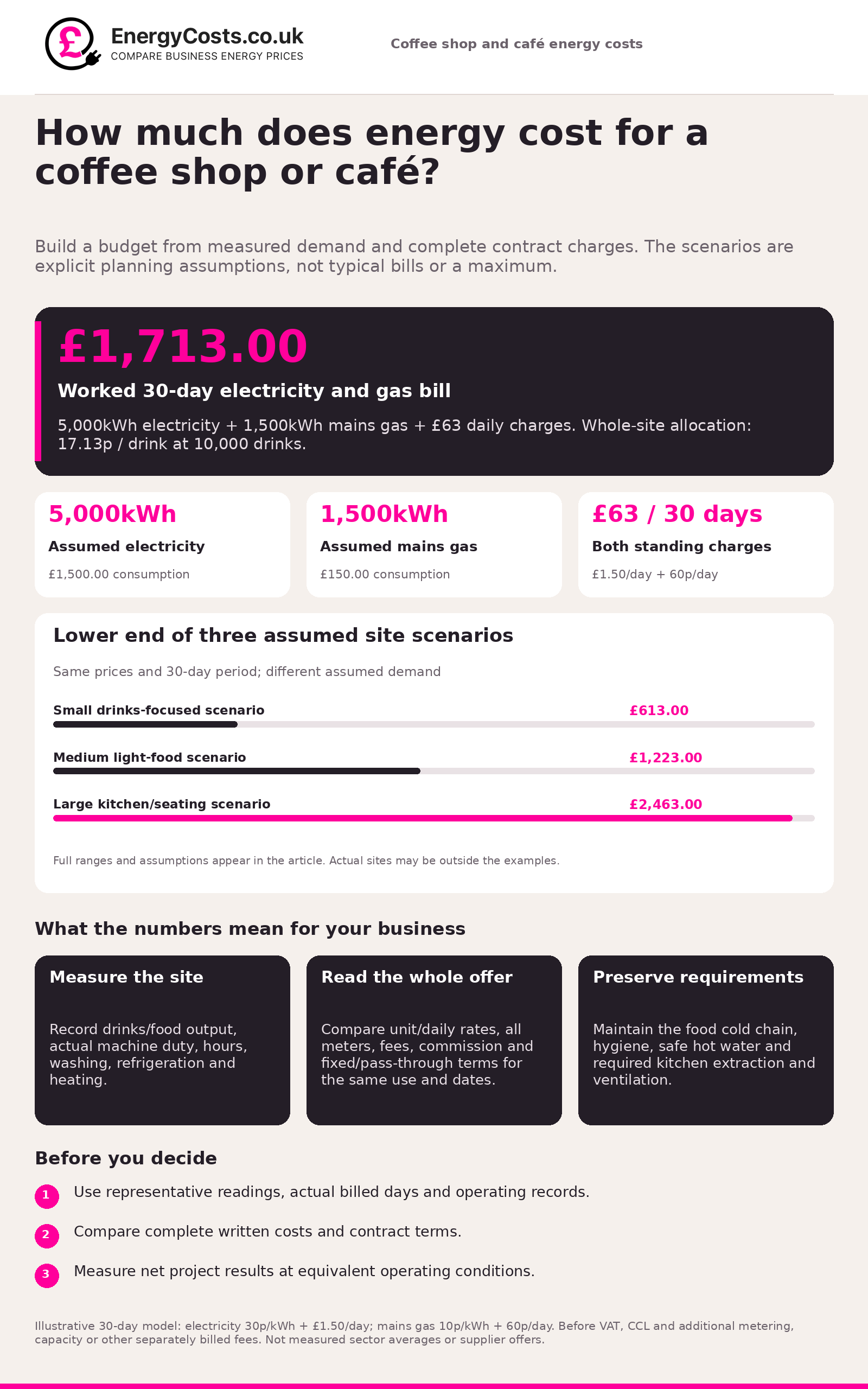
The medium café scenario below assumes 3,600–6,500kWh electricity and 800–2,200kWh mains gas in 30 days. At the stated model prices it costs £1,223–£2,233 before VAT, CCL and extra fees. These are planning assumptions, not a measured sector average or quote.
| Assumed site scenario | Electricity kWh/30 days | Mains gas kWh/30 days | Electricity model cost | Gas model cost | Combined 30-day model |
|---|---|---|---|---|---|
| Small drinks-focused scenario | 1,800–3,500 | 100–500 | £585.00–£1,095.00 | £28.00–£68.00 | £613.00–£1,163.00 |
| Medium light-food scenario | 3,600–6,500 | 800–2,200 | £1,125.00–£1,995.00 | £98.00–£238.00 | £1,223.00–£2,233.00 |
| Large kitchen/seating scenario | 7,000–12,000 | 3,000–6,000 | £2,145.00–£3,645.00 | £318.00–£618.00 | £2,463.00–£4,263.00 |
The totals include one electricity and one mains-gas standing charge in a 30-day month. Actual footfall, menu, heating fuel, required refrigeration and equipment duty can put a café outside these examples; the large scenario is not a maximum.
Prices and assumptions used in this cost model
The cost models on this page use a 30-day month, electricity at 30p/kWh plus £1.50/day and gas at 10p/kWh plus 60p/day. These are rounded planning inputs near November 2026 published quote observations, held constant to isolate the effect of consumption. They are not supplier offers or measured sector averages. Totals exclude VAT, CCL, additional metering/capacity charges and other separately billed items; add only the items applicable to the site.
For context, November 2026 published supplier-panel observations are available for business electricity and business gas. These observations cover 1–9 November, include the publisher’s maximum commission and are not sector averages or a quote for this site.
Use kWh × p/kWh ÷ 100 plus charged days × p/day ÷ 100 for each fuel and meter. Apply every time band separately. The model’s daily charges total £63 over 30 days; actual charged days, daily charges, additional meters and separately billed services can differ.
Actual offers depend on meter details, load shape, annual use, credit, start date and term. Check whether network, policy, metering and broker costs are included, fixed, passed through or reconciled later. A fixed unit rate does not fix consumption or every component of the bill.
Standard business supplies normally attract 20% VAT. Small-quantity and other qualifying supplies have different treatment: during 1 October 2026–30 June 2027, qualifying electricity in Great Britain is temporarily zero-rated; qualifying electricity in Northern Ireland and qualifying gas remain at 5%. The small-quantity tests are applied separately to each fuel and billing supply, not simply to a combined annual bill. Check HMRC’s fuel and power guidance.
The main CCL rate is 0.801p/kWh for electricity and gas from 1 April 2026 to 31 March 2027. Add it only to taxable consumption and only if it is not already included. Small-quantity supplies can be exempt; a renewable tariff alone does not remove CCL.
Which café equipment uses the most energy?
| Equipment or activity | What to measure | Interpretation |
|---|---|---|
| Espresso machines and grinders | Electrical input, warm-up, service/idle hours and manufacturer controls | Match schedules to service and safe equipment operation. |
| Refrigeration and display fridges | Continuous readings, required temperatures, doors and defrost | Maintain food-safe storage; closing time does not justify switching off required refrigeration. |
| Dishwashers and glasswashers | Cycle energy, hot-water source and throughput | Maintain hygiene and required programme performance. |
| Ovens, combi ovens and grills | Fuel input, warm-up, cooking hours and output | Compare actual fuel and complete appliance performance. |
| Hot-water systems | Fuel input, volume and storage/distribution losses | Preserve safe hot-water and hygiene controls. |
| Lighting, heating and ventilation | Input, hours, weather and required extraction | Kitchen extraction fans normally use electricity, even with gas cooking. |
| Hot displays and warming cabinets | Input, hours and required food temperatures | Preserve food safety and manufacturer conditions. |
Espresso machines, refrigeration and heating systems run for most of the day, making them major contributors to energy use.
Key factors affecting café energy costs
- Operating hours: compare actual service, preparation, cleaning and idle time. Longer opening can add demand, but no fixed 35% premium applies to every café.
- Kitchen intensity: Adding cooked meals, hot sandwiches or bakery services significantly increases gas and electricity usage.
- Customer footfall and seating areas: Heating and cooling large seating areas increases energy usage, especially in winter and peak summer.
- Equipment performance: compare measured energy, duty and required capacity rather than age alone. New equipment is not automatically 25% lower-use; check manufacturer data, installation, maintenance and full cost.
Energy-saving strategies for coffee shops
| Action to assess | Evidence needed | Operating constraint |
|---|---|---|
| Refrigeration review | Continuous input, required temperatures, seals and comparable replacement performance | Use relevant product labels/specifications; retain the food cold chain. |
| Suitable coffee-machine schedules | Warm-up and service pattern, idle readings and manufacturer advice | Do not compromise equipment or food-service hygiene. |
| LEDs and lighting controls | Input, required lighting quality and hours | Maintain safe preparation and customer-area lighting. |
| Ventilation and heat-recovery design | Required airflow, compatible design and useful recovered heat | Preserve extraction, fire precautions and air quality. |
| Hot-water insulation and maintenance | Loss survey, approved work and comparable demand | Retain safe temperatures and cleaning requirements. |
| Contract comparison | Complete costs for matched demand, dates and coverage | No guaranteed fixed/seasonal-tariff saving; check time bands and pass-through charges. |
Worked example: a 30-day energy bill
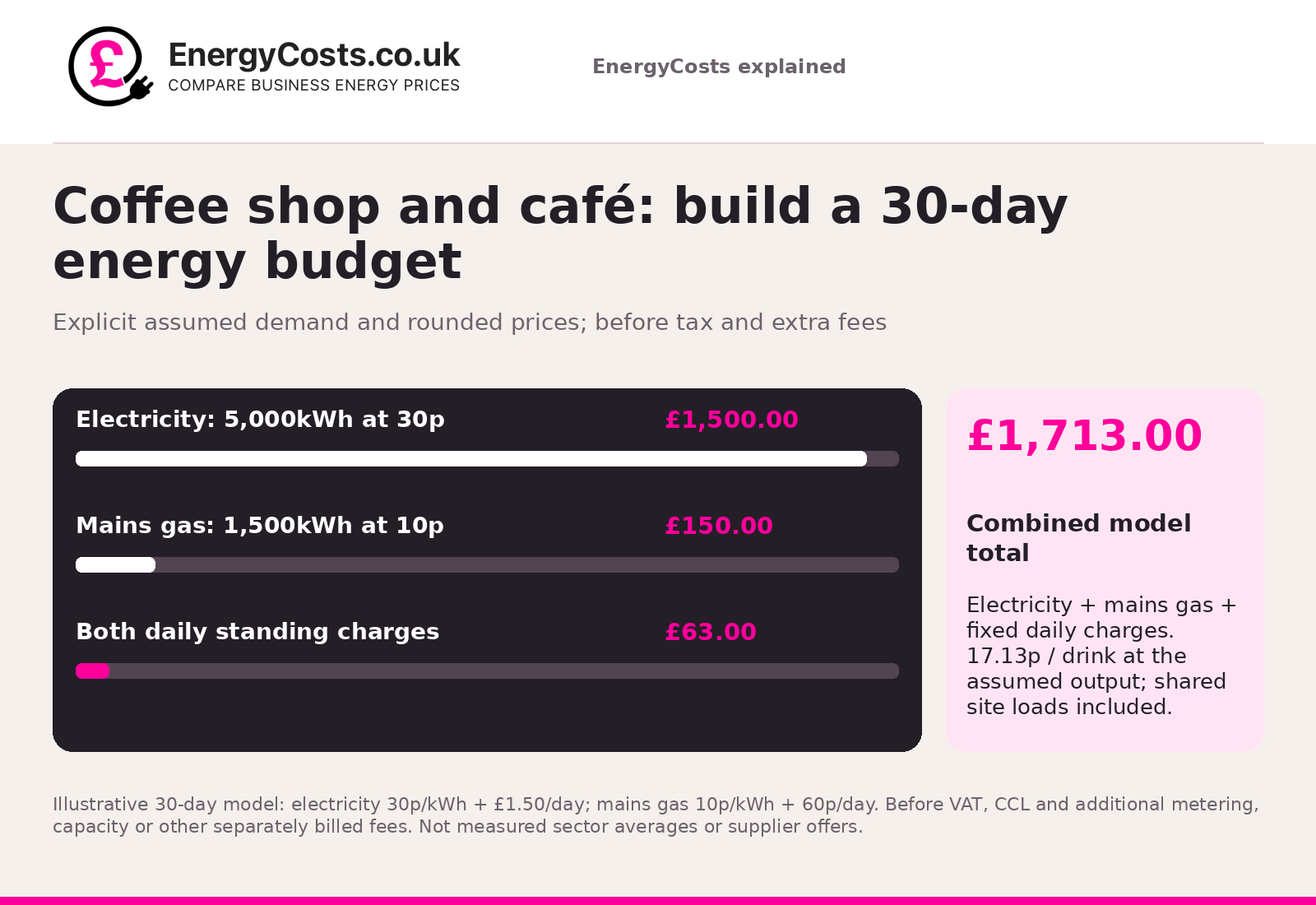
Assume 5,000kWh electricity and 1,500kWh mains gas in a 30-day month, using the stated model prices. Electricity consumption costs £1,500.00, gas costs £150.00 and the two standing charges total £63. The combined bill is £1,713.00 before VAT, CCL and additional fees.
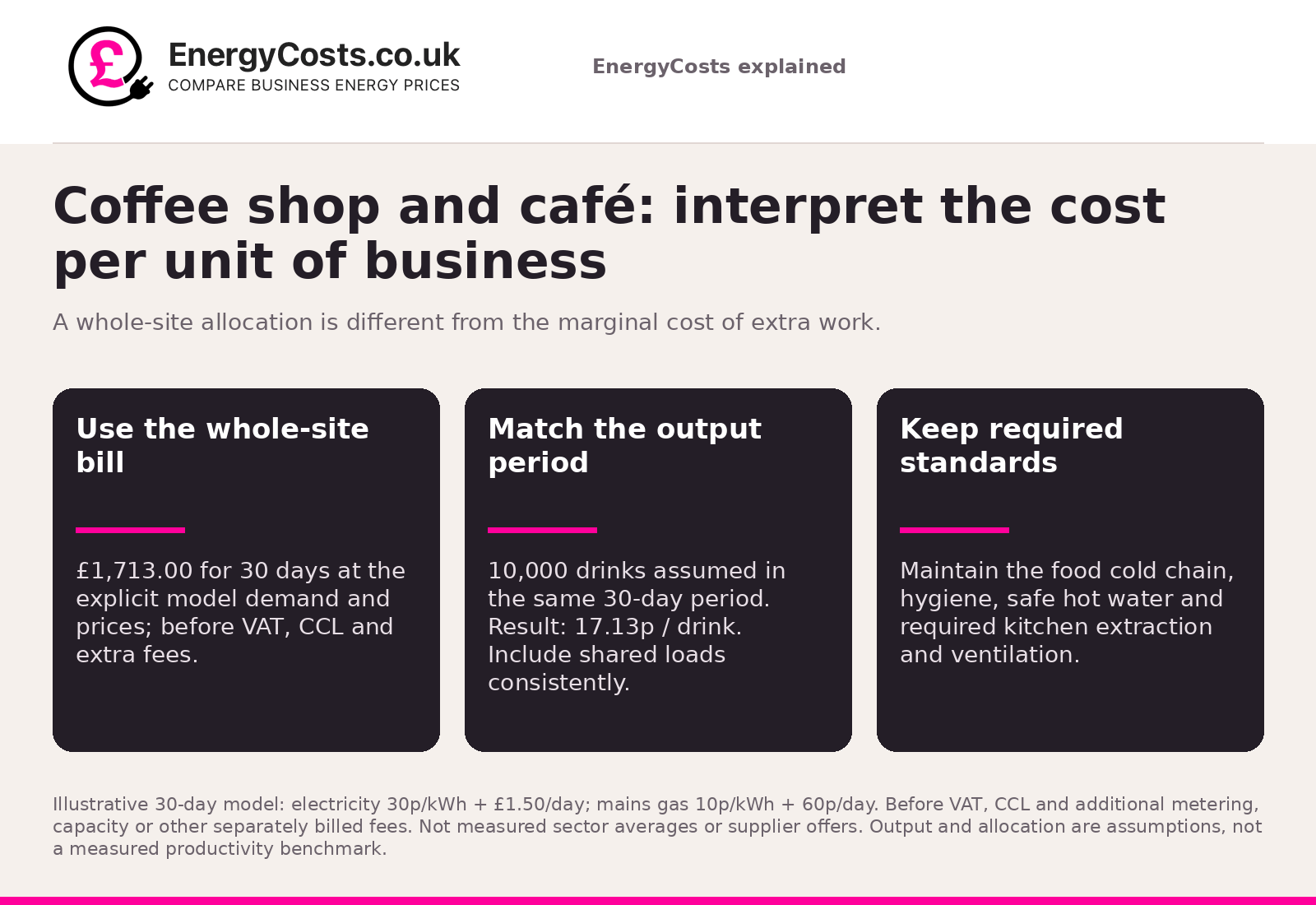
If the same site records an assumed 10,000 drinks sold in that period, dividing the whole-site bill by that output gives 17.13p per drink. This allocates heating, lighting and other shared loads as well as production/service energy; it is not the marginal energy cost of one extra unit of business. Use matching periods and actual output.
Use the business’s food-safety management system when assessing operational changes. Government food-hygiene guidance covers safe cooking, chilling, cleaning and storage; energy controls must preserve the required food-safety outcome.
Why energy matters in cafés
Calculate energy’s share of operating costs from the actual accounts for the same period and tax basis. There is no supported universal 6–14% or 18% ratio here. Energy divided by turnover is a different metric and should be labelled separately.
High refrigeration demand, heating requirements and long operating hours make energy one of the largest variable expenses.
Energy tariff options for café businesses
Compare complete fixed, variable and time-of-use offers using actual interval demand where available. Gas and electricity may be contracted separately; combining them does not guarantee a discount. Early-morning demand helps only when it falls in genuinely cheaper billed periods and total costs remain competitive.
Save money on your coffee shop energy bills with EnergyCosts.co.uk
Whether you run a small coffee shop or a full-service café with kitchen facilities, accurate energy budgeting and tariff selection can improve profitability. Use EnergyCosts.co.uk to compare business energy suppliers offering bespoke rates for hospitality and food-service businesses.
FAQ
The medium café scenario assumes 3,600–6,500kWh electricity and 800–2,200kWh mains gas in 30 days, giving £1,223–£2,233 at the stated prices before VAT, CCL and extra fees. The worked 5,000kWh/1,500kWh bill is £1,713. These are assumed budgets, not measured averages.
The small drinks-focused scenario assumes 1,800–3,500kWh electricity over 30 days. At 30p/kWh plus £1.50/day its electricity-only model cost is £585–£1,095 before tax and extra fees. Actual espresso-machine duty, refrigeration, washing and hours determine the site’s demand.
It depends on the menu, equipment and heating fuel. In the worked example electricity is £1,545 and mains gas £168 including daily charges, but that is one assumed site. A full gas kitchen or electric heating changes the split; compare measured demand rather than a universal ratio.
Espresso machines, refrigeration, washing, cooking, hot water and environmental services can all matter. Measure actual input and hours. Kitchen extraction fans normally use electricity, including above gas cooking; ovens and water heaters may use either fuel. Required food refrigeration may continue when the café is closed.
Seating can add comfort heating/cooling, lighting and washing demand, but there is no universal 20–35% premium. Assess floor area, occupancy, weather, hours and installed equipment. Keep shared services counted once and maintain safe temperatures, ventilation and access lighting.
Maintenance, appropriate lighting controls, suitable coffee-machine schedules and hot-water loss reduction can help. Follow manufacturer advice and preserve food refrigeration, hygiene, safe hot water and required extraction. Measure equivalent service periods before claiming a saving; there is no guaranteed 10–18% reduction.
Its share depends on cabinet type, required temperatures, room conditions, doors, defrost and service hours. Use continuous readings rather than a universal 20–30% allowance. Compare applicable labels and manufacturer performance for equivalent storage conditions, retaining the food cold chain overnight.
A fixed agreement protects specified prices but not consumption or every pass-through charge. Compare complete offers using the café’s load and risk preference. Time-of-use products help only where suitable demand matches cheaper billed periods. Neither structure guarantees an 8–12% annual saving.
Longer opening can increase machine, lighting and comfort-system use, while refrigeration and other continuous loads may change less. There is no universal 30–40% premium. Compare meter readings against hours, service output and weather, separating essential continuous operation from avoidable idle demand.
Calculate the ratio from matching accounts and a consistent tax basis; no universal 6–14% or 18% figure is established here. The guide’s £1,713 bill divided by 10,000 assumed drinks is 17.13p per drink as a whole-site allocation, including food and premises loads, not marginal drink energy.