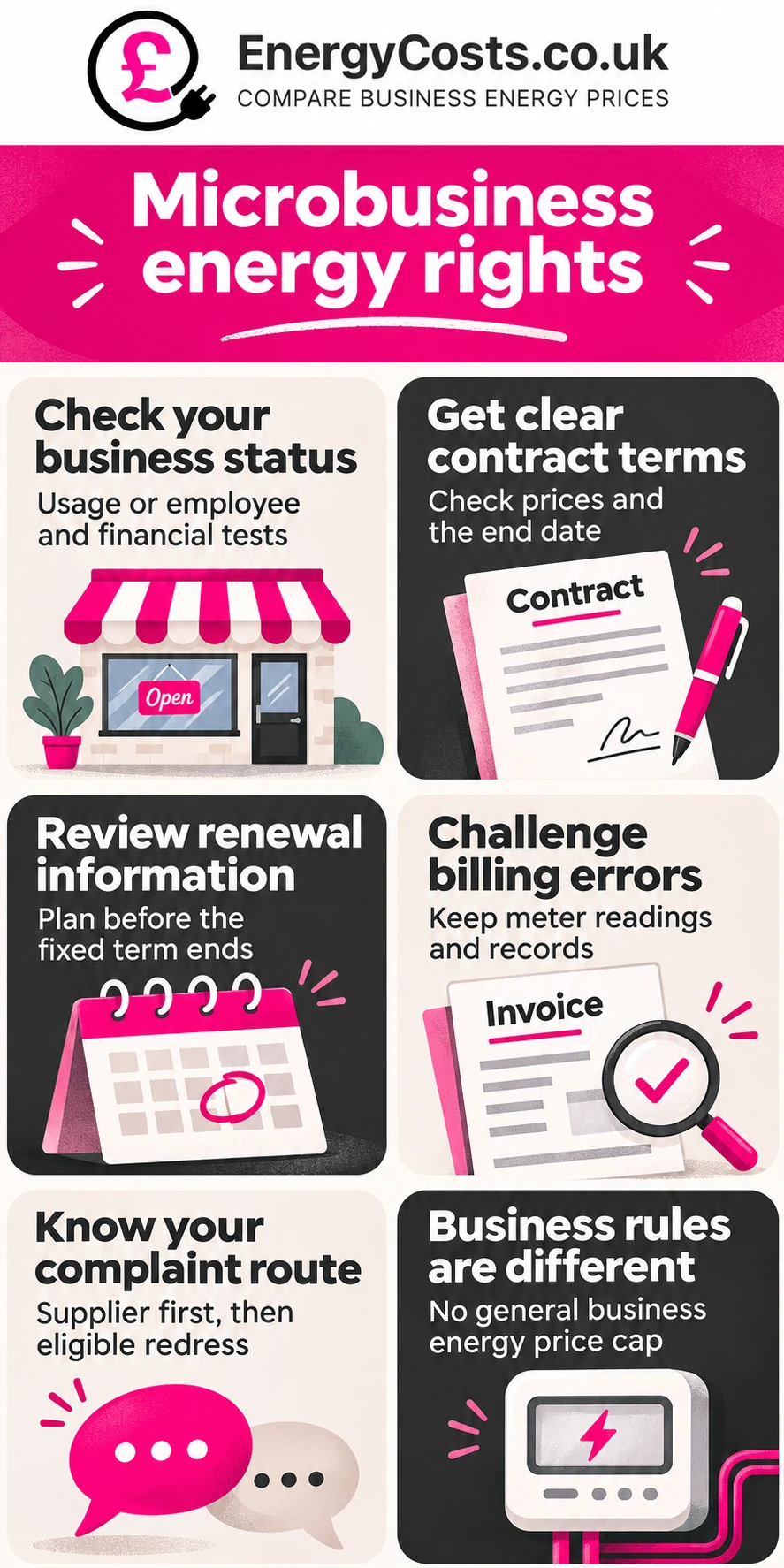
Microbusiness energy rights can give smaller organisations extra protections when agreeing contracts, dealing with billing errors and resolving complaints. Your status is not determined by employee numbers alone: annual electricity or gas consumption can provide a separate route to eligibility.
There is also a wider small-business category for certain protections, including access to independent dispute resolution. Being eligible for that category does not automatically give you every microbusiness-specific right. This guide explains the main tests and how to use the appropriate protections when buying or managing business energy.
Who qualifies as a microbusiness energy customer?
For Great Britain’s business electricity and gas market, the current published criteria include the alternatives below. The employee-and-financial route requires both parts of that route; the relevant consumption route is an alternative. Keep a record of how the supplier assessed your account.
| Eligibility route | Microbusiness threshold | Wider small-business threshold |
|---|---|---|
| Electricity consumption | No more than 100,000 kWh a year | No more than 200,000 kWh a year |
| Gas consumption | No more than 293,000 kWh a year | No more than 500,000 kWh a year |
| Employees and finances | Fewer than 10 full-time equivalent employees AND annual turnover or balance sheet total no more than £2 million | Fewer than 50 full-time equivalent employees AND annual turnover no more than £6.5 million OR balance sheet total no more than £5 million |
In the final column’s employee-and-financial test, the fewer-than-50 requirement must be met alongside either financial limit. It does not mean that a large employer qualifies purely because its balance sheet is below £5 million. Consumption provides a separate route and can produce a different result.
These thresholds are set out in current supplier business-status guidance and the Energy Ombudsman’s eligibility explanation. The wider redress category was introduced through the 2024 amendment to the Redress Order. Northern Ireland has a separate regulatory framework; these Ofgem protections should not simply be assumed to apply there.
You do not need to pass every test
A business can qualify through the relevant annual consumption test even where it does not meet the employee-and-financial test. Conversely, an organisation that meets the employee-and-financial route may qualify despite using more energy than the consumption threshold. Ask the supplier to confirm the route it has used for the particular fuel and protection.
The examples below illustrate the logic using assumed figures. They are simplified eligibility scenarios, rather than determinations about real companies.
| Illustrative business | Assumed facts | What to investigate |
|---|---|---|
| Small consultancy | 6 full-time equivalent employees and £900,000 turnover | Microbusiness employee-and-financial route |
| Larger office employer | 70 employees and 80,000 kWh annual electricity use | Electricity microbusiness consumption route despite headcount |
| Manufacturing company | 30 employees, £8 million turnover, £4 million balance sheet and 250,000 kWh electricity use | Wider small-business employee-and-financial route via balance sheet |
| Electricity-intensive tenant | 55 employees, £9 million turnover, £7 million balance sheet and 180,000 kWh electricity use | Wider small-business electricity consumption route |
Full-time equivalent is not necessarily the same as the number of names on the payroll. Give the supplier accurate information rather than guessing from the number of part-time staff. Retain accounts or other evidence supporting the relevant turnover or balance sheet total.
Can electricity and gas have different classifications?
Yes. Where you rely on consumption, each fuel needs appropriate assessment. The government’s redress implementation guidance explains separate treatment of electricity and gas and the use of an appropriate annual period or estimate where a business has not operated for 12 months.
For example, assume a company does not meet the employee-and-financial route, uses 150,000 kWh of electricity and 250,000 kWh of gas a year. Those figures fall within the wider small-business electricity limit and the microbusiness gas limit. Do not assume one label on a dual-fuel account settles every right for both supplies.
For multi-site organisations, ask the supplier how it has assessed the customer, premises and consumption for the relevant rule. Do not divide company-wide figures arbitrarily between addresses to claim a preferred status. Document the actual contractual arrangement and the basis of the assessment.
What protections should you check?
| Area | Why status matters | Practical action |
|---|---|---|
| Clear contract information | Microbusiness rules add requirements around principal terms | Keep the offer, acceptance and full conditions |
| Renewal and leaving | Microbusiness rules distinguish fixed, rollover and evergreen arrangements | Identify the exact contract type before relying on a notice period |
| Previously unbilled energy | The 12-month back-billing protection is microbusiness-specific, with exceptions | Separate old unbilled consumption from bills already correctly issued |
| Complaints and redress | Qualifying small businesses as well as microbusinesses can access the Energy Ombudsman | Record the formal complaint date and evidence |
| Fair treatment and fees | Some protections apply more widely than microbusinesses | Request clear costs and explanations regardless of the marketing label |
“Small business tariff” is a product description, not proof of a legal classification. Likewise, being offered a larger-business account manager does not by itself remove a protection you qualify for. Request a written assessment if the supplier’s records appear inconsistent with your evidence.
Contract information and renewal rights
The current electricity supply licence conditions, condition 7A, require clear written terms for microbusiness contracts and renewal information around 60 days before the initial period ends, unless a new contract has already been agreed. The rules distinguish leaving at the end of the initial fixed period, a rollover period and evergreen supply.
At the initial fixed-term end, the microbusiness rules prohibit requiring termination notice to leave or switch, subject to the relevant transfer provisions. Evergreen microbusiness contracts have a maximum 30-day termination-notice period. A supplier’s stated 30-day process should not be presented as a universal requirement for every microbusiness arrangement.
The practical task is to establish which agreement currently applies and the earliest transfer date. These protections do not create a general right to abandon the initial fixed term without consequences. Check the business energy renewal guide and obtain written clarification if a supplier says you have missed a deadline.
Keep a diary entry well before the end date so there is time to compare prices and resolve meter-record issues. If a supplier has failed to provide required information, raise that specific issue. Do not assume the failure automatically cancels every charge or permits immediate departure from any agreement.
Is there a cooling-off period?
Do not rely on a general household-style cooling-off right after agreeing a business energy contract. Ofgem’s intermediary guidance warns that business contracts can be binding when agreed by telephone and that there is no general cooling-off period. Check any additional cancellation provision the supplier explicitly offers.
Before accepting, confirm the business name, supply address, meter identifiers, rates, payment terms, start date and contract length. Make sure the person negotiating understands whether they are requesting information or authorising a binding agreement. Keep the recording or written acceptance where available.
If the dispute concerns misleading selling or lack of authority, ask for the evidence of agreement and use the complaints process. That is different from assuming every business can change its mind within 14 days. Our guide to leaving a business energy contract covers the wider options.
Microbusiness back-billing: what the 12-month rule means
Ofgem’s back-billing explanation says the protection applies to households and microbusinesses in qualifying circumstances. It can prevent recovery of certain previously unbilled charges for energy used more than 12 months earlier where the supplier failed to bill accurately.
It is not a rule that every bill over 12 months old disappears. Correctly issued unpaid bills, obstruction of accurate billing and other exceptions need separate consideration. Nor does qualifying for the wider small-business complaints category automatically make you eligible for microbusiness back-billing protection.
An illustrative catch-up invoice could contain £1,500 for older, previously unbilled consumption and £2,000 for recent consumption. Those amounts should be assessed separately. A valid challenge to the first part does not automatically remove the second part. Request a breakdown by consumption period and explain why you believe the protection applies.
Our business energy back-billing guide gives a fuller explanation. Keep reading submissions, attempted contacts and earlier invoices so the dispute can be assessed against what the supplier and customer actually did.
Rights that extend beyond microbusinesses
Ofgem expanded the non-domestic Standards of Conduct to businesses of all sizes from 1 July 2024. It also extended principal-terms disclosure of relevant intermediary fees to all non-domestic contracts signed from 1 October 2024. Its announcement of the changes explains the wider scope.
Ask what services are included, which suppliers are considered and how any fee is calculated. For an illustrative consumption-based fee of 0.5p/kWh on 80,000 kWh, the annual amount is £400 before any relevant tax. A fee quoted in fractions of a penny can therefore still be material over a multi-year agreement.
The calculation does not establish what any particular intermediary charges. It shows how to convert a disclosed fee into a figure your business can assess. Check whether the fee is already included in the quoted unit rate before adding it again to an annual comparison.
How to make an effective supplier complaint
Start with the supplier’s formal complaints process and explain the outcome you want. A concise complaint supported by specific dates and figures is easier to investigate than a general statement that the account is unfair. Ask for a reference number and keep the date the complaint was raised.
- Identify the legal business name, account number and supply address.
- Explain the classification route you believe applies and attach relevant evidence.
- Set out the disputed event, invoice, contract term or payment.
- Provide readings, correspondence and the amount involved where relevant.
- Request a specific correction, explanation, refund or other remedy.
- Keep the written response and any deadlock letter.
Eligible microbusiness and small-business customers can approach the Energy Ombudsman after eight weeks without resolution, or earlier with a deadlock letter, subject to the scheme’s rules. The service can consider appropriate disputes about treatment or incorrect charges; it does not set a cheaper market tariff simply because an agreed price now looks expensive.
See our deadlock letter guide for what that response means. Ofgem regulates suppliers, but the supplier and eligible redress process are the usual routes for resolving an individual account complaint.
What microbusiness status does not guarantee
It does not create a general business energy price cap, a guaranteed cheapest tariff, automatic acceptance by every supplier or a universal right to exit a fixed deal early. A supplier can assess commercial eligibility and credit risk, subject to the applicable rules. A deposit or payment requirement needs its own examination.
Microbusiness status also differs from VAT small-supply eligibility and tax definitions of a small company. Being a microbusiness for energy contracts does not by itself mean all energy attracts favourable tax treatment. The VAT on business energy guide explains why usage and purpose need separate assessment.
For example, a business using 90,000 kWh of electricity may fit the microbusiness electricity consumption route, but that does not make it a low-volume electricity supply for VAT. Avoid treating the word “small” as one universal threshold across contracts, tax and accounting.
An eligibility and buying checklist
Before comparing tariffs, assemble annual usage by fuel, the latest bill, current contract dates and employee-and-financial information where needed. Ask the supplier to correct an inaccurate classification before it causes a problem at renewal or during a complaint.
Compare the actual annual charges and the commitment the business can afford. Keep a record of the status assessment alongside the contract, rather than relying on a conversation that cannot later be retrieved. That gives you a clearer basis for both buying decisions and any future challenge to how the account has been handled.
Frequently asked questions
Current published tests include no more than 100,000 kWh of annual electricity or 293,000 kWh of annual gas, or fewer than 10 full-time equivalent employees alongside turnover or balance sheet total no more than £2 million. The relevant route and fuel should be confirmed for the particular protection.
No. The relevant annual consumption route is an alternative to the employee-and-financial route. Within the latter route, you must meet the employee requirement alongside the applicable financial test. Keep evidence and ask the supplier which route it used when classifying the account for the protection involved.
Yes, where eligibility depends on consumption. A business can fall inside the microbusiness threshold for one fuel and the wider small-business threshold for the other. Ask for separate confirmation where relevant rather than assuming a single description on a dual-fuel account determines every protection.
No. The wider small-business category expands access to certain protections, including redress, but does not automatically confer every microbusiness-specific right. The 12-month back-billing rules have their own eligibility and exceptions. Correctly issued unpaid bills should also be distinguished from consumption that was not previously billed accurately.
Do not assume a household-style cooling-off period applies. Business energy agreements can become binding over the telephone. Check any express cancellation provision before accepting and retain the principal terms. A complaint about misleading selling or lack of authority is different from a general right to change your mind.
No. The rules distinguish initial fixed terms, rollover periods, evergreen contracts and out-of-contract arrangements. Evergreen microbusiness contracts have a maximum 30-day notice period, while different rules govern leaving at the initial fixed-term end. Identify your current agreement and ask the supplier to explain any notice demand.
Eligible small businesses and microbusinesses can use the service for appropriate unresolved disputes, subject to its scheme rules. Complain to the supplier first. Escalation is generally available after eight weeks without resolution, or earlier if the supplier issues a deadlock letter. Keep evidence of the complaint and responses.
No. Energy-contract classifications and VAT eligibility use different tests. The purpose and volume of a supply can affect its tax treatment, while microbusiness status concerns particular contractual and regulatory protections. Ask for each assessment separately and do not assume a business-size label determines the VAT on every invoice.
Compare business energy quotes with accurate annual usage and contract dates, and keep your business-status assessment alongside the written offer.