
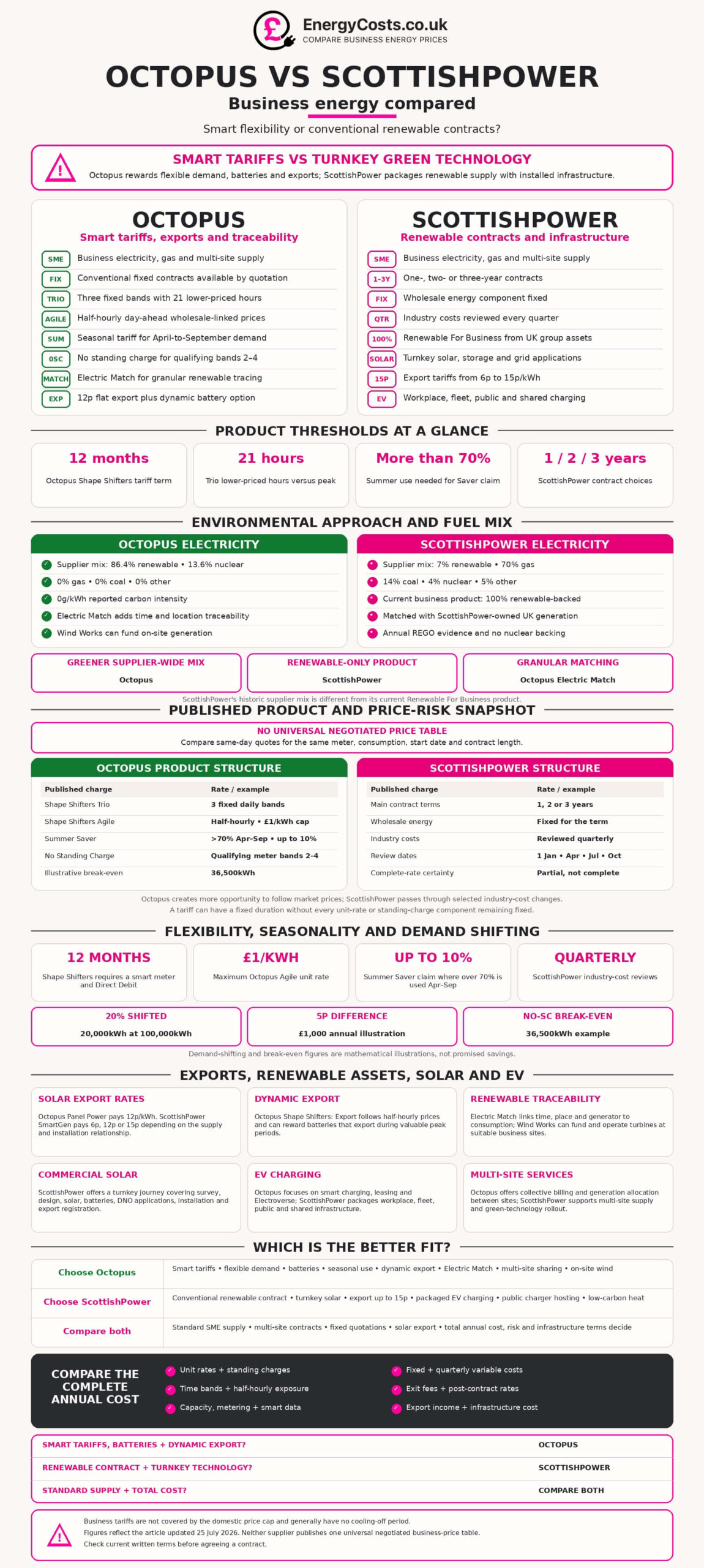
Octopus Energy and ScottishPower both supply electricity and gas to UK businesses, but their strongest products are designed around different priorities.
Octopus Energy for Business focuses heavily on smart tariffs, flexible electricity consumption, solar exports, batteries, multi-site management and detailed renewable-energy matching. Its Shape Shifters tariffs reward businesses that can move electricity use away from peak periods, while Summer Saver is designed for highly seasonal companies.
ScottishPower takes a more conventional fixed-contract approach. Its business tariffs are available for one, two or three years and divide the price into a fixed wholesale-energy component and variable industry costs reviewed every quarter. Its current business electricity proposition is backed by 100% renewable electricity generated by ScottishPower’s UK renewable assets.
Octopus may be the stronger choice for a business with flexible machinery, electric vehicles, batteries or solar panels. ScottishPower may suit a company wanting a more conventional contract combined with renewable electricity, commercial solar, EV charging or low-carbon heating.
Neither company is universally cheaper. Business energy prices depend on the premises, meter, postcode, consumption profile, credit history and contract dates.
Octopus vs ScottishPower at a glance
| Feature | Octopus Energy for Business | ScottishPower Business |
|---|---|---|
| Business electricity | Yes | Yes |
| Business gas | Yes | Yes |
| SME supply | Yes | Yes |
| Multi-site supply | Yes | Yes |
| Standard national contract prices published | No | No |
| Online quotation | Yes | Yes |
| Fixed contracts | Available by quotation | One, two or three years |
| Smart time-of-use tariff | Shape Shifters Trio and Agile | No directly comparable permanent business product |
| Seasonal electricity tariff | Summer Saver | No prominent business equivalent |
| No-standing-charge tariff | Available for qualifying meter bands | No prominent equivalent |
| Fixed wholesale-energy component | Available on fixed products | Yes |
| Industry costs fixed | Product-dependent | No; reviewed quarterly |
| Standard business electricity credentials | Zero carbon | 100% renewable-backed |
| Supplier-wide renewable share | 86.4% | 7% in the 2024/25 total fuel mix |
| Supplier-wide nuclear share | 13.6% | 4% |
| Supplier-wide gas and coal | 0% | 84% combined |
| Published carbon intensity | 0g CO₂/kWh | Product-dependent |
| Time-matched renewable service | Electric Match | Annual REGO matching |
| Direct renewable generation | Wind Works and renewable PPAs | ScottishPower-owned UK renewables |
| Solar export tariff | Panel Power at 12p/kWh | SmartGen at 6p, 12p or 15p/kWh |
| Dynamic export | Shape Shifters: Export | No directly comparable published business tariff |
| Commercial solar installation | Bespoke renewable infrastructure | Nationwide solar and battery installation |
| EV charging | Smart import tariffs and wider Octopus EV services | Workplace, fleet, public and shared charging |
| Public charger hosting | Not a main standard business offer | Fully funded option for suitable sites |
| Heat solutions | Less prominent for businesses | Bespoke commercial heating, cooling and hot water |
| Direct sales model | Yes | Direct and intermediary routes |
| Best suited to | Flexible, technology-led and exporting businesses | Companies wanting a conventional renewable contract and installed green technology |
Which businesses can apply?
Both suppliers can serve small and medium-sized businesses.
Octopus also provides multi-site and more advanced commercial arrangements, including Electric Match and funded renewable generation.
ScottishPower’s business service is suitable for companies including:
- shops
- offices
- restaurants
- hotels
- care providers
- schools
- charities
- landlords
- workshops
- warehouses
- manufacturers
- multi-site organisations
The supplier may still assess:
- meter configuration
- annual consumption
- creditworthiness
- previous payment history
- property use
- business type
- the proposed contract start date
A supplier is not obliged to offer every applicant a contract.
Example suitability by company type
| Example business | Annual electricity use | Potentially suitable option |
|---|---|---|
| Small shop | 12,000kWh | Standard fixed quote from either supplier |
| Office | 50,000kWh | Octopus fixed tariff or ScottishPower For Business |
| Seasonal attraction | 100,000kWh | Octopus Summer Saver may be relevant |
| Restaurant | 120,000kWh | Compare fixed and time-of-use quotations |
| EV fleet depot | 500,000kWh | Octopus Shape Shifters or ScottishPower fleet charging |
| Business with batteries | 500,000kWh | Octopus Agile and dynamic export |
| Hotel group | 1GWh | Multi-site quotation from either supplier |
| Business wanting rooftop solar | Varies | ScottishPower turnkey installation or Octopus export services |
| Company with several generating sites | Several GWh | Octopus Electric Match |
| Site suitable for a wind turbine | High on-site demand | Octopus Wind Works |
Which supplier is cheaper?
There is no single Octopus-versus-ScottishPower business unit rate.
Both suppliers produce quotations using information such as:
- electricity MPAN;
- gas MPRN;
- postcode;
- distribution region;
- annual consumption;
- meter profile;
- half-hourly demand data;
- residual charging band;
- agreed electricity capacity;
- number of sites;
- payment method;
- credit risk;
- contract start date;
- contract duration; and
- wholesale prices when the quotation is prepared.
A meaningful comparison should calculate:
- Annual consumption × unit rate
- daily standing charge × 365
- capacity charges
- metering and data costs
- network and policy charges
- VAT and Climate Change Levy where applicable
− export income and other credits
The cheapest unit rate does not always produce the lowest annual cost.
How unit-rate differences affect annual costs
| Annual consumption | Value of 0.5p/kWh | Value of 1p/kWh | Value of 3p/kWh | Value of 5p/kWh |
|---|---|---|---|---|
| 10,000kWh | £50 | £100 | £300 | £500 |
| 25,000kWh | £125 | £250 | £750 | £1,250 |
| 50,000kWh | £250 | £500 | £1,500 | £2,500 |
| 100,000kWh | £500 | £1,000 | £3,000 | £5,000 |
| 250,000kWh | £1,250 | £2,500 | £7,500 | £12,500 |
| 1GWh | £5,000 | £10,000 | £30,000 | £50,000 |
| 10GWh | £50,000 | £100,000 | £300,000 | £500,000 |
A business using 1GWh annually saves £10,000 for every 1p/kWh reduction in its average rate.
How standing charges affect costs
| Daily standing-charge difference | Annual difference per meter | Difference across ten meters |
|---|---|---|
| 25p | £91.25 | £912.50 |
| 50p | £182.50 | £1,825 |
| £1 | £365 | £3,650 |
| £2 | £730 | £7,300 |
| £5 | £1,825 | £18,250 |
Standing charges can be particularly important for:
- low-use premises;
- seasonal sites;
- landlords;
- empty properties;
- businesses with several small meters; and
- organisations retaining inactive supplies.
Octopus standard business tariffs
Octopus provides postcode- and meter-specific business quotations rather than publishing one national price table.
Its main business proposition includes:
- fixed electricity tariffs;
- flexible tariffs;
- business gas;
- multi-site portfolios;
- smart-meter products;
- time-of-use electricity;
- commercial export tariffs; and
- bespoke renewable-energy services.
Octopus states that it sells business energy directly rather than relying on brokers for its standard customer-acquisition route.
Its position is that a direct sale avoids incorporating third-party broker commission into the business tariff.
A company can still use an independent consultant to assess the market, but the Octopus quotation should be obtained directly for a fair comparison.
Octopus Shape Shifters
Shape Shifters is Octopus’s most distinctive SME electricity product.
It is a 12-month business electricity tariff requiring:
- a working smart meter;
- Direct Debit;
- an account that is up to date; and
- compatible meter arrangements.
There are two versions.
Shape Shifters Trio
Trio divides electricity use into three time bands:
- night;
- daytime; and
- the 4pm to 7pm peak period.
The time-band rates remain fixed during the tariff.
Octopus states that customers receive 21 hours of lower-priced electricity each day compared with the peak period.
The tariff may suit:
- electric vehicle depots;
- laundries;
- cold-storage facilities;
- workshops;
- commercial kitchens;
- companies with battery storage;
- businesses able to pre-heat or pre-cool buildings; and
- manufacturers that can reschedule machinery.
The business does not need to monitor a different price every half hour. It simply needs to understand the three daily time bands.
Shape Shifters Agile
Agile links the unit rate to wholesale electricity prices.
Prices change every half hour and are shown in advance for the following day.
Octopus applies a maximum rate of £1 per kWh.
Agile has greater saving potential than Trio when wholesale prices are low, but it also creates greater risk.
A business using electricity heavily during an expensive period could pay considerably more than it would on a conventional fixed tariff.
Agile may suit companies with:
- automated energy-management systems;
- battery storage;
- flexible industrial equipment;
- controllable refrigeration;
- overnight EV charging;
- on-site generation; or
- staff able to monitor day-ahead prices.
Potential value of shifting demand
Suppose a business consumes 100,000kWh annually and can move 20% of its consumption away from expensive periods.
It would shift 20,000kWh.
| Price difference between peak and off-peak use | Illustrative annual saving |
|---|---|
| 3p/kWh | £600 |
| 5p/kWh | £1,000 |
| 10p/kWh | £2,000 |
| 15p/kWh | £3,000 |
| 20p/kWh | £4,000 |
These are mathematical illustrations rather than promised Octopus savings.
A business must compare its actual half-hourly consumption with the available regional rates.
Octopus Summer Saver
Summer Saver is intended for businesses that consume most of their electricity between April and September.
It offers:
- a lower summer unit rate; and
- a higher winter rate.
Octopus says a business using more than 70% of its annual electricity between April and September could save up to 10% over the year.
Potential users include:
- campsites;
- outdoor attractions;
- seasonal cafés;
- wedding venues;
- summer events;
- holiday parks;
- visitor centres; and
- seaside hospitality businesses.
The tariff could become more expensive where winter consumption is higher than expected.
The company should examine at least 12 months of meter data before selecting it.
Octopus No Standing Charge Tariff
Octopus has also published a business tariff with no daily standing charge for qualifying electricity meters in bands 2, 3 and 4.
The network and policy costs normally recovered through the standing charge are incorporated into the unit rate.
This may suit:
- seasonal premises;
- low-use meters;
- sites that are closed for long periods;
- businesses with multiple lightly used supplies; or
- premises where consumption is expected to fall.
It is not automatically cheaper.
Break-even example
Suppose the conventional tariff has:
- a standing charge of £2 per day; and
- a unit rate 2p/kWh below the no-standing-charge tariff.
The annual standing charge is:
£2 × 365 = £730
The break-even consumption is:
£730 ÷ £0.02 = 36,500kWh
Below 36,500kWh, the no-standing-charge option may cost less.
Above 36,500kWh, the higher unit rate may outweigh the avoided standing charge.
The calculation must use the rates in the actual quotation.
ScottishPower For Business tariffs
ScottishPower offers one-, two- and three-year business contracts.
Its tariff price is divided into two components.
Fixed energy component
The wholesale energy element is fixed for the contract term.
This protects the customer from changes in the market price ScottishPower pays to obtain the electricity or gas.
Variable industry-cost component
Network, regulatory, policy and other industry costs can change during the fixed term.
ScottishPower reviews these charges every quarter.
Adjustments can take effect on:
- 1 January;
- 1 April;
- 1 July; and
- 1 October.
The variable elements can include:
- distribution charges;
- transmission charges;
- balancing costs;
- Capacity Market charges;
- Renewables Obligation costs;
- Contracts for Difference;
- smart-meter industry costs;
- electricity system levies;
- gas transportation costs; and
- new government or regulatory charges.
This means a ScottishPower tariff can be fixed for a defined term without the complete unit rate and standing charge remaining unchanged.
How ScottishPower’s structure affects budgeting
ScottishPower provides protection against wholesale energy-price increases, but the customer retains some exposure to non-energy costs.
This can make the opening quotation more competitive than a contract under which the supplier accepts every future industry-cost risk.
The disadvantage is that the business cannot know its exact total rate for the full contract term.
A company should ask ScottishPower to show:
- the fixed energy cost;
- the current variable industry costs;
- the date of the next review;
- which indices are used;
- historical quarterly adjustments; and
- which additional costs can be introduced during the contract.
Octopus fixed pricing versus ScottishPower pricing
The key comparison is not simply “fixed versus variable”.
| Price element | Octopus fixed tariff | ScottishPower For Business |
|---|---|---|
| Wholesale energy | Fixed for applicable fixed product | Fixed |
| Standing charge | Set in quotation, subject to terms | Can contain variable industry components |
| Network charges | Treatment depends on Octopus product | Reviewed quarterly |
| Policy costs | Treatment depends on contract | Reviewed quarterly |
| Half-hourly wholesale exposure | Available through Agile | Not a standard SME feature |
| Budget certainty | Product-dependent | Partial rather than complete |
| Ability to benefit from daily low prices | Smart tariffs only | Limited |
| Need to monitor prices | Agile customers | No |
A business prioritising maximum certainty should ask both suppliers for a written schedule identifying every charge that can change.
Published pricing information
Neither supplier publishes one universal table of current negotiated business prices.
Octopus allows a business to check available rates using its postcode and meter details.
ScottishPower publishes regional information showing changes in the industry-cost component, but these tables do not show the customer’s complete contracted tariff.
ScottishPower’s terms page still links to older Standard Variable and deemed schedules carrying a January 2025 effective date. Those figures should not be treated as confirmed current June 2026 prices without direct verification.
The only fair price comparison is therefore a pair of quotes prepared:
- on the same day;
- for the same meter;
- using the same annual consumption;
- with matching start dates; and
- over equivalent contract lengths.
Comparing renewable electricity
Both suppliers provide zero-carbon electricity, but the composition is different.
Octopus fuel mix
Octopus’s disclosed fuel mix for 1 April 2024 to 31 March 2025 was:
| Electricity source | Octopus |
|---|---|
| Renewables | 86.4% |
| Nuclear | 13.6% |
| Natural gas | 0% |
| Coal | 0% |
| Other fuels | 0% |
| Reported carbon emissions | 0g/kWh |
| High-level radioactive waste | 0.0010g/kWh |
Octopus’s overall electricity mix was therefore entirely zero carbon but not renewable-only.
A company with a policy excluding nuclear energy should not assume that Octopus’s standard supplier-wide mix meets a 100% renewable requirement.
ScottishPower supplier-wide fuel mix
ScottishPower’s published total fuel mix for 2024/25 was:
| Electricity source | ScottishPower |
|---|---|
| Renewables | 7% |
| Natural gas | 70% |
| Coal | 14% |
| Nuclear | 4% |
| Other fuels | 5% |
Its non-green tariffs were reported separately as:
| Electricity source | ScottishPower non-green tariffs |
|---|---|
| Renewables | 3% |
| Natural gas | 73% |
| Coal | 14% |
| Nuclear | 4% |
| Other fuels | 6% |
These historic supplier-wide figures should not be confused with ScottishPower’s current Renewable For Business product.
ScottishPower Renewable For Business
ScottishPower’s current business electricity product matches every unit consumed with electricity from ScottishPower’s own UK renewable generation.
The matching uses Renewable Energy Guarantees of Origin.
The supplier describes the product as:
- 100% renewable-backed;
- generated by ScottishPower’s UK renewable assets;
- supported by REGOs;
- suitable for Scope 2 market-based reporting; and
- available alongside one-, two- or three-year contracts.
The physical electricity arriving at the business still travels through the national grid and cannot be separated by generation source.
The environmental claim is based on matching consumption with renewable generation and certificates.
Which supplier has greener electricity?
The conclusion depends on what the business measures.
| Environmental priority | Likely stronger fit |
|---|---|
| Higher supplier-wide renewable percentage | Octopus |
| Zero gas and coal in supplier-wide mix | Octopus |
| 100% renewable product excluding nuclear | ScottishPower |
| Electricity matched with supplier-owned UK renewables | ScottishPower |
| Time-matched or location-matched generation | Octopus Electric Match |
| Lower reported supplier-wide operational emissions | Octopus |
| Avoiding nuclear-backed electricity | ScottishPower Renewable For Business |
| Broad investment in renewable projects | Both |
| Smart demand shifting towards greener periods | Octopus |
| Simple annual REGO evidence | ScottishPower |
Octopus has the greener supplier-wide mix.
ScottishPower has the simpler renewable-only product claim for a company wanting electricity matched entirely with wind and other renewable generation owned by its group.
Octopus Electric Match
Electric Match provides more granular renewable traceability than a conventional annual REGO tariff.
A business can select a group of generators and receive certification showing the electricity matched with its consumption.
The matching can identify:
- the generator;
- the generation location;
- the time electricity was generated; and
- the corresponding business consumption.
Electric Match can be added alongside an Octopus business tariff or incorporated into a bespoke commercial contract.
It can also allow electricity generated at one company site to be allocated to consumption at another.
This may appeal to:
- farms;
- manufacturers;
- property portfolios;
- companies with solar at several locations;
- businesses pursuing 24/7 carbon-free electricity; and
- organisations requiring granular Scope 2 reporting.
ScottishPower’s standard renewable product uses annual certificate matching rather than an equivalent publicly promoted half-hourly matching service.
Octopus Wind Works
Wind Works allows Octopus to fund, build and operate one or more wind turbines at a customer’s premises.
The business buys electricity generated on site, potentially at a lower long-term rate than grid imports.
Octopus can combine wind with other technologies where appropriate.
A Wind Works agreement should be checked carefully for:
- contract duration;
- electricity-price indexation;
- minimum purchasing commitments;
- equipment ownership;
- land rights;
- access rights;
- planning permission;
- maintenance;
- insurance;
- treatment when the site is sold; and
- early termination liability.
Wind Works may be particularly relevant to:
- farms;
- industrial estates;
- quarries;
- logistics sites;
- rural manufacturers;
- food producers; and
- businesses with sufficient land and grid capacity.
Comparing business gas
Both suppliers provide ordinary business gas.
Neither currently promotes a standard SME gas product with the same clear certificate-backed renewable-gas structure offered by some competing suppliers.
A company seeking lower-carbon gas should ask each supplier:
- whether biomethane certificates are available;
- what proportion of use can be matched;
- whether carbon credits are included;
- which verification standard is used;
- whether a premium applies; and
- what evidence is provided for environmental reporting.
The physical gas burned at the premises will still create direct Scope 1 emissions unless the company replaces the gas equipment with an electric or other non-combustion alternative.
ScottishPower may have an advantage where the business wants to combine supply with a commercial heat-pump or low-carbon heating project.
Solar export tariffs
Both suppliers provide attractive export options, but the best tariff depends on the equipment and customer relationship.
Octopus Panel Power
Panel Power pays a flat:
12p per exported kWh
It is available to qualifying businesses that:
- have solar panels;
- have generation capacity below 150kWp;
- have a working smart or export-compatible meter;
- do not receive Feed-in Tariff export payments; and
- buy their imported electricity from Octopus Energy for Business.
Panel Power operates alongside the existing Octopus import tariff.
Octopus Shape Shifters: Export
Shape Shifters: Export changes its payment rate every half hour according to wholesale-market conditions.
It is designed particularly for businesses with:
- solar panels;
- battery storage;
- controllable exports; or
- the ability to store electricity and export during peak periods.
A solar-only business without a battery may find the fixed 12p Panel Power payment simpler.
A company with battery storage may earn more through dynamic export by selling electricity when prices peak, commonly between 4pm and 7pm.
ScottishPower SmartGen tariffs
ScottishPower currently publishes three export rates for eligible generators, including businesses.
| ScottishPower export tariff | Published rate | Main condition |
|---|---|---|
| SmartGen | 6p/kWh | Eligible generator |
| SmartGen Premium | 12p/kWh | ScottishPower supplies imported electricity |
| SmartGen Premium Plus | 15p/kWh | ScottishPower supplies the site and installed the panels or battery |
The business must have:
- eligible low-carbon generation;
- a meter recording exports every half hour;
- installation certification;
- grid-connection evidence; and
- the required ownership or permission documents.
Export-income comparison
| Annual export | Octopus Panel Power at 12p | ScottishPower at 6p | ScottishPower at 12p | ScottishPower at 15p |
|---|---|---|---|---|
| 5,000kWh | £600 | £300 | £600 | £750 |
| 10,000kWh | £1,200 | £600 | £1,200 | £1,500 |
| 25,000kWh | £3,000 | £1,500 | £3,000 | £3,750 |
| 50,000kWh | £6,000 | £3,000 | £6,000 | £7,500 |
| 100,000kWh | £12,000 | £6,000 | £12,000 | £15,000 |
ScottishPower offers the higher flat published rate where it both supplies the property and installed the qualifying equipment.
Octopus provides a strong 12p flat rate without requiring Octopus to have installed the solar system, although it must supply the imported electricity.
Octopus also has the more advanced dynamic export option.
Commercial solar installation
ScottishPower has the clearer standard turnkey commercial solar proposition.
Its service can include:
- initial assessment;
- site survey;
- system design;
- rooftop panels;
- ground or car-park installations;
- battery storage;
- Distribution Network Operator applications;
- installation;
- export registration; and
- monitoring.
ScottishPower’s typical package includes:
- a 24-month installer warranty;
- a 12-year panel manufacturer warranty;
- an inverter warranty beginning from five years; and
- a 25-year performance warranty.
It estimates a typical solar-panel lifespan of 25 to 30 years.
Octopus has strong renewable infrastructure and export products, but ScottishPower publishes a more conventional end-to-end solar-installation journey for an ordinary SME.
Which is better for solar?
| Solar requirement | Likely stronger fit |
|---|---|
| Turnkey SME installation | ScottishPower |
| Nationwide installation service | ScottishPower |
| Flat export rate without supplier installation | Octopus |
| Highest qualifying flat export rate | ScottishPower Premium Plus |
| Dynamic battery export | Octopus |
| Sharing generation between business sites | Octopus Electric Match |
| On-site wind and solar combination | Octopus Wind Works |
| Solar, battery and supplier in one package | ScottishPower |
| Detailed performance warranties | ScottishPower |
| Advanced generator matching | Octopus |
Electric vehicle charging
Both companies can support business electrification, but the public propositions differ.
Octopus
Octopus’s strongest business-EV feature is the Shape Shifters tariff.
A company can reduce charging costs by moving vehicle charging away from 4pm to 7pm or by following half-hourly Agile prices.
Octopus also operates wider EV leasing, charging and public-network services through the Octopus group.
Its Electroverse service provides access to a substantial proportion of UK public charging points.
Octopus may therefore suit a business prioritising:
- lower-cost charging periods;
- automated smart charging;
- vehicle leasing;
- public-network access;
- batteries; or
- tariff optimisation.
ScottishPower
ScottishPower provides a more clearly packaged installation service covering:
- workplace chargers;
- fleet-depot charging;
- employee home charging;
- public charging;
- shared charging;
- fast chargers;
- rapid chargers;
- ultra-rapid chargers;
- access and payment controls; and
- maintenance.
Its business chargers include a three-year maintenance plan and warranty.
ScottishPower also offers fully funded public charging at suitable commercial locations.
Under this arrangement, ScottishPower can:
- lease the space;
- install the chargers;
- own the equipment;
- operate and maintain the chargers; and
- share charging revenue with the site host.
Which is better for EV charging?
| EV requirement | Likely stronger fit |
|---|---|
| Lowest-cost smart charging periods | Octopus |
| Battery and EV tariff optimisation | Octopus |
| Vehicle leasing | Octopus group |
| Public charging-network access | Octopus Electroverse |
| Turnkey workplace installation | ScottishPower |
| Fleet depot, home and public package | ScottishPower |
| Fully funded public chargers | ScottishPower |
| Shared landlord or communal charging | ScottishPower |
| Charger maintenance package | ScottishPower |
| Business already using Shape Shifters | Octopus |
Multi-site businesses
Octopus allows multiple business premises to be combined within one portfolio.
Its multi-site proposition includes:
- switching several sites;
- joint contract renewals;
- one online login;
- collective billing;
- expert support;
- central account management; and
- zero-carbon electricity across the portfolio.
Electric Match can add more detailed renewable allocation between different premises.
ScottishPower also supports multi-site companies through online account management and bespoke quotations.
Its green-technology teams can deliver solar or charging installations across suitable sites.
Octopus has the more clearly developed multi-site energy-management proposition, particularly where the company wants collective billing or to allocate self-generated electricity between properties.
Account management
Octopus
Octopus business customers receive:
- online account access;
- meter and billing information;
- tariff management;
- direct customer service;
- smart-tariff price tools;
- multi-site portfolio management; and
- export credits.
Agile customers can view the following day’s half-hourly prices online.
ScottishPower
ScottishPower customers can:
- monitor consumption;
- enter meter readings;
- view bills;
- make payments;
- manage account details;
- use its mobile app; and
- access energy-efficiency guidance developed with the Carbon Trust.
ScottishPower’s proposition is more conventional, while Octopus provides more advanced live pricing and flexibility tools.
Contract renewal and termination
Octopus applies exit fees to some 12-month, 24-month and No Standing Charge business tariffs.
The exact amount should be shown in the supply summary provided during sign-up.
Shape Shifters is a 12-month tariff and requires a working smart meter and Direct Debit.
ScottishPower normally contacts fixed-term business customers around 60 days before the contract ends.
A customer on a Standard Variable or deemed tariff can move onto a one-, two- or three-year contract, subject to acceptance and available prices.
Both suppliers can move a customer onto variable, deemed or out-of-contract rates when:
- a fixed term expires;
- the customer occupies new premises;
- no replacement contract has been agreed; or
- a switch has not completed.
Contract risks to check
Business energy contracts are not protected by the domestic price cap.
They also generally have no automatic cooling-off period, including contracts agreed by telephone.
Before accepting an Octopus or ScottishPower quotation, check:
- tariff name;
- contract length;
- start and end dates;
- unit rates;
- standing charges;
- fixed and variable components;
- quarterly cost adjustments;
- time-of-use periods;
- Agile price cap;
- meter requirements;
- capacity charges;
- early termination fees;
- payment method;
- broker commission;
- renewable evidence;
- solar export terms;
- renewal process; and
- post-contract prices.
A ScottishPower contract described as fixed can still include quarterly industry-cost changes.
An Octopus smart tariff can have fixed contractual duration while applying variable half-hourly unit rates.
Octopus advantages and disadvantages
Advantages
- Supplies business gas and electricity.
- Offers conventional and smart tariffs.
- Shape Shifters Trio provides predictable daily time bands.
- Shape Shifters Agile follows half-hourly wholesale prices.
- Agile prices are published a day ahead.
- Summer Saver is designed for seasonal businesses.
- A No Standing Charge Tariff is available for qualifying meters.
- Sells directly rather than relying on standard broker distribution.
- Supplier-wide electricity was 86.4% renewable.
- Supplier-wide electricity contained no gas or coal.
- Electric Match provides granular renewable traceability.
- Multi-site generation can be allocated between premises.
- Wind Works can fund on-site renewable infrastructure.
- Panel Power pays 12p/kWh.
- Dynamic export is available for batteries.
- Strong fit for EV fleets and flexible equipment.
- Multi-site collective billing is available.
Disadvantages
- Standard negotiated rates are not published.
- Agile prices can rise to £1/kWh.
- Smart tariffs require a compatible working meter.
- Shape Shifters requires Direct Debit and an up-to-date account.
- A business unable to move demand may save little.
- Supplier-wide electricity includes nuclear generation.
- A standard Octopus tariff is not necessarily renewable-only.
- Summer Saver can be expensive where winter use is underestimated.
- No-standing-charge tariffs can have higher unit rates.
- Exit fees apply to some fixed business tariffs.
- Panel Power is limited to installations below 150kWp.
- Panel Power requires Octopus to supply imported electricity.
- Business gas lacks a prominent standard renewable-gas product.
ScottishPower advantages and disadvantages
Advantages
- Supplies business gas and electricity.
- Offers one-, two- and three-year contracts.
- Wholesale energy costs are fixed during the term.
- Current business electricity is backed by 100% renewable generation.
- Renewable matching uses ScottishPower’s own UK assets.
- No nuclear backing is required for Renewable For Business.
- Online account and mobile app are available.
- Provides nationwide commercial solar installation.
- Offers batteries and export registration.
- Published SEG payments reach 15p/kWh.
- Provides workplace, fleet, public and shared EV charging.
- Business chargers include maintenance and warranty support.
- Fully funded public charger hosting is available.
- Offers commercial heat, cooling and hot-water solutions.
- Works with the Carbon Trust on energy-saving guidance.
Disadvantages
- Standard negotiated prices are not published.
- Tariffs are not completely fixed.
- Industry costs are reviewed every quarter.
- Unit rates and standing charges can change during the fixed term.
- There is no direct equivalent to Shape Shifters Agile.
- No prominent seasonal business tariff is offered.
- No standard no-standing-charge business product is advertised.
- Supplier-wide 2024/25 fuel mix contained substantial gas and coal.
- Standard renewable matching is less granular than Electric Match.
- The highest export rate requires ScottishPower-installed equipment.
- No dynamic business export tariff is prominently advertised.
- Its public multi-site proposition is less developed than Octopus’s.
- Business gas lacks a prominent standard renewable-gas product.
Which supplier is better for different businesses?
| Business type or requirement | Likely better fit | Reason |
|---|---|---|
| Ordinary small shop | Compare fixed quotes | Price and contract terms will decide |
| Business wanting predictable time bands | Octopus Trio | Three fixed daily rates |
| Business with highly flexible demand | Octopus Agile | Half-hourly wholesale-linked prices |
| EV fleet charging overnight | Octopus | Strong tariff optimisation |
| Company wanting installed depot chargers | ScottishPower | Turnkey infrastructure service |
| Seasonal summer business | Octopus | Summer Saver |
| Low-use seasonal meter | Octopus may suit | No Standing Charge Tariff |
| Business excluding nuclear power | ScottishPower | Renewable-only backing |
| Business wanting the greener supplier-wide mix | Octopus | 86.4% renewable and no fossil generation |
| Business wanting energy from supplier-owned renewables | ScottishPower | Own UK generation and REGOs |
| Company requiring granular renewable matching | Octopus | Electric Match |
| Multi-site company with its own solar | Octopus | Generation can be shared between sites |
| Business wanting turnkey solar | ScottishPower | End-to-end installation |
| Solar-only exporter below 150kWp | Octopus | Panel Power at 12p/kWh |
| ScottishPower-installed solar customer | ScottishPower | Export rate can reach 15p/kWh |
| Business with solar and batteries | Octopus | Dynamic export |
| Site suitable for wind generation | Octopus | Wind Works |
| Commercial property wanting public chargers | ScottishPower | Fully funded hosting |
| Landlord requiring shared charging | ScottishPower | Dedicated shared service |
| Business seeking low-carbon heating | ScottishPower | Commercial heat solutions |
| Company wanting direct-only energy sales | Octopus | No standard broker route |
Final verdict: Octopus vs ScottishPower
Octopus and ScottishPower are both credible business energy suppliers, but they suit different types of company.
Octopus is likely to be the stronger choice where the business wants:
- smart time-of-use pricing;
- a tariff linked with half-hourly wholesale markets;
- cheaper off-peak EV charging;
- battery optimisation;
- dynamic exports;
- a seasonal tariff;
- no daily standing charge;
- detailed renewable traceability;
- multi-site energy sharing; or
- funded on-site wind generation.
ScottishPower is likely to be stronger where the company wants:
- a conventional one-, two- or three-year contract;
- renewable-only electricity;
- electricity matched with ScottishPower’s UK renewable assets;
- nationwide commercial solar installation;
- an export payment potentially reaching 15p/kWh;
- workplace or fleet charging;
- fully funded public chargers; or
- a commercial low-carbon heating project.
The principal pricing distinction is risk allocation.
Octopus offers more opportunities to actively respond to electricity-market prices. This can create savings for flexible companies but can also expose them to expensive periods.
ScottishPower fixes the wholesale energy component, but passes through changes in selected network, policy and regulatory costs every quarter. This provides more stability than an Agile tariff, but less certainty than a genuinely all-inclusive fixed contract.
Businesses should obtain quotations from both suppliers and compare:
- projected annual cost;
- unit rates;
- standing charges;
- fixed and variable components;
- contract length;
- exit fees;
- meter requirements;
- renewable and nuclear content;
- half-hourly consumption;
- solar export revenue;
- infrastructure costs;
- customer-service arrangements; and
- prices applying after the contract ends.
For most businesses, the conclusion is:
- choose Octopus for smart tariffs, flexibility, batteries, exports and granular renewable matching;
- choose ScottishPower for a more conventional renewable contract and turnkey green technology;
- compare Octopus Panel Power with ScottishPower SmartGen Premium where solar exports are important;
- compare Shape Shifters with ScottishPower’s fixed-energy structure using actual half-hourly data; and
- select the supplier offering the lowest realistic total annual cost rather than the lowest advertised unit rate.
FAQ
It depends on the individual quotations and consumption pattern. Octopus smart tariffs may reward flexible demand, while ScottishPower fixes wholesale energy but adjusts some industry costs quarterly.
Yes. Octopus and ScottishPower both supply gas to businesses, although neither prominently advertises a standard 100% renewable business-gas tariff.
Yes. Both provide electricity quotations to SMEs and multi-site organisations.
Octopus’s 2024/25 supplier-wide mix was 86.4% renewable and 13.6% nuclear. It was zero carbon but not renewable-only.
ScottishPower says every unit on its current Renewable For Business product is matched with renewable electricity from its own UK renewable generation.
Octopus’s supplier-wide mix includes 13.6% nuclear generation. ScottishPower Renewable For Business is backed by renewable generation rather than nuclear power.
No. Wholesale energy costs are fixed, but network, policy and other industry costs can increase or decrease following quarterly reviews.
It is a 12-month smart business electricity tariff. Trio has three fixed daily time bands, while Agile changes its price every half hour.
Yes. The rate changes with wholesale costs and can reach £1/kWh. A business should only choose it where it can monitor or move electricity demand.
Octopus Summer Saver may suit a company using more than 70% of its electricity between April and September.
Octopus Panel Power pays 12p/kWh. ScottishPower pays 6p, 12p or 15p/kWh depending on whether it supplies the electricity and installed the equipment.
Octopus has the advantage because Shape Shifters Agile and Shape Shifters: Export allow batteries to respond to half-hourly import and export prices.
ScottishPower has the clearer turnkey SME service, covering design, installation, batteries, grid applications and export registration.
Octopus is strong for time-of-use charging tariffs. ScottishPower has the stronger packaged infrastructure service covering workplace, fleet, public and shared chargers.
Octopus Electric Match provides more granular time and location matching. ScottishPower provides conventional REGO-backed renewable evidence.