
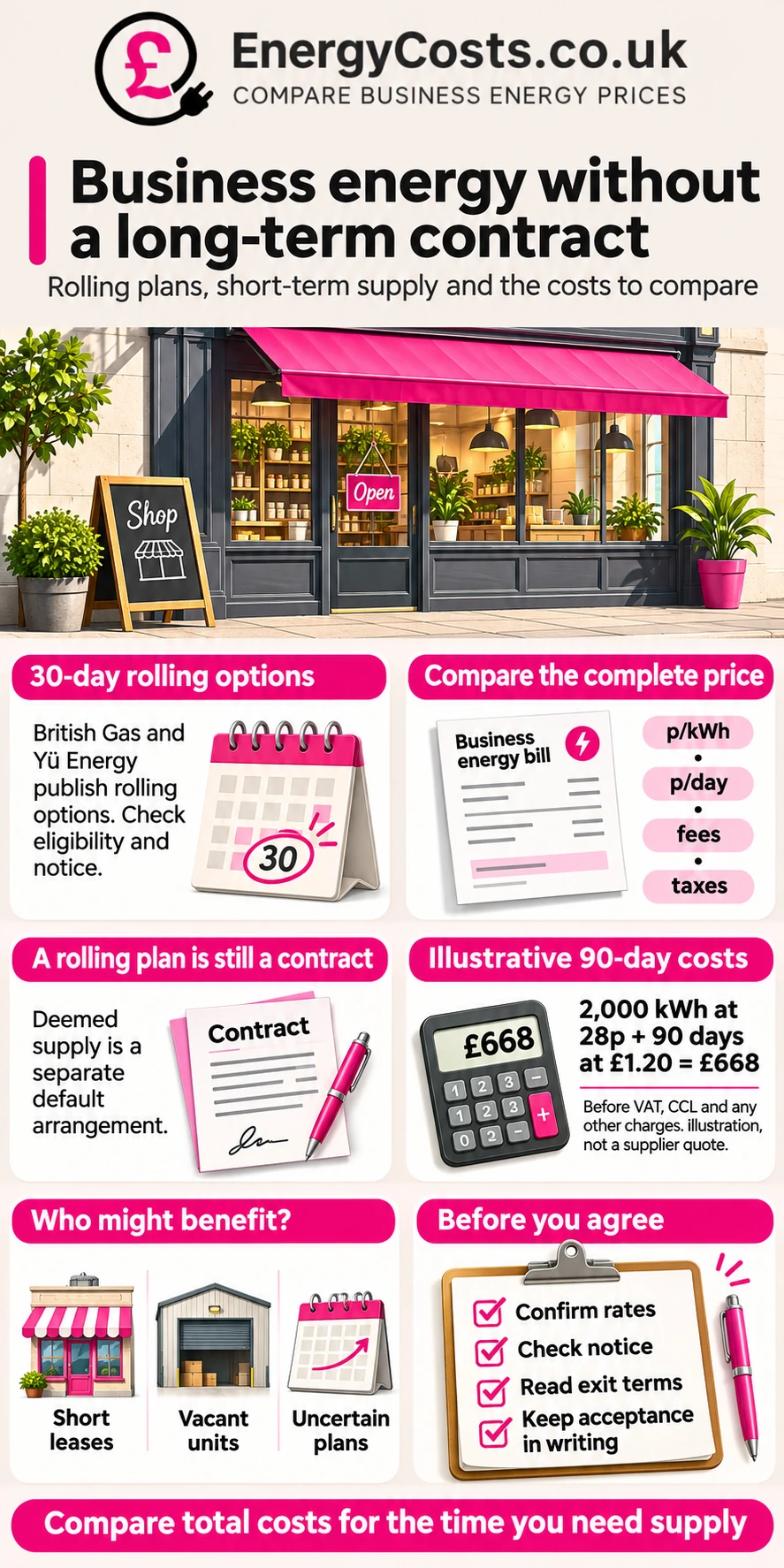
You can buy business gas or electricity without committing to a multi-year fixed tariff. A deliberately chosen rolling agreement can suit a short lease, an empty commercial property, a temporary trading location or a business whose plans are uncertain. The important comparison is the complete cost for the period you expect to need supply.
However, ‘no contract business energy’ is a misleading description. A rolling tariff is still an agreement, and using energy without expressly agreeing a tariff can create a deemed contract. Check the notice period, pricing terms, payment requirements and change-of-occupier provisions before accepting an offer.
Short-term business energy at a glance
| Option | What you agree | Main advantage | Main cost risk |
|---|---|---|---|
| Negotiated rolling tariff | An ongoing supply agreement with notice provisions | Ability to leave without a multi-year commitment, subject to terms | Rates and standing charges can change |
| Short fixed agreement | Defined start and end dates | Certainty for the charges actually fixed | Early departure may trigger costs |
| One-year fix | A longer fixed term than a short occupation | Could offer a competitive annual price | The contract can outlast your need for the premises |
| Deemed supply | A default arrangement arising in qualifying circumstances | Supply can continue while you arrange a tariff | Default charges can be expensive |
| Out-of-contract supply | Terms applying after an agreed contract ends | Time to arrange the next agreement | High ongoing costs while you delay |
For a longer comparison, see our guide to business energy contract lengths. A short commitment and a low price are separate features: the most flexible offer does not automatically have the lowest p/kWh.
Which suppliers publish rolling options?
The supplier product pages below were checked on 25 November 2026. They establish that short-notice products exist; they do not establish that every new applicant, meter or empty property will be accepted. Ask for a written quotation for the actual account.
| Supplier and product | Published arrangement | What to ask before applying |
|---|---|---|
| British Gas: 30 day Rolling Energy Plan | Marketed on its commercial-landlord page as a short-term option with 30 days’ written notice | Availability for your business, current rates, notice procedure and price-change terms |
| Yü Energy: Freedom electricity plan | Published 30-day notice arrangement, with rates reviewed periodically | New-customer eligibility, meter coverage, current rate schedule and any account conditions |
| Yü Energy: Freedom gas plan | Published short-notice gas option with periodic price reviews | Eligibility for the supply point and how switching notice is handled |
Sources: British Gas commercial-landlord plans, Yü Energy electricity plans and Yü Energy gas plans. The published pages do not provide a universal negotiated rolling unit rate or standing charge. Obtain both figures rather than treating a default tariff as the price of a rolling product.
Our British Gas review and business energy suppliers guide can help you compare the wider supply options.
How much does short-term business electricity cost?
Calculate the cost using your expected consumption and the exact number of chargeable days. For a simple single-rate supply, the starting calculation is: electricity cost = kWh × unit rate in pounds + days × daily standing charge. Add separately quoted metering, capacity, network or service costs, then apply the relevant taxes.
The following figures are illustrative comparison inputs, not supplier quotations, market averages or promises of available prices. They show why both the daily charge and unit rate matter. All figures exclude VAT, Climate Change Levy and other charges.
| Illustrative arrangement | Unit rate | Standing charge | Cost for 2,000kWh over 90 days |
|---|---|---|---|
| Rolling offer A | 28p/kWh | 120p/day | £668 |
| Rolling offer B | 30p/kWh | 60p/day | £654 |
| Default-rate comparison | 40p/kWh | 200p/day | £980 |
Offer B costs £14 less than A despite its higher unit rate. Against the illustrative default comparison, A saves £312 and B saves £326 over the same 90 days. These are arithmetic differences between the stated inputs, not measured customer savings.
For 20,000kWh over 90 days, the same rates produce £5,708 for A and £6,054 for B. The preferred offer changes as consumption rises. A busy workshop and an empty shop should therefore not rank tariffs using the same assumption.
Work out the break-even consumption
In the comparison above, A charges 2p/kWh less but 60p/day more. Over 90 days, A has £54 of additional standing charges. Divide £54 by £0.02 to find the break-even point: 2,700kWh.
Below 2,700kWh, B is cheaper on the stated charges. Above 2,700kWh, A is cheaper. This calculation is especially useful for seasonal premises, storage units, vacant properties and businesses with irregular opening hours. If either offer has extra fees, include those before calculating the threshold.
Our guide to business energy with no standing charge explains the same trade-off. A zero daily charge can be useful, but the total price still depends on the unit rate and eligibility.
Short-term business gas costs
Gas should be compared separately. A cheap electricity arrangement does not establish that the same supplier offers the best short-term gas price, and the two fuel contracts can have different notice terms. Use forecast gas consumption for the actual season: an annual average can significantly understate a winter occupation.
| Illustrative 90-day gas comparison | Unit rate | Standing charge | Consumption | Cost before taxes and extras |
|---|---|---|---|---|
| Offer A | 8p/kWh | 100p/day | 5,000kWh | £490 |
| Offer B | 9p/kWh | 50p/day | 5,000kWh | £495 |
| Offer A, low use | 8p/kWh | 100p/day | 1,000kWh | £170 |
| Offer B, low use | 9p/kWh | 50p/day | 1,000kWh | £135 |
The £5 difference at higher usage becomes a £35 advantage for B at lower usage. These are examples only. Compare actual business gas prices using the correct meter and consumption details.
What does 30 days’ notice actually mean?
It normally describes the notice you must give under the agreement; it is not a guarantee that every application can start or finish within 30 days. Registration, meter details, the current contract and any objection all need resolving. Ask the supplier for the earliest valid end date and confirmation that your written notice has been received.
Check whether notice must be sent through a specified email address, customer portal or postal address. Keep a copy, an acknowledgement and the proposed transfer date. Cancelling a Direct Debit does not terminate the supply contract or settle the final account.
Ofgem’s business switching guidance recommends checking your existing contract’s switching, notice and exit provisions. Our guide to blocked business energy switches explains how to investigate a failed transfer.
A rolling plan is different from deemed supply
A negotiated rolling agreement is something you choose and accept. A deemed arrangement can arise when energy is used without an expressly agreed supply contract in the relevant circumstances. An agreed contract that later moves to out-of-contract prices is not automatically a deemed contract.
That distinction affects the applicable terms and protections. Ask the supplier to identify the legal and contractual basis for the account, provide the tariff schedule and explain any notice requirement it says applies. Do not assume that every bill labelled ‘variable’ has identical switching rules.
Read our deemed business energy contracts guide if you have recently taken over a premises and have not agreed prices.
Can you take a one-year fix for a three-month tenancy?
Possibly, but do not assume the contract ends without cost when the lease ends. Before accepting, ask how the supplier treats a genuine change of occupancy, what evidence it requires, and whether the agreement contains continuing liabilities, termination charges or transfer provisions.
For example, an illustrative fixed offer might save £90 over three months compared with a rolling tariff. If leaving it would cost £400, the apparent saving disappears. The relevant comparison is the short-period energy cost plus any exit liability, rather than the annual rate printed on the quotation.
A contract term can also begin before or end after your intended occupation. Confirm actual dates and separate the date you sign from the date supply starts. Our guide to getting out of a business energy contract explains the issues to examine.
Who should consider a short-term tariff?
- Commercial landlords: covering a gap between tenants while preserving essential systems.
- Pop-up shops: matching procurement to a limited trading period, where a direct supplier account is available.
- Businesses planning a move: avoiding a commitment that could outlast their occupation.
- Companies reviewing demand: allowing time to understand actual consumption before a longer purchase.
- Seasonal premises: balancing flexibility with the charges payable outside trading months.
Serviced offices, markets and shared buildings may have landlord or operator billing rather than a direct energy account. Establish who controls the supply before applying. Our guide to new business energy supplies sets out the starting checks.
What are the disadvantages?
A rolling arrangement can expose the business to price increases, repeated quotation work and a higher initial rate than a longer offer. It also creates a need to monitor supplier notices. A plan that was sensible for a two-month gap may become poor value if you leave it running for two years.
Set a review date when you agree the tariff. Record when the lease decision, sale, refurbishment or new tenancy is expected. Review both the continued need for flexibility and the latest complete fixed quotations at that point.
Taxes, metering and other charges
Keep supplier comparison figures on the same tax basis. Depending on use and eligibility, the bill may include VAT and CCL; smaller or qualifying supplies can be treated differently. See our business energy VAT guide and CCL rates and exemptions for the current checks.
Half-hourly sites can also have metering, capacity or pass-through costs. A headline 28p/kWh offer excluding those components is not directly comparable with an inclusive offer. Use your business energy bill to identify existing charges before seeking replacements.
Short-term quotation checklist
- Confirm the legal customer, site address and who is responsible for each meter.
- Record the MPAN or MPRN, meter type and expected start date.
- Forecast consumption for the actual period, including seasonal heating.
- Obtain unit rates, standing charges and all additional fees in writing.
- Confirm whether prices can change and how notice of a change is given.
- Read notice, switching and change-of-occupier provisions.
- Compare the complete cost over the same number of days.
- Check credit, deposit, payment and smart-meter conditions.
- Retain the accepted terms and supplier acknowledgement.
- Set a review date before the temporary arrangement becomes permanent.
Frequently asked questions
Using energy normally creates obligations under an agreed or deemed arrangement. What businesses usually mean is energy without a long fixed commitment. A rolling product can provide that flexibility, but it still has prices, payment terms and a procedure for leaving. Confirm those terms before accepting.
British Gas publishes a 30-day rolling option for commercial landlords, and Yü Energy describes Freedom plans for electricity and gas with 30-day notice. Availability, eligibility and prices must be confirmed for the actual customer and meter. A published product description is not an acceptance guarantee.
Not necessarily. They may cost more per unit than a longer fixed offer while reducing the risk of an unsuitable commitment. Compare unit rates, daily charges, extras and any exit costs over your intended occupation. Low-use premises can be particularly sensitive to standing charges.
No. Notice is a contractual requirement, while the transfer also depends on the current agreement, meter records and registration. Ask for the earliest permitted end date and a confirmed transfer date. Retain evidence that notice was received and investigate any registration failure promptly.
Yes, where the supplier offers an eligible product. It may suit a short lease, vacant unit or uncertain operating plan. Set a review date and compare longer offers once your plans become clearer. Check whether moving to another tariff requires a new acceptance or other conditions.
No. Compare each supply separately and check the dates and notice requirements for both. You might prefer a rolling gas agreement and fixed electricity, or the reverse. Matching terms simplifies administration, but suitability and complete costs should determine the choice.
No. Deemed supply can arise without an expressly agreed supply contract in qualifying circumstances. A negotiated rolling tariff is deliberately accepted. The prices, terms and applicable protections can differ. Ask the supplier to identify your current arrangement rather than assuming every variable account works the same way.
Stopping a payment instruction does not end an energy contract or remove the charges owed. Give notice through the agreed process, confirm the final supply date and arrange the final bill. Keep payment arrangements in place as appropriate while resolving any billing disagreement with the supplier.
Compare business energy quotes using the period you actually need supply, then choose the most suitable combination of complete price, flexibility and contract terms.