
Salons are steady but often high energy users due to the regular use of hairdryers, styling tools, heated water, lighting, air conditioning, and washing equipment.
Styling tools, lighting, hot water, laundry and environmental systems can create substantial electrical demand. The fuel split depends on the installed heating and hot-water systems as well as opening hours and appointments.
This guide uses explicit salon energy scenarios and worked calculations to show how usage, appliance input and contract charges affect the budget across hair, beauty and spa services.
Modelled monthly energy costs for salon businesses
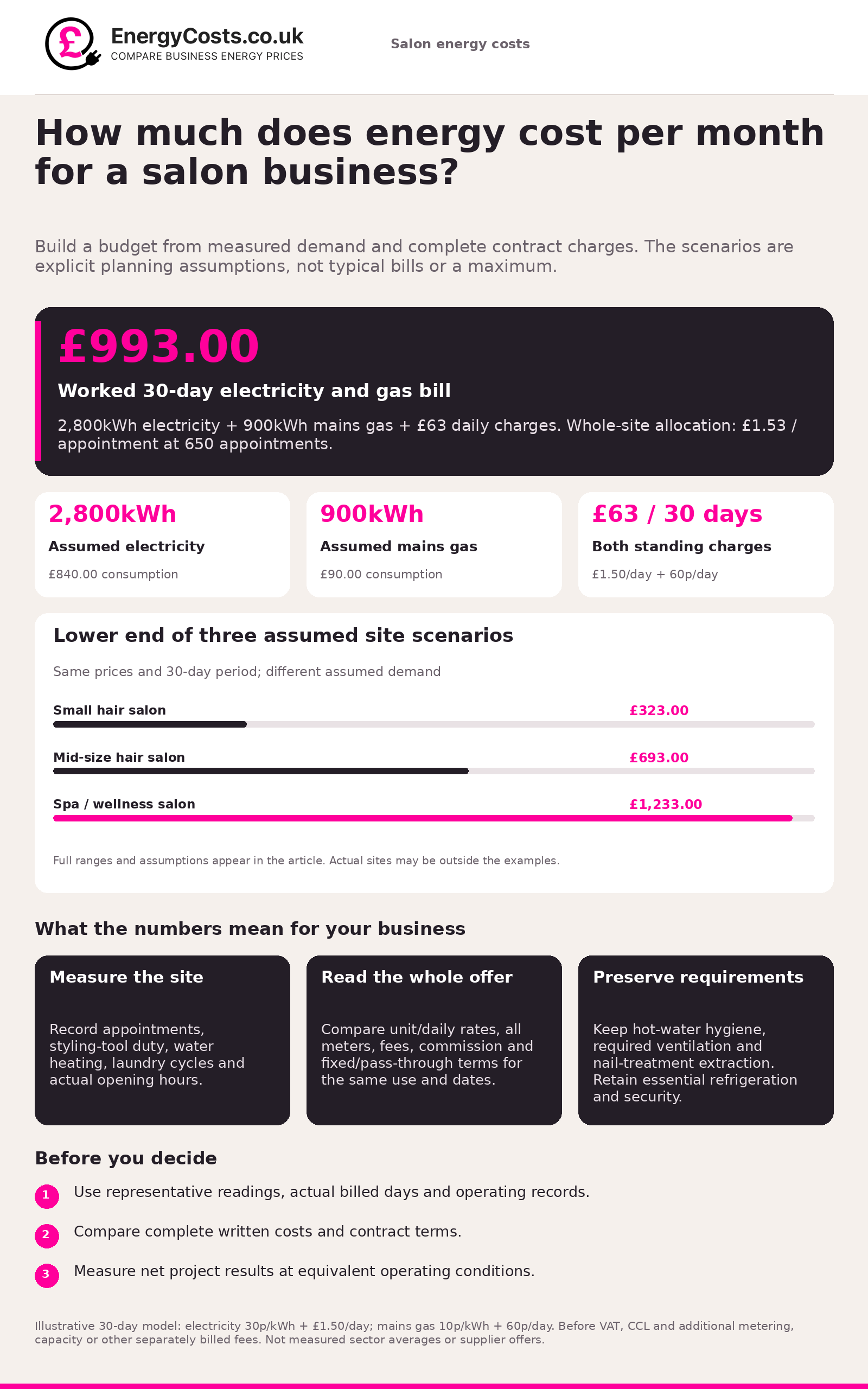
The salon scenarios below are planning assumptions, not a survey of typical bills. Chairs, bookings, opening hours, hot-water strategy and equipment determine actual use. At the stated prices, the illustrated combined bills span £323–£2,613 for 30 days; premises outside these assumptions may cost more or less.
Assumed 30-day energy scenarios by salon type
| Assumed site scenario | Electricity kWh/30 days | Mains gas kWh/30 days | Electricity model cost | Gas model cost | Combined 30-day model |
|---|---|---|---|---|---|
| Small boutique hair salon (1–3 chairs) | 800–2,000 | 200–800 | £285.00–£645.00 | £38.00–£98.00 | £323.00–£743.00 |
| Mid-size hair salon (4–8 chairs) | 2,000–4,500 | 300–1,200 | £645.00–£1,395.00 | £48.00–£138.00 | £693.00–£1,533.00 |
| Beauty salon / nail studio | 1,200–3,500 | 200–700 | £405.00–£1,095.00 | £38.00–£88.00 | £443.00–£1,183.00 |
| Barber shop (3–6 chairs) | 1,500–3,000 | 100–600 | £495.00–£945.00 | £28.00–£78.00 | £523.00–£1,023.00 |
| Spa or wellness salon | 3,500–7,500 | 1,200–3,000 | £1,095.00–£2,295.00 | £138.00–£318.00 | £1,233.00–£2,613.00 |
Prices and assumptions used in this cost model
The cost models on this page use a 30-day month, electricity at 30p/kWh plus £1.50/day and gas at 10p/kWh plus 60p/day. These are rounded planning inputs near November 2026 published quote observations, held constant to isolate the effect of consumption. They are not supplier offers or measured sector averages. Totals exclude VAT, CCL, additional metering/capacity charges and other separately billed items; add only the items applicable to the site.
For context, November 2026 published supplier-panel observations are available for business electricity and business gas. These observations cover 1–9 November, include the publisher’s maximum commission and are not sector averages or a quote for this site.
Use kWh × p/kWh ÷ 100 plus charged days × p/day ÷ 100 for each fuel and meter. Apply every time band separately. The model’s daily charges total £63 over 30 days; actual charged days, daily charges, additional meters and separately billed services can differ.
Actual offers depend on meter details, load shape, annual use, credit, start date and term. Check whether network, policy, metering and broker costs are included, fixed, passed through or reconciled later. A fixed unit rate does not fix consumption or every component of the bill.
Standard business supplies normally attract 20% VAT. Small-quantity and other qualifying supplies have different treatment: during 1 October 2026–30 June 2027, qualifying electricity in Great Britain is temporarily zero-rated; qualifying electricity in Northern Ireland and qualifying gas remain at 5%. The small-quantity tests are applied separately to each fuel and billing supply, not simply to a combined annual bill. Check HMRC’s fuel and power guidance.
The main CCL rate is 0.801p/kWh for electricity and gas from 1 April 2026 to 31 March 2027. Add it only to taxable consumption and only if it is not already included. Small-quantity supplies can be exempt; a renewable tariff alone does not remove CCL.
Where salons use the most energy
Salons rely on consistent electricity use across multiple appliance types.
| Equipment or activity | What to measure | Interpretation |
|---|---|---|
| Styling tools | Electrical input, active minutes and simultaneous use | Use each model’s rating; heating tools cycle on and off. |
| Water heating | Fuel, hot-water volume, temperature controls and storage losses | Preserve hygiene and safe hot-water management. |
| Task/display lighting | Installed input and lit hours | Maintain suitable illumination for treatments and safe work. |
| Heating, cooling and ventilation | Hours, controls, outdoor conditions and required extraction | Nail-treatment extraction and ventilation can be essential. |
| Laundry | Cycles, load mass and programme | Meet hygiene and manufacturer requirements. |
| Reception, POS and security | Active and overnight readings | Keep required security, refrigeration and IT running. |
Impact of salon type on energy use
Different types of salon businesses have unique energy profiles.
| Equipment or activity | What to measure | Interpretation |
|---|---|---|
| Hair salons | Dryers, basins, laundry and ventilation | Cost depends on appointments, equipment and heat source. |
| Nail studios | Task lighting, treatment tools and extraction | Required extraction must continue during relevant work. |
| Barber shops | Tools, lighting, hot water and heating | Lower hot-water demand is not guaranteed at every shop. |
| Beauty salons | Treatment devices, beds, steamers and hot water | Compare actual devices and booked hours. |
| Spa and wellness | Pools, tubs, steam rooms, laundry and climate systems | Specialist water treatment and safety loads can run outside appointments. |
Spa facilities can add substantial heating, pumping, ventilation and laundry loads, but there is no universal percentage premium over a hair salon. Measure each facility and include it once in the site total.
Electricity vs gas use in salons
| Salon type | Electricity to check | Heating/hot-water fuel |
|---|---|---|
| Hair salon | Styling tools, lighting, laundry and controls | May be electric or mains gas; check the installation. |
| Barber shop | Tools, lighting, ventilation and reception | Depends on the building and water system. |
| Nail / beauty salon | Treatment equipment and required extraction | Can be electric or gas; do not infer fuel from business type. |
| Spa salon | Pumps, laundry, treatment and environmental systems | Fuel mix depends on plant and facilities. |
The electricity share is site-specific. In the worked example below it is £885 out of £993, including the electricity standing charge; that example does not establish a sector-wide fuel split.
An illustrative daily usage profile
Salons often run high energy loads throughout the working day:
- 08:00–09:30: Water heating, laundry, lights and HVAC begin
- 10:00–14:00: Styling tools and hot water in peak use
- 14:00–17:00: Consistent use of dryers, radiators, lighting
- 17:00–19:00: Evening appointments maintain full energy load
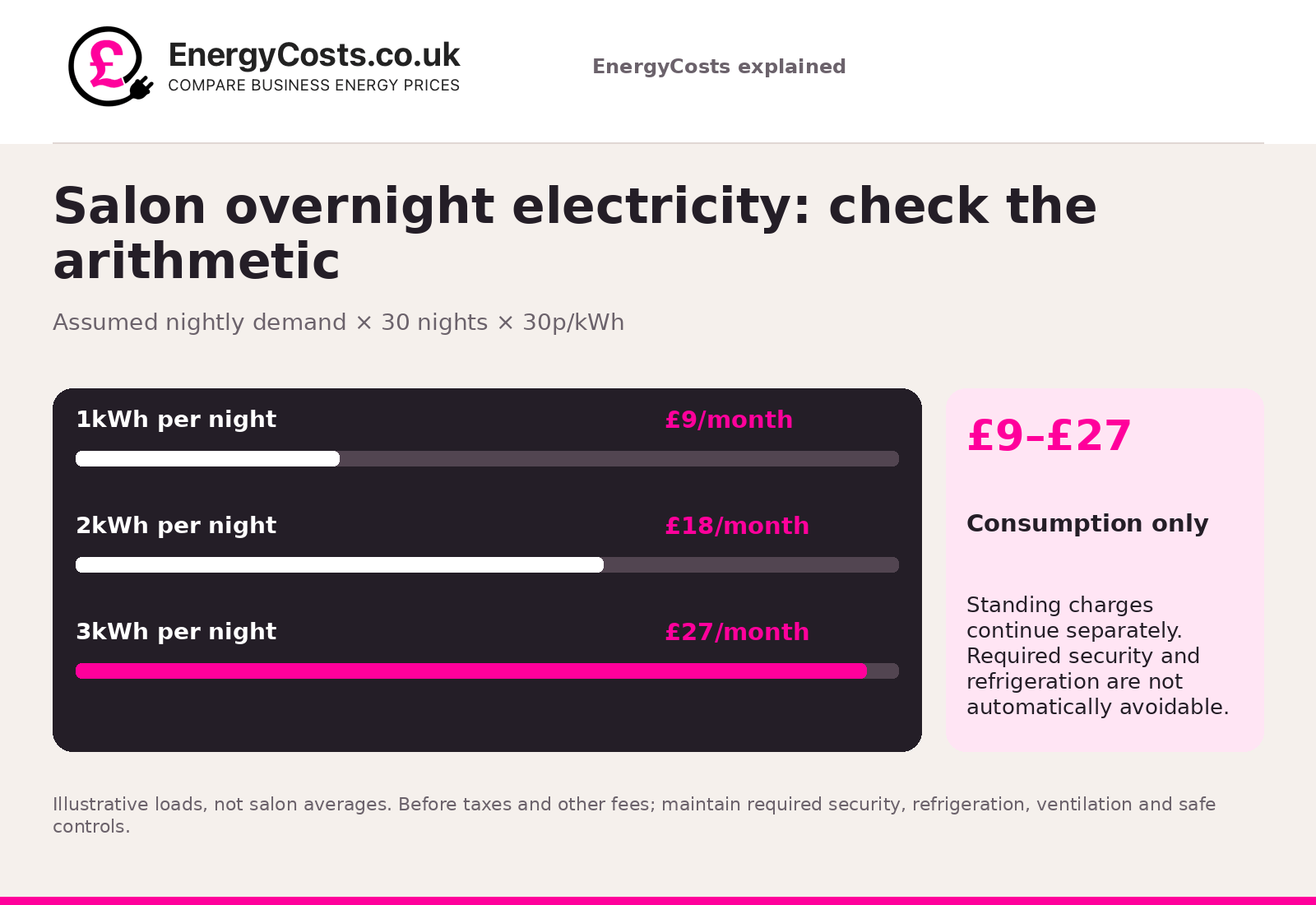
- Overnight: measure the actual baseload. CCTV, security, required refrigeration and some IT may need to remain on; styling tools and other non-essential loads should follow safe shutdown procedures.
For an explicit illustration, 1, 2 or 3kWh per night over 30 nights at 30p/kWh costs £9, £18 or £27 in consumption charges. The standing charge is unchanged. These assumed loads are not salon averages and not all overnight energy is avoidable.
Example equipment energy use
| Illustrative appliance input | Assumed active time | Calculated energy | Cost at 30p/kWh |
|---|---|---|---|
| Hairdryer: 1.5kW | 1 hour | 1.5kWh | £0.45 |
| Straighteners: 0.1kW | 1 hour | 0.1kWh | £0.03 |
| Water heater: 3kW | 1 hour | 3kWh | £0.90 |
| Washer/dryer: 1kW average input | 1 hour | 1kWh | £0.30 |
| UV lamp: 0.05kW | 1 hour | 0.05kWh | £0.02 (rounded) |
| Air conditioning: 1.5kW electrical input | 1 hour | 1.5kWh | £0.45 |
How to calculate your salon’s monthly energy bill
Multiply measured electrical input in kW by operating hours to calculate kWh. The appliance table uses assumed inputs and active times, not representative product specifications. Thermostatic cycling and programme stages can change average demand; use measured kWh where available. Air-conditioner cooling output is different from electrical input.
For the whole site, use actual fuel consumption and every daily charge. Price multiple time bands separately and avoid counting the same water heating or laundry load twice. The following worked bill demonstrates the arithmetic.
Worked example: a 30-day energy bill
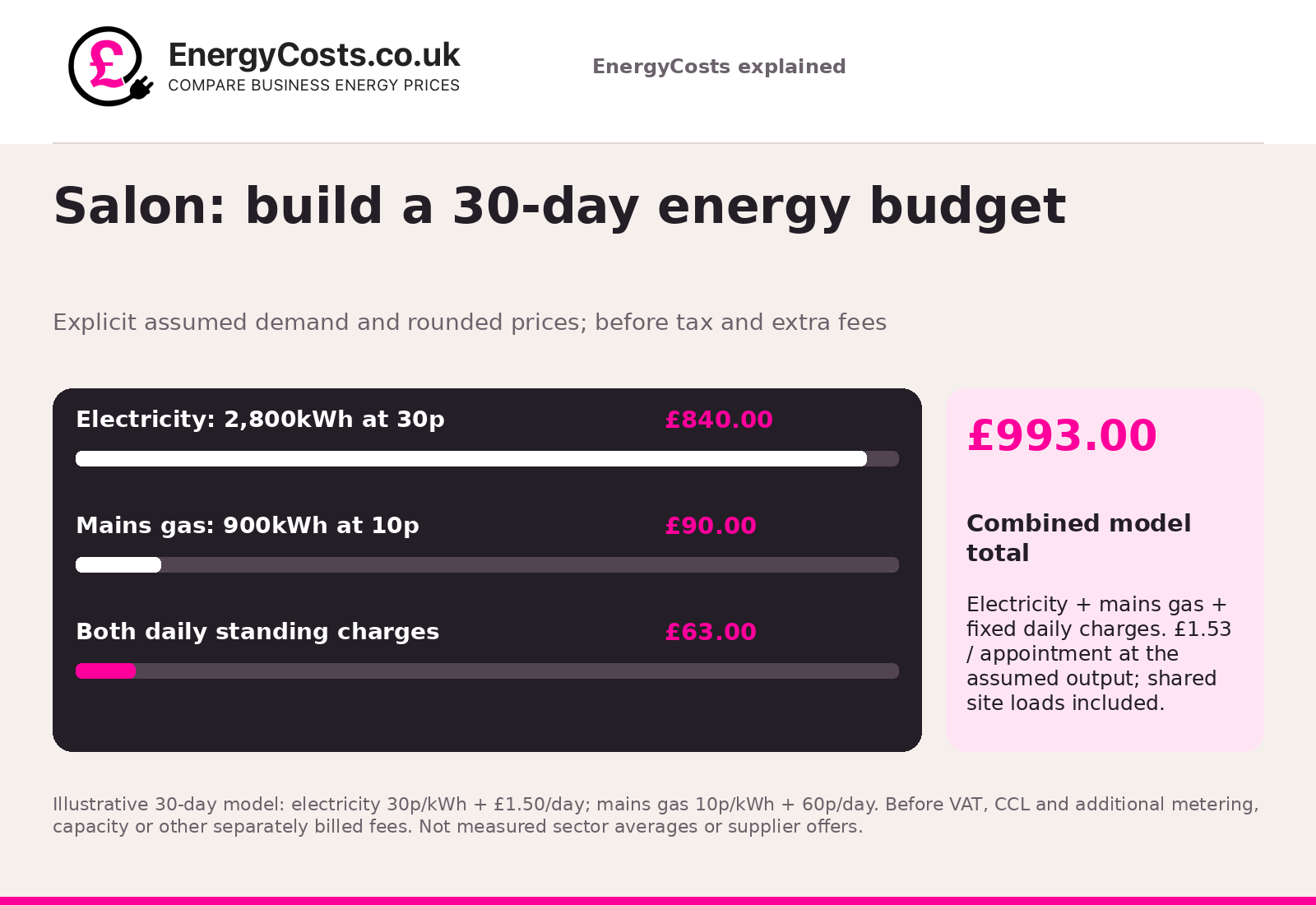
Assume 2,800kWh electricity and 900kWh mains gas in a 30-day month, using the stated model prices. Electricity consumption costs £840.00, gas costs £90.00 and the two standing charges total £63. The combined bill is £993.00 before VAT, CCL and additional fees.
If the same site records an assumed 650 appointments in that period, dividing the whole-site bill by that output gives £1.53 per appointment. This allocates heating, lighting and other shared loads as well as production/service energy; it is not the marginal energy cost of one extra unit of business. Use matching periods and actual output.
Ways salons can reduce energy costs
Prioritise avoidable demand using actual readings and service requirements. Measure savings at comparable appointment volumes and weather; deduct project and maintenance costs rather than assuming a standard percentage.
- Assess LED replacement using lamp input, operating hours and suitable task-lighting quality.
- Switch styling tools off safely between appointments according to manufacturer instructions.
- Review hot-water losses and controls while preserving hygiene and safe storage/distribution temperatures.
- Maintain suitable heating and required ventilation/extraction; avoid blanket shutdowns of safety systems.
- Compare laundry equipment by programme energy, capacity and drying performance for the required hygiene standard.
- Compare complete written energy offers, including daily charges, commission and fixed/pass-through costs.
Summary
The stated salon scenarios give combined 30-day model bills from £323 to £2,613 before VAT, CCL and additional fees. The worked 2,800kWh electricity/900kWh gas example is £993. Actual consumption, facilities, charged days and contract coverage determine the bill; no universal salon average or savings percentage is assumed.
Frequently asked questions
The mid-size hair-salon scenario assumes 2,000–4,500kWh electricity and 300–1,200kWh gas over 30 days. At the stated model prices its combined bill is £693–£1,533, before VAT, CCL and extra fees. These are assumed scenarios, not measured typical bills or supplier quotes.
It depends on the equipment, heating and hot-water system. In the worked example electricity is £885 and mains gas £108, including daily charges. That is one assumed site, not an 80–90% industry rule. An electrically heated salon needs a different fuel model from a gas-heated one.
Spa features can add heat, pumping, ventilation and laundry demand, but there is no universal ranking or percentage premium. The assumed spa scenario here costs £1,233–£2,613 over 30 days before tax and extra fees. Actual pools, tubs, operating hours and required controls can take a site outside that example.
The guide uses explicit scenarios rather than a national average: small hair salons assume 800–2,000kWh and mid-size salons 2,000–4,500kWh over 30 days. Spa examples assume 3,500–7,500kWh. Replace those inputs with actual readings, equipment duty and opening hours to budget for the business.
For an assumed 1.5kW hairdryer used for one active hour, energy is 1.5kWh and costs 45p at 30p/kWh. An assumed 0.1kW straightener uses 0.1kWh and costs 3p. These are calculation inputs, not standard appliance ratings; cycling and actual models affect consumption.
Hot water can be an important load for basins, laundry and spa services. Its share depends on volume, heat source, storage losses and operating pattern, rather than a fixed sector percentage. Review efficient controls and losses without weakening hygiene or safe hot-water storage and distribution requirements.
Longer hours can increase lighting, heating, ventilation and equipment demand, but the result depends on appointments and what remains active. There is no universal premium over retail premises. Compare meter readings against opening hours, output and weather, retaining required continuous security, IT and refrigeration loads.
Assuming 1–3kWh per night for 30 nights at 30p/kWh gives £9–£27 in consumption charges. These are illustrative inputs, not a measured average. Standing charges continue separately, and required CCTV, refrigeration and other essential loads are not automatically waste that can be switched off.
Identify avoidable demand from readings, maintain equipment and use safe tool shutdown, lighting controls and appropriate heating schedules. Preserve hygiene, hot-water management and required nail-treatment ventilation or extraction. Establish a comparable baseline before claiming a saving; there is no guaranteed 10–20% reduction for every salon.
A different supplier or renewal offer can be cheaper, but compare complete costs for the same demand, dates and coverage. Include standing charges, commission, metering and any exit liability. A fixed agreement protects specified prices, not every charge or the amount used; savings are not guaranteed.