
Composite Energy was an unconventional-gas developer associated with coal-bed methane projects. Its exploration and development activities should not be confused with selling a retail gas or electricity tariff to UK businesses.
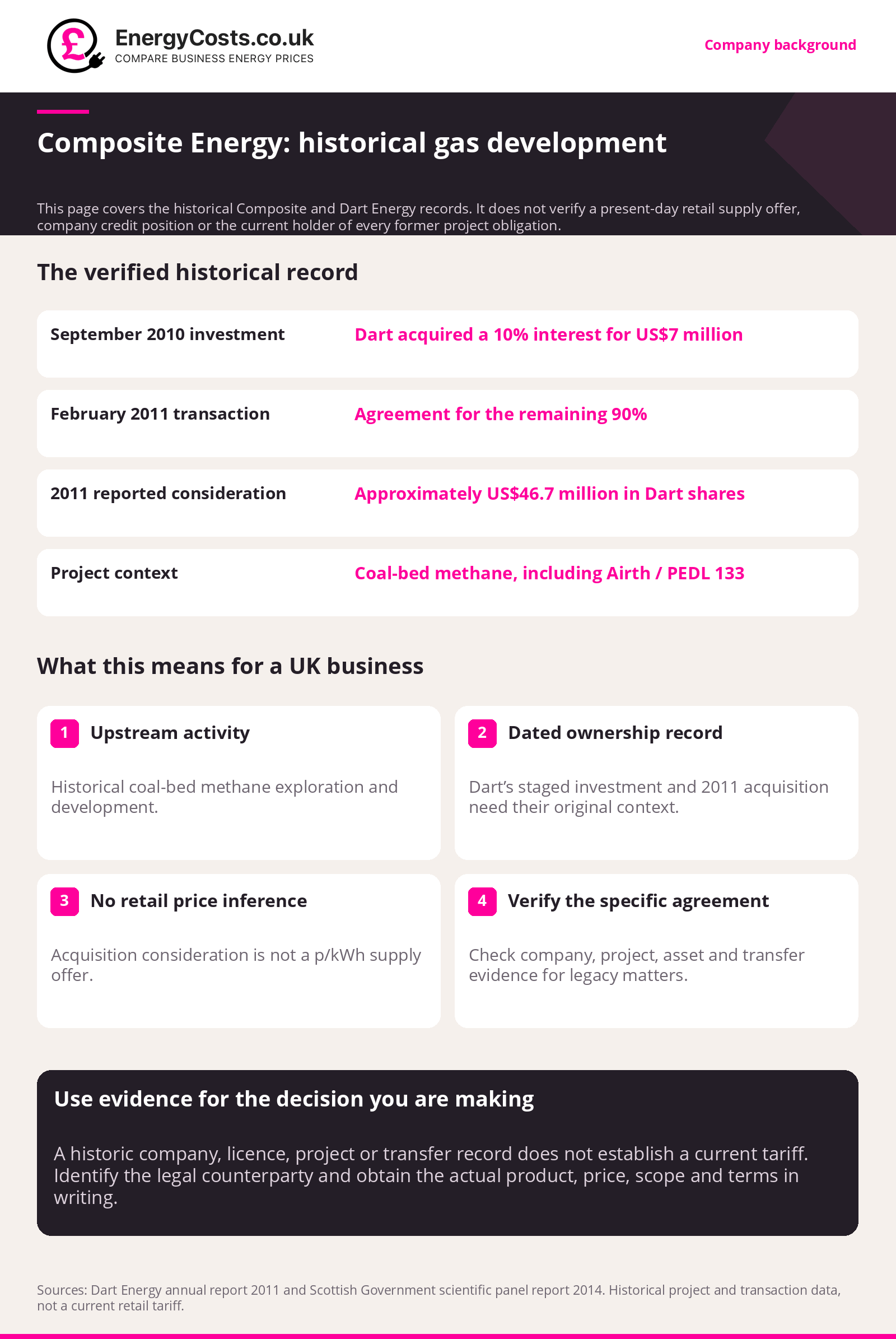
This page covers the historical Composite and Dart Energy records. It does not verify a present-day retail supply offer, company credit position or the current holder of every former project obligation.
Key facts and dates
| Record | Verified detail and scope |
|---|---|
| September 2010 investment | Dart acquired a 10% interest for US$7 million |
| February 2011 transaction | Agreement for the remaining 90% |
| 2011 reported consideration | Approximately US$46.7 million in Dart shares |
| Project context | Coal-bed methane, including Airth / PEDL 133 |
Dart’s 2011 annual report records the staged investment and acquisition. The Scottish Government’s 2014 scientific panel report describes the historical Composite/Dart project and licence context.
What did Composite do?
Coal-bed methane development involves investigating and potentially extracting gas associated with coal seams. That is an upstream resource activity, not the same business model as supplying a shop, office or factory through an ordinary retail energy contract.
The Scottish Government report describes the Airth exploration history and pilot activity. Those dated project records should not be treated as a statement about current planning consent, commercial production or present-day retail energy availability.
How to read the acquisition figures
The US$46.7 million figure is reported in the 2011 acquisition record and relates to consideration in Dart shares. It is not a current valuation of the business, a gas sales price or evidence of present financial strength.
An acquisition also does not, by itself, prove that the original company was dissolved or that every contract and liability moved automatically. Verify the legal entity and the particular asset or agreement before drawing that conclusion.
What should a UK business check?
For a legacy project or agreement, retain the company identity, contract, licence or asset reference and any assignment documents. A broad historical company summary cannot establish the party responsible for a specific obligation today.
For a new retail supply contract, compare business electricity and business gas from suppliers able to serve the actual meter. Request the complete price, start date, product, term and legal supplier identity rather than using an exploration company’s historical investment record as a tariff benchmark.