

Utility Warehouse (UW) is one of the UK’s leading multi-service providers, offering a range of utilities, including business energy. In this review, we’ll explore Utility Warehouse business prices, tariff structure, and features to help you determine whether it is the right fit for your business needs.
Utility Warehouse at a glance
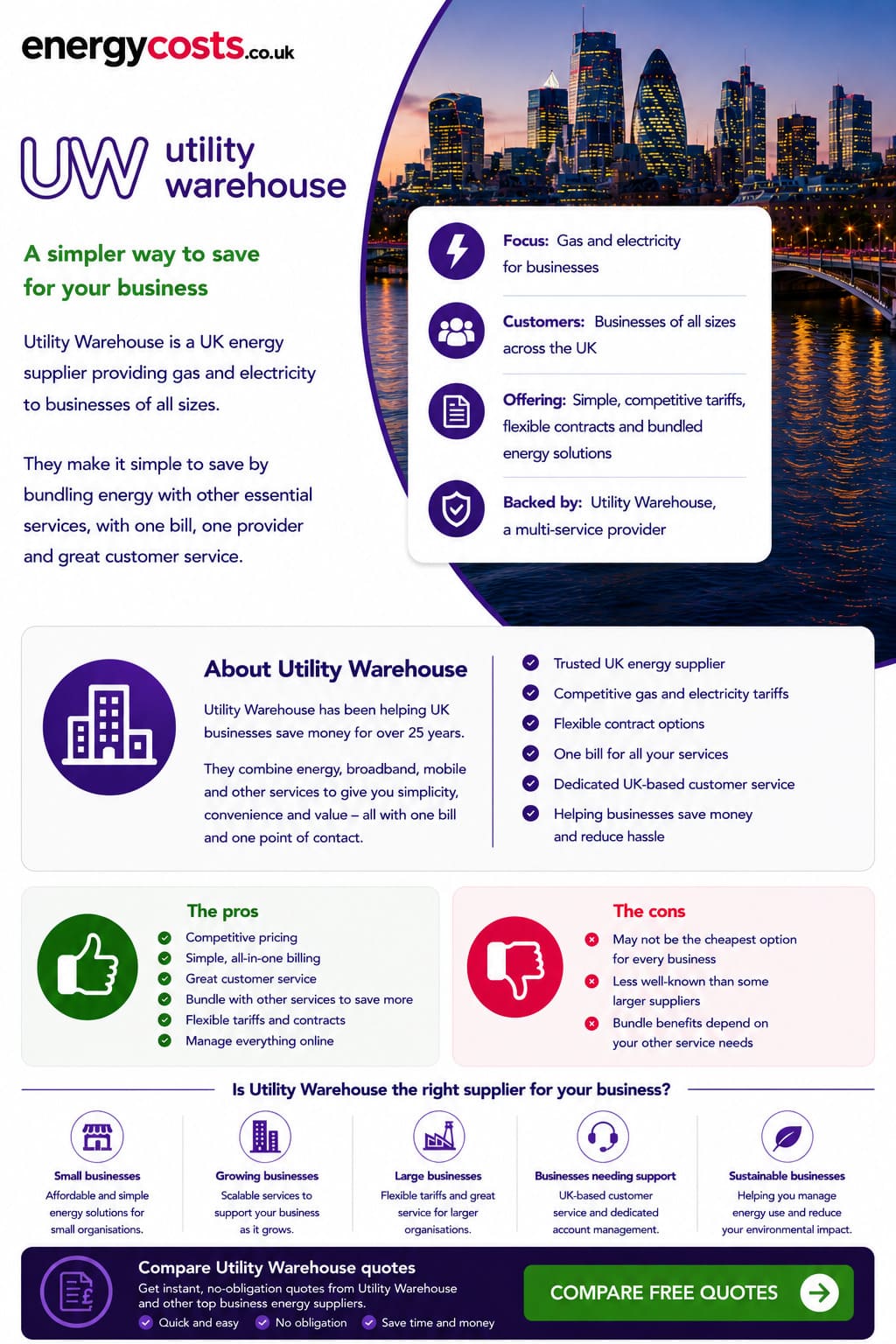
Utility Warehouse (UW) is a multi-utility provider which bundles energy with other services such as broadband, mobile and household utilities. While many businesses recognise UW from the household market, it also offers business energy solutions that can appeal to small enterprises and microbusinesses looking for a simplified, bundled approach to managing costs.
Supplier snapshot:
- Supplier type: Independent multi-utility provider
- Fuel supplied: Electricity and gas (dual fuel)
- Target customers: Microbusinesses and small enterprises
- Tariff types: Fixed and flexible contracts
- Smart metering: Supported
- Customer focus: Bundle convenience and simplicity
An overview of Utility Warehouse for business
Utility Warehouse is known for its unique approach of bundling services together, offering electricity, gas, broadband, and mobile services to both residential and business customers. By combining these services, UW aims to simplify billing and potentially save customers money. The company’s business energy offerings are particularly popular among SMEs, thanks to competitive rates and straightforward tariff options.
Utility Warehouse business energy prices list: commercial rates per kWh
Utility Warehouse’s business energy pricing can vary depending on factors such as location, consumption levels, and contract terms. To provide an indicative overview, I’ve created a table based on typical rates found in the UK market for small to medium-sized businesses. Please note that these rates are approximations and can fluctuate based on market conditions.
| Tariff Type | Electricity Unit Rate (per kWh) | Gas Unit Rate (per kWh) | Standing Charge (per day) |
|---|---|---|---|
| Fixed-rate tariff | 30p – 35p | 9p – 12p | 50p – 75p |
| Variable-rate tariff | 28p – 38p | 8p – 13p | 45p – 80p |
| Green energy tariff | 32p – 37p | 10p – 14p | 55p – 78p |
Notes:
- Electricity unit rate: The cost per kilowatt-hour (kWh) of electricity your business uses.
- Gas unit rate: The cost per kWh of gas consumed.
- Standing charge: A daily charge that covers the cost of supplying energy to your business, regardless of how much you use.
- Prices can vary by region and market conditions, and discounts may apply if services are bundled.
These rates are indicative and meant to give you a general idea of Utility Warehouse’s pricing structure for business customers. For the most accurate and tailored quote, it is recommended to contact Utility Warehouse directly or use our business energy comparison service.
Deemed rates, standing charges and out-of-contract prices
If a business moves into premises already supplied by Utility Warehouse without agreeing a new contract, the supply starts on UW’s deemed contract. If a UW business energy agreement ends and UW remains the registered supplier, the account continues on UW’s Business Energy Out of Contract Tariff until a new agreement is signed or the supply is switched away. UW’s deemed business terms are limited to electricity meters in profile classes 01–04 and gas meters of type U6 or U16.
The benchmark tables below use the current indicative Utility Warehouse business electricity and gas rates shown on EnergyCosts.co.uk’s live comparison pages. They are useful as a baseline for understanding how low standing charges help UW remain competitive for smaller sites, and for showing how much costs can rise if a business drifts onto deemed or out-of-contract pricing.
Utility Warehouse benchmark commercial business rates per kWh and standing charges
| Fuel | Business size / meter group | Indicative unit rate | Standing charge | Annual standing charge equivalent |
|---|---|---|---|---|
| Electricity | PC 01–04 | 30.5p/kWh | 65p/day | £237.25 |
| Electricity | PC 05–08 | 28.5p/kWh | 140p/day | £511.00 |
| Gas | PC 01–04 | 7.3p/kWh | 85p/day | £310.25 |
| Gas | PC 05–08 | 6.8p/kWh | 160p/day | £584.00 |
The annual standing charge equivalents above are calculated from the daily standing charges shown in the benchmark comparison data.
Illustrative deemed or out-of-contract uplift against UW benchmark pricing
| Fuel | Business size / meter group | Contracted benchmark | If prices were 40% higher | If prices were 80% higher |
|---|---|---|---|---|
| Electricity | PC 01–04 | 30.5p/kWh + 65p/day | 42.7p/kWh + 91p/day | 54.9p/kWh + 117p/day |
| Electricity | PC 05–08 | 28.5p/kWh + 140p/day | 39.9p/kWh + 196p/day | 51.3p/kWh + 252p/day |
| Gas | PC 01–04 | 7.3p/kWh + 85p/day | 10.22p/kWh + 119p/day | 13.14p/kWh + 153p/day |
| Gas | PC 05–08 | 6.8p/kWh + 160p/day | 9.52p/kWh + 224p/day | 12.24p/kWh + 288p/day |
These uplift figures are illustrative rather than published UW tariff figures. They are designed to show the possible effect of rolling off a negotiated deal and onto deemed or out-of-contract pricing, using our current UW benchmark rates as the starting point. Our gas comparison guide states that out-of-contract rates can be up to 80% higher than rates available through comparison, while our electricity guide says deemed and variable contracts are usually much more expensive than negotiated fixed deals.
For microbusinesses and other low-usage sites, the standing charge is often one of the most important figures to compare because it is paid every day regardless of consumption. On the current benchmark figures, UW’s smaller-site standing charges sit at 65p/day for electricity and 85p/day for gas, which is materially lower than many of the higher-cost out-of-contract examples shown elsewhere in the same comparison tables.
Utility Warehouse business energy tariffs
Utility Warehouse provides a range of business energy tariffs tailored to suit various needs. Unlike many providers that offer numerous plans, UW tends to focus on simplicity, providing tariffs that are easy to understand. Here are the key types of tariffs typically available for business customers:
1. Fixed-rate tariffs
A fixed-rate tariff locks in the price per unit of energy for a specified period, usually ranging from one to three years. This type of tariff can be beneficial for businesses looking to secure their energy costs against market fluctuations. Fixed-rate plans offer stability and predictability, which is ideal for budgeting and long-term financial planning.
2. Variable-rate tariffs
Variable-rate tariffs are linked to the wholesale energy market, meaning the price you pay for each unit of energy can go up or down. While this option carries more risk due to the potential for price increases, it can also lead to savings when market rates drop. Variable tariffs are suitable for businesses that can accommodate fluctuations in their energy costs.
3. Green energy tariffs
Utility Warehouse has been increasing its focus on sustainability, offering green energy options that provide electricity generated from renewable sources. This type of tariff is particularly appealing to businesses that are committed to reducing their carbon footprint and enhancing their environmental credentials.
Features and benefits of Utility Warehouse for business
Utility Warehouse’s business tariffs come with a range of features designed to make managing utilities straightforward and cost-effective. Here are some of the most notable benefits of choosing UW for your business energy needs:
1. Simplified billing
One of UW’s key selling points is its consolidated billing. Businesses can receive a single bill that covers multiple services, including energy, broadband, and mobile. This approach not only reduces administrative hassle but can also lead to cost savings when multiple services are bundled together.
2. No exit fees
Utility Warehouse often offers contracts without exit fees, giving businesses the flexibility to switch providers if they find a better deal. This is particularly advantageous in a market where energy prices can fluctuate significantly, allowing companies to adapt their strategy without penalty.
3. Dedicated customer support
Utility Warehouse provides dedicated customer support for its business customers, which can make a significant difference when dealing with energy-related issues or queries. Having a single point of contact can speed up the resolution process and reduce downtime for your business operations.
4. Smart meter installation
Smart meters are a standard feature for Utility Warehouse business customers. These devices allow businesses to monitor their energy consumption in real-time, helping to identify areas where they can reduce usage and cut costs. Smart meters also ensure more accurate billing, as readings are automatically sent to the supplier.
Who Utility Warehouse business energy is likely to suit
Utility Warehouse business energy is best suited to businesses with straightforward, smaller-site meter setups. Under UW’s business terms, the supply is for non-domestic use, and its deemed-contract terms say it can only supply electricity to profile class 01, 02, 03 or 04 meters, and gas to properties with U6 or U16 gas meters. That means many small shops, offices, cafés and other microbusiness premises are more likely to fit the supply criteria than larger or more complex sites.
If your premises uses a meter type outside those categories, or if the meter type changes after the supply starts, Utility Warehouse says it may increase the price you pay to reflect any increase in its own costs. For businesses comparing suppliers, that makes meter type and site setup one of the first checks to make before requesting a quote.
Who actually supplies your business energy?
For business energy, the underlying electricity supplier is Electricity Plus Supply Limited and the underlying gas supplier is Gas Plus Supply Limited. Utility Warehouse Limited acts as the agent responsible for registration, management, billing and administration on behalf of those companies, and business energy bills are issued by Utility Warehouse on their behalf.
This matters because many businesses recognise the Utility Warehouse brand first, but the legal supply arrangements sit behind that brand structure. For readers comparing terms, billing responsibility and supplier identity, it is useful to know exactly which companies sit behind the contract.
How Utility Warehouse business billing works
Utility Warehouse says business energy bills are produced monthly unless otherwise agreed, excluding prepayment meters. Bills can be based on actual readings provided by the customer, collected by a meter reader, or taken remotely from a smart meter. If no actual reading is available, UW says it will calculate a reasonable estimate of usage and then use a later accurate reading to correct future billing where appropriate.
UW’s deemed-contract terms also say it will not normally include charges for energy supplied more than 12 months before the date of the relevant bill, subject to specific exceptions. That gives business customers a clearer idea of how estimated bills, corrected bills and older charges are handled.
Switching to Utility Warehouse
If Utility Warehouse is taking over your business energy supply from another supplier, it says it will aim to complete the transfer as soon as reasonably practicable and in any event within five Working Days of the date you enter into the energy agreement. Delays can still happen if you ask to postpone the switch, change your mind, your current supplier objects, you have not provided enough information, or something outside UW’s control prevents the transfer.
For businesses that want a fast, low-friction switch, that five-Working-Day target is one of the most practical details to know. It gives a more concrete expectation than a general promise of a quick or simple transfer.
Leaving Utility Warehouse
If you plan to vacate your premises, Utility Warehouse says you must give at least two Working Days’ notice. If you do not, you can remain liable for energy used until either a new occupier or supplier takes over, or the end of the second Working Day after you inform UW that you have left.
If you simply want to end the agreement, UW says you can terminate at any time by giving 28 days’ notice in writing, unless you are on a fixed-term tariff with its own specific rules. If you switch to a new supplier, UW says it will take all reasonable steps to send your final bill within six weeks of the switch being completed.
Businesses should also be aware that UW may ask for a closing meter reading when the agreement ends. If you do not provide an accurate reading, the final bill may be estimated, and any credit can be withheld until an actual reading is received. UW’s business terms also state that you may have to pay an exit fee if one applies to your agreement or tariff.
UW also says it may object to a switch away if there is an overdue amount on the account that is not in valid dispute, if the proposed switch was a mistake, or if related meters at the property are not all being switched on the same day.
Smart meters and readings
Smart meter installation for business customers is at Utility Warehouse’s discretion and is subject to technical or physical constraints at the property. Where a smart meter is installed, UW says it can collect readings remotely at the frequency notified to the customer, and it may also take additional reads when needed for operational reasons, including when a tariff changes or when the customer switches supplier.
That can be useful for businesses that want less manual meter administration and fewer estimated bills, but it also means smart meter availability is not guaranteed for every site.
Business customer service and complaints
Existing UW for Business customers with customer service queries are directed by Utility Warehouse to call 0344 815 0506. UW’s published complaints guidance also says it aims to resolve complaints made by phone within one working day, while written complaints are targeted for resolution by 5pm on the next working day.
For business owners comparing suppliers on service as well as price, that gives a clearer picture of how Utility Warehouse structures support once the account is live.
Key points to know before taking a quote
Before requesting a Utility Warehouse business quote, it is worth checking your electricity profile class, your gas meter type, whether your premises has a simple single-site setup, and whether you may need an accurate closing read from your current supplier before switching. Those practical details affect eligibility, billing accuracy and how smooth the transfer process is likely to be.
For smaller businesses that want monthly billing, a relatively straightforward switching process and a bundled utility brand, Utility Warehouse may be a sensible option. For more complex sites, unusual metering arrangements or businesses that want broader tariff choice, it is worth checking the contract details carefully before proceeding.
Fuel mix and sustainability credentials
Environmental performance is a key part of many business energy decisions. Utility Warehouse provides transparent information on how it sources energy and supports renewable procurement.
Renewable electricity matching
Utility Warehouse supplies electricity backed by Renewable Energy Guarantees of Origin (REGOs). REGOs certify that the equivalent amount of electricity purchased by a customer has been generated from renewable sources such as wind, solar and hydro. For businesses reporting on Scope 2 emissions, this renewable matching helps demonstrate a link to clean generation.
Carbon intensity and reporting
While electricity physically comes from the UK grid, REGO-matched tariffs allow businesses to associate their consumption with renewable generation on paper, which supports sustainability reporting and ESG commitments.
Green options and energy-efficiency support
Utility Warehouse offers tariffs with a renewable focus, and the bundled nature of its services often includes tools and guidance for better energy usage visibility. This can help small businesses manage consumption more effectively and reduce waste.
Utility Warehouse fuel mix disclosure
Utility Warehouse publishes a fuel mix disclosure showing the source of the electricity it supplies. The latest published breakdown surfaced in UW’s disclosure shows the following mix.
| Fuel source | Share |
|---|---|
| Coal | 15% |
| Gas | 75% |
| Nuclear | 4% |
| Renewable | 0.3% |
| Other | 6% |
Source: Utility Warehouse fuel mix disclosure.
Utility Warehouse customer service and reliability insights
Service quality and reliability are important factors for business energy customers. Utility Warehouse combines multi-utility account management with dedicated support channels for business energy, which can simplify administration for small teams.
Business energy support
Utility Warehouse provides dedicated contact points for energy queries, online account management tools and support for billing, contract renewals, meter readings and tariff questions. These services aim to streamline energy management alongside other utilities.
Independent satisfaction and comparison data
While Utility Warehouse is often featured in household energy customer satisfaction surveys, independent business energy service performance indicators — such as Ofgem complaint metrics and third-party review platforms — give insight into how the supplier performs relative to competitors. Smaller, bundled suppliers often score well on communication and clarity, but ratings can vary depending on business expectations and complexity.
Service transparency and escalation
Utility Warehouse adheres to industry standards for complaints handling and publishes information on how issues are escalated and resolved. Clear escalation paths and published service commitments help give businesses confidence that support is available if issues arise.
How competitive are Utility Warehouse business prices?
While Utility Warehouse does not always promote the lowest energy rates in the market, its prices are competitive when considering the additional features and benefits it provides. The company often positions itself as a value-for-money provider rather than a budget option, emphasising service quality and long-term savings.
Bundling for additional savings
One of the most significant ways businesses can save with Utility Warehouse is through its bundling options. By combining services like gas, electricity, broadband, and mobile, companies can access discounted rates that aren’t available when services are purchased individually. This approach can lead to substantial savings, particularly for small to medium-sized enterprises that rely on multiple utility services.
Pros and cons of Utility Warehouse business energy
Here is a quick breakdown of the advantages and disadvantages of choosing Utility Warehouse for your business energy needs:
Pros
- Simplified billing: One bill for multiple services reduces administrative work.
- Flexible contracts: Many tariffs come with no exit fees, offering greater flexibility.
- Dedicated customer service: Business customers receive priority support.
- Bundling discounts: Combining utilities can lead to significant cost savings.
- Green energy options: Supports businesses looking to reduce their environmental impact.
Cons
- Not the cheapest provider: Utility Warehouse may not always have the lowest rates compared to budget energy suppliers.
- Limited tariff options: Fewer tariff choices may not suit every business’s energy consumption needs.
- Bundling required for maximum savings: The best deals often require committing to multiple services.
Is Utility Warehouse the right choice for your business?
Utility Warehouse is an excellent choice for businesses that value simplicity, excellent customer service, and the convenience of bundling multiple services into one bill. While it might not always be the cheapest option on the market, its competitive rates, flexible contracts, and added features make it a strong contender for small to medium-sized enterprises looking for reliable energy solutions.
For businesses particularly focused on sustainability, UW’s green energy tariffs can be an attractive option. Additionally, the flexibility of no exit fees means you can easily adapt if your business’s energy needs change.
Final thoughts: Utility Warehouse business prices review
UW’s business tariffs offer a balanced mix of competitive pricing, simplicity, and comprehensive support. For SMEs that appreciate a streamlined approach to managing their utilities, Utility Warehouse can be a valuable partner. However, businesses prioritising the absolute lowest rates might want to compare with other suppliers before making a final decision.
When choosing an energy supplier, it’s essential to consider not only the price but also the quality of service, contract flexibility, and the potential for long-term savings. Utility Warehouse delivers on many of these fronts, making it a solid option for many UK businesses.
For more, visit the UW website and see our business gas and electricity comparisons.
FAQ: UW business pricing
Utility Warehouse typically offers a minimum contract term of 12 months for business energy customers. This allows businesses to lock in rates for a year. However, longer contract options are available, which can range from 24 to 36 months, often providing more competitive pricing over extended periods.
Utility Warehouse provides a 5% discount on energy bills for business customers who pay their invoices within 10 days of the issue date. This incentive can be a helpful way to reduce overall costs, especially for businesses that can manage their cash flow efficiently.
Utility Warehouse calculates estimated monthly bills based on average business consumption rates, which for small businesses can be around 2,000 to 3,000 kWh per month for electricity and 3,500 to 4,500 kWh per month for gas. Exact estimates depend on your specific business needs and usage patterns.
If a business customer misses a payment, Utility Warehouse applies a late payment fee of £15. This fee is intended to cover administrative costs associated with processing overdue payments. Repeated late payments may also result in interest charges based on the outstanding balance.
For customers on a variable-rate tariff, Utility Warehouse may charge 5p to 10p more per kWh during peak hours, typically between 4 p.m. and 7 p.m. Businesses with higher energy consumption during these hours might consider a fixed-rate tariff to avoid these increased costs.