
E.ON and British Gas are two of the largest and most established names in the UK business energy market. Both supply gas and electricity to SMEs, offer renewable or zero-carbon electricity products and provide services such as smart meters, energy monitoring, solar panels and electric vehicle charging.
Their business propositions are structured differently.
E.ON Next is the main E.ON brand for small and medium-sized business energy contracts. It offers bespoke fixed tariffs lasting one, two or three years, with 100% renewable-backed electricity included on selected fixed plans. Larger and more complex users may be directed to npower Business Solutions for energy procurement, while E.ON Energy Solutions provides commercial solar, storage, EV charging, heat networks and other infrastructure.
British Gas provides a broader range of energy-supply products under one business brand. Its options include conventional fixed plans, British Gas Lite, a 30-day rolling contract and flexible wholesale purchasing for organisations using more than 1GWh annually. Its qualifying fixed electricity contracts are zero carbon, using renewable and nuclear-backed electricity, while renewable-only electricity and renewable-gas products are also available.
E.ON may be particularly attractive to an SME seeking renewable-backed electricity, detailed energy monitoring and an integrated solar or EV project. British Gas may be more suitable where the company wants greater tariff choice, renewable gas, sophisticated wholesale procurement or support across a large multi-site estate.
Neither supplier is automatically cheaper. Business energy tariffs are individually calculated according to the meter, location, consumption, credit profile, payment method and contract period.
E.ON vs British Gas at a glance
| Feature | E.ON | British Gas Business |
|---|---|---|
| Small-business electricity | Yes, through E.ON Next | Yes |
| Small-business gas | Yes, through E.ON Next | Yes |
| Large-business energy supply | E.ON Next directs larger users towards specialist group services, including npower Business Solutions | Yes |
| Standard contract prices published | No national price table | Maximum microbusiness prices published |
| Fixed SME contract lengths | One, two or three years | Normally one, two or three years; some maximum-price schedules include four years |
| Renewable electricity | 100% renewable-backed on selected fixed E.ON Next tariffs | 100% renewable option available |
| Standard low-carbon electricity | Depends on selected E.ON tariff | Zero carbon on qualifying fixed plans |
| Supplier-wide renewable share | 31.3% in the 2024/25 E.ON Next fuel mix | 35% in the 2024/25 British Gas fuel mix |
| Supplier-wide nuclear share | 2.7% | 55% |
| Supplier-wide gas and coal share | 61.7% combined | 9% combined |
| Online-only SME tariff | Online E.ON Next account, but not a separate equivalent to Lite | British Gas Lite |
| Short rolling contract | Variable price plan after a fixed term | 30-day Rolling Energy Plan |
| Wholesale flexible purchasing | Available through specialist large-business services | Flex Advantage above 1GWh; Full Flex above 10GWh |
| Free SME energy analytics | E.ON Optimum | Energy360 DataView |
| Commercial solar | Yes, including batteries and no-upfront-capital models | Yes, including financed large commercial projects |
| Published business export rate | 8.5p/kWh | 8p/kWh for eligible business supply customers |
| Commercial EV charging | Workplace, fleet, rapid and public charging | Commercial and communal charging |
| Renewable business gas | No equivalent standard SME product prominently advertised | Carbon Neutral Gas and 100% RGGO-backed Renewable Gas |
| Best suited to | SMEs seeking renewable-backed fixed supply and integrated energy technology | Businesses wanting wider contract choice, renewable gas and advanced procurement |
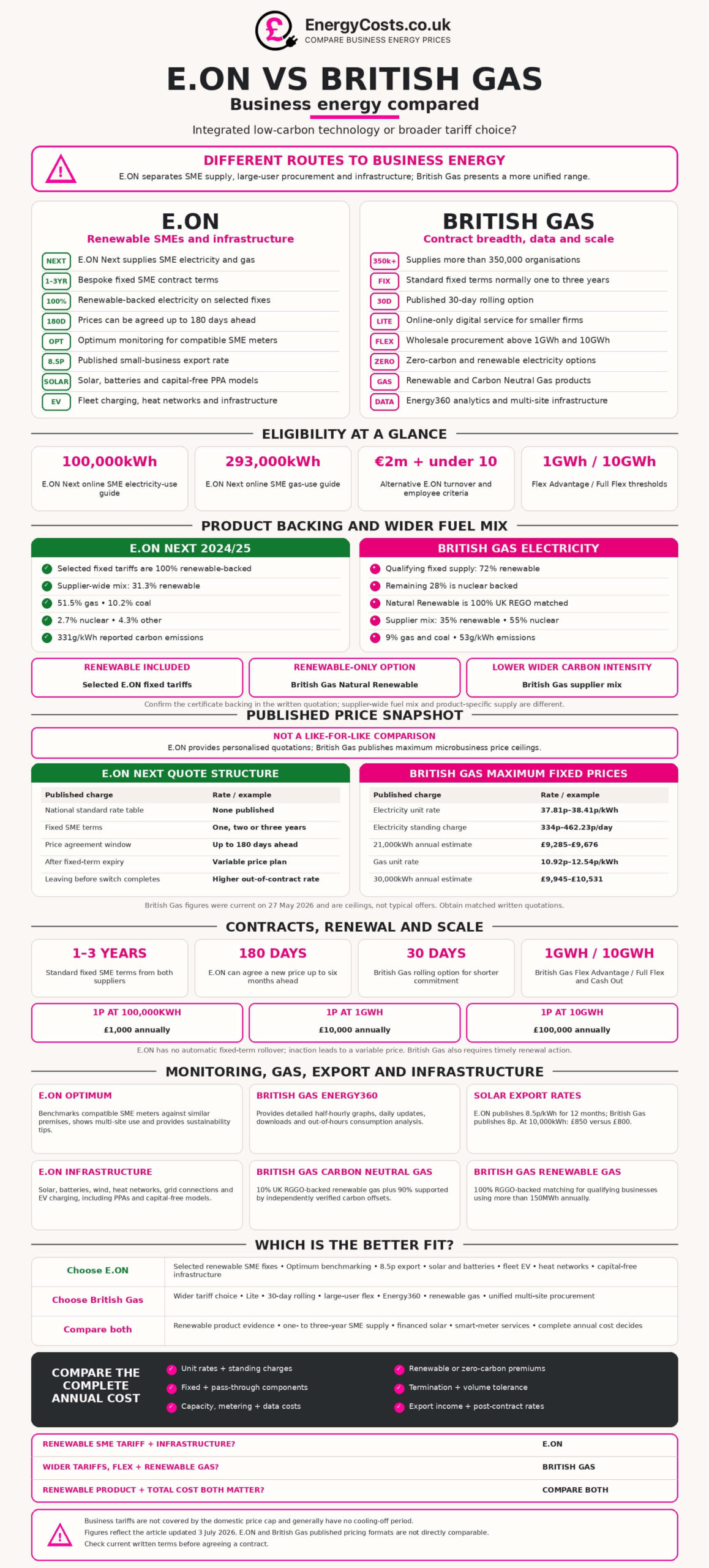
Understanding the E.ON business structure
The term “E.ON business energy” can refer to several related services.
E.ON Next
E.ON Next provides electricity and gas contracts to small and medium-sized businesses.
Its online SME quotation route is best suited where the company:
- uses no more than 100,000kWh of electricity annually;
- uses no more than 293,000kWh of gas annually; or
- has turnover below €2 million and fewer than ten full-time employees.
These thresholds largely reflect microbusiness eligibility definitions rather than an absolute refusal to serve every company outside them.
E.ON Next also accepts enquiries involving:
- two or more business premises;
- landlords;
- managing agents;
- developers; and
- more complicated account structures.
Larger business supply
E.ON Next directs larger corporate energy users towards specialist large-business services, including npower Business Solutions within the E.ON group.
This is relevant because a large manufacturer may not receive its supply quotation, procurement service and infrastructure project from the same E.ON-branded division.
E.ON Energy Solutions
E.ON Energy Solutions provides commercial infrastructure and decarbonisation services such as:
- commercial solar;
- solar farms;
- battery storage;
- wind generation;
- heat pumps;
- heat networks;
- energy management;
- half-hourly metering;
- grid connections; and
- EV charging.
A company could therefore buy its energy through E.ON Next or another E.ON group supply business while separately contracting with E.ON Energy Solutions for on-site equipment.
British Gas provides a more unified customer journey under British Gas Business and Centrica Business Solutions.
Which businesses can apply?
Both suppliers can serve organisations ranging from small shops to major industrial estates.
| Example organisation | Annual electricity use | Likely options |
|---|---|---|
| Independent shop | 12,000kWh | E.ON Next, British Gas or British Gas Lite |
| Office | 60,000kWh | Fixed SME quotation from either supplier |
| Restaurant | 120,000kWh | Bespoke E.ON enquiry or British Gas standard service |
| Hotel | 400,000kWh | Specialist or large-business service |
| Manufacturer | 2GWh | E.ON group large-business service or British Gas Flex Advantage |
| Industrial group | 15GWh | Specialist procurement; British Gas Full Flex may be relevant |
| Multi-site landlord | Varies by property | Bespoke portfolio agreement from either group |
| EV fleet operator | High overnight demand | Supply plus charging infrastructure from either supplier |
Eligibility also depends on:
- meter type;
- credit history;
- payment record;
- premises use;
- company status;
- number of sites; and
- the supplier’s appetite for the proposed contract.
A supplier is not legally required to offer a contract to every business.
Which supplier is cheaper?
There is no single national E.ON or British Gas business price.
The quotation will normally consider:
- electricity MPAN or gas MPRN;
- postcode and distribution region;
- annual consumption;
- meter profile;
- half-hourly consumption pattern;
- agreed electricity capacity;
- contract start date;
- contract length;
- credit risk;
- number of sites;
- payment method;
- renewable product selection; and
- wholesale market prices.
Businesses should compare the complete projected cost:
- Annual consumption × unit rate
- daily standing charge × 365
- capacity charges
- metering and data charges
- network and government policy costs
- renewable product charges
- VAT and Climate Change Levy where applicable
− export income and contractual credits
A supplier offering the lower unit rate can still be more expensive if it applies a much higher standing charge.
How unit-rate differences affect annual costs
| Annual consumption | Value of 0.5p/kWh | Value of 1p/kWh | Value of 3p/kWh | Value of 5p/kWh |
|---|---|---|---|---|
| 10,000kWh | £50 | £100 | £300 | £500 |
| 25,000kWh | £125 | £250 | £750 | £1,250 |
| 50,000kWh | £250 | £500 | £1,500 | £2,500 |
| 100,000kWh | £500 | £1,000 | £3,000 | £5,000 |
| 250,000kWh | £1,250 | £2,500 | £7,500 | £12,500 |
| 1GWh | £5,000 | £10,000 | £30,000 | £50,000 |
| 10GWh | £50,000 | £100,000 | £300,000 | £500,000 |
A difference of only 1p/kWh is worth £100,000 annually to a company using 10GWh.
How standing charges affect the comparison
| Daily difference per meter | Annual difference | Difference across ten meters |
|---|---|---|
| 25p | £91.25 | £912.50 |
| 50p | £182.50 | £1,825 |
| £1 | £365 | £3,650 |
| £2 | £730 | £7,300 |
| £5 | £1,825 | £18,250 |
Standing charges are particularly important for:
- low-consumption properties;
- seasonal premises;
- vacant buildings;
- landlords;
- businesses with numerous small meters; and
- organisations retaining inactive sites.
E.ON Next business tariffs
E.ON Next offers bespoke business gas and electricity prices rather than a universal public unit rate.
Its fixed tariff options normally last:
- one year;
- two years; or
- three years.
Prices can be agreed up to 180 days before the existing contract ends.
Selected fixed electricity tariffs include 100% renewable-backed electricity. Eligibility conditions can include having a compatible smart meter installed where one is available.
The business receives access to:
- a dedicated Energy Specialist;
- an online account;
- electronic bills;
- meter-reading submission;
- card and Direct Debit payments;
- account-detail management; and
- E.ON Optimum where the meter is compatible.
E.ON states that there is no automatic fixed-term rollover. If the customer takes no action, it moves onto a variable business price rather than receiving another fixed contract automatically.
E.ON’s variable and out-of-contract prices
E.ON Next distinguishes between its variable price plan and out-of-contract rates.
Variable price plan
A business can move onto the variable price plan when its fixed contract ends without a replacement being agreed.
E.ON warns that variable business prices are generally higher than fixed prices and may change at any time.
The business can normally move back onto an available fixed tariff.
Out-of-contract rates
Out-of-contract rates can apply after the fixed term ends where the customer has chosen to leave but the switch has not yet completed.
E.ON states that these rates are higher than its variable price plan.
Deemed supply
A deemed contract can arise when a company moves into premises already supplied by E.ON without first agreeing a formal tariff.
E.ON does not currently display a simple national business-rate table equivalent to British Gas’s maximum microbusiness schedule. Customers need to contact E.ON or inspect their bill for the exact unit rate and standing charge.
This makes direct public price comparison difficult.
British Gas maximum microbusiness electricity prices
British Gas publishes the maximum prices that a qualifying microbusiness may pay when entering or renewing a Fixed Price Energy Plan.
These are price ceilings rather than average or typical quotations. Many companies may receive lower prices.
The figures below were current on 27 May 2026 and exclude VAT, Climate Change Levy and other applicable charges.
Single-rate electricity
| Fixed term | Maximum unit rate | Maximum standing charge | Published contract cost |
|---|---|---|---|
| One year | 38.41p/kWh | 334p per day | £9,285 |
| Two years | 37.81p/kWh | 379.96p per day | £18,654 |
| Three years | 38.04p/kWh | 428.43p per day | £28,657 |
| Four years | 38.04p/kWh | 462.23p per day | £38,702 |
British Gas bases its electricity contract estimates on annual consumption of 21,000kWh.
| Contract length | Approximate average annual cost |
|---|---|
| One year | £9,285 |
| Two years | £9,327 |
| Three years | £9,552 |
| Four years | £9,676 |
The two-year option has the lowest maximum unit rate, but its standing charge is higher than the one-year plan.
Day-and-night electricity
| Fixed term | Maximum day rate | Maximum night rate | Standing charge |
|---|---|---|---|
| One year | 40p/kWh | 31.76p/kWh | 334p per day |
| Two years | 39.37p/kWh | 31.17p/kWh | 379.96p per day |
| Three years | 39.61p/kWh | 31.42p/kWh | 428.43p per day |
| Four years | 39.61p/kWh | 31.42p/kWh | 462.23p per day |
Using the two-year rates:
| Proportion used at night | Weighted average unit rate |
|---|---|
| 10% | 38.55p/kWh |
| 25% | 37.32p/kWh |
| 50% | 35.27p/kWh |
| 75% | 33.22p/kWh |
The standing charge must still be included.
Evening-and-weekend electricity
| Fixed term | Evening and weekend rate | Weekday daytime rate | Standing charge |
|---|---|---|---|
| One year | 31.66p/kWh | 42.27p/kWh | 334p per day |
| Two years | 31.17p/kWh | 41.20p/kWh | 379.96p per day |
| Three years | 31.48p/kWh | 40.80p/kWh | 428.43p per day |
| Four years | 31.48p/kWh | 40.80p/kWh | 462.23p per day |
This structure may suit hospitality and leisure companies using a large proportion of their electricity outside standard weekday hours.
British Gas maximum microbusiness gas prices
| Fixed term | Maximum unit rate | Maximum standing charge | Published contract cost |
|---|---|---|---|
| One year | 12.54p/kWh | 1,710.28p per day | £10,005 |
| Two years | 11.44p/kWh | 1,784.47p per day | £19,891 |
| Three years | 10.92p/kWh | 1,862.57p per day | £30,223 |
| Four years | 11.07p/kWh | 1,975.41p per day | £42,125 |
The gas estimates assume annual consumption of 30,000kWh.
The standing charges in this table are unusually high because the figures represent maximum prices rather than the typical rate offered to every British Gas customer.
E.ON does not publish an equivalent maximum-price table, so the figures cannot be used to determine which supplier will be cheaper.
British Gas contract options
British Gas offers a wider range of standardised energy-supply structures than E.ON Next.
Fixed Price Energy Plan
British Gas’s principal fixed tariff normally offers one-, two- or three-year terms.
The contract provides:
- a fixed unit rate;
- a fixed standing charge, subject to the detailed terms;
- Direct Debit payment options;
- online account management;
- renewal reminders; and
- zero-carbon electricity on qualifying plans.
British Gas Lite
British Gas Lite is a fixed-price online-only product for small businesses.
It includes:
- monthly Direct Debit;
- a free smart meter where eligible;
- automatic meter readings;
- 24-hour online account access;
- online billing; and
- support through live chat.
Lite customers do not receive conventional telephone account support.
Thirty-day rolling plan
The 30-day Rolling Energy Plan provides an alternative to a long fixed commitment.
It may suit a company that:
- expects to move premises;
- may close or sell;
- has uncertain future consumption;
- is awaiting a property transaction; or
- wants to retain greater switching flexibility.
Rates can increase or decrease, so it provides less budget certainty.
Flexible purchasing
British Gas has three flexible procurement options.
| Product | Typical annual consumption | Key feature |
|---|---|---|
| Flex Advantage | More than 1GWh | Purchase in 20% tranches |
| Full Flex | More than 10GWh | Fix and unfix in flexible volumes |
| Flex Cash Out | More than 10GWh with variable demand | Settle imbalance exposure using market prices |
Flex Advantage is intended for companies new to flexible purchasing. Full Flex and Flex Cash Out are aimed at businesses with more internal experience or specialist procurement support.
E.ON large-business procurement
E.ON’s large-business energy service is less straightforward from a branding perspective.
High-consumption businesses can be directed towards npower Business Solutions for fixed, flexible and multi-site supply contracts. E.ON Energy Solutions separately provides consultancy, metering, infrastructure and low-carbon technology.
E.ON also advertises an Energy Fund product for smaller commercial users requiring a variable energy contract with a fully risk-managed service.
A large company comparing E.ON with British Gas should establish:
- which E.ON group company will supply the energy;
- which company will install or fund equipment;
- whether invoices are consolidated;
- which entity carries contractual liability;
- whether procurement decisions are fixed or flexible;
- whether network charges are fixed or passed through; and
- which support team manages the account.
British Gas has an advantage in presenting its main fixed and flexible supply products through one business-energy brand.
Comparing renewable electricity
Both suppliers offer renewable-backed electricity, but neither company’s supplier-wide fuel mix is entirely renewable.
E.ON selected fixed tariffs
E.ON Next supplies 100% renewable-backed electricity on selected fixed tariffs for homes and small businesses.
The backing can come from:
- E.ON renewable generation assets;
- agreements with UK renewable generators; and
- renewable electricity certificates.
The physical electricity still arrives through the national grid, which combines generation from many sources.
E.ON Next fuel mix
E.ON Next’s published fuel mix for 1 April 2024 to 31 March 2025 was:
| Source | E.ON Next | UK national average |
|---|---|---|
| Coal | 10.2% | 5.9% |
| Natural gas | 51.5% | 33.3% |
| Nuclear | 2.7% | 16.2% |
| Renewables | 31.3% | 42.1% |
| Other | 4.3% | 2.5% |
| Carbon emissions | 331g/kWh | 205g/kWh |
| Radioactive waste | 0.0002g/kWh | 0.001g/kWh |
The supplier-wide mix is considerably more fossil-fuel intensive than the selected renewable tariff.
A business should therefore confirm that its quotation explicitly includes E.ON’s renewable-backed electricity rather than assuming that every E.ON product has the same environmental credentials.
British Gas zero-carbon electricity
British Gas includes zero-carbon electricity with qualifying new and renewed fixed business contracts.
Its current standard product backing is described as:
| Source | Proportion |
|---|---|
| Renewable generation | 72% |
| Nuclear generation | 28% |
This electricity can support market-based zero-emission reporting, but it is not renewable-only because nuclear power is included.
Natural Renewable Electricity
Eligible British Gas customers can opt into Natural Renewable Electricity.
Under this product:
- 100% of consumption is matched with UK REGOs;
- generation sources include wind, solar and hydro;
- it is available for the same quoted price as standard zero-carbon electricity;
- it can support Scope 2 reporting; and
- availability can vary.
British Gas Lite and non-contracted customers are excluded.
British Gas supplier-wide fuel mix
British Gas’s published 2024/25 fuel mix was:
| Source | British Gas |
|---|---|
| Renewables | 35% |
| Nuclear | 55% |
| Natural gas | 8% |
| Coal | 1% |
| Other | 1% |
| Reported carbon emissions | 53g/kWh |
British Gas’s supplier-wide mix had:
- a slightly higher renewable share than E.ON Next;
- a substantially higher nuclear share;
- much lower gas and coal exposure; and
- a much lower reported carbon intensity.
However, a customer’s product-specific certificate backing matters more than the supplier-wide mix when calculating market-based Scope 2 emissions.
Which supplier has greener electricity?
| Environmental priority | Likely stronger option |
|---|---|
| Renewable-backed SME fixed tariff | E.ON Next or British Gas Natural Renewable |
| Renewable electricity included without a separate British Gas opt-in | Selected E.ON Next fixed tariff |
| Lower supplier-wide carbon intensity | British Gas |
| Lower supplier-wide fossil-fuel share | British Gas |
| Avoiding nuclear-backed supply | E.ON renewable tariff or British Gas Natural Renewable |
| Choice between renewable and nuclear-backed zero carbon | British Gas |
| Direct solar or wind infrastructure project | E.ON may have an advantage |
| Renewable reporting under a standard SME contract | Compare product evidence from both |
A company should not compare only the fuel-mix percentages. It should request written confirmation of the specific certificates allocated to its tariff.
Comparing business gas
The environmental difference is clearer for gas.
E.ON business gas
E.ON Next supplies business gas, but it does not prominently advertise a standard SME gas tariff equivalent to British Gas’s Carbon Neutral Gas or Renewable Gas products.
Unless the quotation states otherwise, a business should treat an E.ON gas contract as conventional network gas.
A large organisation may be able to discuss bespoke low-carbon heat, biomass, heat-pump or district-heating projects with E.ON Energy Solutions.
British Gas Carbon Neutral Gas
British Gas Carbon Neutral Gas is structured as:
| Environmental mechanism | Proportion |
|---|---|
| Gas matched with UK RGGOs | 10% |
| Gas supported by carbon-offset projects | 90% |
The 10% renewable component is matched with biomethane through Renewable Gas Guarantees of Origin.
The remaining emissions are addressed using independently verified offset projects.
British Gas Renewable Gas
Businesses using more than 150MWh of gas annually can request British Gas Renewable Gas.
Under this option:
- 100% of consumption is matched with UK biomethane;
- British Gas holds corresponding RGGOs;
- the physical gas continues to arrive through the shared gas network; and
- the business receives auditable renewable-gas evidence.
British Gas is therefore likely to be the better choice where an organisation specifically requires a defined renewable or carbon-neutralised gas product.
E.ON Optimum vs British Gas Energy360
Both suppliers provide free energy-monitoring tools to eligible customers.
E.ON Optimum
E.ON Optimum is available to SME customers with a compatible smart or automated meter.
It can provide:
- electricity and gas consumption data;
- analysis by meter;
- comparisons across time periods;
- downloadable information;
- multi-site visibility;
- sustainability tips;
- benchmarking against similar premises; and
- guidance on reducing consumption.
The amount of historical information available depends on the meter and when the business consented to data sharing.
British Gas Energy360 DataView
Energy360 DataView is available to existing British Gas business customers with a suitable smart meter.
It provides:
- half-hourly consumption graphs;
- daily data updates;
- historical downloads;
- scheduled reporting;
- out-of-hours analysis;
- identification of unusual demand; and
- data supporting sustainability reporting.
Which platform is better?
| Requirement | Likely stronger fit |
|---|---|
| Benchmarking against similar premises | E.ON Optimum |
| Sustainability tips integrated with the dashboard | E.ON Optimum |
| Detailed half-hourly graphs | British Gas Energy360 |
| Out-of-hours consumption reporting | British Gas Energy360 |
| Multi-site energy visibility | Both |
| Free SME access | Both, subject to meter compatibility |
The usefulness of either platform depends on the accuracy and frequency of the meter data.
Smart meters
Both suppliers offer free smart-meter installation to eligible business customers.
Potential benefits include:
- automatic meter readings;
- more accurate bills;
- reduced estimated billing;
- half-hourly data;
- easier energy monitoring;
- access to flexibility schemes;
- support for solar exports; and
- preparation for market-wide half-hourly settlement.
A smart meter does not automatically reduce consumption. Savings depend on the business acting on the information it provides.
Commercial solar and battery storage
Both groups offer commercial solar installation, but E.ON has a particularly broad public infrastructure proposition.
E.ON small-business solar
E.ON Next provides solar and battery packages for SMEs.
The process includes:
- an initial consultation;
- a bespoke quotation and proposed system design;
- a site survey;
- grid-connection approval;
- installation; and
- monitoring of generation and storage.
The proposal can also incorporate EV charging.
E.ON large commercial solar
E.ON Energy Solutions provides:
- rooftop solar;
- ground-mounted solar farms;
- battery storage;
- Power Purchase Agreements;
- capital-expenditure-free funding; and
- maintenance and energy-management support.
No-upfront-capital models can allow the business to buy electricity generated on its site under a long-term PPA rather than owning the equipment outright.
British Gas commercial solar
British Gas and Centrica Business Solutions provide:
- commercial solar design;
- installation;
- financing;
- monitoring;
- maintenance;
- rooftop, ground-mounted and carport systems; and
- integration with broader energy services.
British Gas says suitable commercial solar projects may reduce grid electricity costs by up to 30%.
It also states that systems can have potential payback periods of two to six years, although actual results vary substantially.
Comparing business solar export payments
E.ON Next publishes an 8.5p/kWh fixed export rate for eligible small businesses.
The tariff:
- lasts 12 months;
- has no exit fee;
- requires a smart export meter;
- requires consent to half-hourly data collection; and
- is open to eligible small businesses even where E.ON does not provide the import supply.
British Gas publishes an 8p/kWh rate for eligible existing business electricity customers.
| Annual export | E.ON at 8.5p/kWh | British Gas at 8p/kWh | Difference |
|---|---|---|---|
| 5,000kWh | £425 | £400 | £25 |
| 10,000kWh | £850 | £800 | £50 |
| 25,000kWh | £2,125 | £2,000 | £125 |
| 50,000kWh | £4,250 | £4,000 | £250 |
| 100,000kWh | £8,500 | £8,000 | £500 |
E.ON currently has the slightly higher published rate.
The final choice should also consider:
- contract term;
- import-supply requirements;
- installed capacity;
- meter eligibility;
- payment frequency;
- tariff-change provisions; and
- whether the business receives Feed-in Tariff export payments.
EV charging
E.ON has the broader publicly advertised commercial charging service.
Its solutions include:
- workplace charging;
- employee charging;
- fleet-depot infrastructure;
- fast chargers;
- rapid chargers;
- public charging;
- access controls;
- load management;
- installation;
- maintenance; and
- vehicle-to-grid trials.
E.ON’s fast chargers can provide up to 22kW, while larger rapid installations are available for sites requiring shorter charging times.
Eligible companies may also be able to use Workplace Charging Scheme support, subject to current government rules.
British Gas offers commercial and communal charging, particularly for:
- commercial landlords;
- apartment blocks;
- shared parking;
- employees;
- tenants; and
- property developers.
E.ON is likely to have the advantage for a business seeking a large fleet-depot or mixed-speed charging project. British Gas may be attractive where charging is part of a commercial landlord or shared-parking arrangement.
Large-business energy infrastructure
E.ON’s major strength lies in the breadth of its infrastructure services.
The group can deliver:
- commercial solar;
- large solar farms;
- wind turbines;
- battery storage;
- heat pumps;
- combined heat and power;
- biomass;
- heat networks;
- building energy management systems;
- half-hourly metering;
- grid connections; and
- commercial EV charging.
Funding options can include:
- direct capital purchase;
- equipment leasing;
- Power Purchase Agreements;
- service contracts; and
- capital-expenditure-free arrangements.
British Gas and Centrica Business Solutions also provide large-scale solar, combined heat and power, batteries and energy optimisation.
A large company should compare the complete project proposition rather than selecting its energy supplier first and automatically using the same group for infrastructure.
Demand flexibility and smart rewards
British Gas has operated PeakSave for Business events for eligible smart-meter customers.
The May and June 2026 promotion provided half-price electricity between 11am and 4pm on selected Wednesdays, capped at a £100 credit per opted-in meter per event.
This was a time-limited promotion rather than a permanent tariff.
E.ON’s business proposition focuses more on consumption visibility through Optimum and on-site technology. Its wider business services can also support demand flexibility, storage and energy optimisation.
Businesses should ask both suppliers about current flexibility programmes because eligibility and event terms can change.
Account management and support
E.ON Next
E.ON Next business customers can manage their accounts online and contact dedicated Energy Specialists.
Support options include:
- telephone;
- email;
- WhatsApp;
- online account management;
- meter readings;
- payment management; and
- tariff renewal.
British Gas
British Gas provides different support models according to the product.
Standard business accounts can access telephone and online support.
British Gas Lite customers receive:
- online account management;
- automated smart readings;
- Direct Debit;
- webchat support; and
- no standard telephone account-service channel.
British Gas also has specialist teams for:
- flexible procurement;
- half-hourly metering;
- large organisations;
- landlords;
- connections; and
- multi-site portfolios.
Contract renewal
E.ON Next allows businesses to discuss a new tariff up to six months before the current contract ends and can agree prices up to 180 days in advance.
Online renewal may become available within 67 days of expiry.
If the business does not renew, it moves onto a variable business price. If it has decided to leave, higher out-of-contract prices can apply until the switch completes.
British Gas also contacts customers before expiry and can move an account onto a variable price where no new fixed agreement has been completed.
Businesses should start comparing prices several months before the contract end date.
Contract risks to check
Business energy contracts are not protected by the domestic price cap.
Most business contracts also do not provide an automatic 14-day cooling-off period, including agreements made over the telephone.
Before accepting an E.ON or British Gas quotation, check:
- contract start date;
- contract end date;
- unit rate;
- standing charge;
- fixed and pass-through components;
- renewable product conditions;
- meter requirements;
- capacity charges;
- volume-tolerance provisions;
- early termination costs;
- security deposits;
- payment method;
- broker commission;
- renewal procedure;
- variable-price terms; and
- deemed and out-of-contract rates.
The business should obtain all principal terms in writing before agreeing.
E.ON advantages and disadvantages
Advantages
- One-, two- and three-year fixed SME tariffs.
- Selected fixed electricity products are 100% renewable-backed.
- Prices can be agreed up to 180 days before contract expiry.
- Dedicated Energy Specialists are available.
- Free smart meters for eligible businesses.
- E.ON Optimum provides free energy monitoring to compatible SME customers.
- Strong commercial solar and battery proposition.
- Published small-business export rate of 8.5p/kWh.
- Export tariff is available even where another company supplies imported electricity.
- Extensive workplace, fleet and rapid EV charging services.
- Large range of commercial heat and renewable infrastructure.
- Capital-expenditure-free solar and PPA funding options.
- Strong building-energy-management and metering capabilities.
Disadvantages
- Standard negotiated prices are not published.
- No simple national maximum-price table.
- Supplier-wide 2024/25 fuel mix contained 51.5% gas and 10.2% coal.
- Renewable electricity only applies to selected fixed tariffs.
- Large-business supply can involve several different E.ON group brands.
- The division between E.ON Next, npower Business Solutions and E.ON Energy Solutions may confuse customers.
- No clearly defined standard renewable business gas product comparable with British Gas Renewable Gas.
- Variable and out-of-contract rates are not clearly displayed in one public national table.
- Export-rate eligibility requires suitable metering and data consent.
- Infrastructure contracts can involve long-term PPA commitments.
British Gas advantages and disadvantages
Advantages
- Supplies more than 350,000 UK businesses.
- Provides fixed, rolling, online-only and wholesale-flex contracts.
- British Gas Lite is designed for price-conscious digital SMEs.
- Flex Advantage is available above 1GWh.
- Full Flex and Flex Cash Out serve major users above 10GWh.
- Qualifying fixed electricity contracts are zero carbon.
- Natural Renewable Electricity is available for eligible customers.
- Renewable electricity can be selected at the same quoted price as standard zero-carbon supply.
- Carbon Neutral Gas and 100% Renewable Gas products are available.
- Energy360 DataView provides detailed half-hourly information.
- Commercial solar, metering and EV services are available.
- Published 8p/kWh business export rate.
- Lower supplier-wide reported carbon intensity than E.ON Next.
- Supply and procurement services are presented through a more unified business brand.
Disadvantages
- Published maximum microbusiness prices contain high standing charges.
- Standard zero-carbon electricity includes nuclear generation.
- Renewable-only electricity must be selected separately.
- British Gas Lite customers receive webchat rather than telephone support.
- Supplier-wide electricity still includes gas and coal.
- Flexible procurement exposes businesses to wholesale market movements.
- Product range can be complicated.
- Its published export rate is slightly below E.ON’s.
- Carbon offsets do not eliminate on-site gas-combustion emissions.
- Renewable Gas requires consumption above 150MWh annually.
Which supplier is better for different businesses?
| Business type or requirement | Likely better fit | Reason |
|---|---|---|
| Small business wanting a renewable fixed tariff | E.ON Next | Renewable backing included on selected fixed plans |
| Online-only microbusiness | British Gas Lite | Dedicated lower-administration online product |
| Company wanting a rolling contract | British Gas | Published 30-day plan |
| Business wanting to fix six months early | E.ON Next | Prices can be agreed up to 180 days ahead |
| Business using more than 1GWh | British Gas may have an advantage | Flex Advantage |
| Business using more than 10GWh | British Gas may have an advantage | Full Flex and Flex Cash Out |
| Company requiring renewable-only electricity | E.ON selected tariff or British Gas Natural Renewable | Both can provide certificate-backed renewable power |
| Company accepting nuclear-backed zero carbon | British Gas | Standard qualifying fixed plans include nuclear |
| Company requiring renewable gas | British Gas | 100% RGGO-backed option |
| SME wanting energy benchmarking | E.ON | Optimum compares usage and provides recommendations |
| Business wanting half-hourly reporting | British Gas | Energy360 DataView |
| SME with rooftop solar | E.ON | Published export rate of 8.5p/kWh |
| Large commercial solar project | Compare both | Both offer financed projects and PPAs |
| Fleet-depot charging | E.ON may have an advantage | Broader fleet and rapid-charging proposition |
| Commercial landlord with shared parking | British Gas may have an advantage | Communal charging tariff |
| Business needing a heat network | E.ON | Extensive heat-network experience |
| Large multi-site energy portfolio | British Gas may have an advantage | More unified procurement and account structure |
| Complex net-zero infrastructure programme | E.ON may have an advantage | Broad solar, wind, heat, storage and network services |
Final verdict: EON vs British Gas
E.ON and British Gas can both provide competitive energy and low-carbon services, but their strongest features address different business needs.
E.ON is likely to be the stronger option where the company wants:
- a one-, two- or three-year SME tariff;
- renewable-backed electricity included on the selected fixed plan;
- free energy benchmarking through Optimum;
- a slightly higher published export rate;
- solar and battery installation;
- fleet or rapid EV charging;
- heat pumps or heat networks; or
- a capital-expenditure-free renewable infrastructure project.
British Gas is likely to be the stronger choice where the company wants:
- a wider selection of conventional supply contracts;
- British Gas Lite;
- a 30-day rolling plan;
- flexible procurement above 1GWh;
- advanced wholesale trading above 10GWh;
- renewable or carbon-neutralised gas;
- Energy360 half-hourly data;
- a unified national multi-site service; or
- a choice between renewable-only and nuclear-backed zero-carbon electricity.
The pricing comparison cannot be resolved from published information alone.
British Gas publishes maximum microbusiness rates, but these are ceilings rather than average quotes. E.ON provides personalised business prices and does not display an equivalent national tariff table.
A fair comparison should require both suppliers to price:
- the same annual consumption;
- the same meter and postcode;
- identical contract dates;
- the same payment method;
- equivalent renewable credentials;
- all standing charges;
- metering and capacity costs;
- fixed and pass-through charges;
- early termination liability;
- solar export revenue;
- variable and out-of-contract rates; and
- the complete projected annual cost.
For most businesses, the conclusion is:
- choose E.ON for renewable-backed SME tariffs, integrated energy monitoring and a broad low-carbon technology package;
- choose British Gas for greater tariff variety, renewable gas, rolling contracts and sophisticated wholesale purchasing;
- compare E.ON’s selected renewable tariff with British Gas Natural Renewable Electricity where renewable-only credentials are essential; and
- select whichever written quotation produces the lowest realistic total cost after every standing, network, metering and pass-through charge has been included.
FAQ
It depends on the individual quotation. E.ON does not publish one national business rate, while British Gas publishes maximum microbusiness prices rather than typical customer quotes.
Yes. E.ON Next and British Gas both supply gas and electricity to SMEs. British Gas also offers the online-only British Gas Lite product.
Yes, but E.ON’s structure is more divided. Larger customers may deal with npower Business Solutions for supply and E.ON Energy Solutions for infrastructure. British Gas provides large-user supply through British Gas Business.
Yes. E.ON Next supplies 100% renewable-backed electricity on selected fixed tariffs for small businesses.
No. E.ON Next’s supplier-wide 2024/25 fuel mix was 31.3% renewable. The 100% claim applies to selected certificate-backed fixed tariffs.
Qualifying fixed contracts are zero carbon, using 72% renewable and 28% nuclear backing. Eligible customers can select 100% Natural Renewable Electricity.
British Gas’s 2024/25 supplier-wide mix had lower fossil-fuel use and lower reported carbon intensity. Product-level renewable backing may be more relevant to the individual business.
British Gas. It offers Carbon Neutral Gas and a Renewable Gas product matched entirely with UK RGGOs for qualifying users above 150MWh.
Both offer terms of up to three years. British Gas’s maximum-price schedules sometimes include a four-year option, subject to availability.
British Gas has the clearer public offering. Flex Advantage starts above 1GWh, while Full Flex and Flex Cash Out are intended for users above 10GWh.
Both have free tools for eligible customers. E.ON Optimum emphasises benchmarking and sustainability recommendations, while Energy360 provides detailed half-hourly and out-of-hours analysis.
E.ON currently advertises 8.5p/kWh for eligible small businesses, compared with the 8p/kWh British Gas business supply-customer rate.
Both provide financed commercial solar and PPAs. E.ON has a particularly broad infrastructure proposition, while British Gas and Centrica have substantial experience with large commercial installations.
E.ON currently presents the broader fleet and workplace charging range, including fast and rapid chargers, infrastructure planning and maintenance.