
E.ON and Octopus Energy are two major UK energy groups offering gas, electricity and low-carbon technology to businesses. However, their commercial propositions have noticeably different strengths.
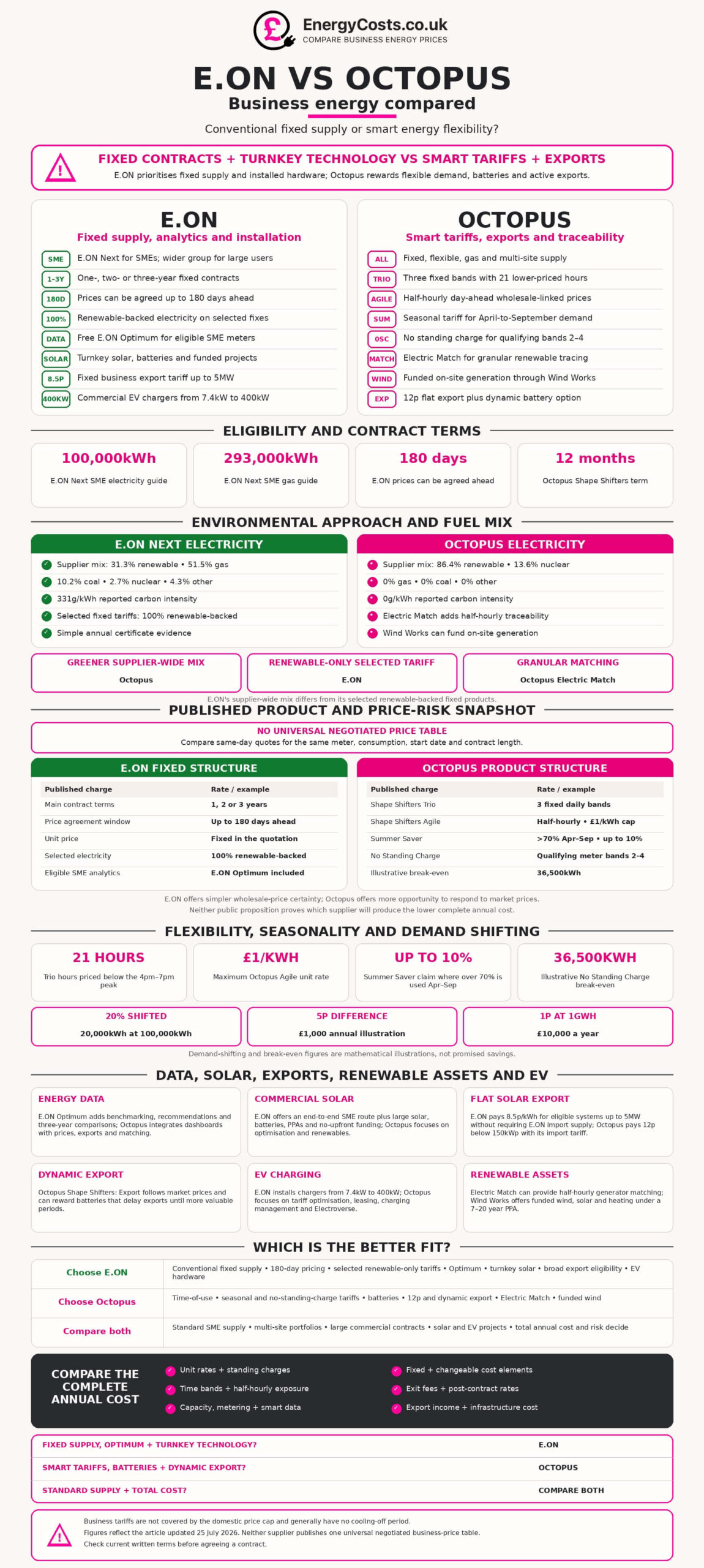
E.ON Next’s business service concentrates on individually quoted fixed contracts lasting one, two or three years. Selected fixed electricity tariffs are backed by 100% renewable electricity, while eligible SME customers receive free access to the E.ON Optimum energy-monitoring platform. The wider E.ON group also installs commercial solar panels, batteries and EV chargers.
Octopus Energy for Business offers conventional supply alongside a broader selection of innovative business tariffs. Shape Shifters Trio and Agile reward companies that can alter when they consume electricity, Summer Saver targets seasonal businesses and a No Standing Charge Tariff is available to qualifying meter bands. Octopus also provides dynamic export payments, detailed renewable matching and funded on-site wind generation.
E.ON may suit a business seeking a conventional fixed tariff, renewable-backed electricity, dedicated account support and a turnkey solar or EV project.
Octopus is likely to be more attractive where the company has flexible machinery, electric vehicles, batteries, solar panels or several premises that could benefit from active energy management.
Neither supplier is universally cheaper. Business energy prices are calculated using the property, meter, postcode, consumption, credit profile and proposed contract.
E.ON vs Octopus at a glance
| Feature | E.ON | Octopus Energy for Business |
|---|---|---|
| Small-business electricity | Yes, through E.ON Next | Yes |
| Small-business gas | Yes, through E.ON Next | Yes |
| Large-business supply | Through npower Business Solutions and wider E.ON services | Yes, including bespoke commercial products |
| Fixed SME contract terms | One, two or three years | Individually quoted; specialist products commonly last 12 months |
| Standard national prices published | No | No |
| Renewable-backed electricity | 100% renewable on selected fixed tariffs | Zero-carbon business electricity |
| Supplier-wide renewable share | 31.3% | 86.4% |
| Supplier-wide nuclear share | 2.7% | 13.6% |
| Supplier-wide gas and coal | 61.7% combined | 0% |
| Supplier-wide carbon intensity | 331g CO₂/kWh | 0g CO₂/kWh |
| Time-of-use SME tariff | No prominent business equivalent | Shape Shifters Trio and Agile |
| Seasonal business tariff | No prominent equivalent | Summer Saver |
| No-standing-charge option | No prominent business equivalent | Available for qualifying bands 2–4 |
| Free SME energy analytics | E.ON Optimum | Online dashboard and smart-tariff tools |
| Granular renewable matching | No direct SME equivalent | Electric Match |
| Funded on-site wind | Not a prominent SME supply product | Wind Works |
| Business solar export rate | 8.5p/kWh | 12p/kWh through Panel Power |
| Dynamic export tariff | No prominent business equivalent | Shape Shifters: Export |
| Commercial solar | Yes | Bespoke and funded renewable projects |
| Commercial EV chargers | 7.4kW to 400kW options | Smart tariffs, charging and wider Octopus EV services |
| Direct-sales model | Direct and broker-supported routes | Standard business service sells directly |
| Best suited to | Conventional fixed supply and installed energy technology | Flexible consumption, batteries, exports and smart energy |
Understanding the E.ON business structure
The E.ON brand covers several related commercial energy operations.
E.ON Next
E.ON Next supplies electricity and gas to small and medium-sized organisations.
Its standard online business service is best suited where the company:
- uses no more than 100,000kWh of electricity annually;
- uses no more than 293,000kWh of gas annually; or
- has annual turnover below €2 million and fewer than ten full-time employees.
E.ON Next can also handle enquiries from:
- landlords;
- property developers;
- managing agents;
- businesses with several premises; and
- companies requiring bespoke account arrangements.
Npower Business Solutions
Larger and corporate energy users are generally directed towards npower Business Solutions, which is part of the E.ON group.
This service covers:
- large fixed contracts;
- flexible wholesale purchasing;
- half-hourly supplies;
- major multi-site portfolios;
- renewable electricity;
- Power Purchase Agreements; and
- complex procurement strategies.
E.ON Energy Solutions
Commercial infrastructure can be delivered through E.ON’s wider energy-solutions operations.
Services include:
- solar panels;
- solar farms;
- batteries;
- EV charging;
- heat pumps;
- heat networks;
- building energy systems;
- grid connections; and
- other decarbonisation projects.
A large organisation may consequently deal with different E.ON group companies for supply, procurement and installed technology.
Understanding Octopus Energy for Business
Octopus presents its SME and commercial supply products through one main business-energy proposition.
Its services include:
- fixed and flexible electricity;
- business gas;
- multi-site portfolios;
- Shape Shifters;
- Summer Saver;
- no-standing-charge tariffs;
- solar export payments;
- dynamic export;
- Electric Match;
- Wind Works; and
- bespoke large-commercial contracts.
Octopus states that it sells its standard business tariffs directly rather than paying brokers or comparison services to acquire customers.
This does not prevent a business from engaging an independent energy consultant, but the company should also obtain Octopus’s direct quotation.
Which businesses can apply?
Both suppliers can serve SMEs, while larger companies have access to specialist services.
| Example business | Annual electricity consumption | Likely options |
|---|---|---|
| Independent shop | 12,000kWh | E.ON Next fixed tariff or Octopus fixed quote |
| Medium-sized office | 60,000kWh | Fixed SME contract from either supplier |
| Restaurant | 120,000kWh | E.ON bespoke route or Octopus business quotation |
| Seasonal visitor attraction | 150,000kWh | Octopus Summer Saver may be relevant |
| Workshop with flexible machinery | 250,000kWh | Octopus Shape Shifters |
| EV fleet depot | 500,000kWh | Octopus time-of-use supply or E.ON charging infrastructure |
| Hotel group | 1GWh | Multi-site arrangement from either group |
| Manufacturer | 5GWh | Npower Business Solutions or Octopus commercial service |
| Major corporate user | 15GWh | Flexible contract or renewable matching |
| Business with several solar sites | Varies | Octopus Electric Match may be relevant |
Eligibility also depends on:
- meter type;
- credit history;
- payment record;
- company status;
- premises use;
- available capacity; and
- the supplier’s commercial assessment.
Which supplier is cheaper?
Neither company publishes one national contract rate applying to every business.
A quotation normally depends on:
- the electricity MPAN or gas MPRN;
- postcode and distribution region;
- annual consumption;
- meter profile;
- half-hourly demand pattern;
- agreed electricity capacity;
- number of sites;
- payment method;
- credit rating;
- contract start date;
- contract length;
- renewable-product selection; and
- wholesale prices when the quote is issued.
The projected annual cost should be calculated as:
- Annual consumption × unit rate
- daily standing charge × 365
- capacity charges
- metering and data costs
- network and policy charges
- environmental-product costs
- VAT and Climate Change Levy where applicable
− export income and other credits
A tariff with a lower unit rate can still be more expensive if it has a higher standing charge.
How unit-rate differences affect annual costs
| Annual consumption | Value of 0.5p/kWh | Value of 1p/kWh | Value of 3p/kWh | Value of 5p/kWh |
|---|---|---|---|---|
| 10,000kWh | £50 | £100 | £300 | £500 |
| 25,000kWh | £125 | £250 | £750 | £1,250 |
| 50,000kWh | £250 | £500 | £1,500 | £2,500 |
| 100,000kWh | £500 | £1,000 | £3,000 | £5,000 |
| 250,000kWh | £1,250 | £2,500 | £7,500 | £12,500 |
| 1GWh | £5,000 | £10,000 | £30,000 | £50,000 |
| 10GWh | £50,000 | £100,000 | £300,000 | £500,000 |
A business consuming 1GWh saves £10,000 annually for every 1p/kWh reduction in its average electricity rate.
How standing charges affect costs
| Daily standing-charge difference | Annual difference per meter | Difference across ten meters |
|---|---|---|
| 25p | £91.25 | £912.50 |
| 50p | £182.50 | £1,825 |
| £1 | £365 | £3,650 |
| £2 | £730 | £7,300 |
| £5 | £1,825 | £18,250 |
Standing charges are especially important for:
- low-consumption properties;
- seasonal premises;
- vacant buildings;
- commercial landlords;
- businesses with several small meters; and
- organisations retaining inactive supplies.
E.ON Next business tariffs
E.ON Next offers individually calculated fixed business contracts lasting:
- one year;
- two years; or
- three years.
The supplier can agree prices up to 180 days before the company’s current contract ends.
Selected fixed tariffs provide 100% renewable-backed electricity.
The business proposition includes:
- a fixed unit price;
- a fixed contract period;
- electricity, gas or dual-fuel supply;
- an online account;
- Direct Debit;
- dedicated Energy Specialists;
- free smart meters where eligible; and
- E.ON Optimum for compatible meters.
The precise standing charge, unit rate and exit fee depend on the customer’s quotation.
Advantages of E.ON fixed tariffs
A conventional fixed tariff can provide:
- protection from wholesale price increases;
- predictable unit rates;
- easier budgeting;
- less need to monitor energy markets;
- one-, two- or three-year planning; and
- renewable-backed electricity on selected products.
This may suit a company that cannot alter when it uses electricity.
Examples include:
- shops operating during fixed opening hours;
- offices;
- surgeries;
- schools;
- care providers;
- restaurants;
- hotels; and
- workshops with inflexible production schedules.
Disadvantages of fixing with E.ON
A fixed contract can prevent the customer benefiting from falling market prices before the term ends.
Early termination charges may also apply if the business:
- closes;
- moves premises;
- changes supplier early;
- materially changes its meter arrangements; or
- otherwise terminates the contract before its scheduled end date.
A company should check whether the quoted tariff fixes every cost or permits changes relating to:
- taxes;
- regulation;
- meter charges;
- electricity capacity;
- third-party industry costs; or
- inaccurate consumption forecasts.
E.ON contract renewal
E.ON allows businesses to discuss contract renewal well before their existing contract expires.
Prices may be agreed up to 180 days in advance, while eligible accounts may be able to renew online closer to the end date.
E.ON says it does not automatically place customers into another fixed-term contract without consent.
Where no new fixed agreement is arranged, the business can move onto a variable tariff.
Variable and out-of-contract prices are normally less competitive than negotiated fixed rates.
Octopus standard business tariffs
Octopus provides fixed and flexible quotations based on the individual property and meter.
Its standard business proposition emphasises:
- transparent pricing;
- direct sales;
- zero-carbon electricity;
- online account management;
- multiple-site portfolios;
- smart meters;
- export payments; and
- innovative tariff structures.
The company does not publish one universal fixed-business price table.
A prospective customer must enter its postcode and supply information to see the current available tariffs.
Octopus Shape Shifters
Shape Shifters is a 12-month smart business electricity contract.
Eligibility normally requires:
- a compatible working smart meter;
- payment by Direct Debit;
- an up-to-date account; and
- compatible supply arrangements.
The tariff is available in two versions.
Shape Shifters Trio
Trio divides each day into three pricing periods:
- night;
- day; and
- the 4pm to 7pm peak.
Octopus says the business receives 21 hours at rates below the daily peak rate.
Prices within each time band are fixed, which makes Trio easier to plan around than a fully dynamic tariff.
It can suit:
- EV fleets;
- laundries;
- refrigeration businesses;
- workshops;
- commercial kitchens;
- companies with batteries;
- charging hubs; and
- manufacturers able to reschedule equipment.
Shape Shifters Agile
Agile changes its electricity rate every half hour according to wholesale-market conditions.
The following day’s prices are published in advance.
The tariff has a maximum rate of £1 per kWh.
Agile may deliver low prices when wholesale electricity is abundant, but it can become expensive during high-demand or low-generation periods.
It is best suited to businesses with:
- automated energy controls;
- battery storage;
- flexible machinery;
- overnight EV charging;
- controllable heating or cooling;
- on-site renewable generation; or
- staff capable of monitoring daily price information.
Potential value of shifting electricity use
Suppose a company uses 100,000kWh annually and can move 20% of its consumption away from expensive periods.
The flexible consumption would be 20,000kWh.
| Difference between expensive and cheaper periods | Illustrative annual saving |
|---|---|
| 3p/kWh | £600 |
| 5p/kWh | £1,000 |
| 10p/kWh | £2,000 |
| 15p/kWh | £3,000 |
| 20p/kWh | £4,000 |
These are mathematical illustrations rather than guaranteed Octopus savings.
A business should analyse at least 12 months of half-hourly data before selecting a time-of-use tariff.
E.ON fixed tariff versus Shape Shifters
| Requirement | E.ON fixed tariff | Octopus Shape Shifters |
|---|---|---|
| Simple predictable unit rate | Strong | Trio has predictable bands; Agile does not |
| Protection from wholesale volatility | Strong | Limited under Agile |
| Ability to benefit from low half-hourly prices | No | Agile |
| Reward for moving demand | Limited | Yes |
| Need for a smart meter | Required where eligible for renewable offer | Required |
| Need to monitor prices | No | Agile customers should monitor prices |
| Suitable for inflexible operation | Yes | Less likely |
| Suitable for batteries and EVs | Conventional supply only | Strong |
| Contract length | One to three years | 12 months |
| Maximum possible Agile rate | Not applicable | £1/kWh |
E.ON is likely to provide greater simplicity.
Octopus provides greater opportunity where the business can actively manage demand.
Octopus Summer Saver
Summer Saver is intended for companies using most of their annual electricity between April and September.
It applies:
- a lower summer unit rate from April to September; and
- a higher winter unit rate from October to March.
Octopus says companies using more than 70% of their annual electricity during the summer period could save up to 10%.
Potential users include:
- campsites;
- holiday parks;
- outdoor attractions;
- seasonal cafés;
- seaside venues;
- wedding businesses;
- visitor centres; and
- summer events companies.
A business should not select Summer Saver based only on its industry.
It should use meter data to confirm that at least 70% of consumption genuinely occurs during the cheaper period.
E.ON does not prominently advertise an equivalent seasonal SME tariff.
Octopus No Standing Charge Tariff
Octopus offers a 12-month business electricity tariff with no daily standing charge for eligible businesses in residual bands 2, 3 or 4.
The costs normally recovered through the standing charge are incorporated into the unit rate.
This may benefit a company that:
- uses relatively little electricity within its band;
- operates seasonally;
- has several lightly used meters;
- closes for long periods; or
- expects consumption to fall.
The tariff is less likely to suit a high-consumption business because its unit rate can be higher.
Break-even example
Suppose a conventional tariff has:
- a £2 daily standing charge; and
- a unit rate 2p/kWh below the zero-standing-charge tariff.
The annual standing charge is:
£2 × 365 = £730
The consumption break-even point is:
£730 ÷ £0.02 = 36,500kWh
Below 36,500kWh, the no-standing-charge option may be cheaper.
Above 36,500kWh, the lower unit rate on the conventional tariff may save more than the standing charge costs.
E.ON does not prominently offer an equivalent no-standing-charge business tariff.
Comparing renewable electricity
Both suppliers provide low-carbon business electricity, but the supplier-wide environmental characteristics differ substantially.
E.ON Next fuel mix
E.ON Next’s fuel mix for 1 April 2024 to 31 March 2025 was:
| Source | E.ON Next |
|---|---|
| Coal | 10.2% |
| Natural gas | 51.5% |
| Nuclear | 2.7% |
| Renewables | 31.3% |
| Other fuels | 4.3% |
| Reported carbon emissions | 331g/kWh |
| Radioactive waste | 0.0002g/kWh |
The general E.ON Next fuel mix therefore contains a significant proportion of fossil-fuel generation.
This should not be confused with the selected fixed business tariffs that are separately backed by renewable electricity.
E.ON renewable business tariffs
Selected E.ON Next fixed business tariffs provide 100% renewable-backed electricity.
The backing can use:
- E.ON renewable-generation assets;
- agreements with UK renewable generators; and
- renewable electricity certificates.
Electricity arriving at the business still comes from the shared national grid.
The 100% claim means that an equivalent quantity of renewable generation and certificates is allocated to the customer.
A compatible smart meter is required where the business is eligible for installation.
Octopus fuel mix
Octopus’s fuel mix for the same reporting period was:
| Source | Octopus |
|---|---|
| Renewables | 86.4% |
| Nuclear | 13.6% |
| Natural gas | 0% |
| Coal | 0% |
| Other fuels | 0% |
| Reported carbon emissions | 0g/kWh |
| High-level radioactive waste | 0.0010g/kWh |
Octopus’s entire supplier mix was reported as zero carbon, but it was not renewable-only because it included nuclear electricity.
Which supplier has greener electricity?
| Environmental priority | Likely stronger fit |
|---|---|
| Higher supplier-wide renewable share | Octopus |
| No gas or coal in supplier-wide mix | Octopus |
| Lower supplier-wide carbon intensity | Octopus |
| Renewable-only selected SME tariff | E.ON |
| Avoiding nuclear-backed electricity | Selected E.ON renewable tariff |
| Smart demand shifting towards low-carbon periods | Octopus |
| Granular generator matching | Octopus Electric Match |
| Simple annual renewable certificate evidence | E.ON selected tariff |
| Wider direct renewable investment | Octopus |
| On-site renewable infrastructure | Compare both |
Octopus has the stronger supplier-wide environmental figures.
E.ON offers a clearer renewable-only claim where the business selects an eligible fixed renewable tariff.
Octopus Electric Match
Electric Match is designed for large organisations wanting more detailed renewable traceability.
It connects the customer with selected renewable generators and matches electricity consumption with generation within half-hourly periods.
The customer receives certification identifying:
- the renewable generator;
- the location;
- when electricity was produced;
- the company’s corresponding consumption; and
- the proportion successfully time-matched.
Octopus says Electric Match can provide:
- 100% guaranteed green electricity;
- potential matching of up to 80% of consumption;
- a choice from approximately 70 renewable generators; and
- downloadable granular reporting.
The standard eligibility profile includes businesses that:
- consume at least 10GWh annually;
- have half-hourly meters;
- want detailed carbon reporting; and
- are willing to discuss the benefits of the product publicly.
E.ON’s standard SME renewable product provides annual certificate backing rather than an equivalent publicly advertised half-hourly matching service.
Octopus Wind Works
Wind Works allows Octopus to fund, install, operate and maintain renewable equipment at a business site.
Available combinations can include:
- wind;
- wind and solar; or
- wind, solar and electrified heating.
The customer purchases the electricity under a Power Purchase Agreement.
Octopus advertises:
- no upfront capital cost;
- contracts lasting between seven and 20 years;
- potential electricity-price reductions of up to 50%;
- price certainty during the agreement;
- operation and maintenance included; and
- the ability to export or allocate surplus electricity.
The strongest candidates generally:
- spend more than £20,000 per month on energy;
- have average demand above 200kW;
- have suitable land;
- can obtain planning permission; and
- are prepared to enter a long-term PPA.
The claimed savings are not guaranteed. They depend on site conditions, generation, grid charges and the price in the PPA.
Comparing business gas
Both E.ON Next and Octopus provide business gas quotations.
Neither supplier prominently advertises a standard SME gas product with a defined 100% renewable-gas certificate structure.
Unless the written quotation says otherwise, the business should treat the contract as conventional network gas.
A company with environmental gas requirements should ask:
- whether biomethane certificates are available;
- what proportion of use is matched;
- whether carbon offsets are included;
- what verification standards apply;
- whether an additional premium is charged; and
- what reporting evidence will be issued.
The physical combustion of gas at the business creates Scope 1 emissions regardless of the supplier.
Businesses seeking substantial reductions may need to consider heat pumps, electric equipment, waste-heat recovery or other heating changes.
E.ON Optimum
E.ON Optimum is a free digital energy-management platform for eligible SME customers with compatible smart or automated meters.
It can provide:
- electricity and gas consumption information;
- usage analysis by meter;
- comparisons across different periods;
- year-on-year comparisons covering up to three years;
- benchmarking against similar premises;
- sustainability recommendations;
- multi-meter visibility; and
- downloadable information.
Optimum can help a business investigate:
- overnight baseload;
- unnecessary weekend use;
- heating schedules;
- refrigeration;
- equipment left operating;
- seasonal changes; and
- unusual consumption increases.
Octopus online energy tools
Octopus business customers can manage:
- bills;
- payments;
- meter information;
- tariff details;
- multiple sites;
- export credits; and
- contract administration online.
Shape Shifters Agile customers also receive access to the following day’s half-hourly prices.
Electric Match customers receive a more advanced dashboard showing:
- forecast renewable generation;
- half-hourly matching;
- consumption;
- billing information;
- emissions data; and
- downloadable reports.
Which has the better data platform?
| Requirement | Likely stronger fit |
|---|---|
| Basic SME energy monitoring | E.ON Optimum |
| Benchmarking against similar businesses | E.ON Optimum |
| Sustainability recommendations | E.ON Optimum |
| Viewing next-day half-hourly prices | Octopus |
| Active tariff optimisation | Octopus |
| Detailed generator matching | Octopus Electric Match |
| Multi-site conventional reporting | Both |
| Three years of year-on-year comparison | E.ON |
| Battery and export optimisation | Octopus |
E.ON’s platform is stronger for conventional energy-efficiency analysis.
Octopus’s tools are more closely integrated with smart tariffs, renewable generation and price-responsive operation.
Solar panels and battery storage
Both energy groups provide commercial solar and battery services.
E.ON SME solar
E.ON Next offers business solar and battery packages covering:
- site consultation;
- bespoke system design;
- survey;
- installation;
- grid applications;
- monitoring;
- battery storage; and
- export payments.
This provides a relatively straightforward route for an SME wanting equipment and an export tariff from the same group.
E.ON large commercial solar
The wider E.ON group also offers:
- rooftop solar;
- ground-mounted solar;
- solar farms;
- commercial batteries;
- Power Purchase Agreements;
- no-upfront-capital funding;
- maintenance; and
- integration with commercial EV charging.
Under a PPA, E.ON or a funding partner can own the installation while the business buys electricity generated on site.
Octopus solar and renewable infrastructure
Octopus’s business proposition emphasises:
- solar export tariffs;
- dynamic export;
- batteries;
- Electric Match;
- Wind Works; and
- bespoke commercial renewable contracts.
Octopus may be particularly attractive where the business already has solar or batteries and wants to optimise the value of the installation.
E.ON may provide the simpler end-to-end installation route for an ordinary SME.
Comparing solar export tariffs
E.ON Next Export Business
E.ON pays eligible small and medium-sized businesses:
8.5p per exported kWh
The tariff:
- is fixed for 12 months;
- has no exit fee;
- requires a smart export meter;
- requires consent to half-hourly data collection;
- is available for qualifying generation up to 5MW; and
- is open to eligible businesses even where another company supplies imported electricity.
Octopus Panel Power
Octopus Panel Power pays:
12p per exported kWh
Eligibility normally requires:
- solar panels;
- generation capacity below 150kWp;
- a compatible smart or export meter;
- no Feed-in Tariff export payments; and
- an Octopus Energy for Business import tariff.
Export-income comparison
| Annual electricity export | E.ON at 8.5p/kWh | Octopus at 12p/kWh | Difference |
|---|---|---|---|
| 5,000kWh | £425 | £600 | £175 |
| 10,000kWh | £850 | £1,200 | £350 |
| 25,000kWh | £2,125 | £3,000 | £875 |
| 50,000kWh | £4,250 | £6,000 | £1,750 |
| 100,000kWh | £8,500 | £12,000 | £3,500 |
Octopus offers the higher published flat payment.
E.ON has broader stated generation-capacity eligibility and does not require the company to buy its imported electricity from E.ON.
Octopus Shape Shifters: Export
Shape Shifters: Export changes its payment rate throughout the day according to wholesale-market prices.
It is designed for businesses with:
- battery storage;
- solar panels;
- controllable exports; or
- the ability to store low-cost electricity and sell it later.
Rates are commonly more valuable around the evening peak.
A business with solar but no battery may prefer the certainty of Panel Power.
A business with a large battery may earn more through dynamic export by delaying sales until market prices rise.
E.ON does not currently advertise a directly comparable mainstream dynamic business-export tariff.
Which is better for solar exports?
| Requirement | Likely better fit |
|---|---|
| Highest published flat rate | Octopus |
| Installation below 150kWp | Octopus Panel Power |
| Installation up to 5MW | E.ON |
| Export without changing import supplier | E.ON |
| Dynamic battery export | Octopus |
| Simple 12-month fixed export rate | Either |
| Solar plus turnkey installation | E.ON |
| Solar and battery market optimisation | Octopus |
Commercial EV charging
Both groups have strong EV propositions, but they approach the market differently.
E.ON business EV charging
E.ON Next and E.ON Energy Solutions offer:
- residential-style commercial chargers;
- workplace charging;
- fleet charging;
- public charging;
- access control;
- load management;
- planning;
- installation;
- maintenance; and
- integration with solar and batteries.
Its published charger categories include:
| Charger type | Maximum published output | Typical use |
|---|---|---|
| Residential-style commercial | 7.4kW | Small premises and home-based businesses |
| Fast commercial | 22kW | Offices and overnight fleets |
| Rapid commercial | 50kW | Car parks and dealerships |
| Ultrafast commercial | 400kW | Taxi fleets and public charging |
E.ON can therefore provide the physical infrastructure for anything from one charger to a large rapid-charging site.
Octopus EV proposition
Octopus’s main business-supply advantage is lower-cost charging through Shape Shifters.
A fleet can schedule charging:
- overnight;
- outside 4pm to 7pm;
- during low Agile-price periods; or
- when renewable generation is abundant.
The wider Octopus group also offers:
- electric vehicle leasing;
- salary-sacrifice schemes;
- charger installation;
- charging management; and
- Electroverse public-network access.
Which is better for EVs?
| EV requirement | Likely stronger fit |
|---|---|
| Physical workplace charger installation | E.ON |
| Rapid or ultrafast chargers | E.ON |
| Public charging site | E.ON |
| Overnight tariff optimisation | Octopus |
| Half-hourly dynamic charging | Octopus |
| Battery and EV integration | Octopus |
| Fleet leasing | Octopus group |
| Solar plus EV charging installation | E.ON |
| Simple office chargers | E.ON |
| Businesses already on Shape Shifters | Octopus |
A business may use E.ON to install chargers while selecting Octopus for electricity supply, subject to contract compatibility.
Multi-site businesses
E.ON can provide bespoke contracts for:
- landlords;
- managing agents;
- property developers;
- several business premises; and
- larger corporate portfolios.
Large portfolios may be directed to npower Business Solutions.
Octopus allows sites to be combined within a joint portfolio covering:
- switching;
- renewals;
- billing;
- online account access;
- customer support; and
- contract administration.
Electric Match can also allocate renewable output and consumption across multiple properties.
Octopus may have an advantage where the company wants one portfolio combined with smart tariffs or granular renewable matching.
E.ON may have an advantage where the organisation requires wider infrastructure, connections, metering or advanced large-business procurement.
Customer service
E.ON Next
E.ON Next provides business customers with:
- dedicated Energy Specialists;
- telephone support;
- email;
- WhatsApp;
- online account management;
- tariff renewal;
- meter assistance; and
- energy-efficiency support.
This may appeal to a company wanting a recognisable named support model rather than relying principally on self-service.
Octopus
Octopus provides:
- telephone and email support;
- online account management;
- direct quotations;
- smart-tariff dashboards;
- export services;
- multi-site management; and
- specialist commercial teams.
Octopus may be more attractive to businesses comfortable managing tariffs and consumption through digital tools.
Contract expiry and switching
E.ON can agree new prices up to 180 days before the existing tariff ends.
Octopus customers should review their tariffs before expiry, particularly where they use a specialist 12-month product.
If no new agreement is arranged, either supplier may apply:
- variable rates;
- deemed rates;
- out-of-contract rates; or
- other default pricing permitted by the contract.
These rates can be materially more expensive than a negotiated agreement.
Contract risks to check
Business energy contracts do not receive the same protections as household tariffs.
There is generally no automatic cooling-off period after accepting a business energy agreement.
Before selecting E.ON or Octopus, examine:
- unit rates;
- standing charges;
- contract term;
- start and end dates;
- exit fees;
- fixed and variable elements;
- time-of-use periods;
- Agile’s maximum rate;
- Direct Debit requirements;
- meter compatibility;
- capacity charges;
- broker commission;
- renewable certificates;
- export tariff eligibility;
- treatment of moving premises;
- renewal procedures; and
- post-contract prices.
A business should not accept a time-of-use tariff without examining actual consumption data.
E.ON advantages and disadvantages
Advantages
- Supplies gas and electricity to SMEs.
- Offers one-, two- and three-year fixed terms.
- Prices can be agreed up to 180 days in advance.
- Selected fixed tariffs provide 100% renewable-backed electricity.
- Dedicated Energy Specialists are available.
- Free smart meters are offered to eligible businesses.
- Optimum is free for compatible SME customers.
- Optimum includes comparisons with similar premises.
- Offers solar panels and batteries.
- Commercial solar can be funded without upfront capital.
- Business SEG pays 8.5p/kWh.
- SEG is available without requiring E.ON import supply.
- Business export eligibility extends up to 5MW.
- Provides chargers ranging from 7.4kW to 400kW.
- Offers workplace, fleet and public charging.
- Wider E.ON services include heat, networks and large infrastructure.
Disadvantages
- Standard contract rates are not published.
- No prominent SME time-of-use tariff equivalent to Shape Shifters.
- No seasonal business tariff is prominently offered.
- No no-standing-charge business option is prominently offered.
- Supplier-wide electricity contained 51.5% gas and 10.2% coal.
- Supplier-wide carbon intensity was 331g/kWh.
- Renewable backing applies only to selected fixed products.
- Large-business services can involve several E.ON group brands.
- No prominent dynamic business export tariff.
- Published business export rate is below Octopus Panel Power.
- No clearly defined standard renewable business-gas product.
- Fixed terms can restrict access to falling market prices.
Octopus advantages and disadvantages
Advantages
- Supplies business electricity and gas.
- Offers conventional and innovative tariff structures.
- Shape Shifters Trio provides three predictable time bands.
- Agile follows half-hourly wholesale prices.
- Next-day prices allow businesses to plan consumption.
- Summer Saver supports seasonal businesses.
- A No Standing Charge Tariff is available to qualifying meters.
- Standard business sales are direct.
- Supplier-wide electricity was 86.4% renewable.
- Supplier-wide electricity contained no gas or coal.
- Electric Match provides half-hourly renewable traceability.
- Wind Works can be fully funded.
- Panel Power pays 12p/kWh.
- Dynamic battery export is available.
- Strong fit for flexible EV fleets.
- Multi-site joint portfolios are available.
Disadvantages
- Standard negotiated prices are not published.
- Agile prices can rise to £1/kWh.
- Smart tariffs require a compatible meter.
- Shape Shifters requires Direct Debit and an up-to-date account.
- Businesses with inflexible consumption may save little.
- Supplier-wide electricity includes nuclear generation.
- Standard zero-carbon electricity is not renewable-only.
- Summer Saver can cost more if winter demand is underestimated.
- The No Standing Charge Tariff can have a higher unit rate.
- Panel Power requires Octopus import supply.
- Panel Power is limited to systems below 150kWp.
- Wind Works requires a long PPA and suitable site.
- No prominent standard renewable business-gas product.
Which supplier is better for different businesses?
| Business type or requirement | Likely better fit | Reason |
|---|---|---|
| Small business wanting a simple fixed rate | E.ON | Conventional one- to three-year options |
| Business wanting to fix six months early | E.ON | Prices can be agreed 180 days ahead |
| Business with flexible operating hours | Octopus | Shape Shifters |
| EV fleet charging overnight | Octopus | Time-of-use tariffs |
| Business needing EV charger installation | E.ON | Wide hardware and installation range |
| Company with batteries | Octopus | Agile import and dynamic export |
| Seasonal summer company | Octopus | Summer Saver |
| Low-use band 2–4 meter | Octopus may suit | No Standing Charge Tariff |
| Company wanting renewable-only supply | Selected E.ON tariff | 100% renewable backing |
| Company prioritising supplier-wide fuel mix | Octopus | 86.4% renewable and no fossil generation |
| Business excluding nuclear power | Selected E.ON renewable tariff | Octopus mix includes nuclear |
| SME wanting energy benchmarking | E.ON | Optimum |
| Company wanting half-hourly generator matching | Octopus | Electric Match |
| Solar exporter below 150kWp | Octopus | Panel Power pays 12p/kWh |
| Solar exporter not changing import supplier | E.ON | 8.5p tariff is open to eligible non-supply customers |
| Generator above 150kWp | E.ON may suit | Eligibility extends to 5MW |
| Company wanting dynamic battery exports | Octopus | Shape Shifters: Export |
| SME wanting turnkey solar | E.ON | Installation, storage and export route |
| Industrial site suitable for wind | Octopus | Wind Works |
| Large corporate portfolio | Compare both | Npower Business Solutions and Octopus commercial services |
| Business wanting charger outputs up to 400kW | E.ON | Published ultrafast charging range |
Final verdict: E.ON vs Octopus
E.ON and Octopus both provide credible business energy services, but they are best suited to different operating models.
E.ON is likely to be the stronger choice where the company wants:
- a conventional fixed contract;
- a one-, two- or three-year term;
- the ability to agree prices 180 days in advance;
- renewable-only electricity on an eligible fixed plan;
- dedicated Energy Specialists;
- free SME energy benchmarking;
- a turnkey solar and battery installation;
- an export tariff that does not require E.ON import supply;
- workplace, fleet or public EV chargers; or
- wider commercial infrastructure from a large energy group.
Octopus is likely to be the stronger option where the business wants:
- time-of-use electricity;
- half-hourly wholesale pricing;
- seasonal rates;
- a no-standing-charge structure;
- battery optimisation;
- dynamic exports;
- a higher flat solar export payment;
- multi-site smart management;
- granular renewable matching; or
- fully funded on-site wind generation.
The environmental result depends on the comparison being made.
Octopus has the much greener supplier-wide mix, with 86.4% renewable electricity, 13.6% nuclear and no gas or coal.
E.ON’s general supplier mix is more carbon intensive, but selected fixed business tariffs provide 100% renewable-backed electricity and therefore avoid nuclear backing at product level.
The price comparison cannot be resolved using public headline rates. Both suppliers calculate business prices individually.
A fair comparison should require both companies to quote for:
- the same meter and postcode;
- identical annual consumption;
- the same contract start date;
- an equivalent contract duration;
- the same payment method;
- all standing charges;
- meter and capacity costs;
- equivalent renewable credentials;
- time-of-use savings based on actual data;
- export income;
- early termination costs;
- renewal and default prices; and
- the complete projected annual cost.
For most companies, the conclusion is:
- choose E.ON for straightforward fixed tariffs, renewable-only backing and installed energy technology;
- choose Octopus for smart pricing, flexibility, batteries, solar exports and granular renewable services;
- compare E.ON’s selected renewable fixed tariff with Octopus’s standard zero-carbon tariff where environmental credentials matter;
- compare E.ON Optimum with Octopus Shape Shifters tools according to whether the priority is analysing or actively rescheduling consumption; and
- select whichever quotation produces the lowest realistic annual cost after standing charges, export revenue and operational changes have been included.
FAQ
It depends on the individual quotation and consumption profile. Octopus may reward flexible demand, while E.ON provides conventional fixed prices that can be easier to budget.
Yes. E.ON Next and Octopus both provide business gas quotations.
Yes. Both supply electricity to SMEs and can support larger commercial organisations through specialist services.
Yes. Selected E.ON Next fixed business tariffs provide 100% renewable-backed electricity.
No. E.ON Next’s supplier-wide 2024/25 mix was 31.3% renewable. The 100% claim applies only to selected fixed tariffs.
Octopus’s supplier-wide mix was 86.4% renewable and 13.6% nuclear. It was zero carbon but not renewable-only.
Octopus. Its disclosed mix contained no gas or coal and had reported carbon emissions of 0g/kWh.
Octopus. Shape Shifters Trio and Agile are designed specifically around time-of-use business pricing.
Yes. The rate changes every half hour and can reach £1/kWh. It is most appropriate where the business can control when it consumes electricity.
E.ON provides smart meters and Optimum energy monitoring, but it does not currently promote a business time-of-use tariff directly comparable with Shape Shifters.
Octopus Summer Saver may suit companies using more than 70% of their annual electricity between April and September.
Octopus Panel Power pays eligible businesses 12p/kWh. E.ON Next Export Business pays 8.5p/kWh.
Yes. E.ON’s published business export tariff is open to eligible customers even where another company supplies the imported electricity.
Octopus. Agile import pricing and Shape Shifters: Export allow a battery to respond to changing half-hourly prices.
E.ON has the clearer infrastructure proposition, with commercial chargers ranging from 7.4kW to 400kW.
E.ON Optimum is strong for conventional usage analysis and benchmarking. Octopus has the advantage for live price optimisation and granular renewable matching.