

Business smart-meter requirements depend on the premises, existing equipment and energy contract. There is no single date by which every UK business must physically replace every meter. However, new rules in Great Britain will make agreement to smart or advanced metering a condition of new fixed-term supply contracts for designated premises from 1 September 2027.
For an owner comparing energy quotations, the practical questions are whether the site is in scope, what the supplier requires, whether installation can be completed and which costs or tariff consequences could apply. Check these points before accepting the contract rather than waiting for the engineer’s appointment.
Business smart meters: the quick answer
| Question | Practical answer |
|---|---|
| Is every business meter subject to the same rules? | No. Site size, technical classification and existing equipment matter |
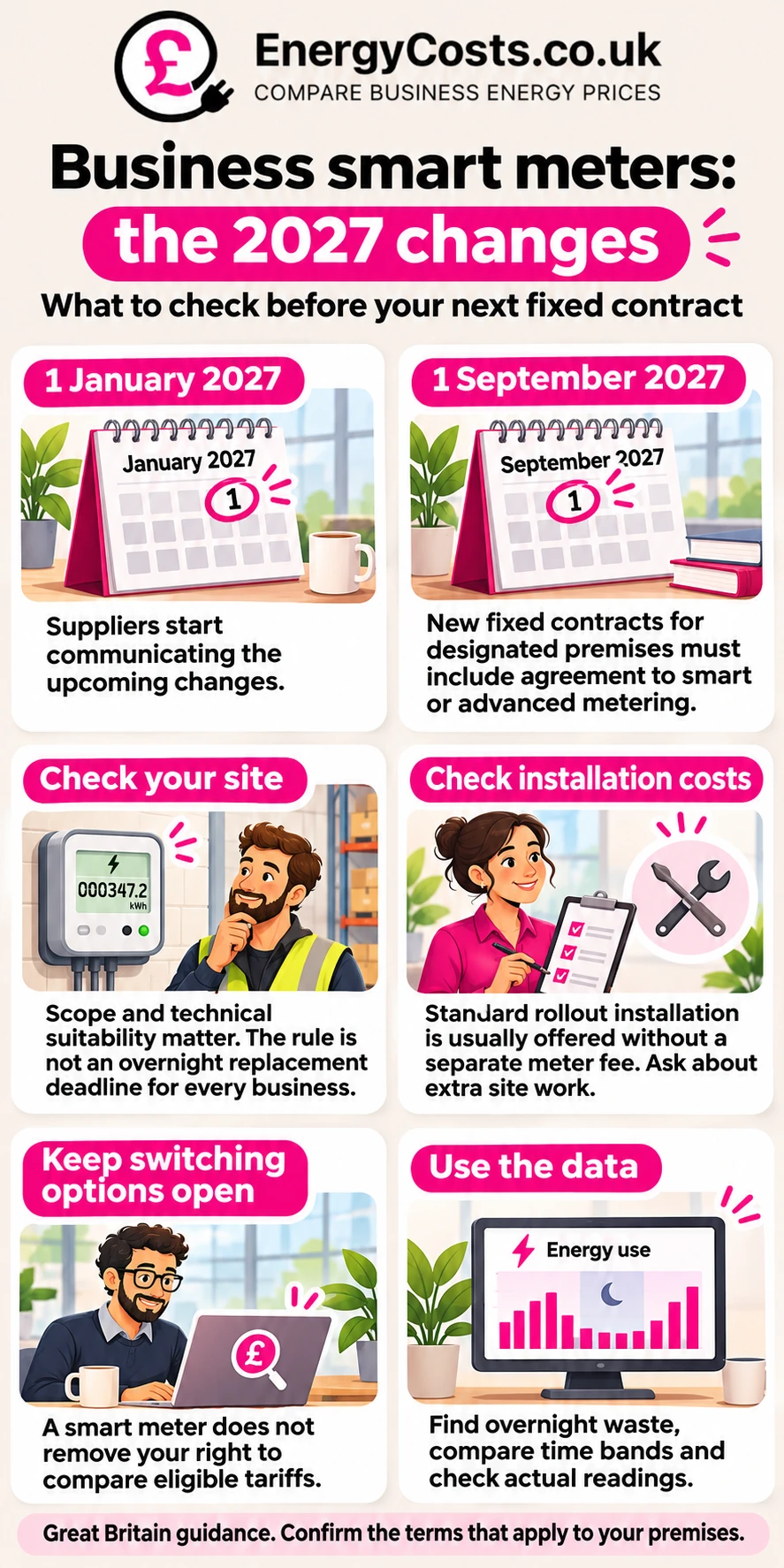
| What changes from 1 January 2027? | Suppliers must begin communicating the upcoming contract changes |
| What changes from 1 September 2027? | New fixed-term contracts for designated premises must include agreement to smart or advanced metering |
| Must all physical installations finish on that day? | The rule concerns contract conditions; it is not a universal same-day installation deadline |
| Is a standard rollout installation separately charged? | Eligible standard installations are commonly offered without an additional meter-installation fee |
| Can other project costs arise? | Yes, for example remedial electrical or building work outside the normal exchange |
| Does a smart meter guarantee cheaper energy? | No. Tariff selection, consumption and action on the data determine savings |
The dates above come from the government’s non-domestic smart-meter rollout outcome. This article concerns Great Britain; Northern Ireland has a separate energy market and regulatory arrangements.
What is a business smart meter?
It measures consumption and can communicate readings remotely, reducing reliance on manual submission when communications are working. Electricity and gas require separate meters because they measure different fuels. A display or dashboard helps you view information but is not the meter itself.
For the business owner, the useful output is a trustworthy record of when energy is consumed. A daily total can reveal general trends; interval data can reveal whether equipment is left on overnight or whether shifting a process would suit a different tariff.
The meter does not decide the tariff price. A reading of 20kWh still needs multiplying by the correct contractual rates, with daily charges, tax and other applicable costs added. Our business energy bill guide explains that calculation.
Smart, advanced and half-hourly meters are different descriptions
| Term | What it describes | What to confirm |
|---|---|---|
| SMETS smart meter | Equipment built to the relevant smart-meter specification | Communication status and supplier support |
| Advanced or AMR meter | Equipment used to record and remotely retrieve consumption data | Metering arrangements, data access and compatibility |
| Half-hourly metering or settlement | Recording or settlement using half-hour periods | Which services and charges apply to the supply |
| In-home display or online dashboard | A way to view information | Availability, update frequency and what costs it displays |
A larger customer may already have advanced metering. Do not assume it needs a household-style replacement just because a headline says ‘smart meters’. Equally, the presence of a digital display does not establish that readings are reaching the supplier.
Our half-hourly meter guide explains larger-site arrangements. MHHS concerns electricity settlement; it should not be treated as the same project as the 2027 contract requirement.
Which premises are covered by the 2027 changes?
The government initially limits the new policy to designated small and medium non-domestic sites. Its supplier-obligations guidance identifies the smaller-site mandate using electricity profile classes 1–4 and annual gas consumption below 732MWh, with separate advanced-meter obligations for larger supplies.
Ask the supplier to confirm the site’s classification and explain how it maps to the current rules. The everyday label ‘small business’ does not by itself establish every meter’s technical position. An organisation with several premises should check each supply point.
The change applies when entering a relevant new fixed-term contract, including a new renewal agreement. It does not mean an existing fixed agreement automatically ends on 1 September 2027. Existing smart-meter clauses may already apply before the new universal requirement starts.
Can a business refuse a smart meter?
Read the proposed agreement before deciding. A supplier can already market a tariff with a metering condition, and the 2027 rules change what relevant new fixed contracts must contain. Refusing installation after agreeing a clear condition is different from reporting a genuine technical barrier.
Ask what alternative products are available, what they cost and what happens if the smart-meter condition cannot be fulfilled. Do not accept an attractively priced tariff while assuming an important condition can simply be ignored. A telephone acceptance can create a binding business agreement.
If you prefer a shorter commitment, compare suitable rolling business energy options, checking their own metering terms. A rolling product is not automatically exempt from every technical or contractual requirement.
How much does a business smart meter cost?
British Gas business advertises eligible smart-meter installations without a separate installation charge. Smart Energy GB’s small-business guidance also describes standard installation at no additional cost. This is different from saying that every possible site alteration is free.
| Cost item | What to budget or ask |
|---|---|
| Standard eligible rollout meter exchange | Published supplier offers commonly show £0 additional installation charge |
| Electrical defects or unsuitable customer equipment | Obtain an electrician’s site-specific quotation |
| Building work, access alterations or moving equipment | Obtain a separate written scope and price |
| Out-of-hours work or an unusual installation request | Confirm whether any fee applies before booking |
| Existing MOP or data-service obligations | Check the current agreement and replacement arrangement |
| Lost trading time or staff attendance | Include your own operational cost |
For example, a £0 standard meter exchange with £300 of separately quoted remedial work is a £300 site project. If it also takes three staff hours valued internally at £20 an hour, the planning cost becomes £360. These are illustrative project inputs, not supplier or electrician price lists.
What if the supplier cannot install the meter?
Ask for a written record of the reason. It could concern equipment compatibility, access, the installation environment or communications. A failed appointment should not leave the customer guessing whether the problem is technical, administrative or a refusal to cooperate.
The government has published a consumer protection code for the new arrangements. Its approach requires fair and proportionate handling, including attention to circumstances outside the customer’s control. The code should be considered alongside the actual contract and the date it applies.
Keep evidence of appointment offers, attendance, access provided and any remedial work requested. Ask the supplier to explain any proposed surcharge or tariff change in writing, identify the relevant term and set out how it has considered the failed installation.
What if the landlord will not agree?
Contact the landlord early, describe the work and ask for a written response. Distinguish a simple meter exchange from work affecting the building’s electrical installation or fabric. If necessary, arrange a discussion between the supplier, installer and landlord so that each knows which party must act.
The government’s supporting policy guidance includes commercial landlord and tenant communication templates and examples involving unresolved works. It supports documenting genuine barriers rather than treating them as deliberate customer non-compliance.
Your practical record should contain the request, response, installer’s findings and the next proposed step. If responsibility for paying for work is disputed, check the lease and obtain advice on the actual provision.
Will installation interrupt trading?
Plan on the basis that an interruption may be required unless the installer confirms otherwise. Ask how long the appointment and outage are expected to take for your equipment and whether a quieter trading period can be used. Do not rely on a general online estimate for refrigeration, medical equipment or production processes.
Prepare access to the meter, tell staff and building management, and agree shutdown and restart arrangements with competent people. Record the old meter’s final reading, the new meter’s serial number and its opening reading. Check the next bill for the exchange date and correct readings.
For a business with separate suppliers for gas and electricity, coordinate the appointments and communication arrangements. A booking with one fuel supplier does not automatically replace the other fuel’s meter.
Can you switch supplier with a smart meter?
Yes, a smart meter does not itself prevent switching. You still need to comply with your current contract and choose a supplier and product compatible with the supply. Ask whether remote readings and data access will continue and what to do if communications are interrupted.
Smart Energy GB’s business switching FAQs address supplier changes. Our switching guide explains the commercial checks. Keep a transfer-day reading as a useful independent record.
How can the data reduce energy costs?
Use it to ask a specific operational question. For example: why does the shop use almost as much electricity after closing, which days have the highest demand, or how much consumption falls in an expensive time band? Compare similar weeks and record changes in weather, opening hours or production.
Suppose you identify a genuinely avoidable continuous 200-watt load. Removing it for 12 hours per day over 300 days avoids 720kWh. At an illustrative 25p/kWh, that is £180 before tax. The saving comes from changing the equipment’s operation, not from the meter’s installation alone.
| Illustrative avoidable overnight load | Hours avoided annually | Electricity avoided | Value at 25p/kWh |
|---|---|---|---|
| 100W | 3,600 | 360kWh | £90 |
| 200W | 3,600 | 720kWh | £180 |
| 500W | 3,600 | 1,800kWh | £450 |
These are calculations, not guaranteed savings. Only switch off equipment when safe and suitable. Use our energy-saving guide to structure a practical review.
Should you choose a smart time-of-use tariff?
Compare your actual consumption in each time band. A low overnight price may be offset by a higher daytime price or daily charge. Model the whole year, including how much use you can realistically move without harming operations.
For example, 2,000kWh moved from an illustrative 30p band to a 20p band reduces unit costs by £200, before losses, taxes or any extra charges. If the alternative tariff adds £250 a year elsewhere, the business is still £50 worse off. See our off-peak business tariff guide.
Business smart-meter checklist
- Identify each supply point, meter and responsible supplier.
- Ask whether the site falls within the relevant metering requirements.
- Read the smart-meter condition before accepting a quotation.
- Confirm standard installation and any separate work or fees.
- Obtain landlord agreement and safe access arrangements where needed.
- Plan the outage with the installer and operational team.
- Keep exchange readings and installation records.
- Check that automatic readings actually reach the supplier.
- Obtain usable consumption data and compare it with invoices.
- Review eligible tariffs using the complete annual cost.
Frequently asked questions
Requirements depend on the premises and existing metering. From 1 September 2027, relevant new fixed-term contracts for designated premises in Great Britain must include agreement to smart or advanced metering. This is not a universal deadline requiring every business meter to be physically replaced on the same day.
Suppliers must begin communicating the upcoming contract changes from 1 January 2027. The new fixed-contract implementation requirement begins on 1 September 2027. Check the current government guidance and your proposed terms, because an individual supplier may already offer tariffs with smart-meter conditions before then.
Eligible standard rollout installations are commonly offered without a separate meter-installation fee. Additional electrical, building, access or relocation work can have separate costs. Ask for written confirmation of what is included and obtain quotations for any remedial work before authorising the project.
The meter itself does not reduce your tariff rate or the consumption of equipment. It can help you identify waste and assess suitable time-of-use tariffs. Calculate savings from actual operational changes and compare all tariff charges rather than assuming installation produces a guaranteed bill reduction.
Yes, subject to the current contract and the receiving supplier’s eligibility requirements. Confirm compatibility, remote-reading arrangements and data access. Keep an independent transfer reading where possible and follow up if the new account relies on estimates or records the wrong meter.
Ask the supplier to record the reason and explain the next steps in writing. Keep appointment records and evidence of cooperation. Genuine barriers should be assessed under the applicable contract and protections rather than assumed to be refusal. Challenge any proposed surcharge or tariff change with supporting evidence.
Not automatically. MHHS changes electricity settlement and is distinct from the physical smart-meter rollout and the 2027 contract policy. The equipment and services needed depend on your supply. Ask the supplier to explain the requirement for your existing meter rather than assuming all businesses need a replacement.
An interruption may be needed, so agree the expected outage with the installer before booking. Plan around essential systems, staff and trading. Record old and new meter readings and serial numbers, then check the following bill to confirm the exchange was processed correctly.
Compare business electricity quotes with the metering conditions, complete charges and installation arrangements clearly stated before you accept.