
You may be due a business energy refund if you have paid more than the correctly calculated charges on your electricity or gas account. Credit can build up through fixed Direct Debits, estimated bills, duplicate payments or account corrections. The first step is to establish how much is genuinely owed after outstanding usage has been billed.
A credit balance on an online dashboard is useful evidence, but it is not always the final refundable amount. Check the latest meter readings, unbilled consumption, recent payments and any security deposit separately. You can normally raise the request with the supplier yourself, using its official business account or customer-service process.
When might a business be owed an energy refund?
| Situation | What to check | Evidence to keep |
|---|---|---|
| Fixed Direct Debit exceeds actual charges | Whether readings and the annual forecast are current | Bills, payment history and meter photographs |
| Duplicate payment | Whether both payments reached the correct account | Bank references and supplier transaction records |
| Account closes in credit after switching | Whether the final bill and transfer reading agree | Final invoice and opening bill from the new supplier |
| Moving out of premises | Correct responsibility dates and closing reading | Lease or handover documents and forwarding address |
| Incorrect tariff or meter reading | Whether a corrected invoice creates credit | Contract rates, serial number and reading history |
| Tax or other charge corrected | Whether the adjustment has been applied to the account | Credit note and relevant declaration or evidence |
| Security deposit becomes returnable | Deposit terms and any sums legitimately offset | Deposit receipt and contract conditions |
The refund request and the reason for the credit are related, but they are different tasks. If a tariff is wrong, first ask for the invoices to be corrected. If a payment is missing, trace it before accepting a statement that says the account has no available credit. Our business energy bill guide explains the main invoice entries.
How to calculate the amount you can request
Reconcile the account over a defined period. Start with the opening balance, add payments and credits, then subtract accurate charges. Include reversals and replacement invoices correctly: an old invoice that has been cancelled should not be counted alongside its replacement as two valid charges.
This is an illustrative account reconciliation, not a supplier offer or a promised refund. The charges are assumed to include the applicable tax so that all lines use the same basis.
| Account entry | Amount | Running credit balance |
|---|---|---|
| Opening credit | £400 | £400 |
| Six payments of £500 | £3,000 | £3,400 |
| Correct charges already invoiced | −£2,650 | £750 |
| Further consumption billed following an up-to-date reading | −£275 | £475 |
| Reconciled credit before any other valid adjustment | — | £475 |
The dashboard might have shown £750 before the extra £275 invoice. Asking for the account to be updated makes the £475 request easier to substantiate. If a separate £300 deposit also exists, do not automatically add it: whether it can be returned depends on the deposit conditions and the status of the account.
For several meters, reconcile each account before combining the result. Ask whether the supplier proposes to offset credit against a debt on another account and the basis for doing so. A group summary should still show which legal entity owns each balance; common ownership does not mean every company account is interchangeable.
Step-by-step: requesting a business energy refund
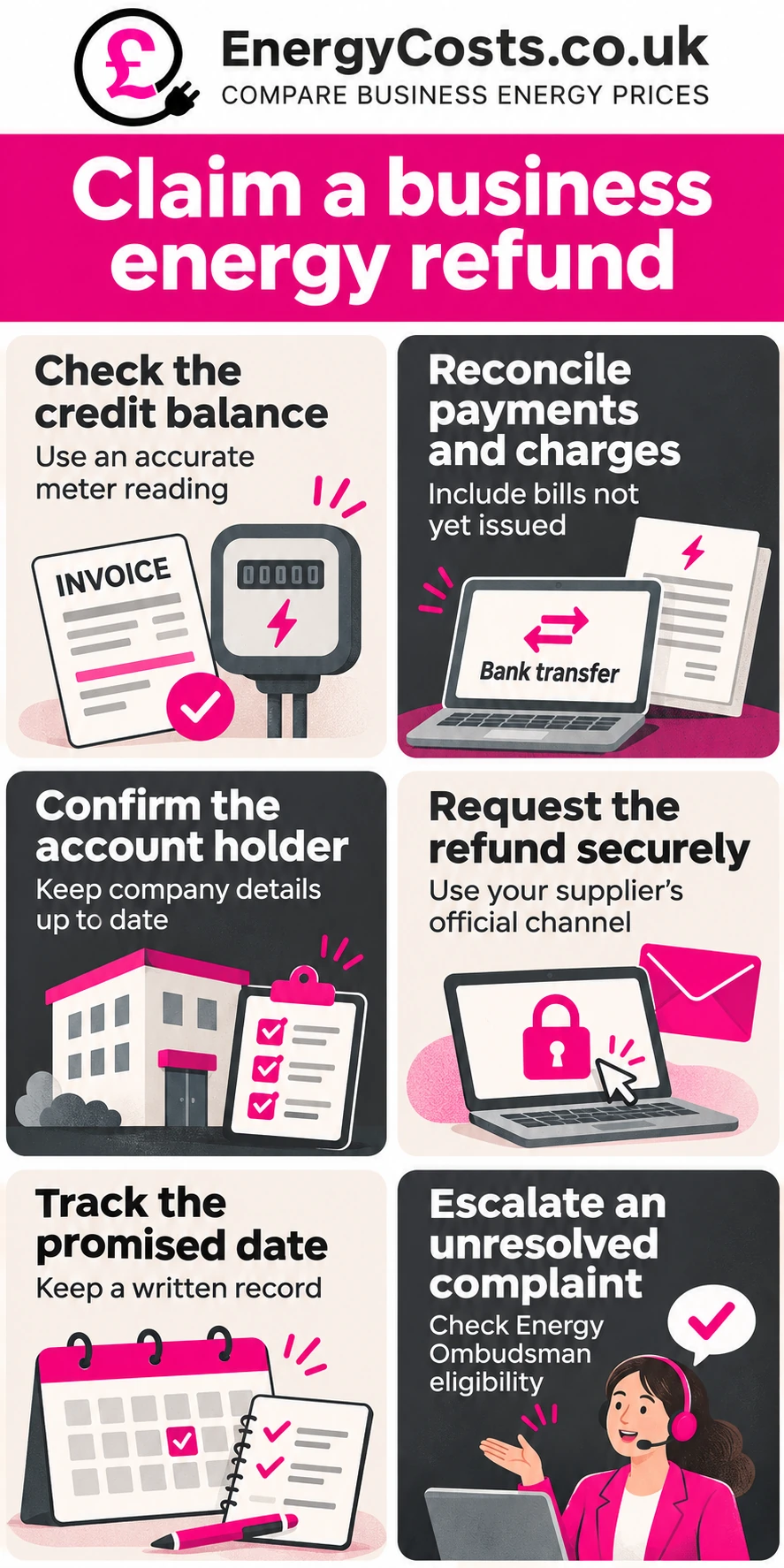
- Download your recent invoices and payment history before an old online account becomes inaccessible.
- Record an accurate meter reading, the date and the meter serial number, or check the latest validated smart data.
- Ask the supplier to bill the account to that reading and explain the resulting balance.
- Confirm the legal account holder, contact details and, where relevant, the forwarding address.
- Request the amount to be returned through the supplier’s official refund channel.
- Ask for the reference number, any missing evidence and the expected payment date.
- Check the bank, card or cheque payment against the amount promised and retain the final statement.
You do not need to treat a third-party refund offer as the first step. If someone contacts you unexpectedly, independently visit the supplier’s official website or use a number on a genuine bill. Never provide online banking passwords or one-time security codes to someone claiming to release an energy refund.
Business supplier refund processes compared
The following are the suppliers’ published processes. They use different starting points and conditions, so 10 working days after eligibility checks is not directly comparable with 28 days after a final invoice or 21 days after validation. These are supplier policies, not a universal statutory refund timetable for every business.
| Supplier | Published process | Action for the account holder |
|---|---|---|
| British Gas business | Eligible finalised accounts are processed automatically within 10 working days when the stated criteria are met | Check accurate readings, recent payment clearance and account-name requirements |
| EDF small business | Following a switch, says final credit is refunded automatically within 28 days of the final invoice | Keep the final invoice and ensure payment or forwarding details are current |
| TotalEnergies Gas & Power | Its refund-request page says payment can take up to 21 days after validation | Supply the requested account, reading and authorised company evidence securely |
British Gas’s refund guidance describes checks and payment methods, including possible transfer of credit to linked outstanding accounts. EDF’s unclaimed-credit guidance also explains requests for current accounts and asks closed-account customers to get in touch if credit has not arrived after 30 days. TotalEnergies’ refund-request guidance specifies the evidence needed for validation.
If your supplier is not listed, ask it to identify its own business refund policy and the stage your request has reached. “Awaiting validation” and “payment sent” are different statuses. Request a clear explanation of the remaining action, who must take it and the expected completion date.
Can you claim credit while the account is still open?
You can ask the supplier to review the balance and return money that is genuinely owed. With a fixed monthly Direct Debit, some seasonal credit may be intended to cover later consumption, particularly where heating demand is concentrated in winter. Ask for the forecast and payment calculation rather than assuming the whole displayed balance is excess.
For example, a business paying an illustrative £600 a month contributes £7,200 a year. If a credible revised forecast is £6,000, the annual difference is £1,200 before considering the existing balance or any change in charges. A refund may solve the immediate surplus, but leaving the payment unchanged can recreate the same problem.
Request two decisions: the amount that can be returned now and the appropriate payment amount going forward. A variable Direct Debit based on actual invoices has a different cash-flow pattern from a fixed monthly amount. Make sure any proposed change suits the business’s seasonal income and bill size.
Refunds after switching supplier
The old supplier needs to complete the final account using the appropriate closing reading. Keep a photograph where possible and check the new supplier’s opening reading against the old supplier’s closing reading. If they do not align, ask the suppliers to investigate through the relevant reading-dispute process rather than changing one figure in isolation.
You can still be waiting for a final bill even if the supply has moved successfully. Keep the old account details and correspondence until the balance has been settled. Check whether any payment taken shortly after the switch covers genuine earlier consumption or creates additional credit.
Do not assume a household switching-compensation or refund deadline automatically applies to a business contract. Ask which commercial contract, licence requirement or published supplier policy governs your case. If the supplier has missed its own promised date, record that specific failure in the complaint.
Refunds after moving out of commercial premises
Give the supplier your responsibility end date, final meter readings and forwarding details. The date you stop trading is not always the date your contractual or property responsibility ends. Keep a lease surrender, completion statement or handover agreement where it helps establish the correct account period.
If you continue to receive charges after a genuine change of responsibility, ask the supplier to correct the occupation records before calculating the refund. Our guide to setting up and closing business energy supplies when moving explains why accurate handover evidence matters.
A property left empty is another situation. If your company remains responsible for a vacant unit, standing charges and some other costs may continue. An account is not necessarily ready for final settlement just because nobody is working there. See energy bills for empty commercial premises before assuming all post-closure charges are incorrect.
Company names, trading names and bank accounts
The supplier must be satisfied it is returning money to the right party. A trading name, a director’s personal account and the legal company name are not automatically equivalent. If the business has changed name, provide the official evidence requested through a secure route.
For a limited company that has closed or entered insolvency, establish who has authority to deal with the balance before requesting payment to an individual. A refund belonging to the company does not automatically belong personally to its director. Ask the appointed professional where there is a formal insolvency process.
Keep the claim focused: identify the company, account, supply address and amount, then attach the documents needed to establish authority and the calculation. Avoid sending unrelated financial information. Verify any request for new bank details through a known supplier contact rather than replying to an unexpected message.
What if an incorrect bill caused the overpayment?
Ask for the bill to be corrected and for the account to be reconciled afterwards. Possible issues include the wrong opening reading, incorrect register allocation, a payment assigned to another account, an incorrect tariff start date or charges covering a period before your responsibility began.
If tax treatment is involved, establish the correct eligibility and period rather than simply asking for all VAT to be removed. Our guide to VAT on business energy explains why the supply and its use matter. Keep the credit note for your bookkeeping and check the treatment of any VAT adjustment with your accountant.
Back-billing protections are a separate issue. A qualifying microbusiness may have protection against certain previously unbilled charges for energy used more than 12 months ago, subject to the rules and exceptions. That is not the same as a universal 12-month limit on refund claims. See our business energy back-billing guide if the supplier’s reconciliation introduces older consumption.
What to do when a refund is delayed
Ask the supplier to identify the obstacle in writing. A recent payment may need to clear, a closing reading may be disputed or the account name may not match the evidence. If no explanation is given, or repeated commitments are missed, use the formal complaints process and retain the date it began.
| Problem | Practical request |
|---|---|
| Balance based on estimates | Rebill using an appropriate accurate reading |
| Refund “being checked” indefinitely | List the outstanding checks and a completion date |
| Payment allegedly sent but not received | Payment date, method and trace reference |
| Company details do not match | Explain which identity or name-change evidence is needed |
| Credit offset against another balance | Identify the account, amount and contractual basis |
| Repeated missed promises | Register a formal complaint and request a written response |
Eligible microbusinesses and small businesses can ask the Energy Ombudsman to consider an unresolved supplier dispute after eight weeks, or earlier with a deadlock letter, subject to its scheme rules. Our microbusiness rights guide explains the eligibility tests. Larger organisations should check the contract’s dispute route.
A practical refund request you can adapt
Keep the request specific: “Please reconcile account [number] using the reading of [reading] taken on [date], and refund the resulting excess credit. My calculation is £[amount], based on the attached invoices and payments. Please confirm any remaining checks, the refundable amount, payment method and expected payment date.”
For a closed account, add the final supply date, final invoice number and forwarding details. For an open account, ask for the Direct Debit and annual consumption forecast to be reviewed too. Keep a copy and note the complaint reference if the matter needs escalation.
Preventing credit from becoming an administrative problem
Review payment amounts when equipment, opening hours or occupancy changes. Download statements during a supplier switch, reconcile accounts after a move and keep company contact details current. A shared finance calendar can flag final refunds and deposits that have not yet been received.
Treat a refund as the return of your own money, and assess the next energy agreement separately. A supplier returning an overpayment is not by itself evidence that its renewal tariff is competitive. Compare prices and service requirements using accurate consumption once the account has been corrected.
Frequently asked questions
Yes, you can ask the supplier to reconcile the account and return excess credit. The amount depends on accurate charges, recent payments and any valid adjustments. Supply an up-to-date reading and request a clear calculation, payment method and expected date rather than relying only on the dashboard balance.
There is no single timetable that covers every commercial account. British Gas, EDF and TotalEnergies publish different processes and starting points for final credit. Ask your supplier which policy applies, whether validation is complete and when payment is expected. Keep evidence if a promised date is missed.
Not necessarily. Consumption may not yet have been billed, recent payments may still be clearing, or a fixed Direct Debit may have built seasonal credit. Ask for accurate billing and the annual payment forecast. A reconciled balance is stronger evidence than an unexplained figure on an online dashboard.
Yes. Keep the old account details, final invoice and transfer reading until the balance is settled. Check that the old supplier’s closing reading aligns with the new supplier’s opening reading. Confirm your forwarding or payment details and follow up through the old supplier’s official refund process.
A deposit has its own contractual return conditions. Keep it separate from ordinary account credit when reconciling the balance. Ask when it becomes returnable and whether the supplier proposes to offset any valid debt. A deposit receipt and the original terms help establish the amount and conditions.
A refund belonging to a limited company is not automatically the director’s personal money. The supplier may require evidence of authority and matching company details. Where the company is insolvent or closed, check the appropriate process and obtain advice before asking for payment to an individual account.
You can usually raise an ordinary account-credit request yourself through the supplier’s official business service. Download statements, provide the necessary evidence and ask for a written decision. Check fees and authority carefully if you choose outside assistance, particularly following an unsolicited approach about money supposedly owed.
Use the supplier’s formal complaints process first. Eligible microbusinesses and small businesses may be able to approach the Energy Ombudsman after eight weeks or sooner with a deadlock letter, subject to scheme rules. Keep invoices, readings, payment records and the supplier’s written responses to support the case.
Once your account is accurate, compare business energy quotes using your current consumption and payment requirements before accepting the next contract.