

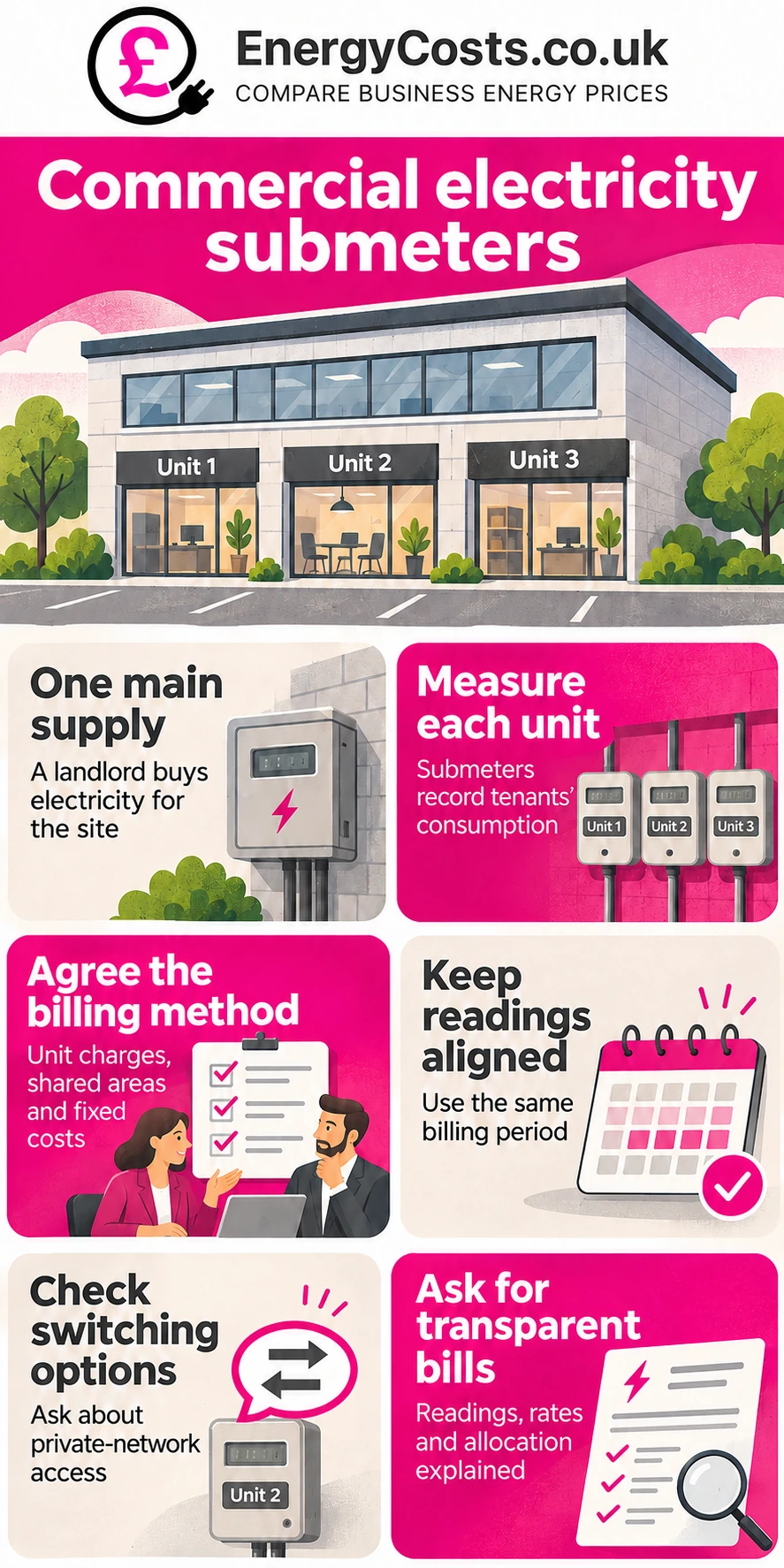
A commercial electricity submeter measures consumption within a building or private site, downstream of the main supply meter. Landlords use them to divide electricity costs between shops, offices, workshops and other units. Businesses can also use them to monitor departments or equipment without changing the main supply contract.
Before agreeing to a submetered tenancy or installing equipment, establish how readings become bills, which charges are shared and whether the tenant has a direct supplier contract. The meter’s purchase price is only part of the decision: installation, billing administration, accuracy and supplier-choice arrangements matter too.
A submeter is different from a separate electricity supply
The main supply meter records electricity entering the premises or private network. An internal submeter records an individual circuit or unit’s share. Installing that submeter does not, by itself, create a separately registered supply point or an ordinary direct contract between the tenant and a licensed supplier.
| Arrangement | Who buys the main electricity supply? | How the occupier pays |
|---|---|---|
| Direct supply with its own registered supply point | Individual business | Supplier invoices that business |
| Landlord’s bulk supply with tenant submeters | Landlord or site operator | Tenant receives an onward bill under the relevant agreement |
| Internal monitoring meter | Business holding the main contract | Department or equipment use is monitored internally |
| Third-party access on a private network | Arrangements allow an embedded customer to appoint a supplier | Settlement and network arrangements determine billing |
Ask for your MPAN if you believe the unit has its own direct supply. A submeter serial number or the landlord’s billing reference is not the same thing. Where the unit is already separately registered, ordinary business electricity comparison may be available subject to the current contract and meter details.
How much does a commercial electricity submeter cost?
Small basic meters can have modest hardware prices, while communicating, three-phase and current-transformer systems have a different specification. Choose equipment for the electrical load and intended billing use. A low-cost single-phase device is not a universal replacement for a larger commercial installation.
The following are published supply-only prices on JSG Metering Solutions’ product listings, checked during the research for this guide. They exclude delivery and installation. VAT-inclusive figures simply apply 20% VAT to the displayed hardware price.
| Hardware example | Published price excluding VAT | With 20% VAT | Important limitation |
|---|---|---|---|
| Eastron SDM120DB-MID single-phase meter | £30 | £36 | Listed as a basic 45A meter; check suitability for the load |
| Eastron SDM120-MOD-MID single-phase meter | £60 | £72 | Listed with Modbus communications and a 45A direct-connected rating |
| ABB four-module DIN-rail enclosure | £37 | £44.40 | Enclosure only; not a complete installed metering system |
See the seller’s SDM120DB-MID listing and SDM120-MOD-MID listing. Prices and stock can change. A qualified installer must select suitable equipment; the table is a pricing reference, not an installation recommendation for a particular property.
An illustrative four-unit installation budget
The example below combines the published hardware inputs above with invented installation and service allowances. It is a budgeting template, not a surveyed project quotation or a market-average installed cost. Existing wiring, available space, shutdown requirements and communications can materially alter the result.
| First-year budget line | Illustrative amount excluding VAT |
|---|---|
| Four £60 meters | £240 |
| Four £37 enclosures | £148 |
| Additional wiring and materials allowance | £200 |
| Installation, testing and commissioning allowance | £400 |
| First-year data or billing service allowance | £120 |
| Total excluding VAT | £1,108 |
| VAT at an assumed 20% | £221.60 |
| Total including VAT | £1,329.60 |
Ask which items are one-off costs and which recur each year. Confirm whether meter-reading communications, software, SIM cards, invoice production, maintenance and replacement are included. If the installer proposes current-transformer metering, request the CT specification, ratio and commissioning records rather than comparing its price with a small direct-connected meter.
What does MID-approved mean for tenant billing?
A device used to calculate a charge needs appropriate approval and accuracy for its application. A monitor intended only to show approximate energy use should not be assumed suitable for tenant billing. Ask for the conformity documentation for the exact model and the approval route that applies.
The Office for Product Safety and Standards explains the Measuring Instruments Regulations approval process. Its guidance explicitly says that Module B type approval alone does not approve a meter for primary or secondary billing applications. “MID” in a product description should therefore prompt a documentation check, not replace one.
Keep the serial number, initial register, date installed and commissioning information. For CT-operated systems, an incorrect ratio or installation can distort the recorded consumption. Ask the installer to demonstrate that each meter measures the correct unit and that import, export and shared circuits are understood.
How should a landlord calculate commercial tenant electricity bills?
Start with the lease or energy agreement, accurate readings and the main supplier’s charges for the matching period. The bill should make it possible to understand the tenant’s consumption, the rate applied and any allocation of shared costs. A single unexplained “electricity charge” is difficult to reconcile.
| Bill component | Information to request |
|---|---|
| Tenant consumption | Opening and closing readings, dates, serial number and multiplier |
| Unit price | Rate per kWh and the contractual basis for setting it |
| Shared-area electricity | What is included and the allocation method |
| Standing or other fixed costs | Total charge and the tenant’s agreed proportion |
| Metering or administration fees | Service provided, amount and contractual basis |
| VAT and other tax | How the onward supply has been assessed |
| Corrections | Previous invoices reversed or adjusted and why |
If the building has a multi-rate tariff, ask how the tenant’s day and night use is measured or allocated. Applying the cheapest night rate to all usage understates the cost; applying an expensive daytime rate to all usage may also misrepresent the agreed arrangement. The method should be explained and consistent with the contract.
Worked allocation across three business units
This illustrative reconciliation assumes a main meter records 10,000 kWh, tenant meters total 9,000 kWh, common areas use 800 kWh and a further 200 kWh is a verified, contractually recoverable network-loss allowance. It uses an invented 25p/kWh rate and £150 of fixed costs, excluding VAT, CCL and other charges.
The agreed allocation of common consumption, losses and fixed costs is assumed to be 40%, 35% and 25%. This is an example of a stated method, not a recommended or automatically lawful charging formula for every lease.
| Charge | Unit A | Unit B | Unit C | Total |
|---|---|---|---|---|
| Direct metered usage | 4,000 kWh | 3,000 kWh | 2,000 kWh | 9,000 kWh |
| Direct usage charge | £1,000 | £750 | £500 | £2,250 |
| Share of 800 kWh common use | £80 | £70 | £50 | £200 |
| Share of 200 kWh verified losses | £20 | £17.50 | £12.50 | £50 |
| Share of fixed costs | £60 | £52.50 | £37.50 | £150 |
| Total before tax and any other agreed items | £1,160 | £890 | £600 | £2,650 |
The total reconciles to 10,000 × £0.25 + £150 = £2,650. If the unexplained difference between the main and submeter totals were larger, investigate reading dates, unmetered circuits and equipment before calling it “losses”. The landlord’s own use should be identified rather than quietly allocated to tenant consumption.
Can a landlord profit from electricity sold to a business tenant?
Do not assume the domestic maximum resale price rule automatically applies to every commercial tenant. Ofgem’s resale review document explains that the existing Maximum Resale Price applies where the end use is domestic, and discusses whether protection should be extended to non-domestic consumers. A review proposal is not itself a new price cap.
For a business-only shop, office or workshop, examine the commercial agreement, the nature of the charges and applicable law. That does not mean any unexplained charge must be accepted. Ask for the relevant clause, calculation and supporting evidence, and obtain property or legal advice where the entitlement to recover a cost is disputed.
Mixed-use buildings need separate attention. A flat above a shop can involve domestic consumption even though the landlord buys the main supply on a business contract. Ofgem’s guidance for homes on business energy contracts explains the domestic resale position. The main account’s label alone does not decide every occupier’s rights.
Electricity, heat and EV charging also have different regulatory considerations. Do not assume an electricity submetering arrangement determines how communal heating or a dedicated vehicle chargepoint must be billed. Set out each service separately in the agreement and seek advice on the actual arrangement.
Can a submetered tenant choose another electricity supplier?
A basic internal submeter cannot simply be switched through the ordinary supplier-transfer process as though it were already a separate registered supply point. However, it is also too broad to say that tenants on private networks can never choose their supplier.
There are third-party-access arrangements for qualifying customers on licence-exempt networks. Government guidance on electricity licence exemptions explains the framework, and Elexon’s live third-party-access guidance describes the registration and settlement arrangements. Eligibility, contracts, technical work and a willing supplier all need consideration.
The Electricity Act’s third-party-access provisions include an expression-of-interest process and evidence of a willing third-party supplier in the relevant circumstances. This is different from submitting an ordinary tariff switch for a meter that is not registered for settlement.
Ask the landlord or network operator whether the unit has a registered supply identifier, what access process is available and what metering or network costs would arise. A new direct connection is another possible route, but may require substantial work and consent. Compare the expected saving with the full implementation cost and remaining lease term.
Moving into or leaving a submetered business unit
Record the meter serial number, all relevant registers and the date responsibility changes. Keep photographs and agree the readings with the landlord where possible. Check whether the bill includes only your unit, shared areas, a standing-cost allocation or prepaid credit inherited from another occupier.
| At move-in | At move-out |
|---|---|
| Obtain the charging schedule and current rates | Record and agree closing readings |
| Check the meter serves the correct unit | Confirm the responsibility end date |
| Record opening credit or debt separately | Request the final reconciliation |
| Identify the main-account holder | Check return conditions for any deposit |
| Ask who handles faults and billing disputes | Provide forwarding and payment details securely |
If the landlord holds the main supply contract, a direct supplier refund may belong to that account holder. Any adjustment due to you must then be considered under your own billing arrangement. Our business energy refunds guide explains the difference between a displayed credit and a reconciled amount owed.
Choosing manual, remote or prepaid submetering
Manual reading can be practical for a small site where meters are accessible and bills are infrequent. Remote reading may reduce administration across many units and improve the evidence for time-based tariffs. Check data ownership and export options so switching the billing service does not strand the readings.
Prepaid submetering collects money before use, but introduces credit-management and interruption risks for tenants. Agree who sets rates, how balances are displayed, what deductions occur and how supply problems are handled. A landlord’s prepaid unit should not be described as the same product as a licensed supplier’s business prepayment tariff.
For internal energy management, additional measurement can identify overnight loads or inefficient equipment without allocating tenant bills at all. Keep that monitoring purpose distinct from revenue billing when specifying the equipment, approval and accuracy requirements.
Questions to settle before you sign
Ask who holds the main supply contract, what the meter measures, how prices can change and how shared costs are divided. Request an example bill for the actual unit, along with the contract clauses supporting it. Establish the fault-reporting and dispute process and the practical supplier-choice options.
For landlords, an accurate meter schedule and transparent reconciliation reduce avoidable disputes. For tenants, understanding the complete bill before agreeing a lease can matter as much as the headline rent. Compare costs over the intended occupation, including any proposed works needed to obtain a different supply arrangement.
Frequently asked questions
It measures electricity used within a building or private network, downstream of the main supply meter. It can record an individual tenant’s unit, department or equipment. Installing one does not automatically create a separate registered supply point or a direct energy contract between a tenant and a licensed supplier.
Published examples in this guide include £30 and £60 single-phase meters, excluding VAT, delivery and installation. Installed cost depends on load, wiring, access, communications and the billing system. Obtain a site-specific quote and separate one-off equipment and labour from recurring software, administration and maintenance charges.
Yes, select equipment approved and suitable for the actual billing application. OPSS guidance explains that Module B type approval alone is insufficient for primary or secondary billing. Ask for the exact model’s conformity documentation and have a qualified installer verify the design, rating, configuration and commissioning records.
An ordinary unregistered internal submeter cannot simply follow a normal supplier switch. However, qualifying private-network customers may have third-party-access options involving registration, settlement arrangements and a willing supplier. Ask the network operator about the applicable process and costs rather than assuming supplier choice is either automatic or impossible.
Do not assume it does. Ofgem’s existing Maximum Resale Price framework concerns domestic end use, while commercial arrangements need their own assessment. Mixed-use premises require particular care. Ask for the lease or supply clause, charging calculation and relevant advice if a business tenant disputes the amount being recovered.
The agreement and applicable rules determine which costs can be recovered and how. Ask for the total fixed charge, the allocation basis and a reconciliation to the main account. Do not assume an equal split is always appropriate, or that the entire standing charge should be added to every tenant’s bill.
Possible causes include different reading dates, common-area consumption, unmetered circuits, losses or incorrect meter configuration. Compare matching periods and investigate the difference before allocating it. Check multipliers and current-transformer ratios where relevant. An unexplained gap should not automatically be treated as a chargeable network-loss allowance.
Usually start with the landlord, managing agent or billing provider named in your agreement. Establish who holds the direct supplier contract before using the supplier complaints route. Rights and redress can differ from a direct energy account. Keep readings, invoices and the charging clauses to support a specific challenge.
If your premises has a direct registered supply, compare business electricity quotes. For a private-network unit, first establish the available supply arrangements and their full costs.