
SSE Energy Solutions and Octopus Energy are two major UK business energy suppliers with strong renewable and low-carbon credentials, but their commercial propositions are built around different priorities.
SSE’s principal fixed products provide 100% renewable electricity from wind and hydro assets wholly or partly owned by SSE Renewables. Businesses can choose SSE Protect for extensive price certainty or SSE Choice for a potentially lower initial price where some non-energy costs remain variable. Larger organisations can access flexible purchasing, daily optimisation, named renewable assets and Corporate Power Purchase Agreements.
Octopus Energy for Business combines conventional fixed supply with a wider range of innovative SME tariffs. Shape Shifters Trio and Agile reward companies that move electricity use away from expensive periods, Summer Saver targets seasonal businesses and a No Standing Charge Tariff is available to qualifying sites.
Octopus also offers flat and dynamic export tariffs, renewable generation matching and services designed for batteries, electric vehicles and flexible demand.
SSE may be the better choice for a business seeking renewable-only electricity, conventional fixed pricing, renewable gas or a large commercial solar and infrastructure project.
Octopus may be more suitable where the company can actively alter when it consumes or exports electricity.
Neither supplier is universally cheaper. Business rates depend on the premises, meter, consumption profile, credit risk, contract term and market conditions when the quote is prepared.
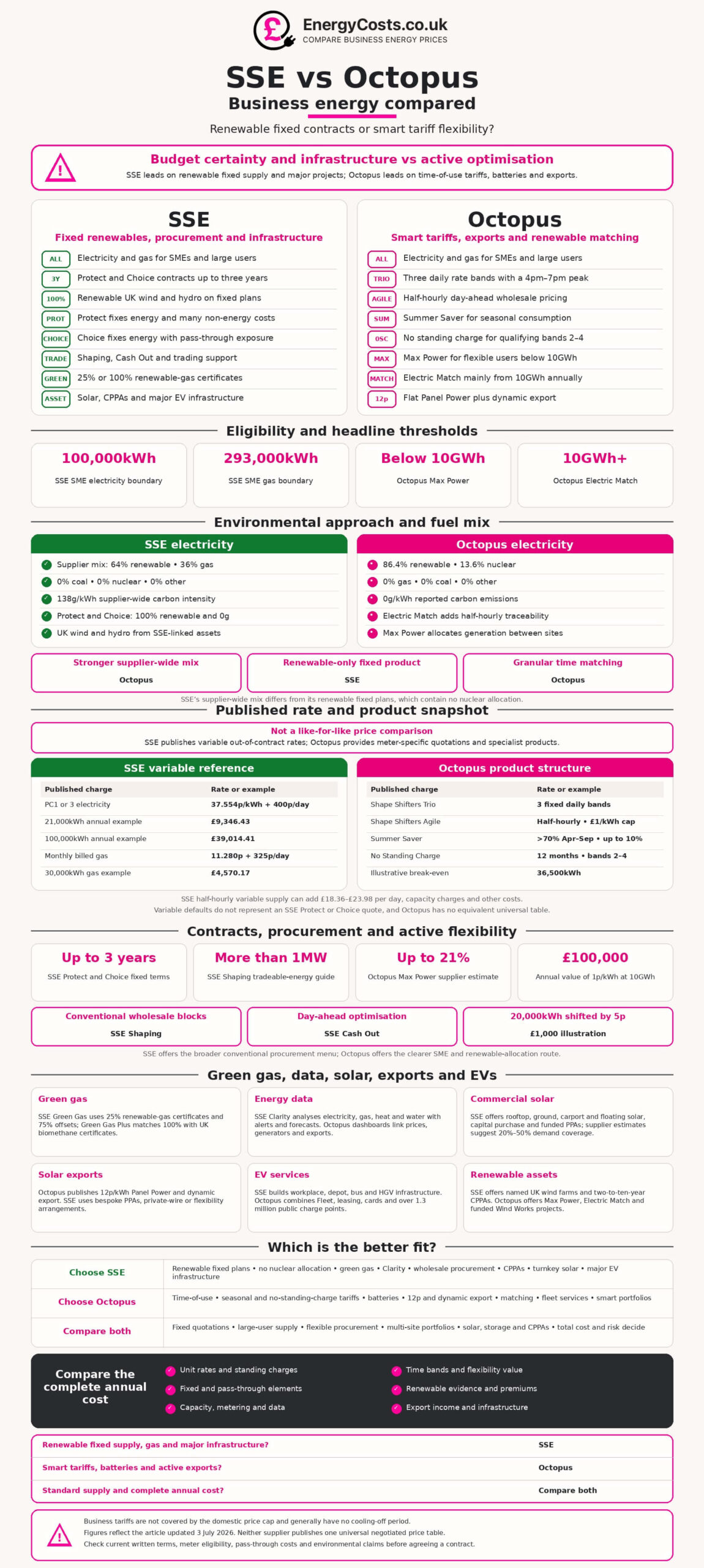
SSE vs Octopus at a glance
| Feature | SSE Energy Solutions | Octopus Energy for Business |
|---|---|---|
| Business electricity | Yes | Yes |
| Business gas | Yes | Yes |
| SME supply | Yes | Yes |
| Large-business supply | Yes | Yes |
| Standard national contracted prices | Not published | Not published |
| Main fixed terms | Up to three years | Individually quoted; specialist products commonly run for 12 months |
| Fully fixed product | SSE Protect | Conventional fixed quotation |
| Partly fixed product | SSE Choice | Product-dependent |
| Time-of-use SME tariff | No directly comparable permanent product | Shape Shifters Trio and Agile |
| Seasonal business tariff | No prominent equivalent | Summer Saver |
| No-standing-charge tariff | No prominent equivalent | Available for qualifying bands 2–4 |
| Renewable electricity with fixed plans | 100% renewable from SSE-linked UK assets | Zero-carbon supply; exact product mix should be confirmed |
| Supplier-wide renewable share | 64% | 86.4% |
| Supplier-wide natural gas share | 36% | 0% |
| Supplier-wide nuclear share | 0% | 13.6% |
| Supplier-wide carbon intensity | 138g CO₂/kWh | 0g CO₂/kWh |
| Renewable gas | SSE Green Gas and Green Gas Plus | No equally prominent standard business product |
| Named renewable asset | SSE Next Generation | Electric Match |
| Half-hourly renewable matching | CPPA and bespoke arrangements | Electric Match and Max Power |
| Energy analytics | SSE Clarity | Online account and smart-tariff dashboards |
| Flexible wholesale purchasing | SSE Shaping and SSE Cash Out | Bespoke large-commercial services |
| Flat solar export rate | No universal published business rate | Panel Power at 12p/kWh |
| Dynamic business export | Bespoke flexibility arrangements | Shape Shifters: Export |
| Commercial solar installation | Rooftop, ground, carport and floating solar | Bespoke projects and renewable-generation services |
| Fully funded solar | Yes, through a PPA | Project-dependent |
| EV proposition | Workplace, fleet, public and HGV infrastructure | Octopus Fleet, smart tariffs, leasing and Electroverse |
| Best suited to | Renewable fixed contracts and major infrastructure | Smart tariffs, batteries, exports and flexible businesses |
Which businesses can use SSE or Octopus?
Both suppliers serve SMEs, multi-site companies and larger commercial organisations.
SSE separates its standard customer routes using annual consumption:
| SSE customer category | Electricity | Gas |
|---|---|---|
| Small or medium business | Below 100,000kWh | Below 293,000kWh |
| Large business | Above 100,000kWh | Above 293,000kWh |
Businesses above these thresholds are directed towards SSE’s large-business products rather than being rejected. SSE’s fixed SME and large-business plans include renewable electricity as standard.
Octopus supplies smaller non-half-hourly sites, half-hourly businesses and multi-site portfolios. Some specialist services have narrower eligibility. Electric Match is primarily intended for organisations using at least 10GWh annually, while Max Power is designed for flexible half-hourly businesses consuming less than 10GWh.
Example suitability by business type
| Example organisation | Annual electricity use | Potentially suitable option |
|---|---|---|
| Independent shop | 12,000kWh | SSE Protect, SSE Choice or Octopus fixed tariff |
| Medium office | 60,000kWh | Fixed contract from either supplier |
| Seasonal visitor attraction | 100,000kWh | Octopus Summer Saver may be relevant |
| Restaurant | 120,000kWh | SSE large-business route or Octopus quotation |
| Workshop with flexible equipment | 250,000kWh | Octopus Shape Shifters |
| Hotel group | 1GWh | Multi-site contract from either supplier |
| Manufacturer with active procurement | Several GWh | SSE Shaping or Octopus bespoke service |
| Company requiring renewable gas | Any eligible level | SSE Green Gas products |
| Business wanting a named wind farm | Varies | SSE Next Generation |
| Flexible company below 10GWh | Below 10GWh | Octopus Max Power |
| Major company seeking half-hourly matching | At least 10GWh | Octopus Electric Match |
| Business requiring major solar infrastructure | Varies | SSE commercial solar |
| Electric HGV operator | High demand | SSE charging infrastructure |
| Mixed company-car fleet | Varies | Octopus Fleet and Electroverse |
Which supplier is cheaper?
There is no universal SSE-versus-Octopus business price.
Commercial quotations are influenced by:
- electricity MPAN or gas MPRN;
- postcode and distribution region;
- annual consumption;
- meter profile;
- half-hourly demand pattern;
- electricity voltage;
- agreed supply capacity;
- residual charging band;
- contract start date;
- contract duration;
- number of premises;
- payment method;
- credit history;
- renewable-product requirements; and
- wholesale energy prices.
A complete comparison should calculate:
- Annual consumption × unit rate
- daily standing charge × 365
- electricity-capacity charges
- meter and data costs
- network and government charges
- environmental-product costs
- VAT and Climate Change Levy where applicable
− export income and other credits
A lower unit rate may be outweighed by a higher standing charge or capacity cost.
How unit-rate differences affect annual costs
| Annual consumption | Value of 0.5p/kWh | Value of 1p/kWh | Value of 3p/kWh | Value of 5p/kWh |
|---|---|---|---|---|
| 10,000kWh | £50 | £100 | £300 | £500 |
| 25,000kWh | £125 | £250 | £750 | £1,250 |
| 50,000kWh | £250 | £500 | £1,500 | £2,500 |
| 100,000kWh | £500 | £1,000 | £3,000 | £5,000 |
| 250,000kWh | £1,250 | £2,500 | £7,500 | £12,500 |
| 1GWh | £5,000 | £10,000 | £30,000 | £50,000 |
| 5GWh | £25,000 | £50,000 | £150,000 | £250,000 |
| 10GWh | £50,000 | £100,000 | £300,000 | £500,000 |
For a business consuming 10GWh, a rate difference of only 1p/kWh is worth £100,000 annually.
How standing charges affect costs
| Daily standing-charge difference | Annual difference per meter | Difference across ten meters |
|---|---|---|
| 25p | £91.25 | £912.50 |
| 50p | £182.50 | £1,825 |
| £1 | £365 | £3,650 |
| £2 | £730 | £7,300 |
| £5 | £1,825 | £18,250 |
| £10 | £3,650 | £36,500 |
Standing charges are particularly important for:
- low-use premises;
- seasonal companies;
- vacant buildings;
- commercial landlords;
- businesses with numerous small meters; and
- organisations retaining inactive supplies.
SSE Protect
SSE Protect is the supplier’s principal fully fixed product.
It provides:
- fixed wholesale energy costs;
- fixed existing non-energy costs;
- contracts lasting up to three years;
- 100% renewable electricity;
- protection against many changes in network and government charges; and
- optional renewable-gas products.
SSE reserves the right to pass through exceptional new taxes, levies or costs outside its control, so “fully fixed” should not be interpreted as an unconditional guarantee that no conceivable charge can change.
SSE Protect may suit a company that values:
- predictable budgets;
- simple forecasting;
- protection from wholesale volatility;
- fewer pass-through adjustments;
- renewable-only electricity; and
- a conventional fixed contract.
The supplier assumes more pricing risk under Protect, so the opening quotation may be higher than a partly fixed alternative.
SSE Choice
SSE Choice fixes the wholesale energy element for up to three years, while allowing some non-energy costs to change.
Potentially variable elements can include:
- transmission costs;
- distribution charges;
- balancing costs;
- environmental levies;
- Capacity Market charges;
- Contracts for Difference;
- industry-service fees; and
- future regulatory costs.
SSE positions Choice as its lower-cost fixed option. It includes the same 100% renewable electricity as Protect.
Choice may be appropriate where the business:
- wants protection from wholesale price increases;
- accepts some movement in industry costs;
- prioritises a lower initial quotation;
- understands pass-through billing; or
- can tolerate modest budget variation.
SSE Protect versus SSE Choice
| Feature | SSE Protect | SSE Choice |
|---|---|---|
| Wholesale energy cost | Fixed | Fixed |
| Existing non-energy costs | Largely fixed | Can change |
| Contract duration | Up to three years | Up to three years |
| Renewable electricity | Included | Included |
| Budget certainty | Higher | Lower |
| Opening price | Potentially higher | Positioned as lower |
| Exposure to network charges | Reduced | Greater |
| Best suited to | Predictable budgeting | Lower initial cost with accepted risk |
A company should request both options and compare the additional price charged for transferring non-energy-cost risk to SSE.
Octopus conventional fixed tariffs
Octopus offers individually priced fixed business tariffs alongside its smart products.
A conventional fixed tariff may suit a business that:
- cannot change its operating hours;
- wants predictable unit rates;
- prefers online account management;
- wants zero-carbon electricity;
- does not have a compatible smart meter; or
- does not want exposure to half-hourly wholesale prices.
Octopus does not publish one national business price table. Customers obtain a quote based on the meter and premises. Its multi-site proposition can combine switching, renewals, billing and online account management within one portfolio.
Octopus Shape Shifters
Shape Shifters is Octopus’s principal smart business electricity product.
To qualify, a business normally needs:
- a working smart meter;
- an active Direct Debit;
- payments to be up to date; and
- no overdue energy debt.
There are two versions.
Shape Shifters Trio
Trio applies three predetermined prices across different periods of the day.
The evening period between 4pm and 7pm is usually the most expensive, while the remaining periods are cheaper.
Trio is easier to budget than a fully dynamic product because each time band has a known rate.
It may suit:
- EV fleets;
- laundries;
- cold-storage businesses;
- workshops;
- commercial kitchens;
- battery owners;
- water-heating systems; and
- manufacturers able to avoid the evening peak.
Shape Shifters Agile
Agile changes the unit rate every half hour according to wholesale market conditions.
The business can see its prices approximately 24 hours ahead and alter consumption accordingly. Octopus caps the rate at £1/kWh.
Agile may suit businesses with:
- automated energy controls;
- battery storage;
- controllable machinery;
- flexible refrigeration;
- overnight EV charging;
- on-site generation;
- flexible heating and cooling; or
- staff able to monitor day-ahead prices.
It may be unsuitable for a company that must consume heavily during expensive periods.
Potential value of shifting demand
Suppose a company consumes 100,000kWh annually and can move 20% of its demand away from expensive periods.
The flexible consumption would be 20,000kWh.
| Difference between expensive and cheaper periods | Illustrative annual saving |
|---|---|
| 3p/kWh | £600 |
| 5p/kWh | £1,000 |
| 10p/kWh | £2,000 |
| 15p/kWh | £3,000 |
| 20p/kWh | £4,000 |
These are mathematical examples rather than promised Octopus savings.
A business should analyse at least one full year of half-hourly data before selecting Agile or Trio.
SSE fixed tariffs versus Shape Shifters
| Requirement | SSE Protect or Choice | Octopus Shape Shifters |
|---|---|---|
| Simple conventional rate | Strong | Trio is structured; Agile is dynamic |
| Protection from wholesale increases | Strong | Limited under Agile |
| Ability to benefit from daily low prices | No | Yes |
| Reward for moving demand | Limited | Strong |
| Smart meter needed | Helpful | Required |
| Need to monitor daily prices | No | Agile customers should |
| Suitable for inflexible business | Strong | Less likely |
| Suitable for batteries and EVs | Conventional supply | Strong |
| Renewable-only electricity | Included | Product evidence should be checked |
| Maximum contract certainty | SSE Protect | Lower |
SSE is stronger for conventional budget certainty.
Octopus is stronger where the company can actively optimise consumption.
Octopus Summer Saver
Summer Saver has two unit rates:
- a cheaper rate from April to September; and
- a higher rate from October to March.
Octopus says the product may save up to 10% where more than 70% of annual electricity is consumed during the summer period.
Potential users include:
- campsites;
- outdoor attractions;
- holiday parks;
- seaside businesses;
- seasonal cafés;
- wedding venues;
- visitor centres; and
- summer event operators.
A company with more winter consumption than expected could pay more than it would on a conventional tariff.
SSE does not prominently advertise an equivalent seasonal SME product.
Octopus No Standing Charge Tariff
Octopus offers a 12-month tariff with no daily standing charge to qualifying businesses in electricity bands 2, 3 and 4.
The network costs normally collected through a standing charge are incorporated into the unit rate instead.
Octopus says the tariff is more likely to help businesses near the lower end of their consumption band. It does not require a smart meter.
Break-even example
Assume a conventional tariff has:
- a £2 daily standing charge; and
- a unit rate 2p/kWh below the no-standing-charge option.
The annual standing charge is:
£2 × 365 = £730
The break-even consumption is:
£730 ÷ £0.02 = 36,500kWh
Below 36,500kWh, the no-standing-charge tariff may be cheaper.
Above that level, the higher unit rate may cost more than the avoided standing charge saves.
SSE does not currently promote a directly comparable business tariff.
SSE Variable Business Rates
SSE publishes Variable Business Rates for businesses that are not on a contracted energy plan.
These may apply where:
- a fixed agreement expires;
- the customer moves into SSE-supplied premises;
- no replacement tariff has been agreed; or
- the business otherwise remains on variable or out-of-contract pricing.
The following rates took effect in June 2026 and exclude VAT and levies such as Climate Change Levy. They can change with market conditions.
Non-half-hourly electricity
| Meter type | Unit rate | Standing charge |
|---|---|---|
| Profile class 1 or 3 unrestricted | 37.554p/kWh | 400p per day |
| Profile class 2 or 4 day | 38.318p/kWh | 400p per day |
| Profile class 2 or 4 night | 34.388p/kWh | 400p per day |
| Evening and weekend weekday | 39.121p/kWh | 400p per day |
| Evening and weekend rate | 35.434p/kWh | 400p per day |
| Off-peak | 34.266p/kWh | 400p per day |
| Profile classes 5–8 unrestricted | 35.729p/kWh | 984.36p per day |
| Profile classes 5–8 day | 36.867p/kWh | 984.36p per day |
| Profile classes 5–8 night | 32.090p/kWh | 984.36p per day |
The 400p daily charge equals £1,460 annually.
The profile class 5–8 charge equals approximately £3,593 annually.
Illustrative SSE variable electricity costs
The following examples use the profile class 1 or 3 unrestricted rate.
| Annual electricity use | Unit-rate cost | Standing charge | Total |
|---|---|---|---|
| 10,000kWh | £3,755.44 | £1,460 | £5,215.44 |
| 21,000kWh | £7,886.43 | £1,460 | £9,346.43 |
| 25,000kWh | £9,388.60 | £1,460 | £10,848.60 |
| 50,000kWh | £18,777.20 | £1,460 | £20,237.20 |
| 100,000kWh | £37,554.41 | £1,460 | £39,014.41 |
These figures exclude VAT, CCL and other possible charges.
They are variable default prices rather than negotiated SSE Protect or Choice quotations.
SSE half-hourly variable prices
SSE’s June 2026 half-hourly schedule includes several different structures.
Examples for low-voltage supplies include:
| Half-hourly arrangement | Unit rate | Standing charge | Capacity charge |
|---|---|---|---|
| Measurement class C or E unrestricted | 33.669p/kWh | £23.98 per day | £1.58 per kVA monthly |
| Measurement class C or E day | 34.741p/kWh | £23.98 per day | Around £1.58 per kVA monthly |
| Measurement class C or E night | 29.521p/kWh | £23.98 per day | Around £1.58 per kVA monthly |
| Measurement class F or G unrestricted | 31.547p/kWh | £18.36 per day | Product-dependent |
| Measurement class F or G day | 32.753p/kWh | £18.36 per day | Product-dependent |
| Measurement class F or G night | 26.717p/kWh | £18.36 per day | Product-dependent |
Seasonal time-of-day peak rates can exceed 70p/kWh during selected winter periods.
This demonstrates why a half-hourly business should use actual interval data rather than comparing only one headline average rate.
SSE Variable Business Rates for gas
| Customer category | Unit rate | Standing charge |
|---|---|---|
| EUC bands 1–2, monthly billed | 11.280p/kWh | 325p per day |
| EUC bands 1–2, quarterly billed | 11.749p/kWh | 325p per day |
| EUC band 3 | 10.735p/kWh | 962p per day |
| EUC bands 4–9 | Individually priced | Individually priced |
Bands 1–2 cover annual consumption up to 293,000kWh.
Band 3 covers 293,001kWh to 732,000kWh.
Illustrative monthly billed gas costs
| Annual gas use | Unit-rate cost | Standing charge | Total |
|---|---|---|---|
| 25,000kWh | £2,819.93 | £1,186.25 | £4,006.18 |
| 30,000kWh | £3,383.92 | £1,186.25 | £4,570.17 |
| 50,000kWh | £5,639.86 | £1,186.25 | £6,826.11 |
| 100,000kWh | £11,279.73 | £1,186.25 | £12,465.98 |
| 250,000kWh | £28,199.31 | £1,186.25 | £29,385.56 |
These examples exclude VAT, CCL and other charges.
Can the published prices identify a winner?
No.
SSE’s public figures are Variable Business Rates applying without a negotiated fixed agreement.
Octopus does not publish one equivalent nationwide table for every business meter.
A negotiated SSE Protect or Choice quotation could be materially lower than the variable prices, while an Octopus rate depends on the specific meter, region and contract date.
The published SSE figures are most useful for showing the potential cost of remaining out of contract.
SSE flexible procurement
SSE provides two prominent large-business flexible products.
SSE Shaping
SSE Shaping allows the customer to purchase baseload power in:
- monthly blocks;
- quarterly blocks; or
- seasonal blocks.
The company can spread purchases across several dates instead of fixing its entire volume at one moment.
Customers can trade through SSE’s online portal or obtain live quotations from its trading team.
SSE describes its flexible contracts as particularly relevant to organisations with more than 1MW of tradeable energy or annual energy expenditure of around £1 million.
SSE Cash Out
SSE Cash Out combines real-time consumption with half-hourly prices for the following day.
It can help businesses:
- improve forecasts;
- move consumption;
- optimise batteries;
- use on-site generation;
- respond to wholesale-price changes; and
- sell power through SSE’s Virtual Power Plant.
It is designed for sophisticated organisations able to alter daily demand.
Octopus services for larger businesses
Octopus’s large-commercial proposition places more emphasis on renewable allocation and flexible consumption than on a conventional list of wholesale-purchasing products.
Max Power
Max Power is intended for half-hourly businesses consuming less than 10GWh annually.
Octopus links the company with selected solar and wind generators. A dashboard forecasts their output, enabling the business to use more electricity when its allocated generators are producing.
Businesses can also transfer self-generated power between their own sites, even where the premises are in different parts of Britain. Octopus advertises potential savings of up to 21%, but this is a supplier estimate rather than a guaranteed outcome.
Electric Match
Electric Match is primarily intended for businesses consuming at least 10GWh annually.
The business selects renewable generators, and Octopus matches consumption with their output in half-hourly periods.
The dashboard identifies:
- the selected generators;
- forecast output;
- actual consumption;
- successfully matched electricity;
- emissions information; and
- billing data.
Octopus says businesses could match up to 80% of consumption while receiving 100% guaranteed green electricity overall.
SSE versus Octopus for large businesses
| Requirement | Likely stronger fit |
|---|---|
| Conventional fully fixed procurement | SSE Protect |
| Fix wholesale but pass through industry costs | SSE Choice |
| Buying wholesale blocks over time | SSE Shaping |
| Day-ahead daily optimisation | SSE Cash Out |
| Access to a trading portal | SSE |
| Business below 10GWh wanting renewable allocation | Octopus Max Power |
| Business above 10GWh wanting granular matching | Octopus Electric Match |
| Self-generation shared between sites | Octopus Max Power |
| Named wind-farm certificate | SSE Next Generation |
| Conventional Corporate PPA | Compare both |
| Virtual Power Plant participation | SSE |
| Smart-tariff-led flexibility | Octopus |
SSE has the more conventional energy-procurement range.
Octopus has the more distinctive renewable-matching and digitally optimised proposition.
Comparing renewable electricity
Both suppliers have strong environmental credentials, but the details differ.
SSE supplier-wide fuel mix
SSE Energy Solutions’ 2024/25 total business fuel mix was:
| Source | SSE Energy Solutions |
|---|---|
| Renewables | 64% |
| Natural gas | 36% |
| Coal | 0% |
| Nuclear | 0% |
| Other | 0% |
| Reported carbon intensity | 138g/kWh |
| Radioactive waste | 0g/kWh |
SSE’s renewable plans were separately reported as 100% renewable with zero market-based carbon emissions. Its other plans and Variable Business Rates were 2% renewable and 98% natural gas, with reported emissions of 374g/kWh.
Octopus supplier-wide fuel mix
Octopus’s corresponding 2024/25 mix was:
| Source | Octopus |
|---|---|
| Renewables | 86.4% |
| Nuclear | 13.6% |
| Natural gas | 0% |
| Coal | 0% |
| Other | 0% |
| Reported carbon emissions | 0g/kWh |
| High-level radioactive waste | 0.0010g/kWh |
Octopus’s supplier-wide mix was entirely zero carbon but not renewable-only because it included nuclear generation.
Which supplier has greener electricity?
| Environmental priority | Likely stronger fit |
|---|---|
| Higher supplier-wide renewable share | Octopus |
| Lower supplier-wide carbon intensity | Octopus |
| No fossil fuel in the total supplier mix | Octopus |
| Renewable-only fixed electricity | SSE |
| No nuclear allocation | SSE renewable plans |
| No radioactive waste | SSE renewable plans |
| Electricity from supplier-linked UK assets | SSE |
| Named wind-farm certificate | SSE Next Generation |
| Granular half-hourly matching | Octopus Electric Match |
| Smart tariffs that reward flexible use | Octopus |
| Conventional annual REGO matching | SSE |
| Multi-site renewable allocation | Octopus |
Octopus has the stronger supplier-wide fuel mix.
SSE provides the clearer renewable-only fixed product because its fixed plans are matched entirely with renewable wind and hydro rather than nuclear generation.
SSE renewable electricity
SSE Protect and Choice include 100% renewable electricity generated by UK wind and hydro assets wholly or partly owned by SSE Renewables.
The electricity is matched through Renewable Energy Guarantees of Origin and independently verified for market-based Scope 2 reporting.
SSE Next Generation
SSE Next Generation allocates the customer’s electricity to a named UK wind farm.
The business receives:
- 100% renewable electricity;
- a proof-of-purchase certificate;
- the name of the allocated wind farm;
- REGOs; and
- evidence supporting zero market-based Scope 2 emissions.
This may suit companies that want a more tangible renewable story than a generic annual certificate.
Octopus Electric Match
Electric Match provides more detailed time-based evidence.
Consumption is matched with specific generators in the same half-hour in which the electricity is produced.
This can show:
- when the renewable electricity was generated;
- where it came from;
- which generator produced it;
- how much of the business’s use was matched; and
- the remaining electricity covered by standard green supply.
Octopus allows customers to select generators from solar, hydro, onshore wind and offshore wind categories.
SSE Next Generation is easier to communicate because it links annual consumption with one named wind farm.
Electric Match provides more granular operational evidence.
Corporate Power Purchase Agreements
SSE offers two principal CPPA structures.
Named Asset CPPA
The business purchases renewable electricity linked to a particular wind, solar or hydro asset.
Portfolio PPA
The customer purchases renewable electricity supported by a portfolio of SSE assets over a flexible period ranging from two to ten years.
SSE can combine a CPPA with fixed or flexible energy purchasing and provide balancing and supply services.
Octopus also supports renewable generator arrangements through Electric Match, Max Power, Wind Works and bespoke commercial contracts.
The strongest provider depends on:
- contract duration;
- generator ownership;
- required traceability;
- electricity-price formula;
- volume risk;
- sleeving costs;
- credit requirements; and
- whether the project creates additional renewable capacity.
Comparing business gas
SSE has a major advantage where a company requires an environmental gas product.
SSE Green Gas
SSE Green Gas matches:
| Environmental mechanism | Proportion |
|---|---|
| Renewable-gas certificates | 25% |
| Carbon offsets | 75% |
SSE also pledges to plant one UK tree for each Green Gas customer.
SSE Green Gas Plus
Green Gas Plus matches 100% of consumption with renewable-gas certificates from UK biomethane production.
The physical gas arriving through the national network remains a mixture of renewable and fossil gas. The certificates show that an equivalent quantity of biomethane has entered the system.
Octopus supplies conventional business gas but does not currently promote an equally prominent standard business product with a defined renewable-gas percentage.
Which is better for business gas?
| Requirement | Likely stronger fit |
|---|---|
| Ordinary business gas | Compare quotations |
| 25% certificate-backed renewable gas | SSE |
| 100% RGGO-backed gas | SSE Green Gas Plus |
| Carbon-offset product | SSE |
| Tree-planting commitment | SSE |
| Smart electricity alongside gas | Either |
| Company replacing gas with electrification | Compare wider technology services |
Gas burned at the premises still creates direct emissions. Certificates and offsets affect the environmental accounting rather than preventing combustion.
SSE Clarity
SSE Clarity is included free with SSE energy plans for customers with suitable smart or AMR data.
It allows businesses to:
- view half-hourly energy use;
- use graphs and tables;
- compare different sites;
- organise data by meter, energy type or time;
- set email alerts;
- identify unusual consumption;
- create forecasts; and
- download reports.
SSE Clarity can analyse information from electricity, gas, heat and water meters.
This makes it particularly useful for:
- multi-site estates;
- manufacturers;
- housing providers;
- public-sector organisations;
- hospitality groups; and
- businesses needing conventional energy reporting.
Octopus data tools
Octopus business customers can manage:
- bills;
- payments;
- meter data;
- contract information;
- multiple premises;
- export credits; and
- smart-tariff details online.
Agile users can see the next day’s half-hourly prices, while Electric Match and Max Power customers receive forecasting dashboards linked to renewable-generator output.
Which has the better data platform?
| Requirement | Likely stronger fit |
|---|---|
| Conventional energy-use analysis | SSE Clarity |
| Email alerts for unexpected consumption | SSE |
| Multi-site comparison | SSE Clarity |
| Forecasting energy demand | SSE |
| Next-day half-hourly price information | Octopus |
| Active tariff optimisation | Octopus |
| Renewable-generator forecasts | Octopus |
| Granular carbon reporting | Octopus Electric Match |
| Utility data beyond electricity | SSE Clarity |
| Battery and export optimisation | Octopus |
SSE Clarity is the stronger conventional energy-management platform.
Octopus’s dashboards are more closely integrated with tariffs, generators and changing market prices.
Commercial solar
SSE has the clearer end-to-end commercial solar proposition.
Its services include:
- rooftop solar;
- ground-mounted solar;
- solar carports;
- floating solar;
- battery storage;
- private-wire connections;
- EV charging integration;
- capital purchase;
- fully funded PPAs;
- operation and maintenance; and
- large solar farms for major users.
SSE says a suitable on-site system might supply approximately 20% to 50% of annual electricity demand. Its capital-purchase examples indicate potential payback periods of five to eight years, while fully funded PPAs require no initial capital payment. These are indicative supplier estimates rather than guarantees.
SSE solar funding
Capital purchase
The customer pays for and owns the equipment.
Potential benefits include:
- free electricity after payback;
- ownership of the asset;
- full attribution of carbon savings;
- potential property-value improvement; and
- long-term protection against grid prices.
Fully funded PPA
SSE funds, installs, operates and maintains the system.
The customer purchases the generated electricity under a long-term agreement.
This reduces the upfront cost but creates contractual commitments involving:
- electricity prices;
- indexation;
- roof or land rights;
- property transfers;
- minimum purchase obligations;
- early termination; and
- end-of-term ownership.
Octopus renewable infrastructure
Octopus is particularly strong where the business already has, or intends to combine:
- solar generation;
- battery storage;
- flexible consumption;
- multiple sites;
- smart import tariffs;
- dynamic export; and
- renewable-generator matching.
Its Max Power product can allocate generation between business sites, while Wind Works can fund on-site wind and other renewable equipment through a long-term PPA.
SSE is more likely to appeal to a business seeking a standard turnkey solar installation.
Octopus may suit a company wanting the solar project integrated with smart import and export pricing.
Solar export payments
Octopus Panel Power
Panel Power pays qualifying businesses:
12p per exported kWh
It applies to eligible business and charity solar systems and requires an Octopus import tariff.
Illustrative annual income is:
| Annual export | Income at 12p/kWh |
|---|---|
| 5,000kWh | £600 |
| 10,000kWh | £1,200 |
| 25,000kWh | £3,000 |
| 50,000kWh | £6,000 |
| 100,000kWh | £12,000 |
Shape Shifters: Export
Shape Shifters: Export changes its payment every half hour in line with wholesale prices.
A business can potentially:
- store daytime solar generation;
- charge a battery when electricity is cheap;
- delay exports; and
- sell electricity during more valuable periods.
SSE does not prominently publish one universal flat business SEG rate. Larger projects are more likely to use a bespoke PPA, private-wire agreement or flexibility arrangement.
Which is better for solar?
| Solar requirement | Likely stronger fit |
|---|---|
| Turnkey rooftop installation | SSE |
| Ground-mounted solar | SSE |
| Floating solar | SSE |
| Solar carports | SSE |
| Fully funded solar PPA | SSE |
| Published flat export payment | Octopus |
| Dynamic battery export | Octopus |
| Sharing generation between company sites | Octopus Max Power |
| Solar linked with flexible wholesale procurement | Compare both |
| Large private-wire solar farm | SSE |
| Battery and tariff optimisation | Octopus |
| Complete operation and maintenance package | SSE |
Electric vehicles
The suppliers also have different EV strengths.
SSE EV services
SSE provides:
- workplace chargers;
- employee and visitor charging;
- fleet-depot infrastructure;
- public rapid-charging hubs;
- bus charging;
- HGV charging;
- site design;
- network connections;
- installation;
- operation; and
- maintenance.
Its workplace service is described as a scalable end-to-end proposition, while its first dedicated HGV hub uses chargers rated at up to 360kW.
Octopus Fleet
Octopus launched an expanded Octopus Fleet service in February 2026.
Its components include:
- public charging through Electroverse;
- fleet charging cards;
- business payment cards;
- home-charging reimbursement;
- EV chargers;
- batteries;
- rooftop solar;
- tariffs; and
- consolidated fleet charging information.
Electroverse provides access to more than 1.3 million charge points across over 50 countries, according to Octopus.
The wider Octopus group also offers business leasing and employee salary-sacrifice schemes.
Which is better for EVs?
| EV requirement | Likely stronger fit |
|---|---|
| Workplace charging installation | SSE |
| Large fleet depot | SSE |
| Bus or HGV infrastructure | SSE |
| Ultra-rapid public hub | SSE |
| EV salary sacrifice | Octopus |
| Company-car leasing | Octopus |
| Public charging roaming | Octopus Electroverse |
| Home charging reimbursement | Octopus Fleet |
| Charging cards and consolidated payments | Octopus |
| Off-peak smart electricity tariff | Octopus |
| Solar, battery and charger infrastructure | Compare both |
| Full site and grid design | SSE |
SSE is likely to be stronger for physical infrastructure.
Octopus has the broader fleet-management, vehicle and roaming ecosystem.
Multi-site businesses
Both suppliers can manage portfolios containing several premises.
SSE provides:
- consolidated account management;
- fixed and flexible procurement;
- SSE Clarity;
- half-hourly meter support;
- renewable products;
- commercial solar;
- EV infrastructure; and
- large-estate services.
Octopus provides:
- joint switching;
- contract renewals;
- billing;
- one online account;
- central customer support;
- export services;
- Max Power;
- Electric Match; and
- renewable allocation between sites.
SSE may be stronger for a conventional national estate requiring infrastructure and procurement support.
Octopus may be more attractive where the organisation wants to share generation, manage exports or actively alter consumption.
Contract expiry and out-of-contract pricing
SSE customers without an active fixed or flexible plan move onto variable or out-of-contract rates that can change with the market. SSE advises customers to renew or agree a fixed plan for greater certainty.
Octopus customers should also review their contract before expiry, particularly when using a specialist smart tariff.
Businesses should begin reviewing prices several months before the end date to avoid:
- variable default rates;
- deemed pricing;
- higher standing charges;
- loss of renewable-product benefits; or
- a rushed procurement decision.
Contract risks to check
Business energy agreements are not protected by the household price cap, and there is generally no cooling-off period after a contract is accepted, including when the agreement is made by telephone.
Before choosing SSE or Octopus, check:
- unit rates;
- standing charges;
- contract duration;
- start and end dates;
- fixed and variable components;
- pass-through network costs;
- smart-tariff time bands;
- Agile’s £1/kWh ceiling;
- capacity charges;
- meter and data costs;
- early termination fees;
- renewable evidence;
- nuclear content;
- export eligibility;
- broker commission;
- renewal procedures; and
- post-contract prices.
SSE advantages and disadvantages
Advantages
- Supplies SMEs and large organisations.
- Offers fully and partly fixed contracts.
- SSE Protect provides extensive budget certainty.
- SSE Choice may provide a lower opening price.
- Fixed terms are available for up to three years.
- Fixed electricity plans include 100% renewable electricity.
- Renewable power comes from SSE-linked UK wind and hydro assets.
- No nuclear generation is allocated to renewable plans.
- SSE Next Generation links consumption with a named wind farm.
- Offers 25% and 100% renewable-gas products.
- SSE Clarity is included with energy plans.
- Provides email consumption alerts and multi-site reporting.
- SSE Shaping supports staged wholesale purchasing.
- SSE Cash Out supports daily optimisation.
- Offers CPPAs lasting up to ten years.
- Strong rooftop, ground-mounted and floating solar proposition.
- Fully funded solar PPAs are available.
- Strong workplace, fleet, bus and HGV charging services.
Disadvantages
- Negotiated contract rates are not published.
- Fixed terms are generally limited to three years.
- SSE Choice leaves customers exposed to non-energy-cost changes.
- Exceptional new charges may be passed through under SSE Protect.
- Variable Business Rates include high standing charges.
- Half-hourly default charges can be substantial.
- Supplier-wide carbon intensity is higher than Octopus’s.
- Non-renewable SSE products were reported as 98% gas.
- No direct SME equivalent to Shape Shifters is prominently offered.
- No seasonal business tariff is prominently advertised.
- No no-standing-charge business tariff is prominently offered.
- No universal flat commercial export rate is published.
- Flexible procurement is complex and aimed at larger users.
- Long PPAs require detailed legal review.
Octopus advantages and disadvantages
Advantages
- Supplies business gas and electricity.
- Offers conventional and smart tariffs.
- Shape Shifters Trio provides predictable time bands.
- Agile follows half-hourly wholesale prices.
- Prices can be viewed approximately one day ahead.
- Summer Saver supports seasonal companies.
- A No Standing Charge Tariff is available to qualifying businesses.
- Supplier-wide electricity contains no gas or coal.
- Supplier-wide carbon intensity is reported as zero.
- Panel Power pays 12p/kWh.
- Dynamic business export is available.
- Strong fit for solar panels and batteries.
- Max Power supports flexible businesses below 10GWh.
- Electric Match provides granular half-hourly traceability.
- Generation can be allocated between company sites.
- Strong EV leasing, fleet and public charging ecosystem.
- Multi-site joint portfolios are available.
Disadvantages
- Negotiated fixed prices are not published.
- Agile rates can reach £1/kWh.
- Shape Shifters requires a working smart meter.
- An inflexible business may save little through time-of-use pricing.
- The supplier-wide mix includes nuclear power.
- The general Octopus mix is zero carbon rather than renewable-only.
- Summer Saver can cost more if winter consumption is underestimated.
- The No Standing Charge Tariff can have a higher unit rate.
- Panel Power requires an Octopus import contract.
- Electric Match is mainly aimed at customers using at least 10GWh.
- Max Power requires half-hourly metering and flexible consumption.
- Octopus does not prominently offer a standard green business-gas product.
- Its conventional commercial-solar installation proposition is less prominent than SSE’s.
- Smart and dynamic products require more active management.
Which supplier is better for different businesses?
| Business type or requirement | Likely better fit | Reason |
|---|---|---|
| Small business wanting predictable costs | SSE Protect | Extensive fixed-cost protection |
| Company accepting some pass-through costs | SSE Choice | Lower-cost fixed structure |
| Business with flexible machinery | Octopus | Shape Shifters |
| EV fleet charging overnight | Octopus | Smart time-of-use pricing |
| Business needing a fleet-depot installation | SSE | End-to-end infrastructure |
| Seasonal summer company | Octopus | Summer Saver |
| Low-use qualifying meter | Octopus may suit | No Standing Charge Tariff |
| Company requiring renewable-only electricity | SSE | Included with fixed plans |
| Company prioritising supplier-wide carbon intensity | Octopus | Zero reported carbon |
| Business excluding nuclear power | SSE renewable plan | Octopus mix includes nuclear |
| Company wanting a named wind farm | SSE Next Generation | Named asset and certificate |
| Business wanting half-hourly generator matching | Octopus | Electric Match |
| Flexible half-hourly user below 10GWh | Octopus Max Power | Designed for this segment |
| Large company wanting staged purchasing | SSE Shaping | Monthly, quarterly or seasonal blocks |
| Business wanting daily market optimisation | SSE Cash Out or Octopus Agile | Different scales and structures |
| Company requiring renewable gas | SSE | Two defined products |
| Business needing conventional energy analytics | SSE Clarity | Forecasts, alerts and multi-site reports |
| Business wanting battery export optimisation | Octopus | Dynamic export |
| Company seeking turnkey commercial solar | SSE | Wider installation proposition |
| Business wanting floating solar | SSE | Specialist service |
| Company wanting a published flat export rate | Octopus | Panel Power |
| Electric HGV operator | SSE | High-powered HGV hub expertise |
| Company-car and mixed charging fleet | Octopus | Leasing, cards and reimbursement |
| Large multi-site organisation | Compare both | Different procurement and technology strengths |
Final verdict: SSE vs Octopus
SSE Energy Solutions and Octopus Energy are both strong choices for UK businesses, but their main advantages suit different operating models.
SSE is likely to be the better option where the company wants:
- a conventional fixed contract;
- extensive budget certainty;
- renewable-only electricity;
- no nuclear allocation;
- renewable gas;
- a named UK wind farm;
- wholesale block purchasing;
- daily optimisation for a major energy user;
- detailed conventional energy reporting;
- a Corporate PPA;
- a turnkey commercial solar installation;
- floating or private-wire solar; or
- substantial workplace, fleet or HGV charging infrastructure.
Octopus is likely to be the stronger choice where the business wants:
- smart time-of-use pricing;
- direct exposure to half-hourly wholesale prices;
- a seasonal tariff;
- no daily standing charge;
- battery optimisation;
- dynamic export payments;
- a published 12p/kWh solar export tariff;
- renewable generation shared between sites;
- granular half-hourly matching;
- EV leasing and salary sacrifice; or
- consolidated home, depot and public fleet charging.
The environmental comparison depends on the measure used.
Octopus had the stronger supplier-wide fuel mix:
- 86.4% renewable;
- 13.6% nuclear;
- no gas or coal; and
- reported carbon emissions of 0g/kWh.
SSE’s total business mix was:
- 64% renewable;
- 36% natural gas; and
- reported carbon emissions of 138g/kWh.
However, SSE Protect and Choice include 100% renewable electricity from SSE-linked wind and hydro assets. These products have no nuclear allocation and are reported as zero carbon under market-based Scope 2 accounting.
The pricing question can only be answered through matched quotations.
A fair comparison should require SSE and Octopus to quote for:
- the same meter and postcode;
- identical annual consumption;
- the same contract start date;
- an equivalent term;
- all standing charges;
- fixed and pass-through costs;
- capacity and metering fees;
- equivalent renewable credentials;
- smart-tariff savings using actual data;
- export income;
- broker commission;
- early termination charges;
- renewal and default pricing; and
- the complete projected annual cost.
For most businesses, the decision can be summarised as follows:
- choose SSE for renewable fixed supply, green gas, large-scale procurement and infrastructure;
- choose Octopus for smart tariffs, batteries, exports, EV fleet services and granular renewable matching;
- compare SSE Protect with an Octopus conventional fixed tariff where price certainty matters;
- compare SSE Cash Out with Octopus Agile or Max Power where demand can be actively controlled;
- compare SSE’s bespoke export and PPA options with Octopus Panel Power and Shape Shifters: Export where generation is central; and
- select the supplier offering the lowest realistic total annual cost after operational flexibility and export revenue have been considered.
FAQ
It depends on the individual quotation. SSE offers conventional fixed structures, while Octopus smart tariffs may reward businesses that can change when they consume electricity.
Yes. Both supply business gas. SSE also offers Green Gas and Green Gas Plus.
Yes. SSE and Octopus supply electricity to SMEs, multi-site organisations and larger companies.
SSE Protect and Choice include 100% renewable electricity from SSE-linked UK wind and hydro assets.
No. SSE’s supplier-wide 2024/25 mix was 64% renewable and 36% natural gas.
Octopus’s supplier-wide mix was 86.4% renewable and 13.6% nuclear. It was zero carbon but not renewable-only.
Octopus. Its disclosed mix contained no gas or coal and had reported emissions of 0g/kWh.
SSE’s renewable plans. Octopus’s overall mix includes 13.6% nuclear generation.
SSE Protect fixes wholesale energy and existing non-energy costs for up to three years, subject to exceptional new charges or taxes.
SSE Choice fixes wholesale energy, but selected network, policy and industry costs can change during the contract.
It is a smart business electricity product. Trio has three fixed daily periods, while Agile changes its price every half hour.
Yes. Prices follow wholesale markets and can reach £1/kWh. It is best suited to businesses that can control their electricity use.
Octopus Summer Saver may suit companies using more than 70% of their annual electricity between April and September.
SSE. Green Gas matches 25% with renewable certificates, while Green Gas Plus matches 100%.
SSE Clarity is stronger for conventional reporting, forecasting and alerts. Octopus is stronger for day-ahead price and renewable-generator information.
Octopus publishes a flat business export payment of 12p/kWh and also offers dynamic export. SSE generally uses bespoke commercial arrangements.
SSE has the clearer end-to-end service covering rooftop, ground-mounted, carport and floating solar, batteries and funded PPAs.
SSE is stronger for physical depot, public and HGV infrastructure. Octopus is stronger for leasing, roaming, payment tools and smart charging.