

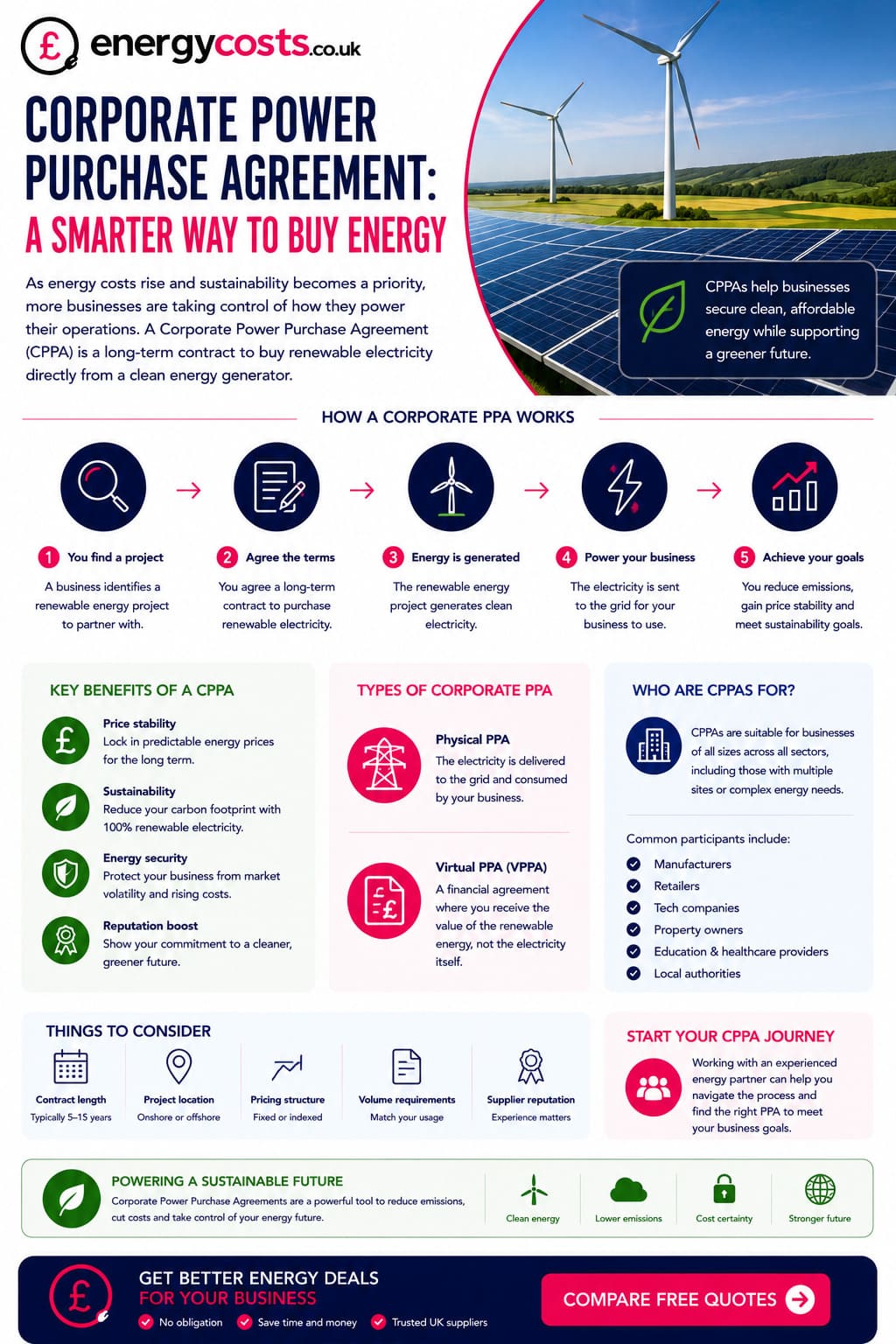
A corporate power purchase agreement, usually shortened to corporate PPA or CPPA, is a long-term electricity contract between a business and a power generator. In most cases, the generator is a renewable energy project, such as a solar farm, wind farm or on-site solar installation.
The short answer is: a corporate PPA allows a business to buy electricity linked to a specific generation project, usually for a fixed or agreed pricing structure over several years.
For businesses, the main attraction is long-term price stability, renewable electricity sourcing and protection against some wholesale market volatility. The main drawback is complexity. CPPAs are usually longer, more technical and more legally demanding than standard business electricity contracts.
Summary answer
| Question | Answer |
|---|---|
| What does CPPA stand for? | Corporate power purchase agreement |
| What is a CPPA? | A long-term electricity purchase agreement between a business and a generator |
| What type of power is usually involved? | Usually renewable electricity, such as solar or wind |
| Typical contract length | Often 5–20 years, depending on the structure |
| Who uses CPPAs? | Large energy users, manufacturers, retailers, data centres, public bodies and increasingly SMEs through solar PPAs |
| Is a CPPA the same as a green tariff? | No. A CPPA is linked to a specific generation project or output |
| Does a CPPA remove all energy bill costs? | No. Businesses still pay network charges, balancing costs, supplier fees, taxes and other charges |
| Main advantage | Long-term price certainty and renewable electricity sourcing |
| Main risk | Long commitment, price risk, volume mismatch, legal complexity and project delivery risk |
The UK Government defines PPAs as long-term electricity purchase agreements between a generator and a buyer, where the buyer may be a utility, supplier, trader or a business using the electricity for its own needs. In January 2026, the Government launched a call for evidence on how to improve the corporate PPA market in Great Britain, specifically to help businesses secure stable, competitively priced electricity.
How does a corporate PPA work?
A corporate PPA usually involves three main parties:
| Party | Role |
|---|---|
| Business buyer | Agrees to buy electricity or financial value from the generation project |
| Generator | Owns or develops the renewable energy asset |
| Licensed supplier | Handles supply, balancing, sleeving, metering and residual power where required |
In a simple version, the business agrees to buy power from a renewable generator for a set period. The generator gets predictable revenue, which can help finance the project. The business gets a long-term electricity price and renewable electricity credentials.
In practice, most CPPAs are more complicated than that. Electricity may still be delivered through the grid, a supplier may still be needed, and the business may still need to buy additional electricity when the generator is not producing enough.
CPPA versus standard business electricity contract
A standard business electricity contract is usually with a supplier. The supplier buys electricity, manages industry costs and sells power to the business at an agreed rate.
A CPPA is different because it links the business more directly to a generation asset.
| Feature | Standard business electricity contract | Corporate PPA |
|---|---|---|
| Main counterparty | Electricity supplier | Generator, often with a supplier involved |
| Contract length | Often 1–5 years | Often 5–20 years |
| Price structure | Fixed, variable, flexible or pass-through | Fixed, indexed, floor/cap, pay-as-produced or synthetic |
| Renewable link | May be based on supplier fuel mix or REGOs | Usually linked to a specific project |
| Complexity | Lower | Higher |
| Legal work | Usually limited | Usually significant |
| Volume risk | Usually managed by supplier | May sit partly with business |
| Best suited to | Most SMEs | Larger or more energy-aware businesses |
A CPPA is therefore not just a cheaper tariff. It is a procurement strategy.
Main types of corporate PPA
There are several types of CPPA. The right structure depends on the size of the business, the location of the generator, the business’s electricity profile and the level of risk the business is willing to take.
| CPPA type | How it works | Best suited to |
|---|---|---|
| Physical sleeved CPPA | Power is sold by the generator and “sleeved” through a licensed supplier to the business | Large businesses wanting renewable sourcing and supplier support |
| Virtual or synthetic CPPA | A financial contract settles the difference between agreed PPA price and market price | Large businesses comfortable with financial settlement |
| Private wire PPA | A generator supplies electricity directly to a nearby business through a private cable | Sites near generation assets or on-site solar projects |
| On-site solar PPA | A third party installs and owns solar panels on the business premises, and the business buys the power | SMEs, warehouses, factories, farms, schools and care homes |
| Aggregated or multi-buyer PPA | Several buyers share output from one or more projects | Medium-sized businesses that cannot support a large CPPA alone |
| Portfolio PPA | The business buys from several renewable projects | Large buyers seeking volume and technology diversification |
Physical sleeved CPPA
A physical sleeved CPPA is one of the most common corporate structures for larger buyers.
The generator sells power to the business, but the electricity is physically delivered through the grid. A licensed supplier “sleeves” the electricity, handling settlement, metering, balancing and top-up supply.
| Element | What happens |
|---|---|
| Generator | Produces renewable electricity |
| Business | Contracts to buy the power |
| Supplier | Sleeves the power through the electricity market |
| Grid | Physically transports the electricity |
| REGOs | May be transferred to the business as evidence of renewable generation |
This structure allows a business to contract with a renewable generator even if the generator is not located next door.
Virtual or synthetic CPPA
A virtual CPPA is a financial arrangement rather than a direct physical supply contract.
The business agrees a strike price with a renewable generator. The generator sells power into the wholesale market. The business continues buying electricity from its normal supplier. The CPPA then settles the difference between the agreed strike price and the market reference price.
| Market outcome | What happens |
|---|---|
| Market price above agreed CPPA price | Generator may pay the business the difference |
| Market price below agreed CPPA price | Business may pay the generator the difference |
| Market price equals agreed CPPA price | Little or no settlement difference |
A virtual CPPA can help a business hedge electricity prices and support renewable generation, but it is more complex. It may involve accounting, credit, collateral and mark-to-market considerations.
Private wire PPA
A private wire PPA is where electricity is supplied directly from a generator to a customer through a private electrical connection rather than being fully delivered through the public grid.
This is common with on-site or near-site projects such as:
- rooftop solar on a warehouse
- solar panels on a factory
- ground-mounted solar next to a business site
- wind generation near an industrial facility
- energy centres serving large campuses
A private wire PPA can reduce exposure to some grid-import costs because the business consumes electricity generated on or near the site. However, the business will usually still need a grid supply contract for times when the generator is not producing enough.
On-site solar PPA
An on-site solar PPA is one of the most accessible forms of PPA for smaller and medium-sized businesses.
Under this model, a third-party investor or solar company pays for, installs, owns and maintains the solar panels. The business agrees to buy the electricity generated at an agreed pence-per-kWh rate for a long period.
| Feature | Typical on-site solar PPA arrangement |
|---|---|
| Upfront cost | Usually £0 or low upfront cost |
| Asset ownership | Third-party funder or solar provider |
| Contract length | Often 10–25 years |
| Power price | Agreed p/kWh rate, often lower than grid import price |
| Maintenance | Usually handled by the system owner |
| Grid electricity | Still needed when solar output is insufficient |
| Best suited to | High daytime electricity users with suitable roofs |
Recent reporting has highlighted growing SME interest in this model. The Times reported in 2026 that some UK solar providers were offering no-upfront-cost solar and battery PPAs, with one provider quoting an average customer price of 18p/kWh compared with an average business electricity price of 24.3p/kWh from the latest ONS figures cited in the article; another provider reported some clients achieving energy costs of 8p/kWh.
CPPA versus green tariff
A CPPA is not the same as a standard green electricity tariff.
With a green tariff, a supplier may match some or all of the customer’s electricity use with renewable certificates. With a CPPA, the business usually has a stronger contractual link to a specific renewable generator or portfolio of projects.
| Feature | Green tariff | Corporate PPA |
|---|---|---|
| Contracting party | Usually supplier | Generator, supplier or both |
| Link to specific project | Sometimes weak or indirect | Usually stronger |
| Contract length | Often 1–5 years | Often 5–20 years |
| Additionality | Variable | Can be stronger, especially if it supports new build |
| Complexity | Lower | Higher |
| Price certainty | Depends on tariff | Often a key objective |
| Suitable for SMEs | Yes | Usually larger users, though solar PPAs can suit SMEs |
Ofgem says the Renewable Energy Guarantees of Origin scheme provides certificates that demonstrate electricity has been generated from renewable sources and provides transparency to consumers about the proportion of electricity suppliers source from renewable electricity. A CPPA may include REGOs, but businesses should check exactly what certificates they receive and whether they can make renewable electricity claims.
Why are businesses interested in CPPAs?
Businesses consider CPPAs for several reasons.
| Reason | Why it matters |
|---|---|
| Price stability | Long-term contracts can reduce exposure to wholesale price volatility |
| Sustainability | CPPAs can support renewable electricity claims and net zero plans |
| Additionality | New-build CPPAs can help finance new renewable generation |
| Brand value | Customers, investors and supply chains may value cleaner electricity |
| Budget planning | A known electricity price can help long-term forecasting |
| Carbon reporting | CPPAs can support Scope 2 emissions strategies |
| Energy security | Diversifies procurement away from short-term market buying |
| Competitive advantage | Large energy users may secure better long-term cost visibility |
The UK Government’s 2026 corporate PPA call for evidence specifically framed CPPAs as a way to support stable, competitively priced electricity, industrial competitiveness and growth.
Does a CPPA reduce business electricity bills?
It can, but not always.
A CPPA can reduce costs if the agreed PPA price is lower than future market prices or if an on-site/private wire arrangement reduces imported grid electricity. However, a CPPA does not remove every electricity cost.
A business may still pay:
- network charges
- balancing charges
- supplier sleeving fees
- top-up electricity costs
- metering charges
- taxes
- Climate Change Levy, where applicable
- VAT
- imbalance costs
- shaping costs
- legal and advisory fees
For grid-supplied CPPAs, the business is usually not simply replacing the whole electricity bill with one renewable price. It is usually replacing or hedging the wholesale electricity element, while many non-commodity costs remain.
Example: how a CPPA can affect costs
A business uses 2,000,000kWh of electricity per year.
It signs a CPPA for 1,000,000kWh per year at 11p/kWh. Its alternative grid electricity commodity price is assumed to be 15p/kWh.
| Item | Calculation | Annual cost |
|---|---|---|
| CPPA power | 1,000,000kWh × 11p | £110,000 |
| Equivalent market power | 1,000,000kWh × 15p | £150,000 |
| Indicative saving on CPPA volume | Difference | £40,000 |
This is only the power-price comparison. It does not include network charges, balancing costs, supplier fees, top-up electricity, legal costs or the risk that market prices could fall below the CPPA price.
Example: on-site solar PPA for an SME
A business uses 150,000kWh of electricity per year and installs an on-site solar PPA that generates 60,000kWh per year for use on site.
| Item | Assumption |
|---|---|
| Annual business electricity use | 150,000kWh |
| Solar PPA electricity used on site | 60,000kWh |
| Grid electricity price | 25p/kWh |
| Solar PPA price | 14p/kWh |
| Saving per solar kWh | 11p |
| Annual saving | £6,600 |
This is an illustrative example. Actual savings depend on roof size, generation, self-consumption, grid rates, PPA price, indexation and contract terms.
Typical CPPA contract length
CPPA contracts are usually longer than normal business energy contracts.
| CPPA type | Typical length |
|---|---|
| Standard SME energy contract | 1–5 years |
| On-site solar PPA | 10–25 years |
| Physical sleeved CPPA | 7–20 years |
| Virtual CPPA | 10–15 years |
| New-build renewable CPPA | Often 10–20 years or more |
Long contract length is both the advantage and the risk. It can provide price stability, but it also locks the business into a structure that may outlast management teams, leases, premises plans or changes in electricity demand.
How is CPPA pricing set?
CPPA pricing can be structured in several ways.
| Pricing model | How it works | Main advantage | Main risk |
|---|---|---|---|
| Fixed price | Business pays a fixed p/kWh price | Predictable | May be expensive if market prices fall |
| Indexed price | Price rises with inflation or another index | Protects generator from cost inflation | Business faces annual price increases |
| Floor and cap | Price moves within an agreed band | Shares risk | More complex |
| Market discount | Price set at discount to market rate | Can maintain savings | Less long-term certainty |
| Pay-as-produced | Business buys actual output as generated | Simple link to generation | Volume may not match demand |
| Baseload | Generator or supplier shapes output into a flatter profile | Easier for buyer | Shaping cost may be higher |
| Contract for difference style | Financial settlement against market price | Useful hedge | Accounting and market risk |
The most suitable pricing model depends on whether the business wants certainty, savings, carbon benefits or a balance of all three.
What is volume risk?
Volume risk is one of the main issues in a CPPA.
A renewable generator does not usually produce exactly the same amount of electricity that the business uses at each moment. Solar produces during daylight. Wind output changes with weather. Business electricity demand changes by day, season and activity.
| Situation | Risk |
|---|---|
| Generator produces less than expected | Business must buy more top-up power |
| Generator produces more than business needs | Excess may be sold or financially settled |
| Business demand falls | Business may be over-contracted |
| Business demand rises | CPPA covers a smaller share of usage |
| Weather changes output | Renewable generation varies |
| Site closes or relocates | Long-term PPA obligation may remain |
This is why CPPAs are often easier for businesses with stable, predictable electricity demand.
What are REGOs and why do they matter?
REGOs are Renewable Energy Guarantees of Origin certificates. They are used to show that electricity has been generated from renewable sources.
For a business signing a CPPA, REGOs are important because they support renewable electricity claims and carbon reporting. The business should check whether the CPPA includes REGOs, whether they are bundled with the power, and whether the certificates are transferred to the buyer or retained by another party.
Ofgem says REGOs demonstrate that electricity has been generated from renewable sources and are designed to provide transparency to consumers about renewable electricity sourcing.
What are sleeving fees?
A sleeving fee is a charge paid to a licensed electricity supplier to manage the delivery and settlement of power from a generator to the business through the electricity system.
The supplier may handle:
- electricity settlement
- balancing
- top-up power
- spill power
- metering
- billing
- reconciliation
- data reporting
- credit support
- supply licence obligations
Sleeving fees are important because they can affect the total value of the CPPA. A low generation price may look attractive, but the full delivered cost may be higher once sleeving, shaping and balancing costs are included.
What is shaping?
Shaping is the process of turning irregular renewable generation into a supply profile that better matches the buyer’s electricity demand.
For example, a solar farm produces during the day and more in summer. A business may use electricity in the evening, at night or during winter. The difference between generation and demand has to be managed.
| Issue | Why shaping matters |
|---|---|
| Solar output peaks at midday | Business may need power outside solar hours |
| Wind output is variable | Business demand may be more stable |
| Business uses power 24/7 | Renewable project may not produce continuously |
| Demand changes seasonally | Renewable output may not match seasonal usage |
| Generator output is intermittent | Supplier or market must fill gaps |
Shaping can make a CPPA more useful, but it adds cost.
What risks come with a CPPA?
CPPAs can be valuable, but they carry risks that standard energy contracts may not.
| Risk | What it means |
|---|---|
| Long-term commitment | The business may be locked in for 10–20 years |
| Market price risk | The CPPA price could become expensive if market prices fall |
| Volume risk | Generation may not match business demand |
| Project delivery risk | A new renewable project may be delayed |
| Credit risk | The generator or buyer may face financial problems |
| Legal complexity | Contracts require specialist review |
| Accounting treatment | Some structures may affect accounts or derivatives reporting |
| Collateral requirements | Some agreements may require credit support |
| Sleeving cost risk | Supplier charges can affect savings |
| REGO risk | Renewable claims depend on certificate treatment |
| Change of premises | Site moves or closures can create problems |
| Grid connection risk | Renewable projects can be delayed by connection queues |
The Government’s 2026 call for evidence was partly designed to identify barriers and opportunities in the GB CPPA market, reflecting the fact that CPPAs are useful but not always easy for businesses to access.
Which businesses are best suited to a CPPA?
CPPAs are usually most suitable for businesses with high, predictable electricity demand and long-term site or operational certainty.
| Business type | CPPA suitability |
|---|---|
| Large manufacturer | Strong candidate if electricity demand is stable |
| Data centre | Strong candidate because of high continuous demand |
| Supermarket group | Strong candidate for portfolio CPPAs |
| Warehouse or logistics operator | Good candidate, especially with rooftop solar |
| Food producer | Good candidate if demand is stable |
| Cold storage business | Strong candidate due to continuous load |
| Hotel group | Possible candidate, especially multi-site |
| Care home group | Possible candidate for on-site solar PPAs |
| Small office | Usually less suitable for a large CPPA |
| Start-up or short-lease tenant | Usually less suitable because of long commitment |
The business does not always need to be huge. On-site solar PPAs can suit smaller businesses if they have enough roof space, daytime usage and long-term occupancy.
When might a CPPA be unsuitable?
A CPPA may be unsuitable if the business:
- has uncertain long-term electricity demand
- may relocate soon
- has a short lease
- uses very little electricity
- cannot commit to a long contract
- lacks internal finance or procurement expertise
- needs simple monthly billing
- cannot manage legal complexity
- has weak creditworthiness
- wants complete flexibility at renewal
- is uncomfortable with market-price risk
For many smaller businesses, a shorter fixed business electricity contract or an on-site solar lease may be easier than a full corporate PPA.
CPPA and business energy bills
A CPPA does not automatically replace a business electricity bill. In many cases, it sits alongside a normal supplier contract.
A business may still need:
| Requirement | Why it is needed |
|---|---|
| Residual supply contract | To cover electricity not supplied by the CPPA |
| Import supply agreement | To bring power through the grid |
| Sleeving supplier | To manage physical delivery and settlement |
| Export arrangement | For excess on-site generation |
| Metering and data services | To measure usage and settlement volumes |
| Network charge recovery | To pay TNUoS, DUoS and other network costs |
| Tax treatment | VAT and CCL still need to be considered |
This is why businesses should compare the delivered cost of a CPPA, not just the headline p/kWh generation price.
Does a CPPA avoid non-commodity charges?
Usually not completely.
Non-commodity charges include network, balancing, policy and system costs such as TNUoS, DUoS, BSUoS, Contracts for Difference, Capacity Market and other charges. Some of these may still apply, especially where electricity is delivered through the public grid.
| CPPA type | Non-commodity charge exposure |
|---|---|
| Physical sleeved CPPA | Usually still exposed to many grid and supplier charges |
| Virtual CPPA | Standard electricity bill continues separately |
| Private wire PPA | May reduce some grid-import charges for on-site consumption |
| On-site solar PPA | Reduces imported electricity, but standing charges and grid costs remain |
| Aggregated CPPA | Depends on supplier and structure |
A private wire or on-site PPA can reduce imported grid electricity, but it does not necessarily eliminate standing charges, backup supply costs or all network-related costs.
CPPA and Contracts for Difference
A CPPA is different from the Government’s Contracts for Difference scheme.
Contracts for Difference, or CfDs, are a support mechanism for low-carbon generation. The CfD scheme provides revenue stability for eligible low-carbon generators through a guaranteed strike price, funded through the Supplier Obligation Levy on electricity suppliers.
| Feature | Corporate PPA | Government CfD |
|---|---|---|
| Buyer | Corporate business or group of businesses | Low Carbon Contracts Company mechanism |
| Purpose | Business electricity procurement and renewable sourcing | Support low-carbon generation investment |
| Contract parties | Business, generator, supplier | Generator and LCCC |
| Bill impact | Direct to participating business | Cost or credit recovered through supplier obligation |
| Voluntary for businesses | Yes | No, costs are recovered through market arrangements |
Some renewable projects may use either CPPAs, CfDs or a mixture of routes to market, depending on financing and revenue strategy.
CPPA and the Capacity Market
A CPPA also does not remove the need for security of supply. The Capacity Market is designed to ensure there is enough reliable electricity capacity available when needed. The Government describes it as providing payments for reliable sources of capacity alongside their electricity revenues.
This matters because a business using renewable electricity under a CPPA still needs electricity when the wind is not blowing or the sun is not shining. That backup and wider system reliability cost remains part of the electricity system.
How to assess a CPPA offer
A business should assess a CPPA using total delivered cost, risk and strategic value.
| Question | Why it matters |
|---|---|
| What is the contract length? | Determines long-term commitment |
| Is the price fixed or indexed? | Affects future cost certainty |
| What volume is covered? | Determines how much usage is hedged |
| Is it pay-as-produced or shaped? | Affects mismatch risk |
| Are REGOs included? | Determines renewable claims |
| Who pays sleeving fees? | Affects delivered cost |
| Who manages imbalance risk? | Can create extra costs |
| What happens if the project is delayed? | Important for new-build PPAs |
| What happens if the site closes? | Protects against operational change |
| Are there break clauses? | Provides flexibility |
| How is credit risk handled? | May require guarantees or collateral |
| What happens if market prices fall? | Tests downside risk |
| Are network charges included? | Determines full bill impact |
| Is legal advice required? | Usually yes for larger CPPAs |
CPPA checklist for businesses
Before signing a corporate PPA, a business should review:
| Area | What to check |
|---|---|
| Consumption profile | Annual kWh, half-hourly demand, seasonal patterns |
| Site certainty | Lease length, expansion plans, relocation risk |
| Contract structure | Physical, virtual, private wire or on-site |
| Price terms | Fixed, indexed, floor/cap or market-linked |
| Volume terms | Baseload, pay-as-produced or shaped |
| Certificates | REGOs and carbon-reporting treatment |
| Supplier role | Sleeving, balancing, billing and top-up supply |
| Legal terms | Default, termination, change in law and force majeure |
| Credit requirements | Parent guarantees, collateral or deposits |
| Accounting treatment | Financial reporting and derivative implications |
| Sustainability claims | Whether claims meet internal and external standards |
| Exit options | Assignment, transfer and early termination |
Advantages of a corporate PPA
- Long-term price certainty: Helps protect against wholesale volatility
- Renewable electricity sourcing: Supports sustainability and net zero goals
- Additionality: Can help finance new renewable generation
- Reputation benefit: Demonstrates practical decarbonisation action
- Budget planning: Provides a long-term price benchmark
- Potential savings: Can reduce costs if market prices rise
- Supply chain value: Helps meet customer and investor expectations
- Energy strategy: Moves procurement beyond short-term tariff switching
Disadvantages of a corporate PPA
- Long commitment: Can outlast premises, strategy or demand forecasts
- Complexity: Requires legal, procurement and energy expertise
- Price downside: The business may overpay if market prices fall
- Volume mismatch: Renewable output may not match demand
- Extra fees: Sleeving, shaping and advisory costs can reduce savings
- Credit requirements: Some buyers may need guarantees or collateral
- Project risk: New renewable projects may be delayed
- Accounting issues: Virtual PPAs can have financial reporting implications
- Not always suitable for SMEs: Some businesses are too small or uncertain
How CPPAs fit with UK energy policy
CPPAs are becoming more important because businesses want lower-carbon electricity, stable prices and protection from volatile energy markets. They also help renewable developers secure predictable revenue, which can support investment in new projects.
The UK Government’s 2026 call for evidence sought views on how to develop and improve the GB CPPA market, with a focus on barriers and opportunities for businesses to secure stable, competitively priced electricity. The call ran from 9 January 2026 to 6 March 2026.
This makes CPPAs part of a wider debate about business energy costs, clean power, industrial competitiveness and how companies can secure long-term electricity supply.
Final verdict: CPPAs explained
A corporate power purchase agreement is a long-term electricity contract between a business and a power generator, usually a renewable generator. It can help a business secure long-term electricity price certainty, support renewable energy development and strengthen sustainability claims.
However, a CPPA is not simply a cheaper version of a normal business electricity tariff. It is a more complex procurement arrangement that can involve long contract terms, volume risk, sleeving fees, balancing costs, REGOs, legal advice and detailed financial modelling.
CPPAs are most suitable for businesses with high, predictable electricity use and a long-term commitment to their premises or operations. Large manufacturers, data centres, retailers, cold stores and multi-site businesses are often the strongest candidates. Smaller businesses may still benefit from simpler on-site solar PPAs where a third party installs panels and sells electricity back to the site at an agreed rate.
The key question for any business is not just “is the CPPA price lower than my current electricity rate?” It is: what is the full delivered cost, what risks am I taking, and does the agreement still make sense over the full contract term?
FAQ
A corporate PPA is a long-term electricity purchase agreement between a business and a power generator. The generator is usually a renewable energy project such as a solar farm, wind farm or on-site solar installation.
CPPA stands for corporate power purchase agreement.
Many CPPAs last between 5 and 20 years, although on-site solar PPAs can run for 10–25 years. The length depends on the project, technology, buyer, financing and contract structure.
It can be, but not always. A CPPA may provide savings if the agreed price is lower than future market prices. However, businesses must include sleeving fees, shaping costs, balancing costs, top-up power, network charges and legal costs when comparing options.
Some can, especially through on-site solar PPAs. Large off-site CPPAs are usually more suitable for bigger electricity users, but third-party-funded solar PPAs can work for SMEs with suitable roofs and high daytime electricity demand.
No. A green tariff is usually bought from a supplier and may be based on renewable certificates. A CPPA is normally linked more directly to a specific renewable generation asset or portfolio.
A private wire PPA supplies electricity directly from a generator to a nearby business through a private electrical connection. It is common for on-site or near-site solar and wind projects.
A virtual PPA is a financial agreement where the business and generator settle the difference between an agreed price and a market reference price. The business usually continues buying physical electricity from its normal supplier.
They can, but not always. Businesses should check whether Renewable Energy Guarantees of Origin are included, transferred and suitable for the company’s sustainability claims.
The main risks are long contract length, market price changes, volume mismatch, project delays, legal complexity, credit requirements, sleeving costs and uncertainty over future business electricity demand.