
TotalEnergies is one of the world’s largest energy providers, with a diverse portfolio that includes electricity, natural gas, renewables, and energy services. With a presence in over 130 countries, TotalEnergies aims to be a major player in the transition to cleaner energy while providing reliable and affordable solutions. For UK businesses, they offer a range of tailored energy plans designed to meet the needs of companies of all sizes. In this article, we will review TotalEnergies business prices, explore their tariffs, and discuss the key features they offer to help businesses make an informed decision.
TotalEnergies at a glance
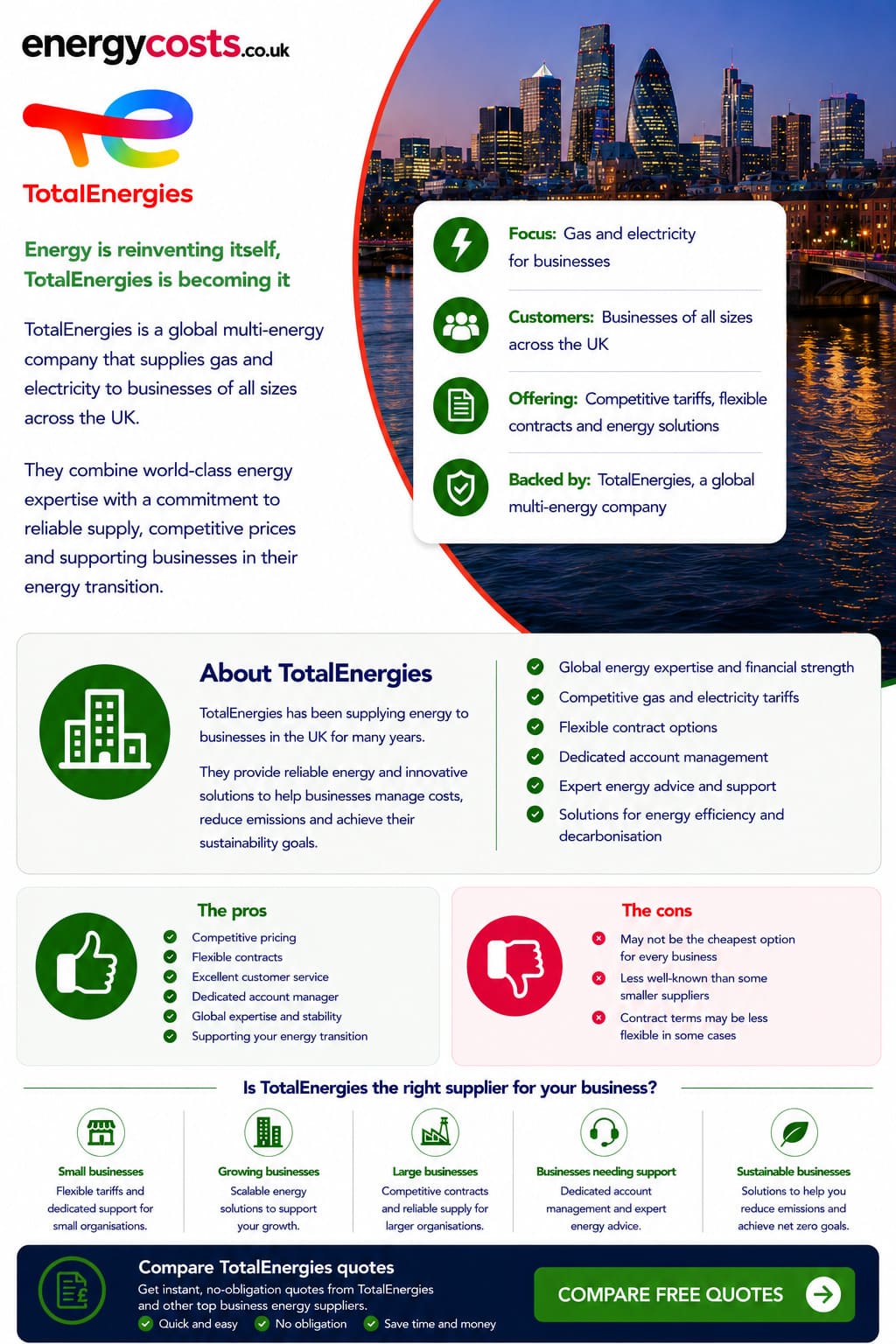
TotalEnergies is a major international energy company with a growing presence in the UK business energy market. It supplies both electricity and gas to a variety of commercial customers, from small enterprises to larger, energy-intensive organisations.
Key details:
- Supplier type: Global energy supplier (TotalEnergies Group)
- Fuel supplied: Electricity and gas (dual fuel available)
- Target customers: SMEs through to large businesses
- Tariff types: Fixed, flexible and bespoke contracts
- Smart metering: Supported
- Low-carbon focus: Renewable electricity options available
TotalEnergies combines its global energy expertise with local supply capabilities in the UK, offering a broad range of contract types and options tailored to different business needs.
TotalEnergies business prices list – rates per kWh
While actual rates may fluctuate, here is a table with approximate price ranges for TotalEnergies business tariffs to give you a sense of the potential costs:
| Tariff Type | Unit Rate (per kWh) | Standing Charge (per day) |
|---|---|---|
| Fixed-rate (Electricity) | 16p – 22p | 30p – 55p |
| Fixed-rate (Gas) | 4p – 7p | 15p – 35p |
| Flexible-rate (Electricity) | 15p – 25p | 25p – 60p |
| Flexible-rate (Gas) | 3.5p – 8p | 12p – 40p |
| Renewable (Green Energy) | 17p – 24p | 35p – 60p |
Notes:
- Fixed-rate tariffs provide stability, so the rates will not change for the duration of the contract, despite market fluctuations.
- Flexible-rate tariffs might offer lower prices initially but can fluctuate depending on market conditions.
- Renewable tariffs are often slightly higher due to the premium on green energy sources, but this can be offset by incentives and environmental benefits.
These prices are indicative and can vary based on specific business requirements and market conditions. For the most accurate and up-to-date rates, it’s recommended to contact TotalEnergies directly or use our business energy quote comparison to get a tailored quote for your business.
TotalEnergies out-of-contract rates
Businesses that do not agree a new contract before their existing deal ends may move onto a deemed contract or a standard variable tariff, depending on their circumstances. TotalEnergies publishes both sets of rates, which gives businesses a clearer idea of the cost of leaving a supply arrangement unchanged.
Current deemed rates
The rates below are the published TotalEnergies deemed rates effective from 1 April 2026. Gas deemed customers pay a published unit rate and daily standing charge, while electricity deemed customers pay published unit rates and a site-specific daily charge shown on the bill.
| Supply type | Standing charge | Unit rate |
|---|---|---|
| Gas deemed | 256p/day* | 13.46p/kWh |
| Electricity deemed HH | Site-specific daily charge | 39.63p/kWh |
| Electricity deemed NHH day | Site-specific daily charge | 48.24p/kWh |
| Electricity deemed NHH night | Site-specific daily charge | 33.30p/kWh |
| Electricity deemed NHH single | Site-specific daily charge | 44.83p/kWh |
* If annual gas consumption is above 732,000 kWh, TotalEnergies says it may apply a site-specific daily standing charge instead of the standard 256p/day figure.
Current standard variable tariff rates
TotalEnergies also publishes standard variable tariff rates. It describes this tariff as one that allows customers to leave by giving 30 days’ notice, and says a pricing uplift is applied for non-Direct Debit customers. The current published rates are effective from 1 December 2025.
| Supply type | Standing charge | Unit rate |
|---|---|---|
| Power NHH single | Bespoke for each meter | 35.42p/kWh |
| Power NHH day | Bespoke for each meter | 37.78p/kWh |
| Power NHH night | Bespoke for each meter | 27.33p/kWh |
| Power HH | Bespoke for each meter | 30.56p/kWh |
| Gas | 256p/day* | 8.33p/kWh |
* If annual gas consumption is above 732,000 kWh, TotalEnergies says it may apply a site-specific daily standing charge.
Overview of TotalEnergies business tariffs
TotalEnergies provides a variety of business energy tariffs that cater to small businesses, medium-sized enterprises, and large corporations. Their business tariffs include fixed-rate and flexible options, designed to suit different budget requirements and energy consumption patterns. Here’s a closer look at these options:
Fixed-rate tariffs
Fixed-rate tariffs from TotalEnergies are designed to provide stability and predictability in your energy costs. With a fixed-rate plan, the price per unit of energy remains the same throughout the contract period, protecting your business from market fluctuations.
Key features of fixed-rate tariffs:
- Budget certainty: Your rates are locked in for the duration of the contract, helping you manage expenses without the worry of sudden price hikes.
- Contract flexibility: Fixed-rate contracts are typically available for periods ranging from one to three years, giving you the option to choose a term that best suits your business needs.
- Ideal for: Small to medium-sized businesses that prefer consistent billing and predictable expenses.
Flexible-rate tariffs
Flexible-rate tariffs are designed for businesses that have the ability to adapt their energy usage based on market conditions. These tariffs can provide cost savings when energy prices are low but may involve higher costs if market prices rise.
Key features of flexible-rate tariffs:
- Market-driven pricing: Prices may vary based on wholesale energy costs, allowing potential savings when the market rates are low.
- Greater control: Businesses can adjust their energy strategy in response to price changes, maximising efficiency and minimising costs.
- Ideal for: Larger businesses or enterprises with high energy usage that can closely monitor market trends and adjust their consumption accordingly.
Renewable energy options
TotalEnergies is committed to sustainability and offers green energy options for businesses that want to reduce their carbon footprint. Their renewable energy tariffs include electricity sourced from wind, solar, and hydro, enabling businesses to take a more eco-friendly approach to their energy consumption.
Benefits of TotalEnergies’ renewable energy options:
- Support for net-zero goals: Businesses can lower their carbon emissions and contribute to environmental sustainability.
- Enhanced reputation: Using green energy can boost a company’s brand image, showing customers and stakeholders a commitment to sustainable practices.
- Potential cost savings: Some renewable energy tariffs can be cost-effective in the long run, especially with incentives and reduced environmental taxes.
Sustainability credentials
Sustainability is increasingly critical for UK businesses, and TotalEnergies has placed a strategic emphasis on renewable energy and carbon-reduction goals. The company is actively transitioning its generation mix towards lower-carbon sources and offers business electricity tariffs that can support sustainability commitments.
Renewable electricity and REGOs
TotalEnergies provides electricity tariffs backed by Renewable Energy Guarantees of Origin (REGOs). These certificates show that an equivalent amount of electricity purchased by a business has been generated from renewable sources, which supports Scope 2 emissions reporting and ESG disclosure requirements.
Carbon intensity
TotalEnergies’ energy portfolio includes a mix of renewable generation alongside conventional sources. While the physical electrons delivered to a site are indistinguishable at a grid level, REGO-backed tariffs give businesses confidence that their energy use is matched with renewable generation on paper.
Broader green initiatives
TotalEnergies participates in wider decarbonisation initiatives, such as investing in wind and solar capacity, and supporting energy-efficiency programmes for commercial customers. For businesses looking to blend cost with carbon-reduction strategy, these options can form part of a broader sustainability plan.
Smart meters and AMR meters
TotalEnergies offers both smart meters and AMR technology for business customers. Both options send readings automatically, helping reduce estimated bills and the need for manual submissions. TotalEnergies says microbusiness customers meeting the relevant eligibility rules will be offered a smart meter, while non-micro business customers can choose a smart meter or AMR installation.
A microbusiness customer is defined by TotalEnergies as a business that either has fewer than 10 employees and annual turnover or balance sheet no greater than £2 million, uses no more than 100,000 kWh of electricity a year, or uses no more than 293,000 kWh of gas a year.
For larger organisations, AMR can be especially useful because it automates readings and can support more detailed energy monitoring. TotalEnergies also says its Platinum service includes an enhanced AMR service with daily readings and half-hourly consumption data in a regular report.
Fuel mix
TotalEnergies publishes a fuel mix disclosure for its supplied electricity. For the period April 2024 to March 2025, it states that its supplied electricity came from 9% coal, 45% natural gas, 2% nuclear, 40% renewable sources and 4% other sources. For comparison, the UK average shown on the same page is 6% coal, 33% natural gas, 16% nuclear, 42% renewable and 3% other.
| Fuel source | TotalEnergies fuel mix | UK average |
|---|---|---|
| Coal | 9% | 6% |
| Natural gas | 45% | 33% |
| Nuclear | 2% | 16% |
| Renewable | 40% | 42% |
| Other | 4% | 3% |
TotalEnergies also states an environmental impact figure of 292g/kWh CO2 emissions and 0.0003g/kWh radioactive waste for this fuel mix disclosure period.
Complaints and dispute resolution
TotalEnergies says that once a complaint reaches its complaints team, it will provide a response within 10 working days, unless the customer is told otherwise. If the customer remains dissatisfied, they can request an internal review by a senior member of staff.
If the issue is still unresolved, eligible small business consumers and microbusiness customers can take the complaint to the Energy Ombudsman once TotalEnergies has said it can take no further action, or once 8 weeks have passed since the original complaint was raised. TotalEnergies says the Ombudsman service is free, independent and binding on the supplier, not the customer.
TotalEnergies defines a small business consumer as a business with fewer than 50 employees and turnover of at most £6.5 million or a balance sheet of £5.0 million, or one using no more than 200,000 kWh of electricity a year, or no more than 500,000 kWh of gas a year. It defines a microbusiness customer as a business using less than 100,000 kWh of electricity or less than 293,000 kWh of gas a year, or one with fewer than 10 employees and annual turnover not exceeding £2 million.
Service standards for microbusinesses
TotalEnergies is a member of the I&C Shippers and Suppliers trade body group, and it publishes Guaranteed Standards of Performance for microbusinesses. The supplier says that where a meter appointment is arranged that requires access to the premises, it will be made during normal working hours and within a four-hour slot.
If TotalEnergies fails to meet those published service standards, it says it will credit the customer’s account with £40 within 10 working days of the failure.
Billing and account management
TotalEnergies provides detailed guidance on how business invoices work. For gas bills, it explains that usage is calculated from the meter readings and then adjusted using the correction factor, conversion factor and calorific value before being converted into kWh and multiplied by the unit rate. VAT is then added, normally at 20% unless exemptions apply, and Climate Change Levy may also apply unless reductions are available.
For electricity bills, TotalEnergies says the invoice may include unit charges, standing charges and capacity charges depending on the meter and tariff structure. Non-half-hourly supplies may have separate day, night or single-rate readings, with the applicable prices set out in the contract.
To reduce estimated billing, TotalEnergies asks customers to submit meter readings between the 24th and the end of each month. It says readings sent outside that window may be used only to calculate an estimated reading.
Customers paying by Direct Debit can also avoid an additional £20 plus VAT admin charge per invoice. TotalEnergies says Direct Debits are normally taken 14 days after the date of each invoice.
TotalEnergies customer service and reliability insights
Beyond price and contracts, the quality of customer service and reliability is a key consideration for business energy buyers. TotalEnergies offers structured support designed to meet the needs of commercial customers across different sectors.
Dedicated business support
TotalEnergies provides business customers with access to specialised account management services and customer support channels. These include online account tools for contract administration and billing, as well as direct support for meter queries, usage data and renewals.
Independent satisfaction data
Large suppliers such as TotalEnergies are regularly assessed in independent customer satisfaction surveys and in regulatory reports (such as Ofgem complaint and service performance data).
Service transparency and escalation
TotalEnergies publishes service performance metrics and clearly outlines complaint handling procedures, offering businesses transparency on service standards and what to expect if issues arise. This can be particularly reassuring for organisations with complex energy arrangements or multiple sites.
Additional features and services
Beyond their competitive tariffs, TotalEnergies offers several features and services that add value to their business energy solutions. Here are some of the key highlights:
Smart metering
TotalEnergies provides smart meters to all business customers, ensuring accurate billing and better energy management. Smart meters enable businesses to track their energy usage in real-time, helping to identify areas where they can reduce consumption and save on costs.
Energy efficiency support
TotalEnergies also offers energy consultancy services to help businesses optimise their energy usage. This service includes tailored advice and strategies to improve energy efficiency, reduce waste, and ultimately lower energy bills.
Dedicated account management
For larger businesses, TotalEnergies provides a dedicated account manager who acts as a single point of contact for all energy-related needs. This personalised service ensures that your business receives expert guidance and support tailored to your specific energy requirements.
TotalEnergies business prices: What to expect?
The exact cost of TotalEnergies business tariffs can vary depending on several factors, including the size of your business, location, energy consumption, and the type of contract you choose. Here are a few factors that influence TotalEnergies’ pricing structure:
- Business size and energy consumption: Larger businesses with higher energy usage may have access to more competitive rates compared to smaller enterprises.
- Contract length: Longer-term contracts often come with more favourable rates, offering businesses a better deal in exchange for their commitment.
- Market conditions: For flexible-rate tariffs, the prices are directly linked to the current market rates, which can fluctuate due to supply and demand dynamics.
For an accurate quote, businesses should contact TotalEnergies directly or use a price comparison tool to assess the best available rates for their specific needs.
Pros and cons of choosing TotalEnergies for business energy
Pros
- Diverse tariff options: A wide range of fixed-rate and flexible tariffs to suit different business requirements.
- Green energy focus: Strong commitment to renewable energy solutions, making it easier for businesses to go green.
- Advanced metering and energy services: Smart meters and energy consultancy services to enhance efficiency and control over energy use.
- Competitive pricing: Customised quotes and competitive rates, especially for larger enterprises.
Cons
- Price variability on flexible tariffs: Flexible-rate tariffs can be risky if energy prices rise significantly.
- Limited contract lengths for smaller businesses: Fixed-rate contracts may not always offer shorter-term flexibility for small enterprises.
Is TotalEnergies the right choice for your business?
TotalEnergies offers a comprehensive range of energy solutions that cater to businesses of all sizes. Their commitment to sustainability, coupled with their diverse tariff options and support services, makes them a strong contender in the UK business energy market. Whether you’re looking for budget certainty through a fixed-rate plan or the flexibility to take advantage of market prices, TotalEnergies has a tariff that could suit your needs.
Final thoughts
When considering an energy supplier like TotalEnergies, it’s essential to compare their offerings with other providers in the market. Business energy costs can have a significant impact on your bottom line, so take the time to evaluate the benefits, features, and overall value that TotalEnergies provides.
Use our energy comparison tool and seek expert advice if needed to ensure you make the most cost-effective decision for your business. For more, visit the TotalEnergies website.
FAQ: TotalEnergies business prices
TotalEnergies offers business contracts starting at a minimum of 12 months. For businesses seeking longer commitments, they also provide options for 24 or 36 months. Longer contracts can sometimes secure more competitive rates, with fixed-rate plans providing price stability throughout the term.
TotalEnergies typically takes 2 to 4 weeks to set up a new business energy account, depending on the complexity of the business needs and any existing contracts. This period includes time for meter readings, contract agreement, and the switching process if moving from another supplier.
For businesses with high energy usage, TotalEnergies may offer discounts of up to 5% off the standard rates for electricity and gas, based on annual consumption. Larger enterprises consuming over 100,000 kWh annually are more likely to receive these discounted rates, subject to negotiation.
TotalEnergies charges a late payment fee of £40 for invoices not paid within the specified payment terms. Additional interest may also apply at 8% above the Bank of England’s base rate until the balance is settled, in line with UK commercial debt regulations.
Yes, TotalEnergies applies exit fees if a business terminates its contract early. Fees can range from £50 to £300 per meter, depending on the remaining contract length and energy usage. It’s important to review the terms to understand the financial implications of early termination.