

A green business energy tariff supplies ordinary grid electricity under a contract that matches some or all of the business’s consumption with renewable generation evidence. In Great Britain, that evidence is normally Renewable Energy Guarantees of Origin, or REGOs. One REGO represents one megawatt hour (MWh), equal to 1,000 kilowatt hours (kWh), of eligible renewable electricity.
That sounds simple. The difficult part is that two tariffs can both be sold as “100% renewable” while doing very different things. One supplier may buy inexpensive certificates separately from the electricity. Another may buy power and certificates together from named British generators. A third may match demand with renewable output every half hour. A large company may sign a long-term power purchase agreement that helps a new wind or solar project obtain finance.
All four arrangements can have value, but they are not environmentally equivalent. Nor does a green tariff mean that renewable electrons travel directly from a wind turbine to the customer’s socket. Electricity is pooled on the grid, and every connected site receives the physical mix available in its area at that moment.
This guide explains those distinctions, compares current UK business propositions, puts costs into pounds and pence, and shows what evidence a business should obtain before describing its electricity or gas as green.
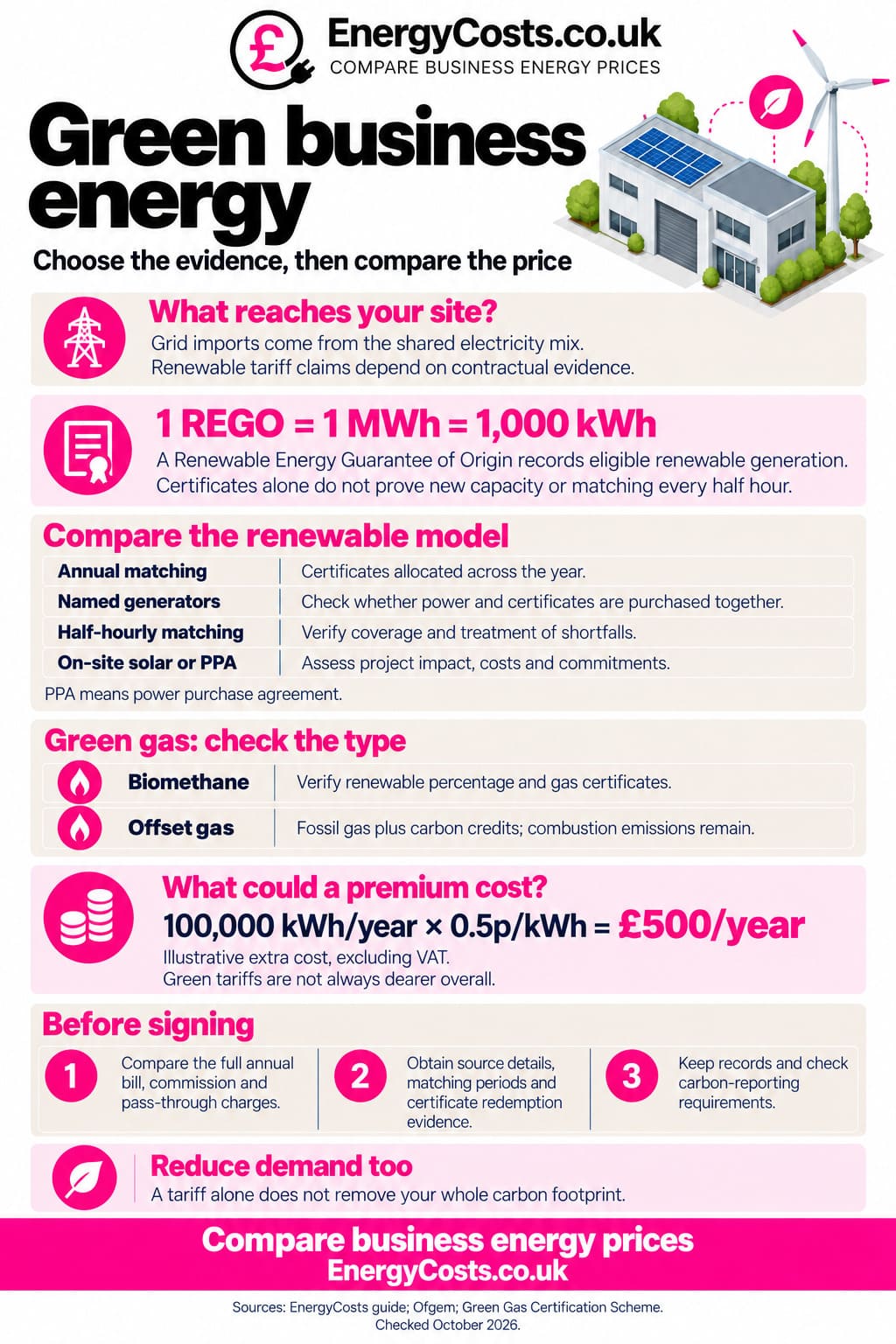
Green business energy at a glance
| Question | Short answer |
|---|---|
| What is a green business electricity tariff? | A supply contract under which some or all consumption is matched with renewable electricity attributes, normally REGOs in Great Britain. |
| Does renewable power physically reach the premises? | The site receives the local grid mix. The renewable claim is contractual unless there is a private wire or qualifying on-site generation arrangement. |
| What does “100% renewable” usually mean? | Over the relevant matching period, the supplier allocates renewable certificates equal to 100% of the eligible metered volume. It does not necessarily mean a 100% renewable match in every half hour. |
| Does a REGO prove additional generation? | No. It proves that eligible renewable electricity was generated and assigns its attribute. Additionality needs separate evidence, such as a new-build PPA or direct investment. |
| Is green gas always renewable gas? | No. Biomethane matched with RGGOs is different from fossil natural gas paired with carbon credits. |
| Are green tariffs always dearer? | No. The environmental component may carry a premium, but the total quote also depends on wholesale timing, contract length, profile, region, credit and standing charges. |
| Does green electricity avoid Climate Change Levy? | Normally not. From 1 April 2026 the main CCL rate is 0.801p/kWh for both electricity and gas. |
| Can a business report zero Scope 2 emissions? | A qualifying contractual instrument may support a zero market-based generation figure. UK reporting guidance still expects a location-based figure, and Scope 3 transmission, distribution and upstream emissions may remain. |
| What is the strongest evidence? | Contract terms, supplier product methodology, metered consumption, certificate volume and vintage, source details, proof of redemption or cancellation, and independent assurance. |
Why green business energy matters now
Renewable generation is no longer a marginal part of the UK power system. In the first quarter of 2026:
- renewable electricity generation reached a quarterly record 43.7 TWh, up 18% year on year;
- renewables produced 53.1% of UK electricity generation, up 7.4 percentage points;
- wind generated a record 29.3 TWh, or 35.6% of total generation;
- renewable capacity reached 66.0 GW, up 3.4 GW in a year;
- low-carbon sources, including nuclear, supplied 63.8% of generation; and
- fossil fuels still supplied 32.8%, almost all from gas.
These figures are a quarterly snapshot, not a promise that every hour was majority-renewable. They show both the progress made and the reason contractual detail still matters. A company can purchase renewable attributes while consuming during a dark, windless period when gas generation is high. Conversely, shifting flexible demand into windy or sunny periods can help the system absorb more renewable output.
For businesses, the decision is about more than a logo on an invoice. Electricity procurement may affect:
- Scope 2 greenhouse-gas reporting;
- bids and customer questionnaires;
- science-based or internally set climate targets;
- product and corporate environmental claims;
- exposure to energy-market prices;
- landlord, tenant and multi-site arrangements;
- plans for solar, batteries, electric vehicles and heat electrification; and
- the credibility of a wider net zero strategy.
What counts as green business energy?
“Green energy” is not one precisely defined commercial product. It is an umbrella expression used for several different arrangements.
| Term | What it normally means | Important limitation |
|---|---|---|
| Renewable electricity | Power generated from replenishing sources such as wind, solar, hydro and eligible bioenergy | Renewable does not mean impact-free or zero lifecycle emissions |
| REGO-backed tariff | Consumption matched with UK renewable certificates | May be an annual, certificate-only match with limited additionality |
| Source-specific tariff | Certificates, and sometimes power, associated with named technologies or assets | Check whether the underlying power and certificates are bought together |
| Hourly or half-hourly matching | Consumption compared with renewable output in shorter time intervals | Ask for the achieved percentage, treatment of gaps and verification method |
| Corporate PPA | Contract linking a business to a generator, physically or financially | Long term, complex and exposed to volume, price, credit and accounting risks |
| On-site renewable electricity | Power generated at the premises, usually by solar PV | Output varies; grid imports and exports still need separate treatment |
| Renewable gas | Biomethane or another eligible renewable gas, normally tracked by gas certificates | The gas molecule at the premises is still the network mix |
| Carbon-offset gas | Fossil gas whose emissions are paired with carbon credits | Combustion still occurs and remains distinct from renewable gas |
| Low-carbon electricity | Electricity with relatively low greenhouse-gas emissions, potentially including nuclear | Nuclear is low-carbon but not renewable and does not receive REGOs |
| Carbon-neutral energy | A claim that residual emissions have been balanced or otherwise accounted for | Quality depends on boundary, method, reductions and any credits used |
Three distinctions prevent most misunderstandings:
- Renewable is not the same as low-carbon. Wind and solar are both. Nuclear is low-carbon but non-renewable. Biomass can qualify as renewable while still requiring careful scrutiny of feedstock, land use and lifecycle emissions.
- Renewable is not the same as zero-emission. Wind and solar have no fuel-combustion emissions at generation, but construction, maintenance, grid losses and supply chains have impacts.
- A contractual claim is not a physical-flow claim. Unless a business uses an on-site system or private wire, its electricity comes through the shared grid.
How a green electricity tariff works
The commercial process normally has four layers.
1. A generator produces electricity
A wind, solar, hydro or eligible bioenergy plant exports metered electricity. It may sell the power through a supplier, trader, exchange or power purchase agreement.
2. Ofgem issues renewable evidence
Ofgem’s REGO scheme issues one certificate per MWh of eligible renewable output. The certificate records attributes such as the generating station, technology and production period. The scheme gives consumers transparency about the proportion of electricity suppliers source from renewables.
3. The supplier allocates electricity and certificates
The supplier buys electricity for its customers and acquires enough eligible REGOs to support the renewable proportion it promises. The electricity and certificates may be purchased together from the same generator (often called bundled), or separately in different transactions (often called unbundled).
4. The claim is disclosed and evidenced
Great Britain’s Fuel Mix Disclosure rules require suppliers to disclose annually the coal, gas, nuclear, renewable and other sources used for electricity supplied over the 1 April to 31 March disclosure period. Disclosure is due by 1 October. Relevant REGOs must be in the supplier’s account by the Ofgem deadline and are then redeemed for FMD.
The system is meaningful, but evidence control matters. An Ofgem review found that 20 suppliers had collectively overstated renewable electricity in their 2019/20 disclosures by 2,151,820 MWh because the corresponding certificates were not held at the deadline. The suppliers corrected their statements and some surrendered additional REGOs.
What a REGO proves (and what it does not)
A REGO is an energy-attribute certificate. Its essential job is to show that one MWh of eligible renewable electricity was generated and to prevent the same attribute being claimed repeatedly within the scheme.
It can support a renewable procurement claim when the certificate is valid, relevant to the period and market, owned or redeemed by the correct party, and allocated to the customer’s consumption.
A REGO does not, on its own, prove that:
- the renewable generator supplied the physical electrons entering the premises;
- the supplier bought the underlying power from that generator;
- generation occurred at the same time as the business used electricity;
- the generator is new;
- the tariff caused a new project to be built;
- the renewable technology has no environmental impacts;
- the whole supplier portfolio is renewable; or
- every carbon-reporting or environmental-claim framework will accept the same wording.
That is why “REGO-backed” should be the start of due diligence, not the end.
Bundled and unbundled REGOs
With a bundled purchase, the electricity and its renewable attribute are contracted together. This creates a clearer commercial link to a generator, especially where the contract identifies the asset and the supplier has a PPA with it.
With an unbundled purchase, wholesale electricity and certificates are acquired separately. This is a legitimate certificate mechanism and can be a low-cost entry point for an SME. Its weakness is not that the certificate is fake; it is that the business’s payment may provide a smaller or less direct investment signal than a long-term bundled contract.
Ask the supplier:
- Are the power and REGOs purchased together?
- If not, where do the certificates come from?
- Are they UK REGOs from the same disclosure year as consumption?
- Can the supplier name the generators and technologies?
- Is the customer volume matched before or after transmission and distribution losses?
- Who redeems the certificates and when?
Annual matching and time-based matching
Most green tariffs reconcile consumption and renewable evidence across a year. A site can therefore use electricity at 7pm on a still winter evening and be matched with solar generation produced months earlier.
Shorter-interval matching asks a harder and more useful question: how much consumption coincides with renewable generation in the same hour or settlement period? This is sometimes called 24/7 carbon-free energy or granular matching.
It is important to read the small print. “Real-time matched” may still mean that a high percentage is matched every half hour and the remaining shortfall is balanced annually. Good Energy, for example, says its latest published fuel mix achieved an independently verified 88% half-hourly match, with gaps balanced over the year; Octopus offers large businesses its Electric Match product, matching traceable green sources within half an hour of generation.
The direction of carbon accounting is also towards greater granularity. GHG Protocol consulted on proposed revisions that included hourly matching and deliverability requirements, with possible exemptions and phased implementation for smaller organisations. Those proposals are not yet the current final standard, but they make future-ready data and contract design worth considering now.
The green tariff quality ladder
There is no official Ofgem league table of “greenest” tariffs. The following ladder is a practical procurement framework, not a regulatory rating.
| Level | Procurement model | Evidence strength | Likely additionality |
|---|---|---|---|
| 5 | On-site generation, private wire or long-term PPA enabling a new project | Very high if metered, contracted and independently checked | Usually strongest |
| 4 | Sleeved or direct PPA with named existing/new UK assets; power and REGOs bundled | High | Medium to high, depending on project and term |
| 3 | Supplier buys bundled power and REGOs from a disclosed generator portfolio, possibly with half-hourly matching | High attribution; good transparency | Medium and supplier-dependent |
| 2 | Source- or technology-specific annual REGO-backed tariff | Valid renewable attribute with moderate transparency | Usually limited to medium |
| 1 | Generic annual REGO match purchased separately from wholesale power | Meets a basic renewable-evidence need | Usually limited |
An inexpensive Level 1 tariff may be entirely appropriate for a small firm beginning its decarbonisation work. The mistake is to describe it as if it delivers Level 5 impact. Procurement should fit the organisation’s objectives, budget and reporting obligations.
What additionality means
Additionality asks whether the buyer’s action helps create renewable generation or emissions reductions that would not otherwise have happened, or accelerates them materially.
It is a spectrum rather than a yes/no label. Strong indicators include:
- a long contract that gives a new project bankable revenue;
- a direct equity or capital contribution;
- an on-site asset funded by the customer;
- a tariff with a transparent reinvestment commitment;
- support for newer, unsubsidised or community-scale generators; and
- a credible causal explanation backed by money flows and contracts.
Weak indicators include an unsupported claim that buying any REGO “builds new renewables”. Certificates provide revenue to generators and create an auditable market for renewable attributes, but the price and causal effect vary. A company should report the procurement mechanism separately from any claimed real-world impact.
Green business energy suppliers compared
There is no single best green business energy supplier. A microbusiness wanting a simple fixed contract has different needs from a manufacturer buying 20 GWh a year. The right comparison is at product level: a supplier’s standard fuel mix, green add-on, named-source tariff and PPA can have completely different credentials.
The table below summarises business products verified on suppliers’ public pages on 17 July 2026. It is a shortlist, not a recommendation, price ranking or guarantee of availability. Obtain a written quotation and product specification for the exact meter, customer and reporting year.
| Supplier and proposition | Stated renewable model | Useful for | Points to verify |
|---|---|---|---|
| 100Green business energy | Says it supplies 100% renewable electricity and can supply 100% green gas; its EKO gas uses natural waste and excludes crops grown solely for energy | SMEs and multi-site buyers seeking electricity and genuine biomethane options | Exact green-gas percentage, certificate scheme, feedstock, vintage and carbon-accounting treatment |
| Bryt Energy | Solar, wind and hydro electricity matched annually with REGOs; also purchases loss-factor volume and obtains independent verification | Businesses wanting an unusually clear explanation of annual matching | Annual rather than complete half-hourly matching; exact asset and certificate source for the quote |
| Crown Gas & Power | Electricity options plus gas blends of 10%, 25%, 50% or 100% biomethane | Gas-intensive businesses wanting a phased renewable-gas purchase | Whether each percentage refers to certificate allocation, physical procurement or both; RGGO details and production support |
| Drax Energy Solutions | Renewable-source Flex and Fix plans, certificates and CPPAs; says it buys from around 2,300 independent generators | Larger users needing flexible procurement, RECs or a generator-linked PPA | Technology mix, treatment of biomass, contract length, sleeving and shaping costs |
| ENGIE Green Power | UK Green REGO supply, named-asset UK Green Plus and Green Select PPA with a new UK asset | Buyers that want a progression from certificates to named source or new-build PPA | Which tier is quoted, source technology, duration, portability and market-based factor |
| Good Energy for Business | 100% renewable annual supply from more than 3,000 independent British generators, with published half-hourly matching performance | Organisations prioritising British generator relationships and granular matching | Current achieved half-hourly percentage, treatment of unmatched periods and green-gas composition |
| Octopus Energy for Business | SME green tariffs, time-of-use Shape Shifters, half-hourly Electric Match for large businesses and funded on-site Wind Works | Smart-metered SMEs, flexible loads, EV fleets and larger users seeking granular matching | Product-specific renewable evidence; time-of-use risk; advance payment and eligibility terms |
| ScottishPower Renewable for Business | REGOs and electricity sourced from ScottishPower’s own renewable resources in Great Britain; one-, two- or three-year terms described | SMEs wanting a mainstream supplier with vertically integrated renewable generation | Current tariff availability, generation mix, fixed versus variable cost elements and certificate wording |
| SmartestEnergy Business SmartFix Renewable | Hydro, solar and wind matched with UK-recognised certificates and verified by the Carbon Trust | SMEs wanting fixed terms, half-hourly usage data and third-party product verification | Whether certificates are bundled, source and age of projects, and whether the assurance statement covers the full contract year |
| SSE renewable business energy | Small-business renewable supply, named UK wind-farm product and CPPAs; REGOs and independent verification | SMEs through to corporates, especially those seeking a named source or PPA | Product tier, minimum volume (SSE quotes 10 GWh a year for its CPPA example) and green-gas methodology |
| TotalEnergies Pure Green | REGO-matched solar, wind and hydro; explicitly excludes biomass | Large businesses with technology preferences or biomass exclusions | Product availability, whether power and REGOs are bundled, source geography and portfolio versus product mix |
| Valda Renewable | SME add-on with 100% REGO matching; says it works with GB generators through PPAs | Existing or new SME customers wanting a renewable upgrade to a standard contract | The size of the unit-rate uplift, asset list, matching period and whether power and certificates are bundled |
| Yü Energy Pure Green | REGO-backed electricity; fixed plans stated at 12, 24 and 36 months; gas proposition uses Verra carbon offsets | SMEs wanting a conventional fixed contract and renewable electricity evidence | Treat the gas as offset fossil gas, not biomethane, unless the written contract says otherwise; examine credit quality and claims |
Other licensed suppliers also offer renewable products, and propositions change frequently. Do not assume that a supplier’s brand, group-wide generation portfolio or overall Fuel Mix Disclosure automatically describes the product in your quote. Compare business energy suppliers and request the product methodology alongside price.
How to read supplier fuel-mix data
Fuel Mix Disclosure is useful but easy to misuse.
- Supplier portfolio mix describes electricity allocated across all relevant customers in the disclosure period.
- Product-level mix may describe a particular premium or renewable tariff.
- Group generation mix describes what a parent company owns or generates and may not equal what its retail arm allocates to customers.
- Your contractual allocation should be evidenced by the terms and customer-specific statement.
A supplier could have a fossil-heavy default portfolio and a valid 100% renewable add-on. Another could have a 100% renewable portfolio but use generic annual matching. Neither percentage alone measures additionality, hourly alignment or service quality.
Renewable electricity sources explained
Wind
Onshore and offshore wind dominate UK renewable generation. Wind produces no fuel-combustion emissions and can generate at large scale, but output varies with weather. Ask whether a tariff identifies onshore or offshore assets, their location and whether the supplier holds the associated REGOs.
Solar
Solar PV works well for on-site generation because output often overlaps with daytime commercial demand. It can reduce grid imports, expose the business to fewer purchased kWh and create export revenue. Seasonal variation, roof condition, planning, landlord consent, grid connection and asset ownership all matter.
Hydropower
Hydro can be predictable and, where storage is available, flexible. UK capacity is geographically constrained, and projects can affect waterways and habitats. A hydro-backed tariff should still identify certificate origin and matching period.
Biomass, biogas and energy from waste
Eligible bioenergy can receive REGOs, but “renewable” does not settle its sustainability. Impacts vary with feedstock, counterfactual waste treatment, transport, forest-management assumptions and combustion. A buyer with a strict procurement policy may choose a tariff excluding biomass; TotalEnergies’ Pure Green product is one example. Others may accept only waste-derived or independently certified sources.
Tidal, wave and geothermal
These technologies can qualify as renewable but currently make up a small part of most UK business tariff portfolios. They may appear in specialist or future contracts rather than standard quotes.
Green gas explained
Gas claims require more care than electricity claims because three products are routinely described with similar language.
Biomethane
Organic feedstocks (such as food waste, sewage, manure or other biodegradable material) are broken down to make biogas. After upgrading to the required specification, biomethane can be injected into the gas network.
The Green Gas Certification Scheme issues Renewable Gas Guarantees of Origin (RGGOs). One RGGO represents one kWh of green gas produced. When allocated to a consumer it is cancelled, preventing reuse. The scheme explicitly says RGGOs do not track physical gas flow: the consumer withdraws the network mix and is matched to green gas injected into that network. Green Gas Certification Scheme
RGGOs can record far more than a headline percentage, including:
- production and injection dates;
- producer, plant and commissioning details;
- feedstock information;
- production method and gas type;
- whether government production support was received;
- sustainability criteria;
- reported greenhouse-gas intensity; and
- whether manure or captured-carbon credits were used in the calculation.
Those fields matter. A business purchasing biomethane should specify acceptable feedstocks, geography, vintage, production support, sustainability labels and emissions methodology, not just “100% green gas”.
The UK biomethane market is much smaller than the electricity market. Under the Green Gas Support Scheme, 321.7 GWh of eligible green gas had been injected by registered participants by March 2025, attracting £20.1 million of support. Ofgem estimated that volume could heat 27,977 typical homes for a year.
Blended green gas
A supplier may match 10%, 25%, 50% or another share of consumption with RGGOs, leaving the remainder as conventional natural gas. This can reduce cost and let a gas-intensive company phase procurement. Claims must state the percentage and basis clearly.
Carbon-offset gas
Offset gas is normally fossil natural gas paired with carbon credits from projects elsewhere. It is not renewable gas. Burning it still releases carbon dioxide at the premises, so the business should not quietly replace its gross Scope 1 combustion figure with zero.
Before buying an offset product, ask:
- Which registry, standard, project and vintage are used?
- Have credits been retired for the customer?
- Are reductions additional, conservatively quantified and durable?
- Is there reversal or leakage risk?
- Does the claim cover combustion only or upstream extraction and transport too?
- What does the company’s reporting framework permit?
Reduction and electrification should normally come before offsets. For many buildings, heat pumps, fabric improvements, controls and heat recovery offer a more durable route away from fossil gas than repeatedly buying credits.
Hydrogen
Hydrogen is not a standard green business gas tariff today. Its emissions depend on production: renewable electrolysis differs from fossil-gas-derived hydrogen, even with carbon capture. Any future contract should disclose production pathway, electricity source, leakage, certification and delivery infrastructure.
Types of green business energy tariff
| Contract type | Typical user | Price structure | Environmental proposition | Main risk |
|---|---|---|---|---|
| Fixed renewable tariff | Microbusiness or SME | Unit rate fixed wholly or partly for an agreed term | Usually annual REGO match | “Fixed” may exclude pass-through charges; limited additionality |
| Variable renewable tariff | Small business needing flexibility | Rate can change with notice or market conditions | REGO matching may continue | Budget volatility |
| Time-of-use tariff | Smart-metered flexible site | Different peak and off-peak prices | Rewards demand shifting; renewable status must be checked separately | Savings depend on changing operations |
| Renewable add-on | Existing customer | Separate p/kWh or annual uplift | Certificates applied to standard supply | Easy to confuse with bundled power |
| Flexible or basket contract | Larger user | Purchases fixed in tranches; non-energy costs may pass through | Certificates or renewable blocks added separately | Requires governance and market expertise |
| Named-source supply | Medium or large user | Fixed or flexible | Linked to a named plant or portfolio | Name alone does not prove new capacity |
| Sleeved physical PPA | Large user | Generator price plus supplier sleeving, shaping and balancing | Direct contractual link; REGOs normally transfer with power | Complexity, volume mismatch and long commitment |
| Virtual PPA | Large corporate | Financial contract for difference plus separate retail supply | Can support a project and transfer certificates | Derivative/accounting, basis and settlement risk |
| Private-wire PPA | Site near generator | Direct price, often long term | Strong physical and commercial link | Planning, network, outage and counterparty risk |
| On-site PPA | Site with roof or land | Developer owns asset; customer buys output | Additional local generation without upfront ownership cost | Long lease/PPA terms and property restrictions |
Fixed does not always mean fully fixed
Business quotes can fix the wholesale energy component while allowing network, policy, metering or other non-commodity charges to change. Ask for a schedule showing which elements are fixed, pass-through, indexed or reopenable. Compare the same basis across every quote.
Deemed and out-of-contract supply
When a business moves into premises or lets a fixed contract end without a replacement, deemed or out-of-contract rates can apply. These are usually expensive, and the renewable status may be unclear. Confirm occupancy promptly, take opening meter readings and arrange a suitable contract. Business tariffs are not protected by the domestic price cap; read EnergyCosts.co.uk’s guide to the business energy price cap.
Do green business tariffs cost more?
Sometimes, but not inevitably. A quote combines wholesale energy, network costs, policy charges, metering, supplier margin, credit risk, contract shape, standing charges and any renewable evidence. A green tariff can beat a conventional quote simply because it was priced on a different day or hedged differently.
The latest official historic benchmark is useful context, not a live quote. In the first quarter of 2026, average UK non-domestic prices including Climate Change Levy were:
- 24.14p/kWh for electricity, down 6.2% year on year; and
- 5.17p/kWh for gas, down 6.7% year on year.
Manufacturing averages excluding CCL were 17.47p/kWh for electricity and 3.73p/kWh for gas. Business contracts are agreed at different times, so market changes feed through unevenly.
These are aggregated prices per kWh, not a supplier’s current standalone unit rate. Multiplying them by a sample volume is useful only as a scale illustration. Actual quotes separate or combine unit rates, standing, capacity, metering and other charges differently, and VAT must be added according to the customer’s circumstances.
What a green premium means in pounds
The table isolates a hypothetical renewable premium. It does not predict supplier prices.
| Annual electricity use | 0.25p/kWh premium | 0.5p/kWh premium | 1p/kWh premium | 2p/kWh premium |
|---|---|---|---|---|
| 10,000 kWh | £25 | £50 | £100 | £200 |
| 30,000 kWh | £75 | £150 | £300 | £600 |
| 100,000 kWh | £250 | £500 | £1,000 | £2,000 |
| 1,000,000 kWh | £2,500 | £5,000 | £10,000 | £20,000 |
Against 24.14p/kWh, a 0.5p premium is about 2.1% of the unit benchmark; 1p is about 4.1%. For a low-usage site, a difference in standing charge may outweigh the green uplift. For a high-usage site, a fraction of a penny becomes material.
Compare:
- annual consumption cost;
- standing charge;
- capacity, metering and data charges;
- fixed and pass-through elements;
- broker or consultant commission;
- volume tolerance and take-or-pay rules;
- payment terms and security deposits;
- exit, change-of-tenancy and termination terms; and
- the environmental product and evidence.
Since 1 October 2024, Ofgem rules require principal terms for new non-domestic contracts to show broker fees, and suppliers must make the information available on request.
Climate Change Levy and VAT
Climate Change Levy
A persistent myth is that buying renewable electricity automatically removes CCL. It normally does not. The old exemption for renewable electricity ended for generation on or after 1 August 2015, and its transitional arrangements ended in 2018.
From 1 April 2026, the main CCL rate is £0.00801/kWh, or 0.801p/kWh, for electricity and gas. The published 2027 rate is £0.00827/kWh. Climate Change Agreement participants can qualify for reduced rates, and other exclusions or reliefs may apply.
| Annual use | CCL at 0.801p/kWh |
|---|---|
| 10,000 kWh | £80.10 |
| 30,000 kWh | £240.30 |
| 100,000 kWh | £801 |
| 1,000,000 kWh | £8,010 |
VAT
Most business energy is subject to 20% VAT. The reduced 5% rate can apply to qualifying use, including small supplies. HMRC’s de minimis thresholds are no more than an average 33 kWh/day or 1,000 kWh/month for electricity, and 145 kWh/day or 4,397 kWh/month for piped gas, at one customer’s premises. Charity non-business use and certain mixed-use supplies can also qualify.
Eligibility is a tax question, not a green-tariff feature. Check the business’s circumstances and certificates rather than relying on a salesperson’s estimate.
Green tariffs and carbon reporting
Buying renewable electricity and calculating a carbon inventory are related but separate tasks. The contract supplies evidence; the reporting framework determines how it may be used.
Scope 1, Scope 2 and Scope 3
- Scope 1 covers direct emissions from sources the business owns or controls, including natural-gas combustion in its boilers.
- Scope 2 covers indirect emissions from purchased electricity, heat, steam and cooling.
- Scope 3 includes other value-chain emissions. For electricity, this can include fuel and energy-related activities such as upstream fuel production and transmission and distribution losses.
A renewable electricity tariff primarily affects the market-based Scope 2 calculation. It does not automatically eliminate gas Scope 1, grid-loss Scope 3, generator lifecycle emissions or the rest of the value chain.
Location-based and market-based figures
The location-based method uses average emissions for the grid where consumption occurs. It answers: What was the average carbon intensity of the electricity system serving this location?
The market-based method uses qualifying contractual instruments and supplier-specific data. It answers: What emissions attributes did the business contractually purchase?
GHG Protocol’s Scope 2 Guidance contains eight quality criteria for contractual instruments and calls for transparent disclosure. A certificate is not automatically usable merely because it says “renewable”; ownership, uniqueness, vintage, market boundary and retirement all matter.
UK government environmental reporting guidance requires the location-based grid average for Scope 2. A market-based figure may be reported in addition, with narrative information about the contractual arrangement and whether it creates additional generation. The 2026 conversion-factor workbook states this directly.
A 2026 worked electricity example
The official 2026 UK electricity generation factor is 0.13096 kgCO2e/kWh. The Scope 3 transmission and distribution factor is 0.01299 kgCO2e/kWh, while the well-to-tank factor for UK electricity generation is 0.03682 kgCO2e/kWh.
For a business using 100,000 kWh in calendar 2026:
- location-based Scope 2 = 100,000 × 0.13096 ÷ 1,000 = 13.096 tCO2e;
- Scope 3 transmission and distribution = 100,000 × 0.01299 ÷ 1,000 = 1.299 tCO2e; and
- Scope 3 well-to-tank electricity generation = 100,000 × 0.03682 ÷ 1,000 = 3.682 tCO2e.
If all 100,000 kWh are covered by qualifying renewable contractual evidence with a zero generation emission factor, the company may be able to report zero market-based Scope 2 generation emissions, while still showing 13.096 tCO2e location-based Scope 2 and considering the relevant Scope 3 factors. Use the reporting year’s factor, preserve calculations and take advice where a framework or assurance provider imposes different treatment.
The 2026 grid factor fell 26% from the 2025 publication after methodology and data-timing improvements. That illustrates why location-based reductions can occur without a tariff switch, and why a company should not claim every year-on-year grid improvement as the result of its own procurement.
Evidence to retain for an audit
Keep a file for every reporting year containing:
- signed contract and product schedule;
- meter-point list and reporting boundary;
- invoices and actual kWh data;
- supplier renewable certificate or annual statement;
- REGO quantity, technology, country, production period and redemption status;
- explanation of loss adjustments and estimated data;
- supplier-specific emission factor and methodology;
- independent assurance statement, if available;
- location-based conversion factor and workbook version;
- market-based and location-based calculations; and
- exact public wording used in the annual report, tender or website.
Avoid accepting a decorative “green certificate” that does not identify the period, sites, volume, evidence scheme or matching method.
SECR, SBTi and customer targets
Large UK companies and LLPs within the Streamlined Energy and Carbon Reporting regime have statutory energy and emissions disclosures to consider. A renewable tariff does not remove the need to disclose underlying energy consumption and methodology. Check the organisation’s reporting status and current government guidance.
For companies using the Science Based Targets initiative, the April 2026 near-term criteria identify 80% renewable electricity procurement by 2025 and 100% by 2030 as thresholds for a renewable-electricity target approach, with 100% maintained thereafter for long-term targets. Eligibility still depends on SBTi’s rules and active-sourcing evidence.
Customers, investors and tender authorities may set different rules. Before signing, map the proposed tariff against every framework the company actually uses.
How to make green claims without greenwashing
Environmental claims must describe the evidence precisely. The CMA’s Green Claims Code requires claims to be truthful and accurate, clear and unambiguous, to include material information, compare fairly, consider the full lifecycle where relevant and be substantiated. Its 2026 supply-chain clarification also says a business repeating another party’s claim must take steps to verify that it is accurate and non-misleading.
The advertising regulator is also scrutinising absolute language. A June 2026 ASA study of more than seven million online adverts found environmental claims in around 1% of them, but about three-quarters of those claims were absolute. The ASA notes that absolute claims typically need a particularly high level of substantiation.
Better and worse wording
| Risky wording | Why it is risky | More defensible wording |
|---|---|---|
| “Our business runs on emission-free energy.” | Ignores grid mix, lifecycle and non-electricity emissions | “For FY2026/27, 100% of our purchased electricity volume was matched with eligible UK REGOs.” |
| “We use only renewable power, 24/7.” | Annual matching may not cover every hour | “Our supplier annually matches our electricity consumption with renewable generation; it does not represent a complete half-hourly physical match.” |
| “Our Scope 2 emissions are zero.” | Omits the method and location-based result | “Our market-based Scope 2 generation figure is zero under our stated methodology; our location-based figure is X tCO2e.” |
| “We are carbon neutral because we switched tariff.” | A tariff covers only part of the footprint | “Renewable electricity procurement is one action within our emissions-reduction plan.” |
| “Our gas is green.” | Could mean biomethane, a blend or offset fossil gas | “25% of our annual gas consumption is matched with cancelled UK biomethane RGGOs; the remainder is natural gas.” |
| “This tariff created a wind farm.” | Causation may be unsupported | “Our ten-year PPA provides contracted revenue to the named project; its financing and additionality are described here.” |
Good disclosure states the period, boundary, percentage, evidence type, geography, matching interval and accounting method. It also says what is not covered.
Benefits of green business energy
- Lower market-based Scope 2 emissions: Where the evidence meets the relevant quality criteria, a renewable contract can materially reduce the market-based Scope 2 figure. This may help with customer requests, target progress and transition planning.
- Stronger tender and supply-chain evidence: Major customers increasingly request energy and carbon data from suppliers. A well-documented tariff gives an SME something concrete to provide: kWh, certificate basis, period and methodology.
- Reputation with evidence behind it: Specific, qualified disclosures can be more credible than broad sustainability slogans. The value comes from transparent proof, not the word “green” alone.
- Support for renewable generators: All credible renewable procurement assigns value to a clean-generation attribute. Direct PPAs, named-source bundled purchases and on-site projects can provide a stronger investment signal and longer revenue certainty.
- Access to smart tariffs and flexibility: Some green-focused suppliers pair renewable supply with time-of-use pricing, half-hourly data, export tariffs, batteries or EV charging. A business able to shift refrigeration, charging, heating or production can lower both cost and peak-system pressure.
- A route into wider decarbonisation: Procurement often exposes poor data, inefficient equipment and avoidable gas use. It can become the starting point for efficiency, solar, storage and electrification rather than a substitute for them.
Limitations and risks
- Green does not guarantee cheap: Certificate cost may be small relative to wholesale and network charges, but the total quote can still be uncompetitive. Compare whole-contract cost.
- Annual matching can overstate intuitive meaning: Most customers hear “100% renewable” as every hour. Annual accounting is looser. Explain it.
- Additionality may be limited: Buying certificates from long-established assets may not change build decisions. If impact matters, pay for a product designed to create it.
- Supplier and product are different: A supplier can own renewable generation but quote a product with generic certificates. Another can own no generation yet contract transparently with independent plants. Assess the contract.
- Long contracts transfer new risks: PPAs can stabilise part of the price but create volume, profile, credit, curtailment, basis and accounting exposure. They are not simply extra-long fixed tariffs.
- Renewable gas is scarce and complex: Biomethane volume, feedstock quality and certificate cost can constrain 100% coverage. Carbon treatment is more complicated than a renewable electricity purchase.
- Claims can outgrow the evidence: Marketing teams may turn a precise procurement fact into an absolute corporate claim. Establish an approval process connecting energy, finance, sustainability and legal teams.
How to compare green energy suppliers
Step 1: Define the objective
Choose the priority before requesting prices:
- basic renewable evidence at low cost;
- a lower market-based Scope 2 figure;
- British or local generation;
- a specific technology or biomass exclusion;
- half-hourly matching;
- a measurable additionality story;
- renewable gas;
- budget certainty; or
- integration with solar, batteries, EVs or multiple sites.
Step 2: Establish clean consumption data
Collect at least 12 months of invoices and, where available, half-hourly data. Record annual kWh, peak demand, meter profile, MPAN or MPRN, contract end date, standing charge, unit rates, capacity and pass-through charges. Compare business electricity prices and business gas prices on the same consumption basis.
Step 3: Set an evidence specification
State in the request for quotation:
- renewable percentage;
- accepted technologies;
- UK/GB geographic requirement;
- production vintage;
- annual or half-hourly matching;
- bundled power and certificates, if required;
- named assets or portfolio disclosure;
- treatment of line losses;
- independent assurance; and
- annual customer evidence deadline.
Step 4: Compare like with like
Normalise every quote into an estimated annual cost using the same kWh and days. Separate the renewable premium where possible, but do not ignore differences in the underlying tariff.
Step 5: Check contract terms
Review price components, change-in-law clauses, pass-through costs, tolerances, renewal, termination, payment, credit security, data access, meter obligations, change of tenancy and what happens if certificates become unavailable.
Step 6: Validate environmental claims
Ask the sustainability or assurance team to approve the reporting treatment and public wording before signature, not after the reporting year.
Step 7: Contract and monitor
Switching supplier does not normally interrupt physical supply or require new wiring. Submit final and opening readings, confirm every MPAN/MPRN, check the first bill and obtain the promised evidence annually. Follow EnergyCosts.co.uk’s small-business switching guide.
Questions to ask a green supplier
Use this as a procurement checklist.
- What exact percentage of my electricity or gas is covered?
- Is matching annual, monthly, hourly or half-hourly?
- Which certificate scheme proves the claim?
- What generation and consumption vintages are used?
- Are certificates sourced in Great Britain or elsewhere?
- Are the electricity and REGOs bought together?
- Can you name the generators, locations and technologies?
- Are biomass and energy from waste included?
- Do you match network-loss volume as well as metered demand?
- Who owns and redeems or cancels the certificates?
- Will I receive customer-specific evidence showing sites, kWh and period?
- Is the product independently assured, and can I see the latest statement?
- What supplier-specific market-based emission factor should I use?
- What wording may I use publicly, and what limitations must accompany it?
- How does the product support new generation or existing generators?
- What part of the price is the renewable premium?
- Which charges are fixed, variable, pass-through or indexed?
- What broker commission is included over the full term?
- Are there volume tolerances, take-or-pay rules or reconciliation charges?
- What happens if consumption, regulation or certificate supply changes?
- Can I retain renewable attributes if I install on-site generation?
- Is half-hourly data available in a downloadable format?
- For gas, is this biomethane, a blend or fossil gas with offsets?
- Which feedstocks, plants, subsidies and RGGO attributes support green gas?
- How are certificates treated if I move premises or sell the business?
Corporate PPAs explained
A corporate power purchase agreement links a business with a renewable generator for part of its electricity needs. CPPA terms of five to 20 years are common, although market terms vary. The attraction is a clearer generator relationship, potential price stability and, for a new project, stronger additionality.
Physical or sleeved PPA
The generator sells electricity and attributes, while a licensed supplier “sleeves” them through the market to the customer. The supplier handles balancing, settlement and top-up power when generation and demand differ.
Virtual PPA
The business and generator agree a financial strike price. Differences between the strike and market price are settled financially, while the business retains a normal retail supply contract. Certificates may transfer separately. A virtual PPA can support a project in another location, but may create derivative-accounting, basis and cash-flow volatility.
Private-wire or on-site PPA
The generator supplies a nearby site through a dedicated line, or a developer installs an asset at the customer’s premises and sells its output under a long-term contract. This provides the clearest physical link but depends on property, planning, electrical and operational arrangements.
PPA due-diligence checklist
Specialist legal, tax and accounting advice is essential. Review:
- project status, planning and grid connection;
- whether the project is existing or new;
- commissioning delay and long-stop dates;
- output forecast and degradation;
- customer demand profile and expected match;
- volume, shape and imbalance responsibility;
- curtailment and negative-price treatment;
- strike price, escalation, floor and cap;
- change in law and network charges;
- certificate ownership, technology and vintage;
- credit support and parent guarantees;
- force majeure and termination compensation;
- assignment, change of control and site closure;
- supplier sleeving and replacement rights; and
- accounting treatment, including possible financial-instrument consequences.
Do not compare a PPA strike price with a retail tariff unit rate without adding sleeving, shaping, balancing, top-up supply, network and policy costs.
On-site generation, storage and demand flexibility
A tariff changes contractual attribution. On-site action can change physical consumption.
Owned solar
The business funds and owns the system, uses generation behind the meter and exports surplus. It bears capital, maintenance and performance risk but keeps the asset and most benefits.
Solar lease or on-site PPA
A third party funds and owns the system. The business buys generated electricity or pays a lease charge. This reduces upfront cost but creates a long property-linked commitment.
Battery storage
A battery can increase on-site solar use, move grid demand away from expensive periods, protect capacity limits and enable flexibility revenue. It does not generate renewable energy. Its carbon benefit depends on when and from what source it charges.
Electric vehicles and heat
Electrifying fleets and heating can increase purchased kWh while reducing direct fuel use. Size the connection and tariff for the new load. Smart charging, thermal storage and pre-heating can shift demand to cheaper, cleaner periods.
Export evidence
Define who owns exported electricity and its REGOs. A business should not claim attributes it has sold to a supplier or another buyer. Keep import, self-consumption and export calculations separate.
The strongest sequence is usually:
- measure consumption;
- remove waste;
- electrify suitable fossil-fuel loads;
- generate on site where viable;
- shift flexible demand;
- procure credible renewable electricity for the remainder; and
- address residual emissions transparently.
Worked business examples
These examples are illustrative, not quotations or carbon-accounting advice. Each cost example simply multiplies the official aggregated p/kWh benchmark by the stated volume; it is not a reconstructed bill. A real quote may itemise standing, capacity, metering and other charges separately, and VAT must be added where applicable.
Small office: 10,000 kWh electricity
A small office wants simple renewable evidence for customer questionnaires. At the Q1 2026 non-domestic average of 24.14p/kWh, its consumption benchmark is £2,414. A hypothetical 0.5p/kWh renewable premium costs £50 a year. CCL at 0.801p/kWh is £80.10, subject to eligibility; the site may fall near HMRC’s small-supply VAT threshold depending on its daily/monthly pattern.
Best-fit route: compare fixed annual REGO-backed tariffs, prioritising clear product evidence and total annual cost. A PPA would be disproportionate.
2026 location-based Scope 2: 10,000 × 0.13096 ÷ 1,000 = 1.310 tCO2e.
Restaurant: electricity plus gas
A restaurant uses 30,000 kWh of electricity and 120,000 kWh of gas. Its electricity benchmark at 24.14p/kWh is £7,242; gas at 5.17p/kWh is £6,204. CCL, before any relief, is £240.30 on electricity and £961.20 on gas.
A 100% renewable electricity tariff can address purchased-power market-based Scope 2, but it does nothing by itself to eliminate the boiler and kitchen’s Scope 1 gas emissions. The business could:
- buy renewable electricity with documented annual evidence;
- reduce heat loss and optimise controls;
- assess induction cooking and heat-pump suitability;
- use a partial biomethane match for residual gas; and
- describe any gas percentage and certificate mechanism precisely.
Buying offset gas and saying “our restaurant uses renewable gas” would be misleading if the product is actually fossil gas plus credits.
Manufacturer: 1 GWh electricity
A manufacturer using 1,000,000 kWh has a simple consumption benchmark of £241,400 at 24.14p/kWh. A 0.25p renewable premium is £2,500; a 1p premium is £10,000. CCL is £8,010 before any Climate Change Agreement relief.
Its 2026 location-based Scope 2 is 130.96 tCO2e. The scale may justify comparing:
- generic annual REGO supply;
- a named-source bundled product;
- half-hourly matching;
- a flexible supply contract with renewable blocks;
- an on-site solar PPA; and
- a sleeved PPA, depending on credit and demand stability.
The procurement team should model total cost and risk, not choose solely on the lowest PPA strike price.
Multi-site retailer
A retailer with 60 shops faces a boundary problem before it faces a certificate problem. Meter data, leases and landlord-supplied electricity may be inconsistent. It should:
- build a complete MPAN and landlord-supply register;
- separate directly contracted, recharged and unmetered sites;
- choose a common reporting period;
- procure renewable evidence for directly controlled contracts;
- request allocation evidence from landlords for recharged electricity;
- prevent the same site being claimed twice; and
- use consolidated billing and downloadable half-hourly data where possible.
A supplier certificate saying “100% renewable customer” is inadequate if it does not list the covered meters and kWh.
Special situations
Tenants and serviced offices
If the landlord or operator holds the electricity contract, the tenant may have no right to switch. Ask for the supplier, tariff, fuel mix, contractual allocation and evidence for the tenant’s share. A recharge invoice alone may not establish renewable attributes.
Landlords and managing agents
Decide whether renewable benefits are retained, allocated to tenants or sold. Lease wording, metering and service-charge transparency should agree with the carbon claim.
Home-based businesses
A domestic tariff may cover a home office, but business reporting should use a reasonable allocation of kWh. Do not claim the whole company is renewably powered merely because one director’s household tariff is green.
New premises
Take dated opening readings, identify the incumbent supplier, provide change-of-tenancy evidence and secure a contract quickly. Check whether the quoted renewable product begins from the supply start date or only after a later certificate period.
Northern Ireland
Ofgem administers REGO issuance for Northern Ireland on behalf of the Utility Regulator, but the retail market and regulatory arrangements differ from Great Britain. Ofgem’s GB Fuel Mix Disclosure rules should not be assumed to apply identically. Use Northern Ireland-specific supplier terms and regulatory guidance. For context, renewable generation equalled 47% of Northern Ireland’s gross final electricity consumption in the year ending December 2025.
Which green energy route fits your business?
| Business need | Sensible starting point | Upgrade path |
|---|---|---|
| Lowest-cost credible renewable claim | Annual UK REGO-backed fixed tariff | Technology-specific or bundled certificates |
| Strong British-generation story | Disclosed UK generator portfolio | Named-source contract |
| Better time alignment | Half-hourly data and published matching percentage | 24/7 granular matching plus storage/flexibility |
| New-generation impact | On-site funded asset or new-build PPA | Portfolio of PPAs and direct investment |
| Gas-heavy operations | Efficiency and electrification plan plus partial biomethane | Higher RGGO coverage for hard-to-electrify residual use |
| Volatile flexible load | Time-of-use or flex contract | Automated demand response and storage |
| Many small sites | Consolidated REGO supply and meter register | Portfolio PPA or multi-site solar programme |
| Formal net zero target | Framework-compliant evidence and dual Scope 2 reporting | Granular matching and documented consequential impact |
Glossary of green business energy terms
| Term | Plain-English meaning |
|---|---|
| Additionality | Evidence that a purchase helped cause, finance or accelerate generation or emissions reduction beyond what would otherwise have happened. |
| Baseload | The relatively steady minimum level of electricity demand over a period. A variable renewable generator does not necessarily follow it. |
| Bundled electricity | Power and its renewable certificates bought together from the same generator or portfolio. |
| Carbon credit | A tradable unit normally representing one tonne of avoided, reduced or removed carbon dioxide equivalent. It is not renewable-energy evidence. |
| Climate Change Agreement | A voluntary agreement under which eligible energy-intensive facilities can receive reduced CCL rates in return for meeting efficiency or emissions targets. |
| Climate Change Levy | A tax charged on taxable business use of electricity, gas and certain fuels. A renewable electricity tariff does not normally remove it. |
| Corporate PPA | A longer-term power purchase agreement between a business and generator, arranged physically, financially or through a supplier. |
| Fuel Mix Disclosure | The annual statement showing the proportions of coal, gas, nuclear, renewable and other electricity a GB supplier has allocated to customers. |
| Green premium | The identifiable extra price for renewable attributes or a higher-quality green product. It should be separated from other tariff differences where possible. |
| Half-hourly data | Consumption recorded for each 30-minute settlement period. It makes profile analysis, flexible tariffs and granular renewable matching possible. |
| Imbalance | The difference between contracted or forecast electricity and actual generation or consumption, which must be settled in the market. |
| Location-based Scope 2 | Purchased-electricity emissions calculated using the average grid factor for the location. |
| Market-based Scope 2 | Purchased-energy emissions calculated using qualifying supplier data or contractual instruments allocated to the buyer. |
| MPAN | The Meter Point Administration Number identifying an electricity supply point. It is not the same as the meter’s serial number. |
| MPRN | The Meter Point Reference Number identifying a gas supply point. |
| Private wire | A dedicated electrical connection between a generator and customer that avoids or supplements ordinary public-grid delivery. |
| REGO | A Renewable Energy Guarantee of Origin: the UK certificate issued for one MWh of eligible renewable electricity. |
| RGGO | A Renewable Gas Guarantee of Origin used to track one kWh of certified green gas within the Green Gas Certification Scheme. |
| SECR | Streamlined Energy and Carbon Reporting, the UK regime requiring certain organisations to disclose energy use, emissions and related information. |
| Sleeving | The service through which a licensed supplier manages delivery, balancing and settlement between a generator and a business under a physical PPA. |
| Unbundled REGO | A renewable certificate purchased separately from the underlying electricity. |
| Vintage | The period in which the renewable electricity, biomethane or carbon credit was produced or issued. |
FAQ
Green business energy is electricity or gas sold with an environmental proposition. For electricity, it usually means consumption is matched with eligible renewable generation certificates. For gas, it may mean certified biomethane, a biomethane blend or fossil gas paired with offsets, which are materially different products.
The supplier buys energy for the customer and allocates renewable evidence equal to the promised share of consumption. In Great Britain, electricity evidence is normally REGOs. The customer still receives the physical grid mix unless generation is connected by a private wire or is produced on site.
It normally means that the supplier matches 100% of eligible metered consumption with renewable certificates across the relevant reconciliation period. It does not automatically mean every half hour, a named generator or new capacity.
Yes. REGOs are the UK’s official renewable electricity attribute certificates, administered by Ofgem. They provide traceability and support Fuel Mix Disclosure. Their limitation is scope: a certificate proves renewable generation and attribute ownership, not physical delivery or additionality.
Not by definition. A precise claim that consumption was matched with valid REGOs can be accurate. Greenwashing risk arises when a company implies more (such as continuous physical renewable supply or new-build impact) without evidence.
They create demand and revenue for renewable attributes, but the direct effect varies. Long-term new-build PPAs, on-site investment and bundled purchases from named generators generally provide a stronger additionality case than cheap, separately purchased annual certificates.
It can be. The renewable premium is only one component, and a green quote may have lower wholesale or standing-charge costs than a conventional alternative. Compare total annual cost on the same date, volume and contract basis.
No, not normally. The renewable electricity exemption ended for generation from 1 August 2015. From 1 April 2026, the main CCL rate is 0.801p/kWh for both electricity and gas, subject to exclusions and reliefs.
Not because it is green. Most business energy carries 20% VAT. The 5% rate depends on qualifying use, including HMRC’s small-quantity thresholds and certain charity or mixed-use situations.
A qualifying renewable instrument may support zero market-based Scope 2 generation emissions. A company should still calculate or disclose the location-based result where required, account for remaining Scope 3 factors as applicable and explain the method.
No. Nuclear power is low-carbon but relies on a finite fuel and does not qualify for REGOs. A “zero-carbon” tariff may include nuclear; a “renewable” tariff should use eligible renewable sources.
Eligible biomass can be classified as renewable and receive REGOs. Its climate and environmental performance depends heavily on feedstock, sourcing, counterfactual use and lifecycle method. Businesses can specify exclusions or sustainability criteria.
It is normally biomethane produced from organic material, injected into the gas network and matched to the customer with RGGOs or equivalent evidence. The gas at the premises is the network mix.
Not necessarily. It often means fossil natural gas paired with carbon credits. The boiler still emits CO2, and the business should report gross combustion consistently with its framework.
Yes. Many suppliers offer fixed REGO-backed electricity to microbusinesses and SMEs. The best starting point is a whole-cost comparison plus a request for written certificate and reporting evidence.
Often, yes. Gas and electricity are separate supplies and need not use the same supplier. A business can compare renewable electricity and biomethane options independently if that produces a better fit.
Normally no. The network and meter continue to deliver energy; the commercial supplier changes. Problems can arise from incorrect meter details, debt objections, contract dates or change-of-tenancy records, so verify them early.
Start before the renewal window closes, often several months ahead for ordinary fixed contracts and much earlier for a complex PPA. Check the current contract’s notice and termination provisions rather than assuming a universal deadline.
A PPA is a longer-term contract linking a business to a generator. A physical PPA delivers through a supplier; a virtual PPA settles financially; a private-wire PPA supplies directly. Each has different price, accounting and operational risks.
It can replace some grid imports, but most sites still import electricity when output is insufficient. The business may need a renewable tariff for residual imports and must decide who owns attributes attached to exported generation.
At least annually and whenever the tariff, supplier, sites, accounting framework or public claim changes. Review volume, period, certificate source, redemption and the latest assurance statement.
The bottom line
A good green business energy tariff is not defined by the brightest leaf logo. It is defined by an auditable chain from meter to contract to certificate to claim.
For most SMEs, a competitively priced UK REGO-backed electricity tariff with clear annual evidence is a practical starting point. Businesses with stronger climate targets should ask for bundled power, named British assets, half-hourly matching or a PPA. Gas users must distinguish biomethane from offsets and place efficiency and electrification first.
The decision rule is simple:
Buy the strongest environmental product that fits the organisation’s genuine objective and budget, then describe it no more broadly than the evidence allows.
Gather the latest bills, meter numbers, annual kWh and contract dates, then compare the whole cost and environmental specification, not the green label alone.
This guide is general information, not legal, tax, accounting or carbon-assurance advice. Check current contract terms, regulation and reporting requirements for the organisation’s circumstances.