
Ceres Energy is a specialist gas supplier and gas shipper focused on commercial gas supply, green gas-to-grid, biomethane, hydrogen and commercial arrangements between gas producers and end users. It is not a conventional small business gas and electricity supplier with instant online quotes, domestic-style tariff pages or a broad SME dual fuel product.
For EnergyCosts.co.uk readers, the most important point is that Ceres Energy should be viewed as a specialist non-domestic gas supplier rather than a mainstream SME energy brand. It supplies gas to non-domestic customers, works with producers to realise the value of green gas assets, and describes itself as having deep experience in European gas markets, gas purchasing, supply, shipping and regulation.
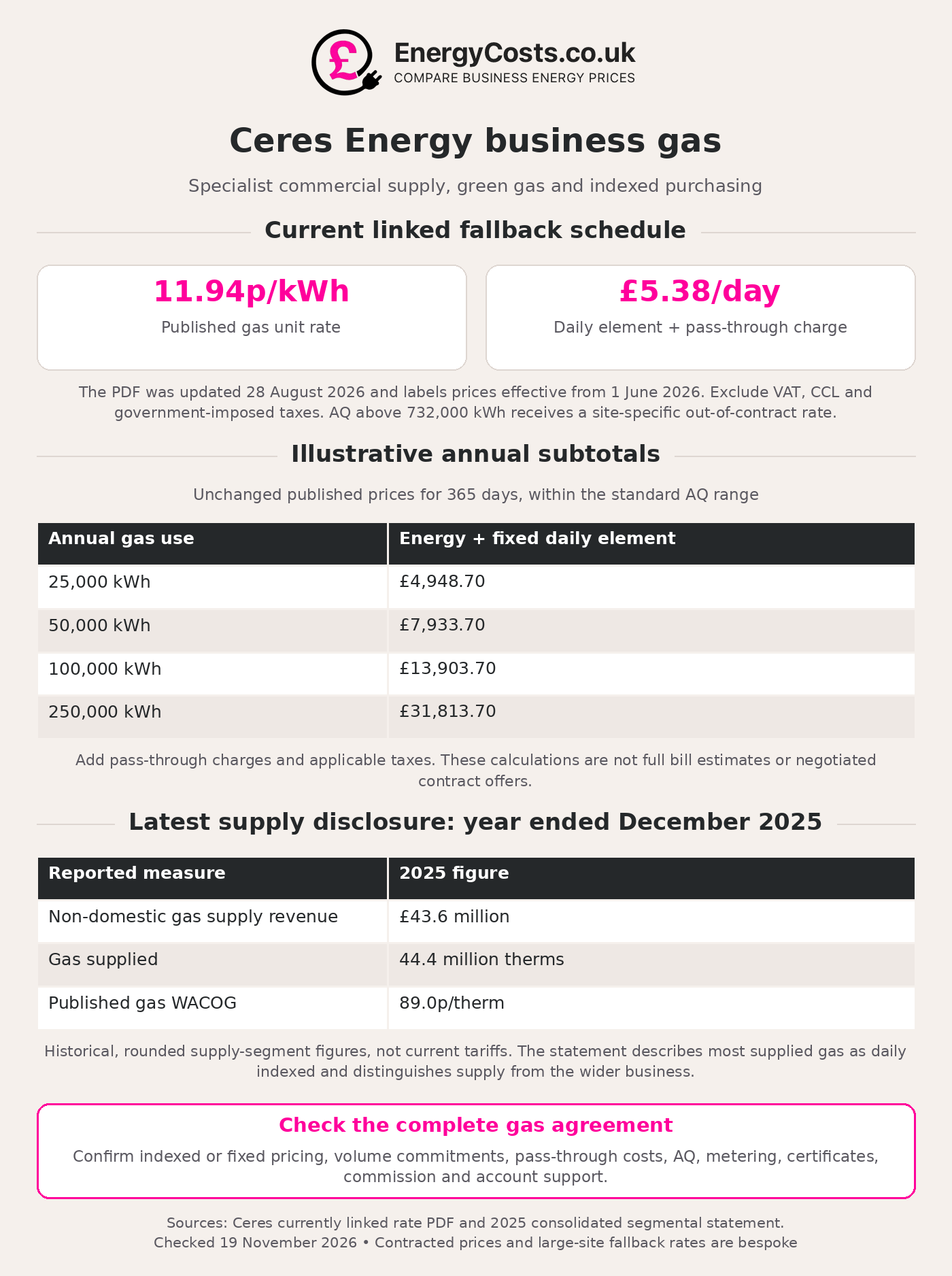
From a pricing perspective, Ceres Energy does not publish a simple table of standard fixed business gas tariffs. Contracted prices are likely to be bespoke and may be linked to wholesale market structures, site usage and commercial terms. However, Ceres does publish out-of-contract and deemed rates. From 1 June 2026, the published rate is a pass-through charge plus 538p per day, with a unit rate of 11.94p/kWh. These prices exclude VAT, Climate Change Levy and government-imposed taxes, and sites with annual quantity above 732,000 kWh receive a site-specific out-of-contract rate.
The rate PDF currently linked by Ceres was checked on 19 November 2026. It is headed updated 28 August 2026 and states the 11.94p/kWh rate is effective from 1 June 2026, despite the September filename. Confirm any newer account-specific notice before relying on it.
That makes Ceres Energy more relevant to larger gas users, green gas producers, transport fuel users and organisations with specialist gas procurement needs than to a very small shop, salon or office looking for a simple gas tariff.
Ceres Energy business gas at a glance
| Category | Ceres Energy business gas review |
|---|---|
| Supplier name | Ceres Energy |
| Legal company name | Ceres Energy Limited |
| Company number | 06490828 |
| Incorporated | 1 February 2008 |
| Previous names | Tethra Energy Limited, Crossco (1088) Limited |
| Registered office | The Old Grammar School, Hallgate, Hexham, England, NE46 1XD |
| Company status | Active |
| Main product | Non-domestic gas supply |
| Business electricity | No clear electricity supply offer |
| Business gas | Yes |
| Domestic energy | No clear domestic supply offer |
| Core specialism | Gas purchasing, gas supply, gas shipping, green gas and regulation |
| Green gas focus | Yes, including green gas-to-grid and producer services |
| Hydrogen focus | Yes, Ceres describes itself as a first mover in the GB hydrogen gas-to-grid market |
| Public contracted tariff table | No |
| Public deemed/out-of-contract rates | Yes |
| Current out-of-contract unit rate | 11.94p/kWh from 1 June 2026 |
| Current standing charge | Pass-through charge plus 538p/day |
| Annual standing charge element | £1,963.70 per year, before any pass-through charge |
| Prices include VAT? | No |
| Prices include CCL? | No |
| Large-site pricing | Annual quantity above 732,000 kWh is site-specific |
| Best for | Specialist commercial gas users, larger gas sites and green gas-linked procurement |
| Less suitable for | SMEs wanting a simple online dual fuel tariff |
| Overall view | A specialist business gas supplier, not a standard SME tariff provider |
Our verdict on Ceres Energy for business gas
Ceres Energy is a niche commercial gas supplier. Its strongest fit is likely to be businesses and organisations that need more than a standard gas contract. This may include high-volume gas users, transport fuel users, biomethane-linked buyers, green gas producers, industrial and commercial sites, and organisations needing specialist gas market expertise.
Ceres’s strengths are gas-market expertise, green gas-to-grid, biomethane and hydrogen services. Its latest 2025 segmental statement describes non-domestic gas supply as a minor part of its wider business and says most supplied gas uses daily indexed pricing. This supports assessing Ceres as a specialist commercial provider rather than an ordinary mass-market SME tariff brand.
Its weaknesses are price transparency and accessibility for ordinary small businesses. Ceres does not publish standard contracted business gas rates, and its website is not built around instant SME tariff comparison. The published out-of-contract rate is useful, but it is not a normal long-term contract price.
Overall, Ceres Energy is worth considering for larger or more specialist gas procurement, but small businesses should compare it carefully against mainstream gas suppliers before signing.
Ceres Energy business assessment
| Review area | Evidence and assessment |
|---|---|
| Business gas suitability | Strong specialist gas focus |
| Business electricity suitability | No clear business electricity supply product found |
| Price transparency | Out-of-contract rates are published, but contracted rates are quote-led |
| SME suitability | May suit some SMEs, but not positioned as a simple SME supplier |
| Large gas user suitability | Better fit for larger or specialist gas users |
| Green gas credentials | Strong green gas-to-grid, biomethane and certificate-management focus |
| Customer review visibility | Limited public customer review evidence found |
| Tariff simplicity | Likely bespoke and specialist rather than simple fixed tariff-led |
| Overall rating | Strong for specialist gas users, less suitable for ordinary price-led SMEs |
This is an editorial assessment of published information, rather than a measured star rating or an account-holder service test. Compare the proposal, total fees and written service commitments for your business.
Who is Ceres Energy?
Ceres Energy Limited is a UK company based in Hexham, Northumberland. It was incorporated in February 2008 and operates in the gas market.
The company’s website describes Ceres Energy as working with producers to realise the value of their assets. Its core areas include green gas-to-grid, hydrogen and the green economy. It also says it helps organisations green their gas and fuel supply by structuring commercial solutions between end users and producers.
Ceres Energy should not be confused with Ceres Power, the separate fuel cell and clean technology company. The supplier reviewed here is Ceres Energy Limited, company number 06490828.
What does Ceres Energy offer?
Ceres Energy’s public proposition is focused on gas rather than electricity.
| Product or service | Available from Ceres Energy? | Notes |
|---|---|---|
| Business gas supply | Yes | Non-domestic gas supply is the core licensed supply activity |
| Business electricity | No clear current offer | The supplier is gas-focused |
| Domestic energy | No clear current offer | Public information points to non-domestic gas |
| Green gas-to-grid | Yes | Ceres works with producers and green gas assets |
| Biomethane-linked services | Yes | Strong link to anaerobic digestion and green gas markets |
| Gas shipping | Yes | Ceres describes itself as a licensed shipper |
| Gas purchasing | Yes | The company describes expertise in gas purchasing |
| Gas regulation support | Yes | Regulation is part of its stated expertise |
| Hydrogen gas-to-grid | Yes | Ceres describes itself as a first mover in the GB hydrogen gas-to-grid market |
| Flexible market access | Yes | Referenced for producers |
| Certificate management | Yes | Referenced as part of producer support |
| Standard online SME tariffs | No | No simple business tariff table found |
| Deemed/out-of-contract rates | Yes | Published publicly |
Does Ceres Energy supply electricity?
Ceres Energy should not be treated as a business electricity supplier based on the public information available. Its website and financial disclosures focus on gas, not electricity.
This is important because some business owners search for “business energy” and expect both gas and electricity. Ceres Energy is better understood as a gas specialist. If your business wants one supplier for both electricity and gas, Ceres is unlikely to be the simplest option.
Businesses needing dual fuel should compare Ceres against business energy suppliers such as British Gas, EDF, E.ON Next, TotalEnergies, Corona Energy, Crown Gas & Power, SEFE Energy or United Gas & Power, depending on consumption and contract needs.
Ceres Energy business gas prices
Ceres Energy does not publish a standard table of contracted business gas tariffs. There is no public rate card showing fixed one-year, two-year or three-year unit rates by region, usage band, metering type and standing charge.
This is common for more specialist commercial gas suppliers. Business gas prices can vary significantly depending on the site and contract.
A contracted Ceres Energy gas quote is likely to depend on:
| Pricing factor | Why it matters |
|---|---|
| Annual gas consumption | Higher usage can change the rate and contract structure |
| Annual quantity | Ceres uses annual quantity thresholds for out-of-contract treatment |
| Meter type | Daily metered and non-daily metered sites can be priced differently |
| Site location | Network charges can vary |
| Contract start date | Wholesale gas prices move daily |
| Contract length | Short and long contracts carry different pricing risks |
| Fixed or index-linked structure | The price may be fixed or linked to daily/monthly gas indices |
| Pass-through costs | Transportation, metering and other charges may be passed through |
| Credit risk | Supplier credit checks may affect terms |
| Green gas requirement | Biomethane or certificates may affect the final cost |
| Broker involvement | Third-party commission can be included in the quote |
| Gas profile | Seasonal and peak demand can affect pricing |
| Capacity and supply arrangements | Larger sites may need more bespoke treatment |
This means businesses need a live quote to assess whether Ceres Energy is competitive.
Ceres Energy out-of-contract and deemed rates
Ceres Energy publishes out-of-contract and deemed rates for customers receiving gas without a live contract.
The latest rate PDF linked on the supplier’s website, checked on 19 November 2026, states the following charges. It was updated on 28 August 2026 and labels the prices effective from 1 June 2026:
| Ceres Energy out-of-contract/deemed rate | Price |
|---|---|
| Unit rate | 11.94p/kWh |
| Standing charge | Pass-through charge plus 538p/day |
| Standing charge in pounds | Pass-through charge plus £5.38/day |
| Annual standing charge element | £1,963.70 per year |
| Effective from | 1 June 2026 |
| VAT included? | No |
| Climate Change Levy included? | No |
| Government-imposed taxes included? | No |
| Large-site treatment | Annual quantity above 732,000 kWh receives a site-specific out-of-contract rate |
Source: Ceres’s currently linked deemed and out-of-contract rate sheet. These fallback prices are separate from bespoke contracted supply.
The “pass-through charge plus 538p/day” wording is important. It means the daily cost may not simply be £5.38 per day. A pass-through charge can add further cost depending on the site and the relevant gas market charges.
Example Ceres Energy deemed gas costs
These illustrations use 11.94p/kWh plus £5.38/day, unchanged for 365 days. They exclude the pass-through charge, VAT, CCL and government-imposed taxes, so they are subtotals rather than complete bill estimates. The registered AQ must fall within the published standard-rate range.
| Annual gas use | Energy at 11.94p/kWh | 365 daily charge elements | Annual subtotal before exclusions |
|---|---|---|---|
| 25,000 kWh | £2,985.00 | £1,963.70 | £4,948.70 |
| 50,000 kWh | £5,970.00 | £1,963.70 | £7,933.70 |
| 100,000 kWh | £11,940.00 | £1,963.70 | £13,903.70 |
| 250,000 kWh | £29,850.00 | £1,963.70 | £31,813.70 |
| 500,000 kWh | £59,700.00 | £1,963.70 | £61,663.70 |
| 732,000 kWh | £87,400.80 | £1,963.70 | £89,364.50 |
| More than 732,000 kWh AQ | Site-specific | Site-specific | Site-specific |
The 732,000 kWh threshold matters because Ceres says sites above that annual quantity will be given a site-specific out-of-contract rate. High-consumption users should therefore request the exact site-specific rate in writing.
Monthly cost examples on Ceres Energy deemed rates
The monthly column divides the annual subtotal by 12. It is a budget illustration rather than an actual monthly bill, since usage and the number of days can vary. The same pass-through and tax exclusions apply.
| Assumed annual gas use | Annual subtotal | Annual subtotal divided by 12 |
|---|---|---|
| 25,000 kWh | £4,948.70 | £412.39 |
| 50,000 kWh | £7,933.70 | £661.14 |
| 100,000 kWh | £13,903.70 | £1,158.64 |
| 250,000 kWh | £31,813.70 | £2,651.14 |
| 500,000 kWh | £61,663.70 | £5,138.64 |
| 732,000 kWh | £89,364.50 | £7,447.04 |
These examples show how quickly costs can rise on out-of-contract gas rates. For low-usage businesses, the standing charge element is significant. For high-usage businesses, the unit rate dominates.
Ceres Energy rate change from April to June 2026
The April 2026 rate sheet gives 10.82p/kWh. The currently linked, August-updated sheet gives 11.94p/kWh effective from June; both use the same £5.38/day element plus pass-through charges.
| Published schedule | Daily charge element | Unit rate |
|---|---|---|
| Effective 1 April 2026 | Pass-through charge plus 538p/day | 10.82p/kWh |
| Current linked PDF: effective 1 June 2026 | Pass-through charge plus 538p/day | 11.94p/kWh |
| Difference between the two schedules | No change in the stated fixed daily element | Increase of 1.12p/kWh |
At unchanged usage and prices, the 1.12p/kWh difference adds £280 to the energy charge for 25,000 kWh or £1,120 for 100,000 kWh. Pass-through charges and taxes must still be checked separately.
For low-usage sites the daily charge element remains significant: £1,963.70 for 365 days, before pass-through costs and any gas used. Higher-usage sites should check whether the registered AQ exceeds the 732,000 kWh site-specific threshold.
Ceres Energy prices compared with UK business gas benchmarks
The latest government non-domestic price dataset identified for this review was published on 29 September 2026 and covers April–June 2026. These historical average prices include CCL and exclude VAT; they are not Ceres quotes. Source: government non-domestic price statistics.
| Gas consumption band | Annual use | Q2 2026 average, including CCL |
|---|---|---|
| Very small | Under 278 MWh | 9.308p/kWh |
| Small | 278 to under 2,778 MWh | 4.856p/kWh |
| Medium | 2,778 to under 27,778 MWh | 4.205p/kWh |
| Large | 27,778 to under 277,778 MWh | 3.827p/kWh |
| Very large | 277,778 to under 1,111,112 MWh | 3.971p/kWh |
| Average | All non-domestic users | 5.277p/kWh |
Do not compare the 11.94p/kWh fallback unit rate directly with an average paid price as though their tax and charging bases were identical. Ceres adds a daily element and pass-through costs, while the benchmark includes CCL and covers an earlier period. A fair buying decision needs a complete, current quotation for the same site and usage.
Why Ceres Energy’s target market matters
Ceres’s public services and latest segmental statement describe a specialist gas business working with producers and commercial end users. Its portfolio structure and daily indexed purchasing model differ from a standard online SME fixed-tariff offer.
This matters because a supplier designed around large or specialist gas arrangements may not be the best fit for a low-usage microbusiness. A local office using modest gas for heating may want a simple fixed rate and clear standing charge. A larger industrial user may want more bespoke pricing, index-linked gas supply, green gas certificates or producer-linked arrangements.
| Customer type | Ceres Energy fit |
|---|---|
| Very small office | Limited fit unless already supplied by Ceres |
| Small retail premises | Limited fit for simple low-cost gas |
| Hospitality site | Possible, but compare against SME suppliers |
| Care home or hotel | Possible if gas use is significant |
| Manufacturer | Stronger fit if gas usage is large or specialist |
| Food producer | Stronger fit for large gas demand |
| Transport fuel user | Potentially strong fit due to green gas and fuel focus |
| Biomethane producer | Strong fit due to green gas-to-grid proposition |
| Multi-site gas user | Possible, but needs bespoke quote |
| Organisation needing green gas | Potentially strong fit |
Ceres Energy financial and supply data
The latest consolidated segmental statement linked by Ceres covers the year ended 31 December 2025 and includes the licensed activities of Ceres Energy Limited and Barrow Shipping Limited. Supply is described as a minor part of the wider business. The figures below are disclosed supply-segment data, not a current tariff or the full company accounts.
| 2025 non-domestic gas supply disclosure | Reported figure |
|---|---|
| Year ended | 31 December 2025 |
| Total revenue / energy sales | £43.6 million |
| Other revenue | £0.0 million |
| Total operating costs | £42.8 million |
| Direct fuel costs | £39.5 million |
| Transportation costs | £2.5 million |
| Indirect costs | £0.8 million |
| EBITDA / EBIT | £0.8 million each |
| Gas volume | 44.4 million therms |
| WACOG | 89.0p/therm |
| Meter points, stated in thousands | 0.0 (rounded disclosed figure) |
| Domestic and electricity supply | £0.0 million reported revenue |
The meter-point entry is reported in thousands to limited precision. It must not be treated as proof of zero active supply, an exact customer count, or a basis for calculating precise consumption per meter. The earlier approximate 100-meter and per-meter consumption claims have therefore been removed.
Approximate revenue and cost indicators
These rough 2025 indicators are derived from rounded disclosed figures using approximately 29.307 kWh per therm. They describe the historic supply segment; they are not prices that a business can obtain in a new contract.
| Historical indicator | Approximate 2025 calculation | Result |
|---|---|---|
| Supply revenue per therm | £43.6m / 44.4m therms | 98.2p/therm |
| Revenue per kWh equivalent | 98.2p / 29.307 | 3.35p/kWh |
| Direct fuel WACOG | Published in the statement | 89.0p/therm |
| Direct fuel WACOG per kWh | 89.0p / 29.307 | 3.04p/kWh |
| Transportation per kWh | £2.5m / 44.4m therms, converted to kWh | 0.19p/kWh |
| EBIT per kWh | £0.8m / 44.4m therms, converted to kWh | 0.06p/kWh |
Historical segment averages combine the supplied portfolio and accounting period. They cannot predict the quotation, daily charge, pass-through costs or credit terms for an individual business.
How Ceres Energy buys and prices gas
The 2025 statement says most supplied gas uses daily indexed prices, with wholesale purchases on the same daily index providing a natural hedge. It also describes a smaller fixed-price activity with daily quantity commitments and charges if the end user does not consume the agreed quantity. Check the actual contract’s volume-risk allocation.
This means Ceres Energy may operate more like a specialist gas procurement and shipping business than a simple fixed-rate SME supplier.
| Pricing approach | What it means |
|---|---|
| Daily indexed pricing | Customer price may move with market indices |
| Natural hedge | Wholesale buying and selling can be aligned |
| Limited fixed-price supply | Some gas is delivered at fixed price and daily quantity |
| Fixed daily quantity | Charges may apply if the customer fails to consume the agreed quantity |
| No speculative positions | The supplier says it does not take speculative positions for supplied gas |
| Back-to-back market activity | Fixed sales may be backed out in the market to remove price risk |
For businesses, this makes contract review essential. A daily indexed contract can be suitable for sophisticated buyers, but it is not the same as a fixed-rate SME tariff.
Ceres Energy green gas review
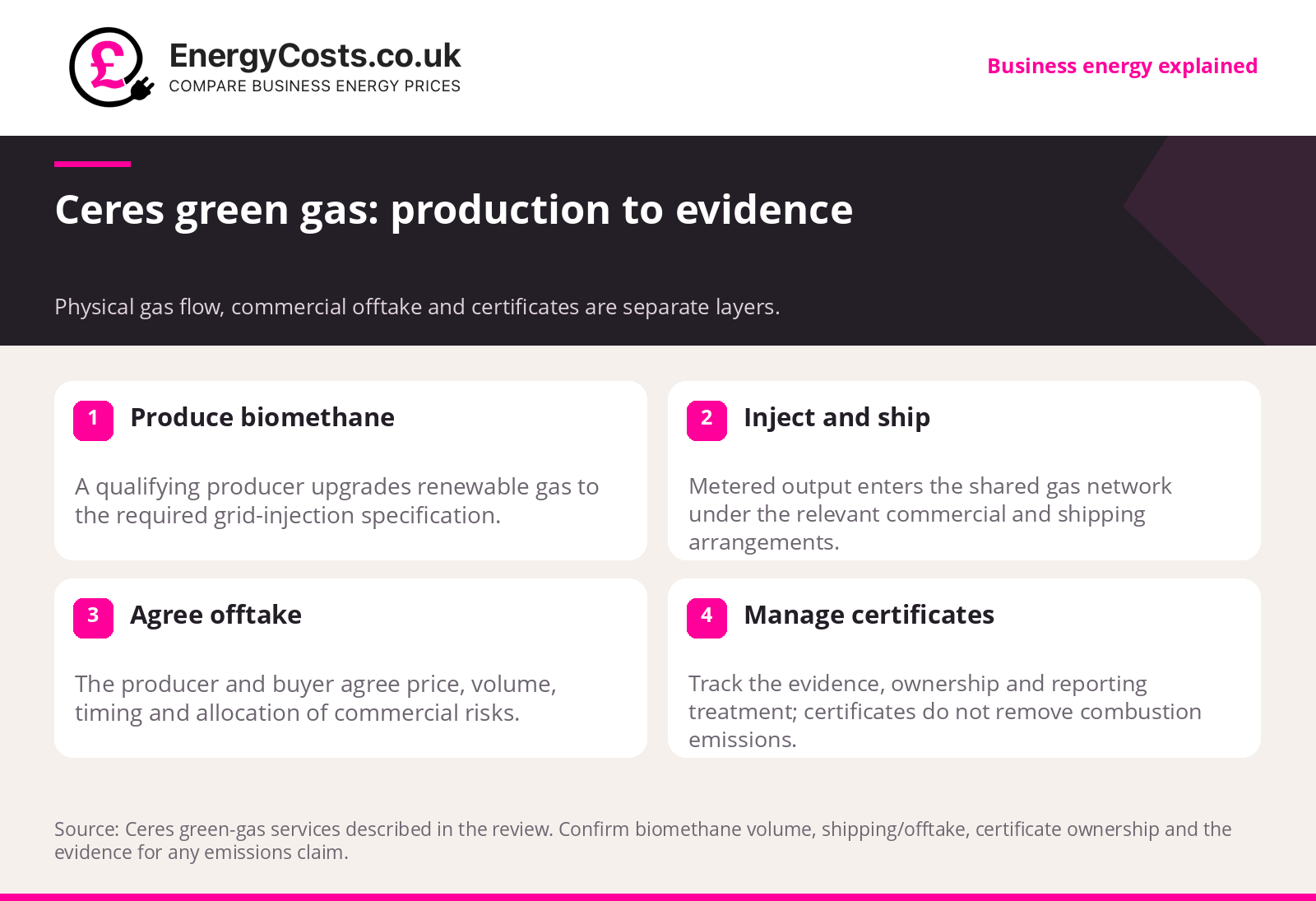
Ceres Energy’s strongest differentiator is its green gas focus. The company’s website refers to green gas-to-grid, support for producers, subsidy scheme applications, certificate management and ISCC certification.
Green gas can mean biomethane produced from sources such as anaerobic digestion, then injected into the gas grid and matched to buyers or transport users through commercial and certificate arrangements.
For businesses, green gas can be relevant where gas use is hard to eliminate quickly. Examples include heating, hot water, industrial process heat, food production, commercial kitchens, laundries, care homes, breweries and transport fuel.
| Green gas benefit | Why it matters |
|---|---|
| Lower-carbon gas procurement | Helps reduce reliance on fossil gas |
| Biomethane linkage | Supports renewable gas production |
| Certificate evidence | Helps with reporting and audit trails |
| Supply chain alignment | Useful for sustainability-led customers |
| Transport fuel relevance | Important for biomethane in road transport |
| Producer relationships | May support more direct green gas arrangements |
| Hydrogen readiness | Relevant to future gas network transition |
Businesses should ask exactly what form of green gas, certificate or biomethane matching is included in any contract.
Ceres Energy and biomethane producers
Ceres Energy’s website is heavily producer-focused. It says it works with producers to realise the value of their assets, provides flexible market access, supports subsidy scheme applications and claims, and offers certificate management and flexible pricing solutions.
This makes Ceres Energy especially relevant for biomethane producers and anaerobic digestion projects, not just gas end users.
| Producer need | Ceres Energy relevance |
|---|---|
| Gas-to-grid market access | Ceres describes itself as a licensed shipper |
| Certificate management | Helps manage green gas certificates |
| Subsidy support | Supports scheme applications and claims |
| Flexible pricing | Helps optimise value from green gas assets |
| Commercial structuring | Links producers and end users |
| Reporting | Supports injection and revenue tracking |
| Regulatory knowledge | Useful in a complex gas market |
For a normal business gas customer, this producer focus may not be directly relevant. However, it shows why Ceres is a specialist rather than a mainstream SME supplier.
Ceres Energy and hydrogen
Ceres Energy’s website describes the company as a first mover in the GB hydrogen gas-to-grid market.
For most business customers, hydrogen is not yet a normal gas tariff product. However, the positioning is relevant because it shows that Ceres is involved in future gas markets and low-carbon fuel infrastructure.
Businesses should not assume that a normal Ceres gas supply contract includes hydrogen or zero-carbon gas. Any claim about hydrogen, biomethane or green gas should be checked against the contract and supporting evidence.
Is Ceres Energy good for small businesses?
Ceres Energy is unlikely to be the most obvious choice for a typical small business gas contract. A small office, shop, salon or local service business may find a mainstream supplier easier to compare and manage.
Ceres may still be relevant to a small business if:
| Situation | Ceres Energy relevance |
|---|---|
| You moved into a site already supplied by Ceres | You may be on deemed or out-of-contract rates |
| You have unusually high gas use | Ceres may be more relevant than for low-use sites |
| You need green gas evidence | Ceres’ green gas expertise may help |
| You use gas as transport fuel | Ceres may be relevant due to green economy focus |
| You work with an energy consultant | A bespoke quote may be easier to assess |
| You need specialist gas advice | Ceres has gas market expertise |
For a low-usage microbusiness, compare at least three mainstream business gas quotes before choosing Ceres.
Is Ceres Energy good for large businesses?
Ceres may suit larger businesses or specialist gas users where producer access, biomethane, indexed procurement or bespoke commercial arrangements matter. The latest 2025 statement supports that specialist positioning, but its rounded meter-point figure should not be used to calculate an exact average site size.
Ceres may suit:
| Business type | Why Ceres Energy may fit |
|---|---|
| Large manufacturers | High gas use and need for specialist procurement |
| Food producers | Process heat and high gas demand |
| Breweries and distilleries | Heat, steam and process energy |
| Commercial laundries | Large hot water and drying loads |
| Hotels and leisure groups | High heating and hot water demand |
| Care home groups | Significant gas consumption across sites |
| Transport fuel users | Green gas and biomethane supply may be relevant |
| Biomethane producers | Ceres supports green gas-to-grid and certificates |
| Industrial estates | Complex gas supply arrangements may need expertise |
| Net zero-focused organisations | Green gas procurement may support transition plans |
Large users should assess Ceres on contract structure, risk allocation and green gas evidence, not only on unit rate.
Metering and data
Ceres Energy’s metering page says the company is involved in rolling out advanced and smart metering systems to supply customers. It says that, because it supplies industrial and commercial customers, it intends to continue providing Advanced Meter Reading solutions for non-daily metered customers.
AMR can help businesses validate invoices, manage gas use and improve energy efficiency. For microbusinesses, Ceres says a smart metering solution should be offered.
| Metering feature | Why it matters |
|---|---|
| AMR for non-daily metered customers | Supports accurate billing and gas management |
| Smart metering for microbusinesses | Can give near real-time usage visibility |
| Invoice validation | Helps identify billing errors |
| Energy efficiency | Usage data can reveal waste |
| Consumption tracking | Useful for carbon reporting |
| Contract accuracy | Better data can support more accurate quotes |
Businesses should confirm whether a smart meter or AMR device is installed, who pays for metering and how consumption data can be accessed.
Complaints and customer support
Ceres Energy publishes a complaints handling procedure for its gas supply customers. It says complaints can be made by phone, email or post and that it will acknowledge complaints within no more than 5 working days.
Ceres says it will respond after investigation within 10 working days, aims to resolve complaints within eight weeks, and provides access to the Energy Ombudsman for eligible microbusiness and small business customers in Great Britain.
| Complaint route | Detail |
|---|---|
| Phone | +44 (0) 1434 602 700 |
| [email protected] | |
| Post | Customer Relations, Ceres Energy Limited, The Old Grammar School, Hallgate, Hexham, NE46 1XD |
| Acknowledgement target | Within no more than 5 working days |
| Investigation response target | Within 10 working days |
| Resolution target | Within eight weeks where possible |
| Ombudsman access | Available to eligible microbusiness and small business customers |
| Possible remedies | Apology, explanation, remedial action, reimbursement or compensation |
For larger commercial customers, the most important question is likely to be who manages the account day to day and how billing or metering issues are escalated.
Customer reviews and reputation
Ceres Energy does not appear to have a strong public customer review profile on major review platforms. This is not unusual for a specialist commercial gas supplier with a relatively small number of high-volume customers.
The lack of review volume means businesses should not rely on Trustpilot-style scoring when assessing Ceres Energy. Instead, they should ask for:
| Evidence to request | Why it matters |
|---|---|
| Customer references | Useful for larger gas users |
| Account management details | Confirms support route |
| Billing examples | Shows invoice clarity |
| Contract examples | Helps compare risk allocation |
| Metering support details | Important for AMR and data access |
| Green gas evidence | Needed for reporting claims |
| Complaints process | Shows escalation route |
| Credit and payment terms | Important for cash flow |
For a specialist supplier, procurement due diligence is more useful than public reviews.
Ceres Energy contract terms to check
Before signing a Ceres Energy gas contract, businesses should review the following points carefully.
| Contract detail | What to check |
|---|---|
| Unit rate | Fixed, indexed or formula-based p/kWh price |
| Standing charge | Daily charge and any pass-through element |
| Annual quantity | Forecast consumption and AQ threshold |
| Metering type | Daily metered, non-daily metered, AMR or smart |
| Contract length | Start date, end date and renewal terms |
| Price index | Whether rates are linked to daily market prices |
| Pass-through charges | Which charges can be added separately |
| Transportation charges | Gas network and shipping-related costs |
| Green gas certificates | Whether biomethane or certificates are included |
| Government-imposed taxes | VAT, CCL and other applicable taxes |
| Volume tolerance | What happens if actual usage differs from forecast |
| Fixed daily quantity | Whether charges apply for under- or over-consumption |
| Credit requirements | Deposits, guarantees or payment terms |
| Broker commission | Whether third-party commission is included |
| Deemed rates | What applies if no contract is in place |
| Site-specific rates | Especially for AQ above 732,000 kWh |
| Termination rights | Notice periods and early exit terms |
| Change of occupancy | What happens when a tenant moves in or out |
| Data access | AMR, meter reads and reporting |
| Complaints route | How disputes are handled |
This is especially important if the contract is index-linked or includes pass-through charges.
Ceres Energy price risks
Ceres Energy’s specialist model can be useful, but businesses should understand the risks.
| Risk | What it means |
|---|---|
| Fallback prices | 11.94p/kWh is the currently linked standard fallback rate, not a contracted offer |
| Pass-through costs | The £5.38 daily element is not the complete fixed daily cost |
| Site-specific treatment | AQ above 732,000 kWh requires a bespoke fallback rate |
| Indexed or fixed-quantity terms | Market prices and consumption commitments can affect costs |
| Green gas evidence | Confirm the purchased volume, certificates and reporting method |
These risks do not mean Ceres Energy is a poor supplier. They mean it should be assessed as a specialist gas supplier, not a simple online tariff.
Pros and cons of Ceres Energy business gas
Pros
| Advantage | Why it matters |
|---|---|
| Specialist gas focus | Useful for businesses with complex gas needs |
| Non-domestic supply experience | Designed around business customers |
| Green gas-to-grid expertise | Strong relevance for biomethane and low-carbon gas |
| Gas shipping capability | Useful for producer and market access arrangements |
| Hydrogen positioning | Relevant to future low-carbon gas markets |
| Published out-of-contract rates | Gives some price transparency |
| AMR metering focus | Helps with billing validation and energy management |
| Producer relationships | May support more specialist green gas solutions |
| Certificate management | Useful for green gas reporting |
| Specialist commercial model | Confirm the named account support in the proposal |
Cons
| Disadvantage | Why it matters |
|---|---|
| No public contracted tariff table | Hard to compare without a quote |
| No clear electricity offer | Not suitable as a dual fuel supplier |
| Less suited to very small businesses | Simple SME gas buyers may prefer mainstream suppliers |
| Out-of-contract rate is high | 11.94p/kWh plus daily charges can be expensive |
| Pass-through charges can apply | Final costs may be higher than headline rates |
| Large sites get site-specific OOC rates | Extra uncertainty for high-consumption users |
| Limited public customer reviews | Harder to judge service quality |
| Specialist contracts may be complex | Procurement or legal review may be needed |
| Not a conventional green tariff brand | Green gas evidence must be checked contract by contract |
| Daily indexed pricing may vary | Less budget certainty than a simple fixed tariff |
Ceres Energy compared with other gas suppliers
Ceres Energy is best compared with suppliers that serve commercial gas users, especially larger or more specialist sites.
| Supplier | Business gas | Business electricity | Main positioning |
|---|---|---|---|
| Ceres Energy | Yes | No clear offer | Specialist non-domestic gas, green gas and gas shipping |
| Corona Energy | Yes | Yes | Business gas and electricity, including corporate supply |
| SEFE Energy | Yes | Yes | Large commercial and industrial gas and electricity |
| TotalEnergies Gas & Power | Yes | Yes | Large business energy supplier |
| Crown Gas & Power | Yes | Yes | SME and commercial gas/electricity supplier |
| United Gas & Power | Yes | Yes | Business gas and electricity supplier |
| British Gas Business | Yes | Yes | Large mainstream business supplier |
| EDF Business | Yes | Yes | Mainstream business supplier |
| 100Green | Yes | Yes | Renewable electricity and green gas |
| Good Energy | Yes | Yes | Green energy supplier |
If a business wants specialist green gas or biomethane-linked arrangements, Ceres may be more relevant. If it simply wants the cheapest fixed gas tariff, mainstream business gas suppliers may be easier to compare.
Alternatives to Ceres Energy
| Business need | Suppliers to compare |
|---|---|
| Simple SME gas tariff | British Gas, EDF, E.ON Next, Yu Energy, Valda Energy |
| Gas and electricity together | British Gas, EDF, E.ON Next, TotalEnergies, Crown Gas & Power |
| Large gas user supply | Corona Energy, SEFE Energy, TotalEnergies, Brook Green Supply |
| Green gas | 100Green, Good Energy, Ecotricity, specialist biomethane providers |
| Biomethane and gas-to-grid | Ceres Energy, Barrow Shipping-linked specialists, gas shippers |
| Transport fuel gas | Specialist green gas and biomethane suppliers |
The right comparison depends on whether the priority is price, simplicity, green gas, volume, risk management or producer-linked supply.
How to get a Ceres Energy quote
To get an accurate quote from Ceres Energy, prepare detailed gas information.
| Information needed | Why it matters |
|---|---|
| Company name | Required for commercial checks |
| Site address | Pricing is site-specific |
| MPRN | Identifies the gas meter point |
| Annual quantity | Main driver of gas pricing |
| Recent gas bills | Show current usage and rates |
| Current supplier | Needed for switching |
| Contract end date | Avoids termination problems |
| Meter type | Daily metered, non-daily metered, AMR or smart |
| Consumption profile | Seasonal and peak use can affect pricing |
| Preferred contract type | Fixed, index-linked or bespoke |
| Green gas requirement | Determines certificate or biomethane options |
| Multi-site details | Needed for portfolio pricing |
| Credit information | May affect payment terms |
| Broker or consultant details | Relevant if using an intermediary |
| Change of tenancy evidence | Needed if moving into a supplied site |
For large users, it is worth preparing monthly or daily gas consumption data rather than just annual consumption.
What to ask Ceres Energy before signing
Before agreeing a Ceres Energy contract, ask:
- Is the contract fixed, indexed or pass-through?
- What is the exact unit rate?
- What is the daily standing charge?
- What pass-through charges apply?
- Are prices excluding VAT and CCL?
- Are government-imposed taxes included or added?
- What annual quantity has been used for the quote?
- What happens if usage differs from forecast?
- Is there a fixed daily quantity?
- Are under-consumption or over-consumption charges possible?
- Is the contract linked to a wholesale gas index?
- What meter type is assumed?
- Is AMR or smart metering included?
- What green gas evidence is included?
- Are biomethane certificates included?
- Is the supply linked to a specific producer?
- Does the quote include broker commission?
- What credit checks or deposits apply?
- What happens when the contract ends?
- What out-of-contract rate would apply?
- What happens if annual quantity exceeds 732,000 kWh?
- Who manages the account?
- How are complaints escalated?
- How can the business access consumption data?
These questions are important because Ceres is a specialist gas supplier, and the contract may be more complex than a standard fixed SME tariff.
Is Ceres Energy cheap?
There is not enough public contracted pricing data to say whether Ceres Energy is cheap. Its standard contracted prices are not published.
The published 11.94p/kWh rate is for deemed or out-of-contract supply and excludes the daily element, pass-through costs and taxes. It should not be used to rank Ceres’s normal contracted prices against suppliers or historical averages. Obtain complete current quotations for equivalent consumption and risk terms.
For a contracted supply, Ceres may be competitive for the right type of user, especially where specialist gas arrangements, indexed pricing, green gas or producer-linked solutions are needed. For a simple small business gas tariff, the only way to judge value is to compare a live Ceres quote against several alternatives.
Final verdict: should your business choose Ceres Energy?
Ceres Energy is worth considering if your business has specialist gas needs, high annual gas consumption, green gas requirements, biomethane interests, transport fuel exposure or a need for gas market expertise. It is not a typical SME dual fuel supplier and should not be judged like one.
For small businesses, Ceres is most likely to be relevant if you move into premises already supplied by it or if your business has unusually high or specialist gas use. For larger gas users, it may be more relevant as part of a formal procurement process.
The main drawback is lack of public contracted price transparency. The published out-of-contract rate gives useful context, but it is not a normal contract price. Businesses should request a bespoke quote, compare the full annual cost, understand pass-through charges, check green gas evidence and avoid remaining on deemed or out-of-contract rates unnecessarily.
VAT and Climate Change Levy
All supplier prices and worked examples shown as excluding tax must have the appropriate tax treatment added. The main CCL rate is 0.801p/kWh for electricity and gas from 1 April 2026 to 31 March 2027, rising to 0.827p/kWh from 1 April 2027, before any exemption or reduction. Our Climate Change Levy guide explains the main reliefs. Ordinary commercial supplies generally attract 20% VAT. HMRC’s guidance provides temporary 0% VAT for qualifying electricity in Great Britain from 1 October 2026 to 30 June 2027; qualifying gas remains at 5%. Eligibility depends on the relevant use or small-quantity conditions, rather than simply being a business customer.
For EnergyCosts.co.uk readers, the practical recommendation is clear: treat Ceres Energy as a specialist commercial gas supplier. It may be a strong fit for the right customer, but ordinary SMEs should compare it carefully against mainstream gas suppliers before signing.
FAQ
Yes. Ceres Energy is a non-domestic gas supplier and gas market specialist. It is not a typical dual fuel SME supplier.
Ceres Energy’s public information focuses on gas. No clear business electricity supply product was found.
Ceres Energy publishes out-of-contract and deemed rates, but it does not publish a simple table of standard contracted business gas tariffs.
The currently linked rate PDF, updated 28 August 2026 and checked 19 November 2026, states 11.94p/kWh plus a pass-through charge and 538p/day, effective from 1 June 2026. It excludes VAT, CCL and government-imposed taxes. Sites with AQ above 732,000 kWh receive a site-specific out-of-contract rate.
No. Ceres Energy says its published out-of-contract and deemed rates exclude VAT, Climate Change Levy and government-imposed taxes.
Ceres Energy may not be the simplest option for small businesses wanting a basic gas tariff. It is more specialist and gas-focused.
Yes, Ceres Energy may be a better fit for larger or specialist gas users, especially those needing green gas, indexed pricing or bespoke commercial arrangements.
Ceres Energy has a strong green gas-to-grid focus and works with producers to structure commercial solutions for green gas and fuel supply.
No. Ceres Energy Limited is a separate gas supplier and shipper. It should not be confused with Ceres Power, the clean technology company.
You should consider Ceres Energy if your business needs specialist gas supply or green gas expertise. For a simple SME gas tariff, compare several suppliers before signing.
Sources and review date
Checked 19 November 2026. We reviewed the supplier’s public products, dated rate schedules and other cited primary sources. Published fallback prices are distinguished from personalised contract quotes. Financial and market statistics relate to the stated reporting periods and are not current tariffs. Annualised examples assume unchanged prices and 365 daily standing charges, with exclusions stated alongside. This is desk research rather than an account-holder service test.