

A pass-through business energy contract can be risky, but it is not automatically a bad deal. The main issue is that the business takes on more exposure to changes in third-party energy costs, instead of paying a fully fixed price where the supplier absorbs or prices in those risks.
The short answer is: yes, a pass-through business energy contract can be risky if the business wants budget certainty, does not understand the charges being passed through, or is exposed to rising network and policy costs.
However, it can also be suitable for larger or more energy-aware businesses that want transparency and are willing to accept variable costs.
What is a pass-through business energy contract?
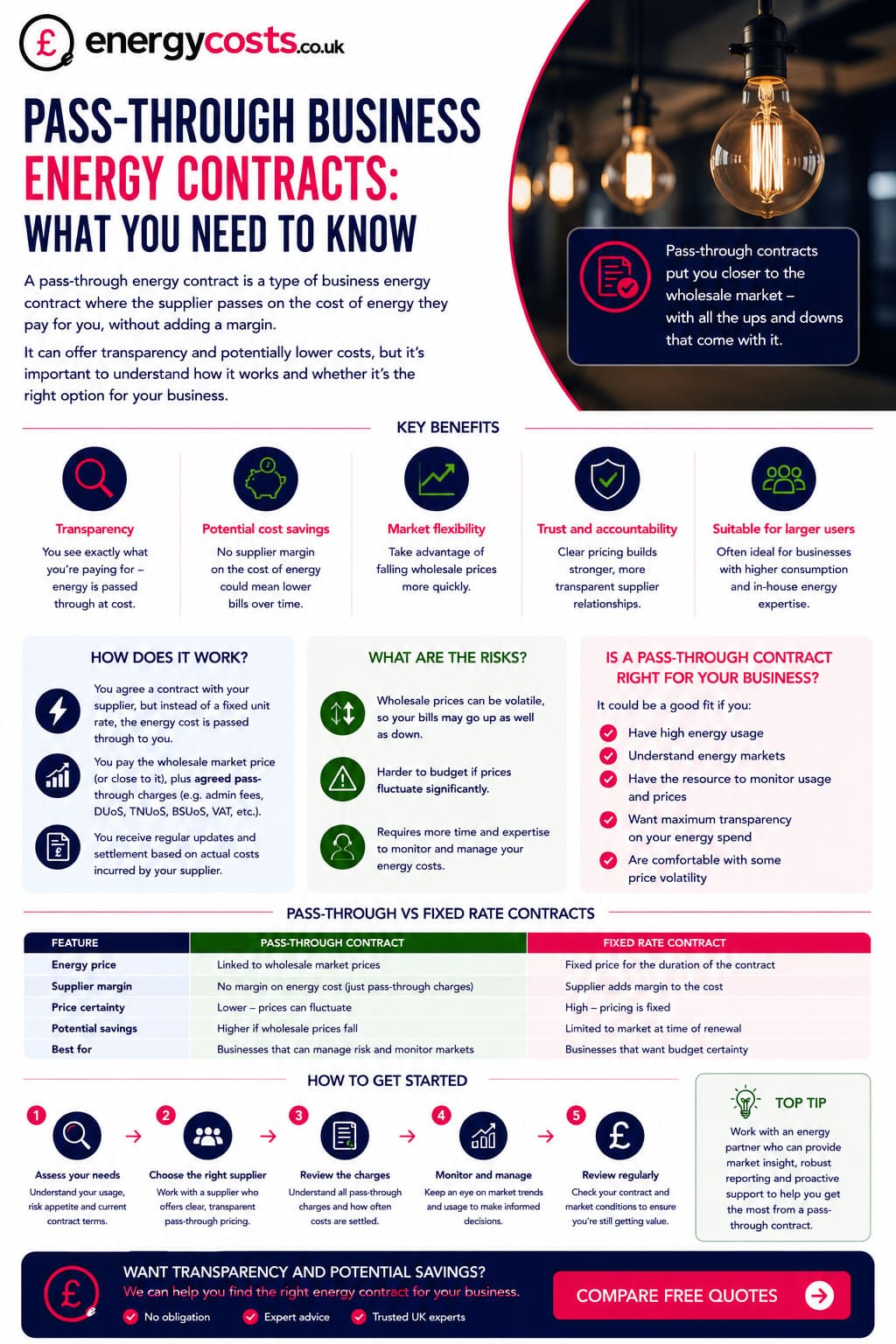
A pass-through business energy contract is an energy contract where some costs are passed directly from the supplier to the customer at actual or updated rates.
In a fully fixed contract, the supplier usually estimates future costs and builds them into the agreed unit rate and standing charge. In a pass-through contract, some of those costs can move during the contract.
| Contract type | How it works | Main benefit | Main risk |
|---|---|---|---|
| Fully fixed | Unit rate and standing charge are fixed for the contract period, subject to the contract terms | Budget certainty | Supplier may price in a risk premium |
| Part pass-through | Some costs are fixed, while others can change | Balance between certainty and transparency | Unexpected bill increases |
| Fully pass-through | Third-party charges are billed at actual or updated cost | More transparent cost breakdown | Less budget certainty |
| Flexible procurement | Wholesale energy may be bought in tranches, with other costs treated separately | Can suit large users with active energy management | Requires expertise and monitoring |
Pass-through contracts are more common among larger businesses, half-hourly metered sites, multi-site organisations and companies using energy consultants or brokers. Smaller businesses may also encounter them, but they need to be especially careful because the risk can be harder to manage without specialist advice.
What costs can be passed through?
The costs passed through vary by supplier and contract. The most common pass-through items are non-commodity charges.
Non-commodity charges are the parts of an energy bill that are not the wholesale cost of the electricity or gas itself. They include network costs, balancing costs, environmental scheme costs and policy-related charges.
Ofgem says business energy bills cover wholesale energy costs, network costs and environmental costs, and that wholesale costs can typically be around 40% of a business electricity bill and around 60% of a business gas bill, although the exact percentages vary.
| Charge | Full name | What it pays for | Risk in a pass-through contract |
|---|---|---|---|
| TNUoS | Transmission Network Use of System | High-voltage electricity transmission network | Can rise significantly from year to year |
| DUoS | Distribution Use of System | Local electricity distribution networks | Varies by region, voltage and usage profile |
| BSUoS | Balancing Services Use of System | Day-to-day electricity system balancing | Can change with system conditions |
| RO | Renewables Obligation | Support for older renewable generation schemes | Policy cost exposure |
| FiT | Feed-in Tariff | Support for small-scale renewable generation | Legacy scheme cost exposure |
| CfD | Contracts for Difference | Support for low-carbon generation | Can move depending on scheme costs |
| Capacity Market | Capacity Market charge | Security of electricity supply | Can be passed through depending on contract |
| Nuclear RAB | Nuclear Regulated Asset Base | Funding model for new nuclear infrastructure | Newer bill component risk |
| Metering and data | Meter operator and data services | Metering, data collection and settlement | May vary by site and supplier |
| Broker or management fee | Energy broker or consultant costs | Procurement and account management | May be added separately or built into rates |
Not every pass-through contract passes through all of these items. The key point is that the contract must be checked line by line.
Why pass-through contracts feel riskier in 2026
Pass-through contracts are more risky when third-party costs are rising. That is exactly the concern for many businesses in 2026.
Cornwall Insight forecast that by 2026, non-commodity charges would make up nearly 60% of a typical business electricity bill, driven by rising transmission costs, new bill components such as the Nuclear Regulated Asset Base, and widening exemption schemes for energy-intensive users.
This means a business could secure a good wholesale electricity price but still see its overall bill rise because the pass-through elements increase.
TNUoS is the clearest example
TNUoS is one of the most important pass-through risks in 2026. It pays for the high-voltage transmission network that moves electricity around Great Britain.
NESO publishes TNUoS tariffs, including final TNUoS tariffs for 2026/27. Industry commentary around the 2026/27 tariffs points to a sharp increase in transmission charges, making TNUoS a major concern for businesses on contracts where the cost is passed through.
| Annual electricity use | Extra cost from a £10/MWh increase |
|---|---|
| 25,000kWh | £250 per year |
| 50,000kWh | £500 per year |
| 100,000kWh | £1,000 per year |
| 250,000kWh | £2,500 per year |
| 500,000kWh | £5,000 per year |
| 1,000,000kWh | £10,000 per year |
| 5,000,000kWh | £50,000 per year |
This is a simplified example. Actual TNUoS exposure depends on meter type, location, voltage level, site capacity, charging band and contract structure.
Why a pass-through contract can be attractive
A pass-through contract is not always worse than a fixed contract. The main advantage is transparency.
A fully fixed supplier contract usually includes a forecast for future third-party charges. If the supplier expects costs to rise, it may include a risk premium. A pass-through contract can avoid some of that premium because the business agrees to pay the actual cost instead.
- More transparency: The business can see more of the underlying cost stack
- Lower supplier risk premium: The supplier does not need to price every future cost movement into the quote
- Possible savings if charges fall: If pass-through charges are lower than forecast, the business may benefit
- Better for large users: Bigger businesses may have the data and expertise to manage variable costs
- More accurate billing: Costs may reflect actual site characteristics more closely
- Useful for flexible procurement: Larger buyers can separate wholesale buying from non-commodity cost management
For a large manufacturer, warehouse group, cold storage business or multi-site retailer, a pass-through contract can make sense if the company has a finance team, broker or energy consultant monitoring the charges.
Why a pass-through contract can be risky
The risk is that the business may not know its true annual cost when it signs.
A supplier or broker might quote a low headline unit rate, but the final bill can rise if pass-through charges increase. This can make the contract difficult to compare with fully fixed offers.
| Risk | Why it matters |
|---|---|
| Budget uncertainty | The final annual cost may be higher than expected |
| Rising network charges | TNUoS and DUoS increases can feed through |
| Policy cost exposure | RO, FiT, CfD, Capacity Market and other scheme costs may change |
| Complicated invoices | Bills may be harder to check and forecast |
| Poor quote comparison | A low unit rate may hide variable extras |
| Reconciliation charges | Supplier may adjust costs later, creating catch-up bills |
| Broker misunderstanding | Some brokers may not clearly explain what is fixed and what is variable |
| Cash-flow pressure | Unexpected increases can affect monthly budgeting |
Ofgem advises businesses not to feel pressured into signing energy contracts, to check terms and fees beforehand, and to ask for phone-discussed contracts in writing before agreeing.
Pass-through versus fixed contracts
| Feature | Fully fixed contract | Pass-through contract |
|---|---|---|
| Budget certainty | Higher | Lower |
| Transparency | Lower to medium | Higher |
| Supplier risk premium | Usually higher | Usually lower |
| Exposure to charge increases | Lower, depending on contract | Higher |
| Ability to benefit from charge reductions | Lower | Higher |
| Invoice complexity | Usually simpler | More complex |
| Best suited to | SMEs wanting certainty | Larger or energy-aware businesses |
| Main danger | Paying too much for supplier risk premium | Underestimating future charges |
A fully fixed contract can be more expensive at the start, but it gives the business a clearer budget. A pass-through contract can look cheaper at the start, but it may become more expensive if third-party costs rise.
Example: fixed versus pass-through quote
A business uses 250,000kWh of electricity per year.
| Item | Fixed contract | Pass-through contract |
|---|---|---|
| Quoted unit rate | 29p/kWh | 26p/kWh |
| Initial annual usage cost | £72,500 | £65,000 |
| Initial saving | — | £7,500 |
| Extra pass-through costs later | £0 | £9,000 |
| Final annual cost | £72,500 | £74,000 |
In this example, the pass-through contract looks £7,500 cheaper at the quote stage, but ends up £1,500 more expensive after charges increase.
The opposite can also happen. If the supplier’s fixed quote includes a large risk premium and actual pass-through charges come in lower than expected, the pass-through contract could be cheaper.
Which businesses are most at risk?
Pass-through contracts are riskiest for businesses that need predictable costs or do not have time to monitor the energy market.
| Business type | Risk level | Why |
|---|---|---|
| Small office | High | Limited expertise and low tolerance for bill surprises |
| Café or restaurant | High | Margins are tight and energy costs are already volatile |
| Small retailer | High | Standing charges and fixed costs can have a large effect |
| Care home | Medium to high | High consumption and need for stable budgeting |
| Hotel | Medium to high | Large usage across heating, hot water, kitchens and laundry |
| Warehouse | Medium | Risk depends on lighting, HVAC, refrigeration and EV charging |
| Manufacturer | Medium | May have enough usage to benefit, but exposure can be large |
| Cold storage site | Medium to high | High continuous electricity use magnifies charge increases |
| Multi-site group | Medium | Can benefit from transparency but needs active management |
| Large half-hourly user | Lower to medium | Often has broker, consultant or internal energy expertise |
A pass-through contract is rarely ideal for a small business that simply wants to know what it will pay each month.
When a pass-through contract may be suitable
A pass-through contract may be worth considering if the business:
- uses a large amount of electricity
- has half-hourly metering
- understands non-commodity charges
- has an energy consultant or experienced broker
- can tolerate bill variation
- wants a transparent breakdown of costs
- has good consumption data
- can forecast and budget for variable charges
- is comparing offers on total estimated annual cost
- has reviewed the worst-case scenario
It may also suit organisations with energy procurement policies that separate wholesale purchasing from regulated and third-party charges.
When a pass-through contract may be unsuitable
A pass-through contract may be unsuitable if the business:
- needs fixed monthly costs
- has tight cash flow
- does not understand TNUoS, DUoS, BSUoS or policy charges
- is comparing only headline p/kWh rates
- does not receive proper cost forecasts
- has no time to check invoices
- has no broker or consultant support
- is a small business with low energy expertise
- cannot absorb a sudden increase
- is already struggling with energy debt
Ofgem says suppliers may require security deposits where there are greater risks of businesses defaulting on payment, and that suppliers are not obliged to offer businesses a contract. This makes it even more important for businesses to understand the terms before signing.
The role of brokers
Brokers can be useful when comparing fixed and pass-through contracts, but the quality of advice varies.
Ofgem announced new rules in 2024 intended to give businesses fairer treatment, more support resolving disputes and greater transparency on broker fees. The Energy Ombudsman also reported that 1,952 brokers were registered with its broker ADR scheme by the end of 2025, with 980 cases accepted during the reporting period, showing that broker-related disputes remain a real issue in the market.
Before signing a pass-through contract through a broker, the business should ask:
- Which charges are fixed? Confirms what is protected
- Which charges are passed through? Identifies variable-cost exposure
- Are forecasts included? Shows the likely annual cost
- What assumptions are used? Helps test whether the quote is realistic
- Are charges reconciled later? Warns of possible catch-up invoices
- How is the broker paid? Reveals commission or fees
- Is commission included in the unit rate? Prevents hidden cost surprises
- What happens if TNUoS rises? Tests the main 2026 risk
- Can the quote be compared with a fully fixed alternative? Enables a fair decision
- What support is available after signing? Important for invoice checking
A broker who cannot clearly explain the difference between fixed and pass-through costs is a warning sign.
What does “fixed” actually mean?
A major problem in business energy is that “fixed” can mean different things.
| Phrase | Possible meaning |
|---|---|
| Fixed unit rate | The p/kWh rate may be fixed, but other charges may still vary |
| Fixed wholesale rate | Only the energy purchasing element is fixed |
| Fixed non-commodity | Third-party charges are included and fixed |
| Fixed standing charge | The daily standing charge is fixed |
| Fixed for budget purposes | Supplier may still reconcile certain charges |
| Fully fixed | Usually means both energy and agreed third-party charges are fixed, subject to contract terms |
Businesses should not rely on a sales description. They should check the contract wording.
What should be in a good pass-through quote?
A good pass-through quote should show more than a headline unit rate.
| Quote item | Why it is important |
|---|---|
| Estimated annual consumption | Basis for the forecast |
| Meter type and profile | Affects charges |
| Region and distribution area | DUoS and network costs vary by region |
| Unit rate | Commodity or energy element |
| Standing charge | Fixed daily cost |
| TNUoS estimate | Major network cost exposure |
| DUoS estimate | Regional distribution cost exposure |
| BSUoS estimate | Balancing cost exposure |
| Policy cost estimates | RO, FiT, CfD and Capacity Market |
| Reconciliation terms | Whether costs can be adjusted later |
| Broker commission | Total cost of intermediary service |
| Worst-case sensitivity | What happens if charges rise |
| Total estimated annual cost | Best basis for comparison |
Without this information, it is difficult to know whether the contract is genuinely competitive.
Worked example: impact of pass-through increases
A business signs a pass-through electricity contract and uses 500,000kWh per year.
| Cost increase | Extra annual cost |
|---|---|
| TNUoS rises by £10/MWh | £5,000 |
| DUoS rises by 0.75p/kWh | £3,750 |
| BSUoS rises by 0.3p/kWh | £1,500 |
| Policy costs rise by 0.8p/kWh | £4,000 |
| Standing charge rises by £3/day | £1,095 |
| Total extra cost | £15,345 |
This shows why pass-through contracts can be risky for high-usage businesses. Even relatively small p/kWh changes can become large annual costs.
How to reduce the risk
Ask for fixed and pass-through quotes
Do not assess a pass-through offer in isolation. Ask for a fully fixed version, a part pass-through version and a full pass-through version so the trade-off is clear.
Compare total annual cost
A low unit rate does not necessarily mean a low bill. Compare the estimated annual cost including standing charges, non-commodity charges, VAT, CCL and broker commission.
Request a sensitivity table
Ask what the annual bill would look like if non-commodity charges rose by 5%, 10%, 20% or more.
Check reconciliation terms
Some contracts allow suppliers to reconcile estimated charges against actual charges later. This can create unexpected debit notes or catch-up bills.
Understand TNUoS treatment
In 2026, TNUoS is one of the most important risks. Ask whether TNUoS is fixed, forecast, reconciled or fully passed through.
Check broker commission
Broker commission can be charged as a p/kWh uplift, a separate fee, or a supplier-paid commission. The business should know the amount and how it is recovered.
Monitor invoices
Pass-through contracts require more invoice checking than simple fixed contracts. If a business does not check bills, errors or unexpected charges may go unnoticed.
Build a contingency budget
A business choosing pass-through pricing should budget for upside risk. Treat the quote as an estimate, not a guaranteed total cost.
Review supply capacity
For larger sites, agreed capacity can affect network charges. If the site has more capacity than it needs, it may be paying avoidable fixed costs.
Use regular meter data
Good consumption data makes forecasting more accurate. Half-hourly data can help identify peak demand and operational changes.
What if the contract was mis-sold?
If a business was told a contract was fixed but later discovers major charges were passed through, it should gather evidence and complain.
Useful evidence includes:
- signed contract
- quote sheet
- broker emails
- call recordings, if available
- supplier welcome pack
- invoices
- renewal letters
- meter data
- commission disclosure
- any written promise that prices were fixed
Small businesses have been able to access the Energy Ombudsman’s independent dispute resolution services for disputes with suppliers since 19 December 2024, subject to eligibility criteria including fewer than 50 employees and turnover or balance-sheet thresholds.
Is pass-through better for gas or electricity?
Pass-through risk is usually more significant for electricity than gas because electricity has more network, balancing and policy-related costs.
| Cost area | Electricity | Gas |
|---|---|---|
| Wholesale commodity | Major cost | Major cost |
| Transmission and distribution | Significant | Significant but different structure |
| Balancing | Significant | Present but usually less visible |
| Low-carbon policy schemes | More extensive | Less extensive |
| Capacity Market | Yes | No |
| Non-commodity complexity | Higher | Lower |
For electricity contracts in 2026, pass-through exposure can be particularly important because non-commodity charges are a large and rising share of the bill.
Is a pass-through business energy contract risky?
A pass-through business energy contract is risky if the business does not understand what is being passed through or needs predictable monthly costs. The risk is especially important in 2026 because non-commodity electricity charges are a large share of business bills and some network costs have risen sharply.
However, pass-through pricing is not automatically bad. It can be transparent and sometimes cheaper than a fully fixed contract, especially for larger businesses that can monitor charges, manage budgets and compare offers properly.
The safest approach is to ask one simple question before signing: what is fixed, what is variable, and what happens if third-party charges rise?
If the supplier or broker cannot answer that clearly in writing, the contract is probably too risky.
FAQ
Yes, it can be. A pass-through contract exposes the business to changes in third-party costs such as network, balancing and policy charges. This can make annual costs harder to predict.
It can be cheaper, but not always. A pass-through contract may avoid some supplier risk premium, but the final cost can rise if non-commodity charges increase.
Common pass-through costs include TNUoS, DUoS, BSUoS, Renewables Obligation, Feed-in Tariff, Contracts for Difference, Capacity Market, metering costs and other industry charges.
Yes. Some contracts fix the wholesale unit rate but still allow certain third-party costs to be passed through or reconciled later. Always check the contract wording.
Pass-through contracts are usually more suitable for larger businesses, half-hourly metered sites, multi-site groups and companies with energy procurement expertise.
Small businesses that need budget certainty, have tight cash flow or do not understand non-commodity charges should be cautious. A fully fixed contract may be easier to manage.
Ask which charges are fixed, which are passed through, whether charges are reconciled later, how broker commission is paid, and what the total annual cost could be if charges rise.
Yes. Start with the supplier or broker. Eligible small businesses may be able to escalate unresolved supplier disputes to the Energy Ombudsman, and broker complaints may also fall within relevant redress arrangements.