

OVO and Ecotricity are both established British energy brands with substantial environmental ambitions. However, their current services for companies are fundamentally different.
Ecotricity actively supplies electricity and gas to small, medium-sized and large businesses. Companies can request a quoted tariff, purchase 100% renewable electricity and access services such as Power Purchase Agreements and time-matched renewable energy reporting.
OVO does not currently advertise standard business electricity or gas tariffs to new customers through its public tariff website. Its ordinary energy plans and quotation service are aimed at households. OVO’s public business services instead concentrate on commercial solar installations, purchasing electricity from renewable generators and managing public charging for electric vehicle fleets.
This means that a company looking for a new business energy supply contract cannot make a conventional OVO-versus-Ecotricity tariff comparison. Ecotricity is the only one of the two currently providing a clear route through which an ordinary business can request a new gas or electricity supply quote.
OVO may still be relevant where a company wants solar panels, has renewable electricity to sell or operates an electric vehicle fleet.
OVO vs Ecotricity at a glance
| Feature | OVO | Ecotricity |
|---|---|---|
| Publicly advertised SME electricity tariff | No standard business tariff currently advertised | Yes |
| Publicly advertised SME gas tariff | No standard business tariff currently advertised | Yes |
| Domestic energy tariffs | Yes | Yes |
| Non-domestic supply licence | Yes | Yes |
| Online business energy quote | No conventional business supply quote | Yes |
| Renewable business electricity | No ordinary business supply product advertised | 100% renewable electricity |
| Fixed business contracts | Not publicly offered for normal supply | Available by quotation |
| Large-business supply | No conventional supply service advertised | Yes |
| Commercial solar installation | Yes | Renewable generation services available |
| Business solar savings claim | OVO says installations could cut electricity costs by 30% to 50% | No equivalent universal percentage |
| Buys renewable electricity from businesses | Yes | Yes |
| Publicly stated PPA threshold | Export capacity above 100kW | Generation above 250kW for its promoted on-site service |
| Typical PPA duration | One to three years for OVO’s fixed-rate product | Bespoke |
| Time-matched REGOs | Not advertised as a business supply feature | Yes |
| Public EV fleet charging | Yes | No directly comparable service |
| EV fleet subscription | £4.20 per driver per month, plus VAT | Not applicable |
| Proposed ownership change | Sale of OVO’s energy retail business to E.ON, subject to approval | None announced |
| Best suited to | Solar, renewable generators and EV fleets | Businesses requiring renewable electricity or gas supply |
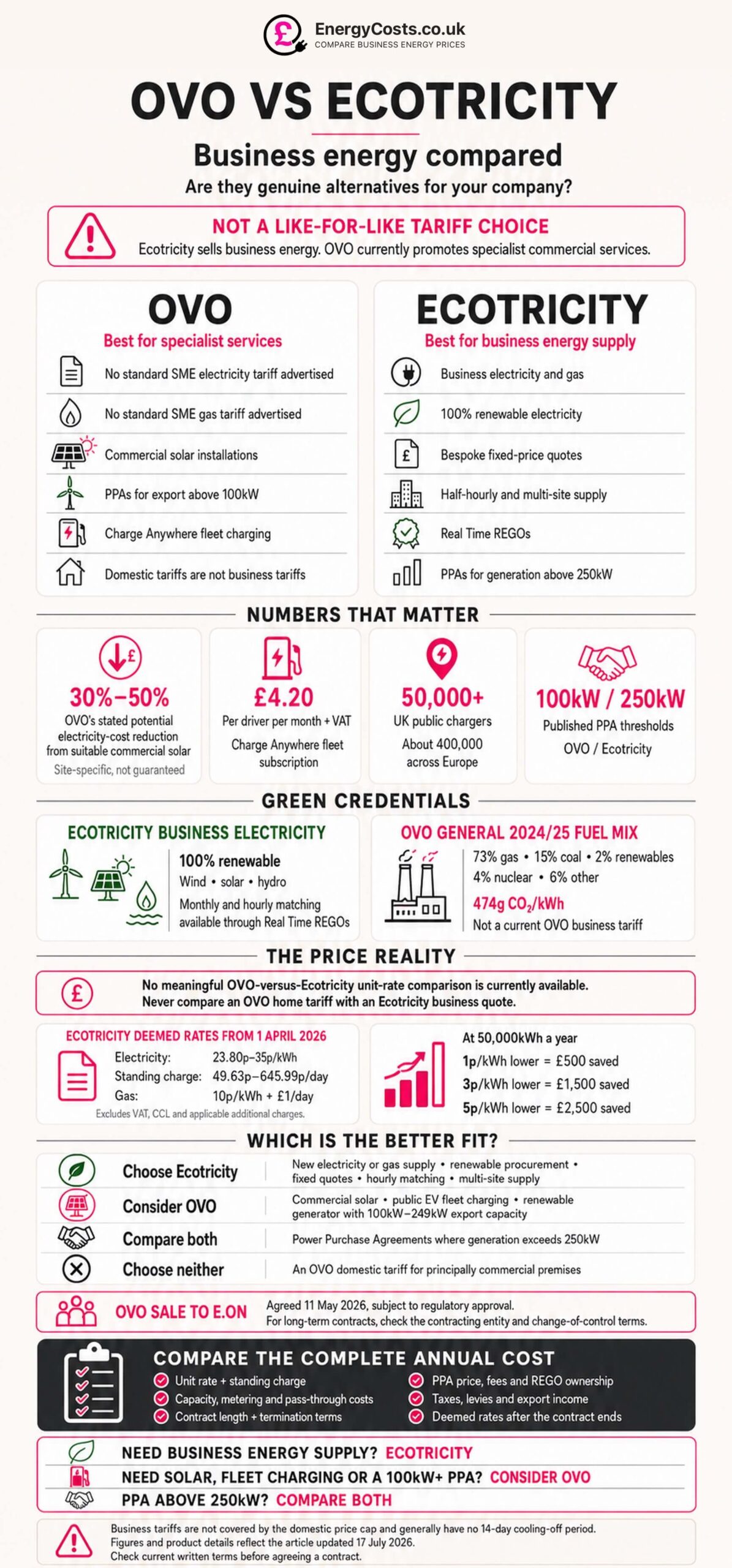
Does OVO currently supply business energy?
OVO Energy Limited holds electricity and gas supply licences that permit it to supply both domestic and non-domestic premises. However, possession of a non-domestic licence does not necessarily mean that a supplier is accepting new business energy customers.
OVO’s current public website directs ordinary tariff enquiries towards home energy plans. Its “For business” navigation concentrates on two services:
- electric vehicle fleet charging; and
- selling renewable electricity to OVO.
OVO also launched a commercial solar installation service in February 2026. However, it does not currently provide a visible route for an SME to obtain a normal OVO business electricity or gas quotation.
Businesses may encounter older articles and comparison pages describing OVO business tariffs, including fixed contracts and variable products. These should not be treated as evidence that an equivalent product remains available in 2026.
A company should obtain direct written confirmation from OVO before assuming that it can place a commercial supply meter on an OVO energy tariff.
Can a business use an OVO domestic tariff?
A company should not use a domestic tariff for premises that are principally used for commercial activity.
Domestic and non-domestic supplies are treated differently in areas including:
- tariff construction;
- VAT;
- Climate Change Levy;
- metering arrangements;
- consumer protections;
- contract termination;
- broker commissions; and
- complaint rights.
A small home-based business may continue to use energy through an ordinary household account where the property remains principally residential. That is different from placing an office, shop, warehouse, workshop or other commercial premises on a domestic plan.
OVO’s well-known products such as Simpler Energy, fixed home plans, Charge Anytime, Power Move and OVO Beyond should not be presented as business energy tariffs unless OVO expressly confirms that a particular commercial customer is eligible.
Ecotricity business energy tariffs
Ecotricity provides a clear business supply proposition covering SMEs and larger organisations.
Its business services include:
- quoted electricity contracts;
- quoted gas contracts;
- fixed pricing for qualifying customers;
- half-hourly supplies;
- multi-site requirements;
- Power Purchase Agreements;
- on-site renewable generation;
- renewable energy reporting; and
- Real Time REGOs.
Ecotricity does not publish one fixed unit price that applies to every company. The quotation depends on the individual supply.
Relevant factors include:
- business location;
- electricity MPAN or gas MPRN;
- annual consumption;
- meter profile;
- half-hourly usage pattern;
- agreed electricity capacity;
- contract term;
- wholesale market conditions;
- credit assessment;
- payment method; and
- whether the contract has fixed or pass-through elements.
A small shop with annual electricity consumption of 12,000kWh will not normally receive the same rate as a factory consuming 2GWh through a half-hourly meter.
Can OVO and Ecotricity business prices be compared?
There is no meaningful new-customer unit-rate comparison because OVO does not currently publish or advertise a standard business supply offer.
The practical position is:
| Question | Answer |
|---|---|
| Can a company request an Ecotricity business supply quote? | Yes |
| Can a company obtain a public OVO home energy quote? | Yes |
| Can a company obtain a standard public OVO business supply quote? | No clear route is currently advertised |
| Can OVO’s domestic rates be compared with Ecotricity’s business rates? | No |
| Does OVO’s non-domestic licence prove that tariffs are available? | No |
| Could OVO potentially agree a specialist commercial arrangement? | Possibly, but availability must be confirmed directly |
Businesses should therefore compare an Ecotricity quotation with quotations from other suppliers that are actively accepting non-domestic customers.
Ecotricity’s published deemed electricity prices
Although Ecotricity’s agreed contract prices are individually quoted, it publishes deemed rates for businesses occupying premises that it already supplies without having agreed a contract.
From 1 April 2026, its published non-half-hourly deemed electricity schedule includes the following charges.
| Ecotricity electricity category | Unit rate | Daily standing-charge range |
|---|---|---|
| Domestic residual band | 23.80p–26.33p/kWh | 49.63p–75.82p |
| No Residual | 33p/kWh | 51.13p–77.87p |
| Band 1 | 35p/kWh | 51.13p–77.87p |
| Band 2 | 35p/kWh | 86.20p–135.96p |
| Band 3 | 35p/kWh | 152.21p–250.10p |
| Band 4 | 35p/kWh | 375.75p–645.99p |
The applicable standing charge depends on the electricity distribution region and the site’s DUoS residual band.
The published figures exclude VAT, Climate Change Levy and some government or industry charges. Half-hourly supplies may also incur costs relating to:
- available capacity;
- excess capacity;
- meter operation;
- data collection;
- reactive power; and
- other ancillary services.
These are deemed rates rather than representative fixed-contract quotations. A business should not use them to estimate the price it will necessarily receive under a newly negotiated Ecotricity agreement.
Ecotricity’s published deemed gas price
Ecotricity’s published deemed business gas charges from 1 April 2026 are:
| Charge | Published rate |
|---|---|
| Gas unit rate | 10p/kWh |
| Daily standing charge | 100p |
| Annual standing charge | £365 |
The following examples demonstrate the resulting cost before VAT, Climate Change Levy and other additions.
| Annual gas consumption | Consumption charge | Standing charge | Subtotal |
|---|---|---|---|
| 25,000kWh | £2,500 | £365 | £2,865 |
| 50,000kWh | £5,000 | £365 | £5,365 |
| 100,000kWh | £10,000 | £365 | £10,365 |
| 250,000kWh | £25,000 | £365 | £25,365 |
| 500,000kWh | £50,000 | £365 | £50,365 |
A negotiated contract may be substantially cheaper than remaining on a deemed rate.
Understanding the effect of unit rates
Small differences in business electricity prices can create significant annual savings.
| Annual consumption | Saving from 1p/kWh reduction | Saving from 3p/kWh reduction | Saving from 5p/kWh reduction |
|---|---|---|---|
| 10,000kWh | £100 | £300 | £500 |
| 25,000kWh | £250 | £750 | £1,250 |
| 50,000kWh | £500 | £1,500 | £2,500 |
| 100,000kWh | £1,000 | £3,000 | £5,000 |
| 250,000kWh | £2,500 | £7,500 | £12,500 |
| 1,000,000kWh | £10,000 | £30,000 | £50,000 |
The standing charge can be equally important for low-consumption premises and multi-site organisations.
| Standing-charge difference | Annual difference per meter | Difference across ten meters |
|---|---|---|
| 25p per day | £91.25 | £912.50 |
| 50p per day | £182.50 | £1,825 |
| £1 per day | £365 | £3,650 |
| £2 per day | £730 | £7,300 |
| £5 per day | £1,825 | £18,250 |
Companies should compare the complete projected annual cost rather than selecting the supplier with the lowest headline unit rate.
OVO commercial solar for businesses
OVO launched a commercial solar installation service in February 2026. It said suitable businesses could reduce their electricity costs by between 30% and 50%.
This is not an OVO business energy tariff. It is a service intended to reduce the amount of electricity a company needs to import from its energy supplier.
Potential savings depend on:
- available roof or land area;
- roof direction and shading;
- structural condition;
- local solar irradiation;
- panel capacity;
- installation cost;
- financing;
- daytime electricity demand;
- export rates;
- maintenance costs;
- business rates and tax treatment; and
- how long the company expects to remain at the premises.
The following table applies OVO’s stated 30% to 50% potential reduction to different annual electricity expenditures.
| Existing annual electricity cost | Illustrative 30% reduction | Illustrative 50% reduction |
|---|---|---|
| £5,000 | £1,500 | £2,500 |
| £10,000 | £3,000 | £5,000 |
| £25,000 | £7,500 | £12,500 |
| £50,000 | £15,000 | £25,000 |
| £100,000 | £30,000 | £50,000 |
These are mathematical illustrations, not guaranteed savings.
A company considering the service should request a site-specific model showing:
- expected annual generation;
- expected self-consumption;
- expected exports;
- annual degradation;
- maintenance assumptions;
- electricity price assumptions;
- payback period;
- internal rate of return; and
- projected cash flow over the equipment’s lifetime.
Buying electricity from renewable generators
Both companies can purchase electricity produced by businesses, landowners and renewable developers, but their publicly described eligibility criteria differ.
OVO Power Purchase Agreements
OVO says it works with renewable generators that have an export capacity above 100kW.
Eligible technologies include:
- solar;
- wind;
- hydroelectricity; and
- anaerobic digestion.
OVO’s standard published proposition is a fixed-rate PPA under which it purchases 100% of the exported electricity at an agreed price per MWh.
Its short-term fixed-rate agreements typically last between one and three years. OVO also says it can discuss bespoke arrangements.
The service includes:
- registration of the half-hourly meter;
- automated billing;
- monthly statements;
- payment in the following month;
- a dedicated account manager; and
- fixed pricing intended to reduce exposure to wholesale volatility.
Ecotricity Power Purchase Agreements
Ecotricity promotes PPA services for businesses generating more than 250kW of green electricity on site. It can also develop more complex supply and generation arrangements for major commercial customers.
A business comparing PPAs should examine:
| PPA consideration | Why it matters |
|---|---|
| Price per MWh | Determines basic export income |
| Fixed or market-linked price | Changes risk and potential upside |
| Contract duration | Affects flexibility and certainty |
| Volume commitment | May create exposure if generation underperforms |
| Route-to-market fee | Reduces net income |
| Balancing responsibility | Determines who bears forecasting risk |
| REGO ownership | Affects the value of environmental certificates |
| Metering costs | Can materially affect smaller installations |
| Payment timetable | Influences cash flow |
| Credit strength | Affects the risk of future non-payment |
| Change-of-control provisions | Important where a buyer may be sold |
| Termination rights | Can make refinancing or selling the asset harder |
Comparing the PPA thresholds
| Export capacity | OVO’s published position | Ecotricity’s promoted on-site position |
|---|---|---|
| Below 100kW | Does not meet OVO’s stated PPA threshold | Does not meet Ecotricity’s stated 250kW threshold |
| 100kW–249kW | Potentially eligible | Below the promoted threshold |
| 250kW–1MW | Potentially eligible | Potentially eligible |
| Above 1MW | Bespoke discussion likely | Bespoke discussion likely |
The thresholds do not guarantee acceptance. Technology, location, metering, credit risk, generation history and contract structure may also affect eligibility.
OVO fleet charging
OVO offers Charge Anywhere for business electric vehicle fleets.
The published service costs £4.20 per driver per month, excluding VAT. Electricity used at public charge points is then charged at the rate displayed through the service.
OVO says the service provides access to:
- more than 50,000 public chargers in the UK;
- approximately 400,000 chargers across Europe; and
- more than 600 charging networks.
Fleet managers receive:
- one monthly invoice;
- live spending information;
- charging data;
- the ability to add or remove drivers;
- CSV data exports;
- ESG reporting information;
- ESOS and SECR information; and
- VAT-compliant records.
The annual subscription cost before VAT is:
| Number of drivers | Monthly subscription | Annual subscription |
|---|---|---|
| 1 | £4.20 | £50.40 |
| 5 | £21 | £252 |
| 10 | £42 | £504 |
| 25 | £105 | £1,260 |
| 50 | £210 | £2,520 |
| 100 | £420 | £5,040 |
These figures exclude VAT and the cost of charging.
Ecotricity does not currently advertise a directly comparable public fleet-charging management service. OVO is therefore the stronger of the two for a company seeking consolidated public charging rather than an energy supply contract.
Comparing environmental credentials
Ecotricity
Ecotricity describes its supplied electricity as 100% renewable and sourced from technologies including wind, solar and hydro.
It also says it generates approximately 10% of the electricity associated with its customer supply and uses revenue from energy bills to develop additional renewable generation.
For businesses, this provides a relatively straightforward procurement statement: the purchased electricity is supported by renewable energy certificates rather than a mixture containing fossil fuels or nuclear power.
Ecotricity’s business services also include Real Time REGOs. These match energy consumption with renewable generation more closely than conventional annual certificate matching.
Its published options include:
- monthly matching;
- hourly matching; and
- matching involving REGOs bundled within sleeved PPAs.
This may be relevant to businesses seeking more detailed evidence for environmental reporting, net-zero commitments and Scope 2 disclosures.
OVO
OVO follows a different environmental reporting approach.
It stopped using standard REGO certificate matching across its ordinary supply in 2023. OVO argues that purchasing unbundled certificates does not itself create more renewable generation and can make a supplier’s disclosed fuel mix look greener without changing the physical grid.
For the period from 1 April 2024 to 31 March 2025, OVO published the following fuel mix:
| Electricity source | OVO published proportion |
|---|---|
| Natural gas | 73% |
| Coal | 15% |
| Renewables | 2% |
| Nuclear | 4% |
| Other | 6% |
| Published carbon intensity | 474g CO₂/kWh |
This disclosure relates to OVO’s general energy supply position and should not be interpreted as a current business tariff, because OVO does not presently market a normal business supply product.
OVO says it instead focuses on direct renewable power purchases, investments in new projects, smart consumption and low-carbon technology.
The two suppliers therefore take different approaches:
- Ecotricity provides renewable certificate-backed supply and more granular time-matching options;
- OVO criticises conventional certificate matching and reports a location-based mix that is much more fossil-fuel intensive on paper.
For a company that needs a clear renewable electricity claim in its procurement documents, Ecotricity provides the more immediately usable business product.
What does OVO’s proposed sale to E.ON mean?
On 11 May 2026, OVO announced that it had agreed to sell its UK energy retail business to E.ON. The transaction remains subject to regulatory approval.
OVO says that, until completion:
- OVO and E.ON remain separate businesses;
- existing tariffs remain unchanged;
- customer balances remain unchanged;
- services continue as normal; and
- no immediate customer action is required.
Businesses considering a long-term OVO solar, PPA or fleet agreement should nevertheless establish:
- which OVO legal entity will sign the contract;
- whether that entity forms part of the proposed transaction;
- whether consent is required to transfer the agreement;
- whether prices or service levels can change after a transfer;
- whether warranties remain enforceable;
- who will maintain installed solar equipment; and
- what termination rights apply following a change of control.
The proposed sale does not mean that OVO is closing or that existing services have stopped. It is, however, relevant due diligence for any company considering a multi-year agreement.
How business energy quotations should be assessed
An Ecotricity quotation should be assessed using the total expected cost, not only the quoted pence-per-kWh figure.
A useful calculation is:
- Annual consumption × unit rate
- standing charge × 365
- capacity charges
- meter and data charges
- pass-through costs
- taxes and levies
− export income and credits
Businesses should ask whether the proposed price is:
- fully fixed;
- fixed except for changes in law;
- pass-through;
- partially fixed;
- wholesale indexed; or
- linked to the company’s consumption profile.
Ofgem indicated in March 2026 that wholesale costs can represent approximately 40% of a business electricity bill and 60% of a business gas bill, although the precise proportions vary.
The remaining costs can include networks, metering, balancing, environmental schemes, supplier operating costs and margin.
Business contract protections
Most business energy contracts cannot be cancelled through the 14-day domestic cooling-off process.
Businesses should therefore obtain the principal terms in writing before accepting a contract and check:
- contract start date;
- contract end date;
- renewal procedure;
- switching window;
- early termination formula;
- minimum consumption;
- maximum consumption;
- volume-tolerance provisions;
- security deposit;
- Direct Debit requirements;
- broker fees;
- commission;
- change-of-tenancy procedure; and
- deemed or out-of-contract rates.
Ofgem also notes that suppliers are not obliged to offer every business a contract. A poor credit profile, previous payment problems or an unusually risky site may result in a security deposit, advance payment requirement or refusal to quote.
OVO advantages and disadvantages
Advantages
- Commercial solar installation service is available.
- OVO says suitable solar customers could cut electricity costs by 30% to 50%.
- Fixed-rate PPAs are available for qualifying generation above 100kW.
- Published PPAs normally last between one and three years.
- OVO offers to buy 100% of exported electricity under its fixed-rate PPA.
- Strong public EV fleet-charging service.
- Charge Anywhere covers more than 50,000 UK chargers.
- Fleet subscriptions are transparently priced at £4.20 per driver per month plus VAT.
- Centralised invoicing and charging data can reduce fleet administration.
Disadvantages
- No ordinary business electricity tariff is publicly advertised.
- No ordinary business gas tariff is publicly advertised.
- Domestic OVO prices cannot be used as commercial price comparisons.
- OVO’s published fuel mix contains a high proportion of gas and coal.
- It does not provide a renewable business supply claim comparable to Ecotricity.
- The energy retail business is due to be sold to E.ON, subject to approval.
- Businesses must check whether the ownership transaction affects long-term commercial contracts.
- Solar savings depend heavily on the individual site and are not guaranteed.
Ecotricity advantages and disadvantages
Advantages
- Actively accepts business supply enquiries.
- Supplies both business electricity and gas.
- Electricity is described as 100% renewable.
- Provides services for SMEs and major energy users.
- Offers fixed business pricing by quotation.
- Real Time REGOs provide more detailed renewable matching.
- Power Purchase Agreements are available for qualifying generation.
- Public deemed prices make out-of-contract exposure more transparent.
- Suitable for companies that require renewable procurement evidence.
Disadvantages
- Standard negotiated prices are not publicly displayed.
- A quotation is required to determine whether it is competitive.
- Published deemed rates can be expensive.
- Some residual bands carry substantial standing charges.
- Additional metering, capacity and ancillary charges may apply.
- The promoted on-site PPA threshold of more than 250kW is higher than OVO’s 100kW threshold.
- Contract termination and consumption-tolerance provisions require careful review.
Which supplier is best for different businesses?
| Business requirement | Better fit | Reason |
|---|---|---|
| New SME electricity contract | Ecotricity | OVO does not advertise an ordinary business supply tariff |
| New business gas contract | Ecotricity | Ecotricity actively supplies business gas |
| 100% renewable electricity | Ecotricity | Clear renewable business supply proposition |
| Fixed-price business energy | Ecotricity | Fixed commercial pricing is available by quotation |
| Commercial solar installation | OVO may be suitable | Dedicated service launched in 2026 |
| Renewable generator with 100kW–249kW export capacity | OVO | Meets OVO’s stated threshold but not Ecotricity’s promoted 250kW threshold |
| Renewable generator above 250kW | Compare both | Both may be able to provide a PPA |
| Public EV fleet charging | OVO | Dedicated subscription and fleet dashboard |
| Hourly renewable matching | Ecotricity | Real Time REGOs are available |
| Multi-site renewable supply | Ecotricity | Active large-business supply service |
| Conventional shop or office | Ecotricity | Only direct supply option of the two |
| Business seeking a domestic-style OVO tariff | Neither | Domestic tariffs should not be used as business contracts |
Final verdict: Ecotricity vs OVO
Ecotricity is the clear choice between these two companies for a business that needs an electricity or gas supplier.
It actively markets non-domestic energy contracts, provides quotations for SMEs and large organisations, supplies 100% renewable electricity and offers renewable reporting and PPA options.
OVO cannot presently be treated as a direct alternative for ordinary business energy supply. Its public tariff pages focus on households, while its current commercial services focus on solar installations, renewable electricity purchasing and electric fleet charging.
OVO may still be the stronger option in three specific situations:
- the company wants a commercial solar installation;
- it operates an electric vehicle fleet and needs public charging management; or
- it generates more than 100kW of renewable electricity and wants a fixed-rate PPA.
The practical conclusion is:
- choose Ecotricity when the company needs a new gas or electricity supply contract;
- consider OVO for commercial solar, fleet charging or renewable export services;
- compare both for PPAs where generation exceeds 250kW; and
- do not compare an OVO domestic tariff with an Ecotricity business tariff.
A company seeking the lowest energy supply price should obtain an Ecotricity quotation and compare it with quotes from several other active business suppliers using the same consumption information, contract start date and contract duration.
FAQ
OVO does not currently advertise standard electricity or gas supply tariffs for new business customers. Its public business services focus on fleet charging and purchasing renewable electricity, while it also offers commercial solar installations.
Yes. OVO Energy Limited holds gas and electricity licences covering domestic and non-domestic premises. However, a licence does not require a supplier to advertise or accept applications for every type of tariff.
There is no current like-for-like tariff comparison because OVO does not publish an ordinary business supply offer. Businesses must compare an Ecotricity quote against quotations from suppliers currently accepting commercial customers.
Not where the premises are principally commercial. Business and domestic contracts have different prices, taxes, terms and protections. The correct non-domestic meter classification and contract should be used.
Ecotricity supplies business electricity described as 100% renewable. OVO does not currently advertise an equivalent business supply tariff and reports a general 2024/25 fuel mix containing 73% gas and 15% coal.
Yes. OVO launched a commercial solar service in February 2026 and said suitable installations could cut electricity costs by between 30% and 50%. Actual savings require a site-specific assessment.
Yes. OVO offers PPAs for solar, wind, hydro and anaerobic digestion installations with export capacity above 100kW. Its fixed-rate agreements typically last between one and three years.
Ecotricity promotes PPAs for businesses generating more than 250kW on site. It can also create more complex renewable supply and hourly matching arrangements for larger organisations.
OVO has the stronger public service. Charge Anywhere costs £4.20 per driver per month plus VAT and provides access to more than 50,000 chargers in the UK and approximately 400,000 across Europe.
Ordinary business electricity and gas contracts are not protected by the domestic energy price cap. Companies should check all charges, renewal conditions and termination provisions before agreeing a contract.
The transaction remains subject to regulatory approval. OVO says it continues to operate separately and that existing tariffs, balances and services remain unchanged until the transaction completes.
Research notes
Current OVO product position: OVO’s public energy quotation pages describe tariffs for homes. Its website’s “For business” section lists fleet charging and selling power rather than conventional business gas or electricity supply.
[2] Non-domestic licences: Ofgem granted OVO Energy Limited electricity and gas licences authorising supply to domestic and non-domestic premises in October 2023. This confirms legal authorisation, not the availability of a current tariff.
[3] Ecotricity business supply: Ecotricity currently advertises green energy supply for SMEs and major companies, including fixed pricing for large users and an online SME quotation journey.
Ecotricity deemed prices: The rates used in the tables are taken from Ecotricity’s schedule effective from 1 April 2026.
OVO commercial solar: OVO announced its commercial solar installation service on 26 February 2026 and stated that suitable businesses could reduce electricity costs by 30% to 50%, subject to site-specific factors.
OVO PPAs: OVO says it buys from generators with export capacity above 100kW, covers solar, wind, hydro and anaerobic digestion, purchases 100% of exports under its fixed-rate product and typically offers terms of one to three years.
OVO fleet charging: Charge Anywhere is advertised at £4.20 per driver per month plus VAT, with more than 50,000 UK charge points, 400,000 European points and consolidated fleet reporting.
Environmental comparison: OVO’s 2024/25 disclosure reports 73% gas, 15% coal, 2% renewables, 4% nuclear and 6% other, with carbon intensity of 474g/kWh. OVO explains that it stopped standard REGO matching in 2023. Ecotricity states that it supplies 100% renewable electricity and generates around 10% itself.
Real Time REGOs: Ecotricity has offered Real Time REGO products to business customers since April 2025, including more granular consumption and renewable-generation matching.
Proposed OVO sale: OVO announced on 11 May 2026 that its energy retail operation would be sold to E.ON, subject to regulatory approval. OVO states that it and E.ON remain separate and that existing services continue unchanged until completion.
Business contract guidance: Ofgem says wholesale energy can represent roughly 40% of an electricity bill and 60% of a gas bill, although this varies. It also warns that suppliers may require deposits and that most business contracts do not have a cooling-off period.