

For many larger business electricity users, the amount of electricity consumed in kilowatt-hours is only part of the bill. The highest level of power required at one time, the capacity reserved for the property and any use above that agreed limit can also create substantial charges.
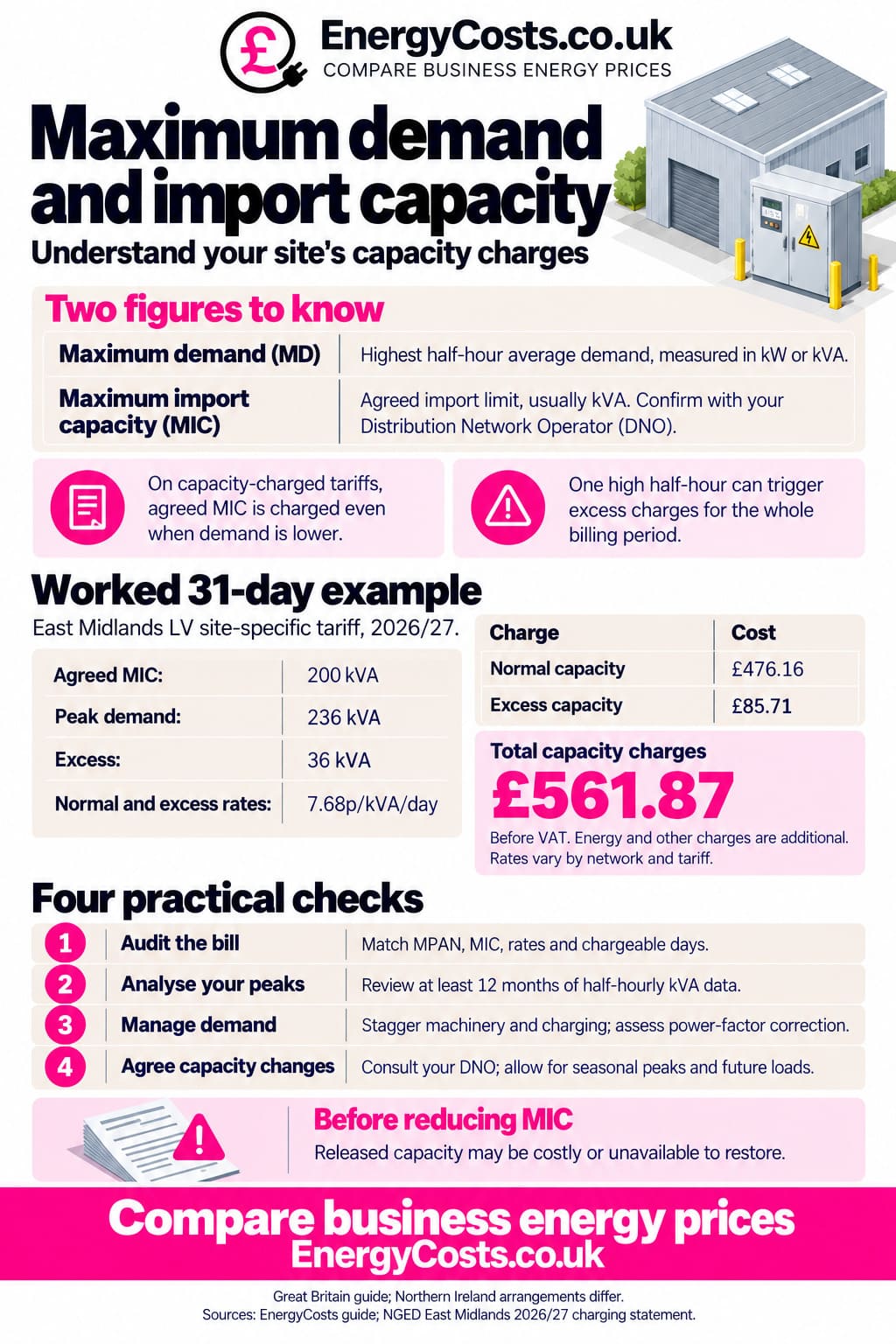
The two figures at the centre of this are Maximum Demand (MD) and Maximum Import Capacity (MIC). Maximum Demand is what the property actually uses at its highest point, usually assessed over a half-hour period. Maximum Import Capacity is the upper limit agreed with the local Distribution Network Operator (DNO).
The distinction matters because the regular capacity charge is normally calculated from the agreed MIC, whether or not all that capacity is used. If measured demand rises above the MIC, an additional excess or exceeded capacity charge can apply. A single high half-hour can therefore affect the charges for a whole billing period.
This guide explains Maximum Demand, Maximum Import Capacity, Available Supply Capacity, kW, kVA, power factor, capacity charges and excess capacity charges. It also shows how to check the figures on a business electricity bill, calculate the likely cost and decide whether a property’s agreed capacity needs to change.
Quick answer: Maximum Demand is the highest power demand recorded for the site, commonly the highest half-hour average in the billing period. Maximum Import Capacity is the contractual ceiling agreed with the DNO. The normal capacity charge is usually MIC × capacity rate × chargeable days. If Maximum Demand in kVA exceeds MIC, the excess charge is usually the excess kVA × excess rate × chargeable days.
Geographical scope: The detailed charging method and examples in this guide cover Great Britain: England, Scotland and Wales. Northern Ireland has separate electricity-market and network regulation, so businesses there should use the applicable NIE Networks charging statement and connection terms.
Maximum Demand and Maximum Import Capacity at a glance
| Term | What it means | Typical unit | Measured or agreed? | Main billing effect |
|---|---|---|---|---|
| Maximum Demand | The site’s highest average demand during a measurement interval, usually half an hour | kW or kVA | Measured | Used to identify whether MIC has been exceeded |
| Maximum Import Capacity | The maximum import permitted at the connection point | Usually kVA | Agreed with the DNO | Used to calculate the normal capacity charge |
| Available Supply Capacity | A commonly used alternative name for MIC | kVA | Agreed with the DNO | Normally has the same billing role as MIC |
| Agreed or Authorised Supply Capacity | Other common bill or contract labels for MIC | kVA | Agreed or recorded | Normally used for the capacity charge |
| Excess or exceeded capacity | The amount by which chargeable demand is above MIC | kVA | Calculated | Used to calculate the additional excess charge |
| Maximum Export Capacity | The separately agreed limit for electricity exported to the network | kW or kVA | Agreed with the DNO | Relevant to generation, batteries and export charges |
The exact wording varies among DNOs, suppliers and older connection agreements. MIC, Available Supply Capacity, Agreed Supply Capacity and authorised capacity often refer to the same practical concept, but the connection agreement and DNO record are authoritative.
What is Maximum Demand?
Maximum Demand is the highest level of electrical demand recorded for a property during a defined period. For site-specific business charging, the relevant interval is commonly 30 minutes. It is therefore a measure of peak power, not total energy consumption.
Maximum Demand is a business’s highest electricity demand in any half-hour period, measured in either kW or kVA.
The distinction between power and energy is important:
- kW or kVA describes the rate at which electricity is required.
- kWh describes the quantity of energy consumed over time.
A factory drawing 300 kW for half an hour and an office drawing 30 kW for five hours each consume 150 kWh. Their energy use for those periods is identical, but the factory’s peak demand is ten times higher. The network must be capable of meeting that higher peak, which is why capacity is charged separately for many larger connections.
Maximum Demand is generally an average across the half-hour rather than the highest millisecond-by-millisecond spike. A very short motor-starting current may therefore have a smaller effect on billed Maximum Demand than a sustained load.
However, short peaks can still create voltage, protection and network-engineering issues, so the connection agreement must not be treated merely as a billing threshold.
What is Maximum Import Capacity?
Maximum Import Capacity is the maximum amount of electricity that a business is permitted to import through its connection point. The Energy Networks Association’s National Terms of Connection define MIC as the maximum flow from the distribution system through the connection point, expressed in kW or kVA.
For most capacity-charged business sites, MIC is recorded in kilovolt-amperes, or kVA. It is agreed with the local DNO when the property is connected or when the connection is subsequently altered. It should appear in the connection agreement and may also appear in the electricity supply contract and on supplier bills.
The DNO plans and operates its network on the basis that this capacity may be required. The business therefore pays for MIC even when actual demand remains below it.
MIC is not:
- A monthly allowance of electricity.
- The same as annual consumption.
- Automatically changed when the electricity supplier changes.
- Automatically reduced when equipment is removed.
- Necessarily identical to the physical rating of the main fuse, cable or transformer.
- Permission to export electricity, which is covered separately by Maximum Export Capacity.
A business could remain close to a 200 kVA MIC throughout the month without exceeding it. Conversely, it could consume relatively little energy overall but breach the MIC during one unusually busy half-hour.
Why do DNOs agree an import capacity?
The DNO owns and operates the local distribution network that carries electricity to the premises. It needs reliable information about the power each connection may require so that cables, switchgear, transformers and substations can be planned and operated safely.
The MIC is also a contractual limit. Under the National Terms of Connection, the customer is required to keep imports at or below MIC. A repeated breach is not simply a choice between paying a normal rate and paying a more expensive rate. The DNO can require the customer to reduce demand, agree a variation or take other action under the connection terms.
The DNO is separate from the electricity supplier. The DNO sets and applies the Distribution Use of System, or DUoS, charging structure. It normally invoices the supplier, which then recovers the charge from the business either as an itemised pass-through cost or within the contracted electricity price.
Maximum Import Capacity, ASC and agreed capacity
Several terms are used for the capacity made available to a property:
- Maximum Import Capacity.
- MIC.
- Available Supply Capacity.
- ASC.
- Agreed Supply Capacity.
- Authorised Supply Capacity.
- Agreed Capacity.
- Availability.
- Maximum Power Requirement.
- kVA allowance or kVA capacity.
National Grid Electricity Distribution describes MIC as also being known as Available Supply Capacity or Maximum Power Requirement. On an invoice, the associated charge may be called a capacity charge, availability charge, available capacity charge or kVA charge.
These labels should not be assumed to be interchangeable in every historic contract. If two documents show different figures, ask the DNO to confirm the current MIC held against the relevant MPAN and connection point.
The difference between kW and kVA
Capacity charging is normally based on kVA because the network must carry both active and reactive power.
- Kilowatts (kW) measure active or real power that performs useful work, such as turning a motor or producing heat.
- Kilovolt-amperes reactive (kVAr) measure reactive power associated with magnetic and electric fields in equipment such as motors, transformers and some lighting.
- Kilovolt-amperes (kVA) measure apparent power: the combined effect of active and reactive power on the network.
The relationship is:
kVA = √(kW² + kVAr²)
Power factor is:
Power factor = kW ÷ kVA
When power factor is 1.00, kW and kVA are equal. When power factor is lower, the network must provide more kVA to deliver the same useful kW.
| Active demand | Power factor | Apparent demand |
|---|---|---|
| 180 kW | 1.00 | 180.0 kVA |
| 180 kW | 0.95 | 189.5 kVA |
| 180 kW | 0.90 | 200.0 kVA |
| 180 kW | 0.80 | 225.0 kVA |
This means that a site can exceed a kVA-based MIC without a corresponding increase in useful kW. Poor power factor can also cause separate excess reactive power charges.
In National Grid Electricity Distribution’s 2026/27 charging statement, reactive power above 33% of active power in a half-hour is chargeable for relevant LV and HV properties. That threshold is equivalent to a power factor of approximately 0.95.
Power-factor correction can reduce kVA demand, but capacitors or other equipment should be specified by a competent electrical engineer. Incorrect correction can create over-correction, resonance or harmonic problems.
Which business properties pay capacity charges?
Capacity charges are most commonly associated with larger, site-specifically billed electricity connections, including many current-transformer-metered sites and connections at low voltage, high voltage or extra high voltage.
Examples include:
- Factories
- Warehouses and distribution centres
- Hospitals and care facilities
- Hotels
- Supermarkets
- Data centres
- Universities
- Large offices
- Sites with substantial electric heating or cooling
- Properties with large-scale vehicle charging
It is no longer safe to say that every half-hourly-settled meter attracts a kVA capacity charge. Market-wide Half-Hourly Settlement means many smaller whole-current business meters are also settled half-hourly.
For example, National Grid Electricity Distribution’s East Midlands 2026/27 charging statement distinguishes aggregated whole-current connections from site-specific connections. Its aggregated charges comprise fixed and unit charges, while site-specific LV and HV charges may also include capacity, exceeded capacity and reactive power charges. Transitional arrangements can also affect some migrated meters.
To establish whether a property is capacity charged, check:
- The bill for a capacity, availability or kVA line.
- Whether the meter is whole-current or uses current transformers.
- The MPAN’s Line Loss Factor Class or DUoS Tariff ID.
- The DNO charging statement for that tariff.
- The site’s connection agreement.
Do not rely on the old Profile Class 00 label alone. Metering and settlement classifications are changing, while the physical connection and DUoS tariff remain central to whether site-specific capacity charges apply.
How is the normal capacity charge calculated?
The normal import capacity charge is usually calculated as:
Capacity charge (£) = MIC (kVA) × capacity rate (p/kVA/day) × chargeable days ÷ 100
The charge is based on agreed capacity, not the site’s actual average use. If a property has a 500 kVA MIC but only reaches 300 kVA, it will normally still pay for 500 kVA on every chargeable day.
The applicable p/kVA/day rate depends on factors including:
- The DNO licence area.
- The charging year.
- Whether the site is connected at LV, HV or EHV.
- Whether it is connected at a substation.
- The LLFC or DUoS Tariff ID.
- Whether the connection falls under the Common Distribution Charging Methodology or EHV Distribution Charging Methodology.
- Any historic contribution or discount arrangements.
- Whether the charge is itemised or incorporated into the supplier’s price.
DNO charging rates normally change at the start of a charging year on 1 April and can be revised. Always use the charging statement that applies to the invoice period.
Worked capacity-charge example
National Grid Electricity Distribution’s East Midlands schedule effective from 1 April 2026 lists a capacity rate of 7.68p per kVA per day for its standard LV Site Specific tariffs. This is one regional tariff example, not a national average.
Assume:
- MIC: 200 kVA.
- Capacity rate: 7.68p/kVA/day.
- Billing period: 31 days.
The capacity charge is:
200 × 7.68 × 31 ÷ 100 = £476.16
The business pays £476.16 before VAT for that capacity component, even if Maximum Demand stays well below 200 kVA. Unit charges, fixed charges, reactive power charges, transmission charges, taxes and other bill components are separate.
At the same rate, reserving 200 kVA for a full 365-day year would cost:
200 × 7.68 × 365 ÷ 100 = £5,606.40
This illustrates why unused MIC can be expensive, but it does not mean capacity should be cut without examining future demand and connection risk.
How are excess capacity charges calculated?
If chargeable Maximum Demand exceeds MIC, the excess amount is generally:
Excess capacity (kVA) = maximum of (Maximum Demand in kVA − MIC, 0)
The charge is then:
Excess capacity charge (£) = excess capacity (kVA) × excess rate (p/kVA/day) × chargeable days ÷ 100
The highest excess calculated during the billing period is normally charged for the full duration of that period.
This is the feature that often surprises businesses: demand may have exceeded MIC during only one half-hour, but the resulting excess kVA can be multiplied by every day in the month or billing period.
The normal MIC charge remains payable as well. Only the portion above MIC attracts the excess rate, rather than the whole Maximum Demand being charged again.
Worked excess-capacity example
Continue the East Midlands LV example:
- MIC: 200 kVA.
- Measured Maximum Demand: 236 kVA.
- Excess capacity: 36 kVA.
- Excess capacity rate: 7.68p/kVA/day.
- Billing period: 31 days.
The excess capacity charge is:
(236 − 200) × 7.68 × 31 ÷ 100 = £85.71
The capacity-related total is:
| Component | Calculation | Charge |
|---|---|---|
| Normal capacity | 200 kVA × 7.68p × 31 ÷ 100 | £476.16 |
| Exceeded capacity | 36 kVA × 7.68p × 31 ÷ 100 | £85.71 |
| Total | £476.16 + £85.71 | £561.87 |
If Maximum Demand had stayed at 200 kVA or below, the excess charge would have been £0, but the £476.16 normal capacity charge would still apply.
The current East Midlands example has the same standard and exceeded rates. That is not universal. Some tariffs can have a different excess rate, particularly where the normal capacity rate contains a historic connection-contribution discount.
Is an excess capacity charge always a penalty rate?
No universal penalty multiplier applies across Great Britain. DNO schedules show separate normal and exceeded capacity rates, and the two rates may be equal or different.
The description of excess charges as a penalty partly reflects Ofgem’s DCP161 decision. DCP161 removed a relevant contribution-based discount from excess capacity rates for customers charged under the Common Distribution Charging Methodology.
Ofgem later directed implementation to be deferred until 1 April 2018. The change was intended to make uncontracted capacity more cost-reflective; it did not establish one national excess-rate multiple.
The correct approach is to find both rates for the property’s exact tariff and charging year. A supplier’s quotation or invoice should not be used to infer that the excess rate is always twice, three times or any other fixed multiple of the normal rate.
How is Maximum Demand calculated from half-hourly data?
For an interval containing only active energy:
Average kW = half-hourly kWh × 2
Multiplying by two converts energy used over half an hour into an average hourly rate. For example, 75 kWh imported in one half-hour represents an average demand of 150 kW.
Where reactive data is available, a common DNO calculation is:
Half-hourly kVA = 2 × √[AI² + max(RI, RE)²]
Where:
- AI is active import during the half-hour, in kWh.
- RI is reactive import during the half-hour, in kVArh.
- RE is reactive export during the half-hour, in kVArh.
The DNO performs the calculation for each half-hour and uses the highest result in the billing period. The exceeded amount is then the positive difference between that result and MIC.
Half-hourly calculation example
Suppose the highest interval contains:
- Active import: 90 kWh.
- Reactive import: 45 kVArh.
- Reactive export: 0 kVArh.
- MIC: 200 kVA.
Active demand is:
90 kWh × 2 = 180 kW
Apparent demand is:
2 × √(90² + 45²) = 201.25 kVA
The site’s useful active demand was only 180 kW, but the lower power factor increased apparent demand to 201.25 kVA. The calculated excess is:
201.25 − 200 = 1.25 kVA
The exact method in the applicable DNO statement and billing data should always take precedence.
Where several MPANs are aggregated at one connection point, half-hourly values may be summed before apparent demand is calculated. Adding each MPAN’s separate monthly maximum can give the wrong result because those maxima may have occurred at different times.
Maximum Demand charge versus capacity charge
The terms are sometimes mixed together, but they are not necessarily the same:
- A capacity or availability charge is normally based on agreed MIC in kVA.
- An excess capacity charge is based on the amount by which calculated demand exceeds MIC.
- A Maximum Demand charge may be a separate supplier or legacy-tariff component based on measured demand in kW or kVA.
If an invoice contains both “maximum demand” and “capacity” lines, ask the supplier to identify the contractual or network basis for each. Do not assume that one is a duplicate without checking the tariff.
Where to find MIC and Maximum Demand
MIC may appear in any of the following places:
- The site-specific connection agreement.
- The electricity bill’s meter or network information section.
- A DUoS or pass-through charge schedule.
- The electricity supply contract.
- A bill-validation or energy-management portal.
- The DNO’s connection records.
Look for labels such as MIC, ASC, Available Capacity, Authorised Supply Capacity, Agreed Capacity, Availability or Capacity in kVA.
Maximum Demand may appear on the bill as MD, Maximum Demand, Peak Demand or Actual Capacity. Raw half-hourly data may show only kWh and kVArh, in which case demand must be calculated interval by interval.
If the current MIC is unclear, contact the DNO with:
- The 13-digit core MPAN.
- The site address.
- The legal customer’s name.
- The existing and proposed capacity, if requesting a change.
- Evidence that the applicant is authorised to act for the connection customer.
National Grid’s load-change guidance lists the MPAN, company details, site address, contact details and existing and proposed capacities among the information required.
How to audit capacity charges
Capacity and excess-capacity errors can persist because supplier, DNO, meter operator and data-collection records must align. For each billed period, check:
- MPAN and site: Confirm that the charge belongs to the correct property and connection.
- MIC: Compare the billed kVA with the latest signed connection agreement or DNO confirmation.
- Effective date: Ensure an agreed change was applied from the correct billing period.
- Tariff: Check the LLFC or DUoS Tariff ID and voltage level.
- Rate: Match the normal and exceeded p/kVA/day rates to the DNO statement effective on each day.
- Days: Check the number of chargeable days, particularly where an invoice crosses 1 April or covers an irregular period.
- Maximum Demand: Recalculate the highest half-hour from actual kWh and kVArh data.
- Power factor: Do not compare kW directly with a kVA MIC unless power factor is known.
- Data status: Identify estimated, substituted or later-corrected half-hourly readings.
- Multiple MPANs: Establish whether the DNO aggregates them at a common connection point.
- Contract treatment: Determine whether DUoS is passed through, fixed, reconciled or bundled.
- VAT: DNO charging statements quote rates excluding VAT; check the supplier’s tax treatment separately.
Ask for a calculation breakdown if an excess charge cannot be reproduced. It should identify the MIC, maximum actual kVA, excess kVA, rate and number of days.
What commonly causes an MIC breach?
Excess capacity charges are often caused by a change in operations rather than a general rise in monthly consumption.
Common causes include:
- Several large motors, compressors, ovens or chillers running together.
- Electric heating and HVAC operating during extreme weather.
- Unmanaged EV charging starting when other site demand is high.
- Batteries charging during the site’s existing peak.
- An additional production line, tenant or shift.
- Temporary plant, construction equipment or events.
- Recovery after a power cut, when equipment restarts simultaneously.
- Poor power factor.
- Failed control equipment or an incorrect building-management schedule.
- A reduction in MIC that left insufficient headroom.
- A meter or data error.
- An MIC record that was never updated after a connection change.
A low monthly kWh figure does not rule out any of these. Capacity exposure is driven by the peak interval.
How to reduce Maximum Demand
There are two broad ways to deal with repeated excess capacity: reduce the peak or increase the contracted MIC.
Reducing energy use is helpful, but an energy-efficiency project will only reduce capacity charges if it lowers demand during the site’s highest intervals.
Stagger major loads
Avoid starting or operating large equipment simultaneously where the process allows it. Sequencing chillers, compressors, ovens, pumps or production lines can materially reduce the highest half-hour without reducing output.
Use automatic demand control
A demand-management system can monitor site import and delay or modulate non-critical loads as demand approaches a set threshold. Alerts at progressively higher percentages of MIC give facilities teams time to intervene.
Apply smart EV charging
The sum of charger nameplate ratings can rapidly exceed existing headroom. Dynamic load management can share the available capacity among vehicles and reduce charging when the rest of the site is busy.
Review heating and cooling controls
Optimise start times, temperature set-points and staged operation. A morning warm-up or simultaneous defrost cycle can create a larger peak than normal occupied-hours demand.
Improve power factor
Correcting poor power factor can reduce kVA for the same useful kW and may also lower reactive power charges. Obtain a suitable site survey before installing or changing correction equipment.
Control battery charging and discharge
A battery can discharge during a site peak and reduce grid import, but uncontrolled charging can create a new peak. The operating strategy must include MIC as a hard constraint and allow for battery availability and state of charge.
Consider on-site generation carefully
Solar generation may reduce daytime grid import, but it does not automatically change MIC. Output varies, evening peaks may be unaffected and the site must consider periods when generation is unavailable.
Generation and battery export also require separate consideration of MEC and connection rules.
Investigate the highest intervals
Rank at least the top 20 half-hours rather than examining only the single maximum. Look for repeated times, weather dependence, particular shifts and operational events. This shows whether the problem is systematic or exceptional.
Should a business increase its MIC?
An increase may be appropriate when forecast demand is genuinely above the existing limit and cannot safely or economically be controlled.
Examples include:
- Electrifying heat.
- Installing substantial EV charging.
- Expanding production.
- Adding a data hall.
- Bringing a new tenant into the property.
Apply before connecting the additional load. The DNO must assess whether the local network and connection assets can support the increase.
The outcome may be:
- A straightforward contractual amendment.
- A requirement to modify protection, metering, cables, switchgear or a transformer.
- Network reinforcement.
- A connection offer with costs and timescales.
- A flexible or constrained connection option in some circumstances.
- Refusal of the requested level until work is completed.
An increase is not automatically available merely because the property has previously exceeded MIC. National Grid notes that increases can incur charges for reinforcement work.
Should a business reduce its MIC?
Reducing an unnecessarily high MIC can produce a recurring saving. However, the decision should be based on measured and forecast demand, not only the latest month’s bill.
Before reducing capacity, review:
- At least 12 months of half-hourly kVA data, and preferably 24 months where operations or weather vary.
- Seasonal and exceptional peaks.
- Power factor.
- Planned EVs, heating, cooling, machinery and production.
- Expected tenancy or occupancy changes.
- Resilience arrangements and post-outage restart demand.
- Maintenance periods that may distort recent data.
- The cost of excess capacity if the new MIC is breached.
- The cost and availability of restoring capacity later.
National Grid says a reduction itself does not require physical work and is not charged in its areas, but relinquished capacity can be allocated elsewhere and may later require paid reinforcement to restore.
Its published process also says reductions are not backdated, normally take effect from the first of the following month after agreement and are restricted to one change in a 12-month period. Check the relevant DNO’s current rules rather than assuming every process is identical.
Do not reduce MIC to exactly the highest recent reading without assessing uncertainty. Suitable headroom should be supported by an electrical load forecast and operating strategy; there is no single percentage that is correct for every business.
Comparing higher MIC with excess charges
A useful financial comparison is:
Annual cost of extra agreed capacity = additional MIC × normal rate × 365 ÷ 100
Compare this with:
Expected annual excess cost = sum of each period’s excess kVA × excess rate × days ÷ 100
Using the 7.68p East Midlands example, adding 36 kVA to MIC for a full year would cost:
36 × 7.68 × 365 ÷ 100 = £1,009.15
One 31-day excess event of 36 kVA costs £85.71 at the same rate. From a purely short-term billing perspective, paying for 36 kVA all year would cost more than one isolated excess month.
That calculation does not make deliberate under-contracting acceptable. MIC is a connection limit, and repeated or material breaches require operational action or engagement with the DNO.
The comparison is useful for choosing among load management, an agreed increase and other engineering measures, not for treating excess charges as permission to exceed.
How to estimate the capacity needed
For an existing site, interval data is normally more reliable than adding equipment ratings. For a new or substantially altered site, a competent designer will build a load schedule that considers:
- The kW and kVA rating of each major load.
- Realistic diversity and coincidence.
- Power factor.
- Motor starting and cyclic loads.
- Seasonal heating and cooling.
- EV charger utilisation and load control.
- Battery charging.
- On-site generation availability.
- Operating hours and production plans.
- Future expansion.
- An evidence-based margin for uncertainty.
Total connected load is not the same as Maximum Demand because not every item runs at full output simultaneously. Equally, using an aggressive diversity assumption can produce an MIC that is too low.
Estimating three-phase kVA from current
For a balanced three-phase supply:
kVA ≈ √3 × line voltage × current per phase ÷ 1,000
At a nominal 400 V:
| Current per phase | Approximate apparent power |
|---|---|
| 100 A | 69.3 kVA |
| 200 A | 138.6 kVA |
| 400 A | 277.1 kVA |
For a single-phase supply:
kVA ≈ voltage × current ÷ 1,000
These are electrical estimates, not proof of contractual MIC. The agreed capacity may differ from the theoretical rating of fuses or equipment. Never alter a DNO-owned fuse or connection equipment.
Maximum Demand when moving premises
Capacity should be checked before signing a lease or committing to electricity-intensive equipment. A property that previously housed light warehousing may not have sufficient MIC for manufacturing, commercial kitchens, electric heating, refrigeration or fleet charging.
Ask for:
- The current connection agreement.
- Confirmed MIC and MEC.
- Between 12 and 24 months of half-hourly kWh and kVArh data.
- The voltage and connection type.
- The metering arrangement.
- Details of any private transformer.
- The latest electricity bill and DUoS tariff.
- Known excess-capacity events.
- Any accepted connection offers or planned network work.
The electricity supply contract can be changed, but changing supplier does not create more network capacity. If extra MIC is needed, include DNO assessment, reinforcement cost and lead time in the property decision.
A practical capacity-management checklist
| Frequency | Action |
|---|---|
| Daily or live | Alert when demand approaches operational thresholds below MIC |
| Weekly | Review the highest half-hours and investigate unusual events |
| Monthly | Reconcile Maximum Demand, MIC and capacity charges against the bill |
| Quarterly | Update the load forecast for new equipment, tenants and projects |
| Annually | Review at least 12 months of kVA demand, power factor and agreed capacity |
| Before a major electrical change | Obtain an engineering assessment and consult the DNO where required |
| Before reducing MIC | Model seasonal peaks, future demand and the cost of restoring capacity |
| After an agreed change | Confirm the DNO record, supplier record and subsequent invoice all match |
FAQ
Maximum Demand is the highest rate at which a property uses electricity during a defined interval, commonly the highest half-hour average in a billing period. It is measured in kW or kVA. It differs from kWh consumption, which measures the total quantity of energy used.
Maximum Import Capacity is the maximum electricity import permitted at a site’s connection point. It is agreed with the local Distribution Network Operator and is usually expressed in kVA for capacity-charged business properties. It forms the basis of the regular capacity or availability charge.
They usually describe the same practical capacity. ASC means Available Supply Capacity or, on some documents, Agreed Supply Capacity. Other common labels include authorised capacity, availability and agreed capacity. The current DNO connection record should be used if bill and contract terminology is inconsistent.
For active energy, half-hourly kWh is multiplied by two to obtain average kW. Where reactive energy is included, apparent demand in kVA is derived from active and reactive half-hourly values. The highest calculated interval in the billing period normally becomes the chargeable Maximum Demand.
It is a network charge based on the electrical capacity reserved for the property. The common calculation is MIC in kVA multiplied by the relevant p/kVA/day rate and the number of chargeable days. It is payable even when the property uses less than its agreed MIC.
They apply when chargeable demand is above the agreed MIC. The excess kVA is the positive difference between actual maximum kVA and MIC. That amount is multiplied by the applicable excess p/kVA/day rate and the number of days in the chargeable billing period.
Yes. One half-hour with the highest calculated demand can set the excess kVA for the billing period, and that excess may then be charged across every day in the period. A very short instantaneous spike is not necessarily identical to a half-hour average, although it may still have connection implications.
No. Market-wide Half-Hourly Settlement means smaller whole-current meters may be settled half-hourly without receiving site-specific kVA capacity charges. Check the connection type, LLFC or DUoS Tariff ID, DNO statement and invoice rather than relying on the phrase “half-hourly” alone.
It may appear in the meter or network information section as MIC, ASC, Available Capacity, Agreed Capacity, Authorised Supply Capacity or Availability. If it is not itemised because charges are bundled, ask the supplier or DNO to confirm the current capacity held for the MPAN.
Yes, where the DNO agrees. A reduction can lower ongoing capacity charges, but it is not normally backdated and restrictions apply to how frequently capacity can be changed. Relinquished capacity may not be available later, and increasing it again could require network reinforcement and payment.
Not automatically. First validate the data and identify the cause. Compare the cost of a higher MIC with demand management and the expected pattern of excess charges. However, a material or recurring breach cannot simply be ignored because MIC is a contractual connection limit.
Solar can reduce daytime grid demand but does not automatically amend MIC. Its output varies and may not coincide with the site’s peak. A formal reduction requires DNO agreement and should account for low-generation periods, equipment outages and future loads. Export is controlled separately through MEC.
Yes. MIC is commonly measured in kVA, which includes active and reactive power. At 180 kW, a power factor of 0.90 produces 200 kVA, while a power factor of 0.80 produces 225 kVA. Poor power factor can therefore cause an MIC breach without an equivalent increase in useful kW.
The bottom line
Maximum Demand is what the property actually requires at its highest point. Maximum Import Capacity is what the DNO has agreed to make available and permit at the connection.
Keeping these figures aligned is essential: too much MIC can mean paying for unused capacity every day, while too little can lead to excess charges, connection breaches and operational risk.
The best approach is to validate the connection record, calculate kVA from accurate half-hourly active and reactive data, understand the exact DNO tariff and forecast future loads. Businesses should then use a combination of sensible headroom, demand management, power-factor control and an agreed capacity change where necessary.
When comparing business electricity contracts, check how capacity, excess capacity, reactive power and other DUoS charges will be treated as well as comparing unit rates and standing charges. A low headline unit price does not necessarily produce the lowest total bill for a capacity-charged property.
Information and tariff example checked on 25 July 2026. DNO rates, charging statements and connection procedures can change. Use the statement applicable to the property’s region, tariff and billing period, and obtain qualified electrical advice before changing a connection or major load.